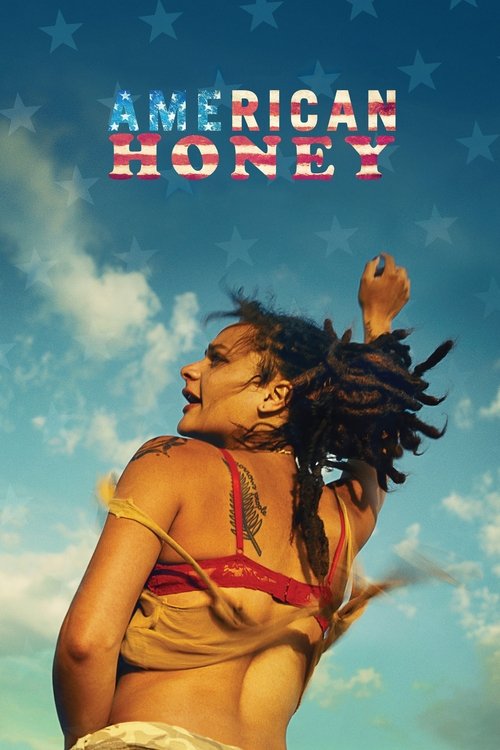
American Honey
2016 · Andrea Arnold
For when you want to disappear into a film rather than be told a story — a long, sensory drift for a patient night when you're craving something real and a little wild. This one asks you to surrender to its rhythm.
What it's about
Star, an eighteen-year-old stuck caring for kids who aren't hers in a broken Oklahoma home, impulsively joins a 'mag crew' — a van full of young drifters who roam the Midwest selling magazine subscriptions door to door. Under a steely boss and alongside a volatile top-seller she can't stay away from, she hustles through motels, parking lots, and strangers' houses, chasing freedom, first love, and some piece of an America she's only ever seen from the outside.
The experience
Loose, immersive, and hypnotic — nearly three hours that feel less like a plot than a life you're riding along inside, all singalongs in the van, sunlight through windows, and sudden flashes of danger. It's tender and raw at once, and it lingers.
Performances
Sasha Lane, discovered on a beach during spring break, is magnetic in her first-ever role — completely unguarded on camera; Shia LaBeouf is live-wire volatile as Jake, and Riley Keough's coolly predatory crew boss is quietly chilling.
The craft
Andrea Arnold shot on the road with a cast of mostly non-actors found along the way, in a boxy square-ish frame that keeps you pressed close to Star's face and feelings. Pop and trap songs playing inside the van do the work of a score, and the whole film glows with caught-on-the-fly natural light.
Why it matters
A Cannes prizewinner that stands as the defining fiction film about young precarious America in the 2010s, and the fullest expression of Arnold's method of blending street-cast performers with lived-in realism.
Snapshot
American Honey is Andrea Arnold's first American feature and her most expansive: a sprawling, near-three-hour road movie that follows Star (Sasha Lane), an eighteen-year-old from an impoverished Oklahoma household, as she abandons her caretaking burdens to join a "mag crew" — a van of itinerant young people who criss-cross the Midwest selling magazine subscriptions door to door. Under the predatory-charismatic management of Krystal (Riley Keough) and the on-the-road tutelage of the volatile hustler Jake (Shia LaBeouf), Star pursues something she can barely name: freedom, belonging, first love, and a stake in an America whose prosperity she only ever glimpses from the outside. The film premiered in competition at Cannes in 2016 and shared in that festival's honors, and it stands as the fullest statement of Arnold's method — handheld, improvisatory, formally rigorous in its cramped 4:3 frame, and committed to the emotional interior of a working-class young woman. It marks the point at which British social realism was transplanted, intact, onto American soil.
Industry & production
The project germinated from a work of journalism: reporting on the exploitative "mag crew" economy — the traveling sales operations that recruit disaffected American youth — which Arnold read about and then researched directly by traveling and observing crews herself. She has described spending time on the road with such groups before writing, and the film reflects that ethnographic groundwork.
Financing came primarily from the British side of Arnold's career. The film was produced through her long-standing relationships with UK institutions, with Film4 and the British Film Institute among its backers and Pouya Shahbazian and others in producing roles; it was made by British production entities despite being shot entirely on location in the United States. In the US it was distributed by A24, then in its ascendant phase as the definitive American indie brand, a fit that aligned Arnold's austere art-house sensibility with a distributor known for placing challenging work. The runtime — roughly 163 minutes — was itself an industrial statement, an insistence on duration and immersion over commercial economy.
Casting was central to the production's identity. Arnold discovered Sasha Lane, who had no acting experience, on a beach during spring break in Florida; American Honey is her screen debut. Much of the crew of young sellers was populated by non-professional performers recruited from around the country, some found through similar chance encounters, alongside the two established leads, LaBeouf and Keough. The production traveled across states of the American Midwest and South — Oklahoma, Kansas and surrounding territory — shooting on real locations and, characteristically for Arnold, filming largely in chronological sequence so that the cast's on-screen bonds could develop in step with the shoot. Box-office and precise budget figures are not something I can responsibly cite here; the film was positioned as a prestige art-house release rather than a wide commercial one.
Technology
American Honey was shot on 35mm film by Robbie Ryan, Arnold's regular cinematographer, and framed in the Academy ratio of roughly 1.37:1 — the boxy, near-square 4:3 format Arnold has used across her features. The choice of celluloid over digital, and of a constricting aspect ratio over widescreen, is the film's foundational technological decision: it privileges grain, natural light, and the vertical human figure over the horizontal expanse the road-movie genre conventionally exploits. The photochemical medium suits Arnold's reliance on available and magic-hour light. Beyond format, the production leaned on lightweight, mobile camera operation to sustain its handheld, embedded aesthetic, and on practical location sound rather than studio control. There is no elaborate visual-effects dimension; the film's "technology" is essentially the classical apparatus of 35mm location shooting used in service of an immersive, documentary-inflected realism.
Technique
Cinematography
Ryan's camerawork is the film's signature achievement. Working handheld and close, he keeps Star almost continuously in frame, often in tight, jostling proximity, so that the audience shares her physical and emotional vantage. The 4:3 frame concentrates attention on faces and bodies and refuses the panoramic sweep; the American landscape enters not as spectacle but in fragments — a sunset through a windshield, light on skin, insects and animals at the frame's edge. Arnold and Ryan repeatedly turn to natural light and to interstitial, in-between moments: hands trailing out of car windows, bodies in motion, the golden hour. This lyrical-observational grammar has invited comparison to the naturalist tradition, and the film's attention to small creatures and to nature as a recurring cutaway is a hallmark Arnold carries from Fish Tank and Wuthering Heights.
Editing
The film was edited by Joe Bini, best known for his long collaboration with Werner Herzog. The cut embraces duration: scenes are allowed to breathe well past conventional beats, and the overall structure is episodic and accretive rather than tightly plotted, mirroring the aimless forward motion of life on the road. Bini's editing sustains an immersive rhythm — building the crew's collective energy in the party and van sequences, then isolating Star in quieter passages — and the willingness to hold shots and extend the running time is inseparable from the film's argument that experience, not incident, is the subject.
Mise-en-scène / staging
Arnold's staging favors authentic, lived-in spaces: motel rooms, gas stations, parking lots, the interiors of the van, and the class-stratified American homes Star enters on sales calls — from oil-worker households to a wealthy suburban home. These door-to-door encounters function as a cross-section of American class, staged so that Star (and the viewer) reads each threshold as a small anthropological study. The crew's world is one of pooled bodies and communal disorder; Arnold stages the group scenes as swarms of movement and noise, then repeatedly extracts Star from them. Recurrent motifs — insects, a bear, dogs, the natural world pressing in — are embedded in the staging as counterpoint to the human hustle.
Sound
One of the film's most distinctive choices is its refusal of a conventional non-diegetic score. The music is overwhelmingly source music — songs that the characters themselves play, sing, and dance to, streaming from phones and car speakers. The soundtrack ranges across contemporary hip-hop and trap, pop, and country; the title itself derives from the Lady Antebellum song "American Honey," and the crew's communal singalongs (including a shared performance of Rihanna's "We Found Love") become emotional set-pieces in which music does the work of score while remaining rooted in the characters' real world. This diegetic strategy binds sound to lived experience and reinforces the film's documentary texture.
Performance
The performances are the product of Arnold's improvisational, chronological method and her mixing of professionals with non-actors. Sasha Lane's Star is a debut of remarkable openness — watchful, sensual, wounded, and resilient — carrying nearly every frame. LaBeouf, cast against his tabloid persona, gives a raw, unstable turn as Jake, and Riley Keough's Krystal is a study in soft-spoken menace and aspirational control. The ensemble of first-time performers lends the crew an unforced authenticity; the sense that the young cast genuinely lived and traveled together during production reads directly on screen.
Narrative & dramatic mode
The film operates in an observational, coming-of-age register rather than a plot-driven one. Its dramatic mode is picaresque: a loose chain of episodes strung along a journey, organized by mood, encounter, and Star's evolving inner life rather than by escalating stakes toward a clean resolution. The central tensions — Star's attraction to Jake, her rivalry with and dependence on Krystal, the moral compromises of the sales hustle, and her intermittent, almost mythic bond with the natural world — recur and deepen without necessarily resolving. This is realist bildungsroman conducted at the level of texture and feeling; the "story" is the accumulation of experience and the gradual, provisional consolidation of a self.
Genre & cycle
American Honey sits at the intersection of two lineages. Generically it is a road movie, and it consciously engages that most American of forms — freedom, movement, self-invention, the highway as promise — while subverting its wide-screen romanticism through the confining 4:3 frame and the precarity of its travelers. It is also a coming-of-age drama and a work of social realism about youth on the economic margins. Within the American independent cinema of the 2010s it belongs to a cycle of immersive, ensemble-driven films about marginalized young people that A24 helped define, adjacent to the tradition of Larry Clark and Harmony Korine's transgressive youth portraiture and to the broader vein of neo-realist Americana.
Authorship & method
This is fundamentally an auteur work. Arnold wrote and directed the film, and her fingerprints are unmistakable: the 4:3 frame, the handheld intimacy, the working-class female protagonist, the recurring animals and natural imagery, the improvisatory shooting in sequence, the casting of non-professionals discovered by chance. Her method privileges authenticity of experience over scripted precision — the screenplay functions as an armature that the shoot, and the young cast's real lives, fill in.
Her key collaborators extend that method. Cinematographer Robbie Ryan, who shot Fish Tank and Wuthering Heights with her, is effectively co-author of the film's visual language; his handheld 35mm naturalism is inseparable from Arnold's cinema. Editor Joe Bini, bringing his Herzogian sensibility, shaped the film's expansive, immersive duration. On sound, the decisive authorial choice — using diegetic pop, hip-hop and country in place of an original score — makes music supervision, rather than a composer, the operative creative force, a deliberate departure from the conventional director-composer partnership. There is, notably, no traditional score credit of the sort a dossier would ordinarily foreground, and that absence is itself a defining authorial decision.
Movement / national cinema
American Honey is a fascinating hybrid of national cinemas. Arnold is a product of British social realism — the lineage running from the Free Cinema and kitchen-sink drama of the late 1950s and 1960s through Ken Loach and the Dardenne-influenced European art film — and she carries that tradition's ethical attention to the working class, its non-professional casting, and its observational realism directly into the American heartland. The film is thus simultaneously a work of British authorship and a portrait of American life, applying a European art-cinema grammar to the iconography of the US road movie. This transatlantic quality — an outsider's rigorous, empathetic gaze on America's economic underclass — is central to how the film has been read.
Era / period
The film is a document of mid-2010s America, and it is acutely of its moment. Its soundtrack of contemporary trap, pop, and country situates it precisely in the smartphone era; its economy of precarious gig labor, its imagery of class stratification and dead-end small towns, and its restless, disaffected youth register the post-recession American landscape. Released in 2016, it arrived at a charged moment in American self-reckoning about inequality and the fraying of the American Dream, and while Arnold's film is not explicitly political, its portrait of young people hustling at the bottom of the economy reads as a timely state-of-the-nation snapshot.
Themes
The film's governing themes are freedom and its cost — the exhilaration and the danger of a life without safety nets. It is a study of class and the American Dream seen from below, dramatized literally through the doorstep encounters that array American households along a spectrum of wealth. It explores found family and belonging: the crew is both a surrogate family and an exploitative labor structure. Youth, desire, and self-invention run throughout, as does the tension between agency and exploitation — Star is at once liberated and used. Arnold threads these human concerns with a persistent motif of nature and animals, positioning the natural world as an emblem of a freedom and innocence set against the human economy of hustle, and using recurrent creatures as almost totemic figures in Star's inner life. Underneath it all is a portrait of yearning — the desire for a better, freer, more loved existence that the film treats with unsentimental tenderness.
Reception, canon & influence
American Honey premiered in competition at the 2016 Cannes Film Festival and was awarded the festival's Jury Prize, a significant institutional endorsement and part of a striking run of Cannes recognition across Arnold's features. Critical reception was broadly admiring though not unanimous: reviewers praised the film's immersive energy, Sasha Lane's breakthrough performance, LaBeouf's rawness, and above all Robbie Ryan's cinematography, while a strand of criticism found the near-three-hour runtime indulgent and the loose, plotless structure taxing. The film brought Sasha Lane to wide attention as a major discovery and was frequently cited among the notable American independent films of its year. I would rather not enumerate specific award tallies beyond the Cannes Jury Prize, as the fuller awards record is not something I can verify precisely from memory.
Looking backward, the film draws on a dense web of influence: the American road-movie tradition and its myths of freedom; the naturalist, magic-hour lyricism associated with Terrence Malick; the transgressive youth cinema of Larry Clark and Harmony Korine; the European social realism of Loach and the Dardenne brothers that shaped Arnold's whole practice; and, crucially, the journalistic reporting on real mag crews that supplied its subject and its ethical grounding.
Looking forward, its legacy lies in consolidating a template for immersive, non-professional-cast American indie realism — the embedded, present-tense portrait of marginalized youth that A24 and its cohort continued to cultivate later in the decade. It confirmed Arnold as a leading art-cinema auteur working across national boundaries and elevated both Sasha Lane and Robbie Ryan's profiles. Its combination of 4:3 intimacy, diegetic pop-music emotionalism, and durational realism has been influential on subsequent independent films seeking authenticity of lived experience over conventional narrative, and it remains a touchstone for filmmakers interested in the road movie as a vehicle for social observation rather than escapist myth.
A Deleuzian reading
A van, a phone propped up somewhere, a crowd of kids shouting "We Found Love" until the words come apart.
The full Deleuzian reading of American Honey →
Reception
It won Arnold her third Cannes Jury Prize in 2016 to strong reviews but plenty of 'nearly three hours of nothing' pushback; since then it's been fully embraced by the Letterboxd generation as one of the decade's defining road movies — though it's also now inseparable from being the set where Shia LaBeouf and FKA twigs met.
How American Honey was received, from release to now →
How to watch American Honey: what to notice on a first viewing
- Notice the frame is nearly square, not wide. Ryan shoots a road movie in Academy ratio on 35mm. The width is gone, so America arrives in pieces. A sunset through a windshield, light on an arm, an insect at the edge. The prosperity Star is selling her way toward is never in the shot with her.
- Listen for where each song is coming from. There is no score. Every track plays off a phone, a car stereo, or somebody's mouth. When the crew sings along in the van, the music is an object in the room with them. The bodies have to meet the music instead of being told by it how to feel.
- Watch how Star changes at each front door. She rearranges her face and her story for whoever opens up. In an oil worker's kitchen she is one thing. In a wealthy suburban living room she becomes another. Every doorstep sets out an American class position, and Star's posture is where you can read it.
- Notice how long scenes run past the point. Joe Bini holds. Hands out a car window, a field going by, a stretch of highway with nothing advancing. The film keeps handing you time where a tighter cut would move on. The subject is experience rather than incident, so those held minutes are where the film puts its weight.
- Watch for insects, dogs, and weather at the edges. Arnold keeps cutting away to creatures and open country that have no business in the plot. A moth on a hand, a stray dog, wind moving through a field. The world keeps going regardless of the hustle, and those cutaways are where Star's inner life is kept.
The whole guide to watching American Honey, with the keys for a rewatch →
Influences: the films it descends from and the films it influenced
- Fish Tank (2009) — Arnold and Robbie Ryan's earlier template: a non-professional lead cast off the street shot handheld in boxy 1.33:1 academy ratio, filmed largely in sequence so the actor's real emotional arc drives the frame.
- Wuthering Heights (2011) — Ryan's 4:3, available-light, textural handheld — rain, hair, skin, animal inserts shot tight and tactile — is the exact naturalist grammar carried directly into American Honey.
- Red Road (2006) — Arnold's debut establishes her observational surveillance-close handheld POV glued to a working-class woman's face, the present-tense watching that structures the road film's intimacy.
- Kids (1995) — Clark and writer Harmony Korine's embedded, quasi-documentary portraiture of real teenagers behaving in near-real time, casting non-actors to erase the line between performance and lived youth.
- Gummo (1997) — The plotless, episodic-vignette structure and mixed-media grab of marginalized American kids models the durational, anti-narrative 'just be present with these people' architecture Arnold adopts.
- Days of Heaven (1978) — Magic-hour, natural-light lyricism plus recurrent cutaway inserts to insects, birds and wind-blown fields — the poetic nature-interruption device Arnold threads through her realism.
- Badlands (1973) — The young lovers-adrift-across-Americana road structure scored to found pop and landscape, treating the drifting couple as anthropological rather than mythic-heroic.
- Kes (1969) — Loach's foundational British social realism — non-professional working-class kid, regional authenticity, undramatized location shooting — is the tradition Arnold was trained inside and transplants to America.
- Rosetta (1999) — The Dardennes' shoulder-mounted camera welded to the back and face of a precarious young woman, refusing establishing geography, is the handheld-proximity ethic underlying Arnold's chase of Star.
- Wanda (1970) — A drifting, economically stranded woman filmed in grainy quasi-documentary 16mm with a loose, wandering itinerary — the precursor to the female-drifter road picture stripped of genre momentum.
- Easy Rider (1969) — Pioneered building the road movie's emotional register entirely from a diegetic/needle-drop pop soundtrack in place of an original score — the sound strategy American Honey pushes to its logical end.
- American Hustle (2013) — Carries forward the improvised-ensemble, non-locked-blocking American-striver film, building scenes from behavioral spontaneity and a continuous pop-music bed.
- The Florida Project (2017) — Extends the immersive, non-professional-cast portrait of American economic-margin youth, letting real kids improvise in real motel locations with the drama emerging from behavior, not script.
- The Rider (2017) — Non-professionals playing lightly fictionalized versions of themselves, shot in wide-sky magic-hour natural light — the same fusion of documentary casting and Malickian golden-hour lyricism.
- Nomadland (2020) — Recasts the American road movie as embedded social observation among real itinerant workers, privileging present-tense lived texture over escapist myth exactly as Arnold prescribed.
- Never Rarely Sometimes Always (2020) — Hittman keeps the handheld camera tight on a teenage girl's face through unscripted-feeling durational scenes in natural light, inheriting Arnold's intimate, class-attentive observational realism.
- Bird (2024) — Arnold and Ryan's own continuation: non-professional working-class youth, boxy handheld framing, animal-motif inserts and diegetic-music emotionalism, now folded with magical-realist flourishes.
- Emily the Criminal (2022) — Arnold's sustained handheld available-light shooting across American working-class landscapes, following a young woman's economic self-determination through marginal channels with a 4:3 aspect ratio that intensifies bodily intimacy, established the visual grammar Ford adapts for Los Angeles.
- Dìdi (弟弟) (2024) — Plotless, episodic-drift structure following a youth collective through handheld, present-tense observation with non-professional casting — the loose editorial rhythm Dìdi's summer wandering echoes.
- Ratcatcher (1999) — Ramsay's British poetic-realist grammar — tactile macro close-ups of hands, water and vermin, and lyrical drift over plot — is the parallel Scots-lens sibling to Arnold's sensory naturalism.
- The Favourite (2018) — Robbie Ryan's other signature collaboration, showcasing the same restless natural-light, lens-distorting handheld immediacy he transposes onto the candlelit palace.
- The Little Sister (2025) — A street-cast non-professional lead carried through an episodic, accretive coming-of-age scored by curated pop needle-drops.
- Short Term 12 (2013) — Handheld immersion among marginalized young people built around a street-cast breakout newcomer (Sasha Lane), extending the same vérité-with-nonactors craft.
- C'mon C'mon (2021) — Robbie Ryan again: an immersive, observational road movie built from handheld proximity to young non-professionals rather than plot beats.
- Bones and All (2022) — Itinerant youth crisscrossing the Midwest in a loose, immersive road movie shot on boxy 35mm with nonprofessional textures and restless natural light.
- mid90s (2018) — The same 1.37 academy-ratio, non-professional-ensemble, episodic-road structure in which a curated needle-drop soundtrack defines a subculture from the inside.
- Waves (2019) — Naturalist youth ensemble captured with roving handheld intimacy and a nearly continuous needle-drop soundtrack that carries the drama's emotional register.
- Left-Handed Girl (2025) — Immersive handheld coverage of a nonprofessional youth ensemble hustling at society's economic margins, shot for texture over plot.
- I'm No Longer Here (2019) — A non-professional youth ensemble roving as a music-bonded social body, with pop tracks and group choreography structuring scenes rather than plot, close kin to Frías's Terkos.
- Blue Is the Warmest Color (2013) — Chronological shooting, a nonprofessional lead, an enormous ratio of handheld 4:3 footage and scenes allowed to run until behavior stops reading as performance — the same extraction economy as Blue, applied to a group rather than a couple.
- Captain Fantastic (2016) — Van as portable commune — a youth ensemble whose collective identity is expressed almost entirely through diegetic group singing in the vehicle, shot handheld in available light with the camera inside the huddle rather than observing it from outside.
Similar films
- The Florida Project (2017) — influence & lineage
- Easy Rider (1969) — influence & lineage
- Fish Tank (2009) — influence & lineage
- Nomadland (2021) — shared sensibility
- Little Miss Sunshine (2006) — shared sensibility
- Hit the Road (2021) — shared sensibility
- Boyhood (2014) — shared sensibility
- American Graffiti (1973) — shared sensibility