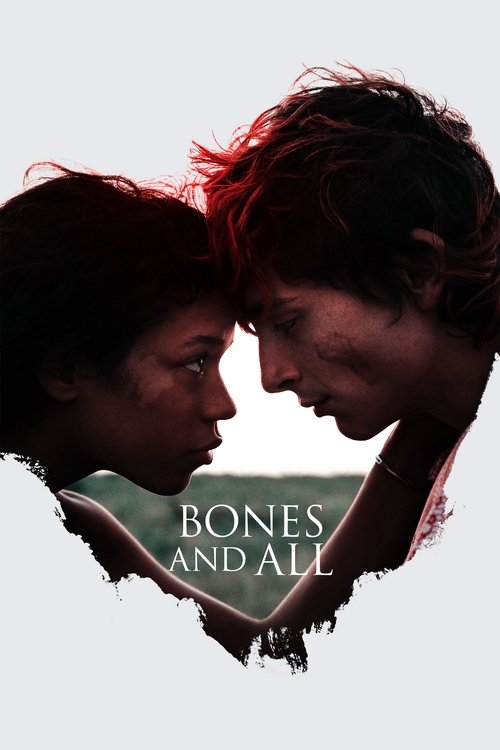
Bones and All
2022 · Luca Guadagnino
The horniest working prestige director, in the culture's affectionate phrasing: Challengers and Queer in a single year made him the center of every conversation about desire on screen, and his prolific pace (Bones and All, After the Hunt) is itself a talking point. Also permanently attached to the Call Me by Your Name/Armie Hammer asterisk.
For when you want a doomed love story with teeth — swooning and unsettling at once. Not for the squeamish, but if you like romance with an ache and an edge, this is the evening.
What it's about
Abandoned by her father, a teenage girl sets off across the backroads of 1980s middle America and discovers she isn't the only one born with her terrible hunger — she's an 'eater,' and there are others. On the road she falls in with a wounded young drifter like herself, and their romance becomes a thousand-mile attempt to outrun what they are.
The experience
Dreamy and mournful with sudden jolts of the grisly — it plays like a sad American road movie that happens to be about cannibals, tender one minute and genuinely frightening the next. The melancholy lingers longer than the gore.
Performances
Taylor Russell is the revelation here, carrying the film with watchful, bruised grace; Timothée Chalamet gives the drifter a raw fragility, and Mark Rylance is unforgettable — skin-crawlingly gentle as an older eater who keeps appearing out of the dark.
The craft
Shot on 35mm, it turns gas stations, cornfields, and prairie dusk into something out of a stranger's faded photographs — Guadagnino films the Midwest like a foreign country seen with fresh, sorrowful eyes. The sound design lets quiet do the menacing; it rewards a dark room and patience.
Why it matters
Guadagnino's first film shot in America, it announced Taylor Russell as a major actor and became a touchstone for the idea that horror and romance can share one bloodstream — a fable for anyone made to feel monstrous by what they never chose.
For his first film shot on American soil, Luca Guadagnino turned Camille DeAngelis's young-adult cannibal novel into something closer to Badlands: a mournful road movie drifting through the underpasses and cornfields of the Reagan-era Midwest. Taylor Russell, in the performance that announced her, plays a teenager cut loose by her father who learns she is not alone in her appetite; Timothée Chalamet, reuniting with the director of Call Me by Your Name, is the wounded drifter who joins her. The horror is real — Mark Rylance is skin-crawlingly gentle as an older 'eater' who materializes out of the dark — but Guadagnino treats the hunger as inheritance and stigma, a fable of anyone made monstrous by what they never chose. Arseni Khachaturan shoots gas stations and prairie dusk on 35mm with the melancholy of a stranger's photographs of America, while Trent Reznor and Atticus Ross, in a career about-face, supply a hushed score of fingerpicked guitar. Venice gave Guadagnino the Silver Lion for direction and Russell its Mastroianni prize for emerging talent.
A Deleuzian reading
A man materializes out of the dark, soft-voiced and courtly, with all the time in the world, and what he wants is to be kind to the girl.
The full Deleuzian reading of Bones and All →
Reception
Premiered to acclaim at Venice 2022 — where Guadagnino took the Silver Lion for direction — then quietly underperformed at the box office and got largely shut out of awards season; since then it's been steadily adopted by young cinephiles as a beloved modern romance rather than the hard sell it looked like on paper.
How Bones and All was received, from release to now →
Influences: the films it descends from and the films it influenced
- Badlands (1973) — The core template Guadagnino cites: fugitive young lovers driving across a flat, sun-bleached Midwest, their spree narrated in affectless voiceover with natural light and real landscape standing in for moral weather.
- Days of Heaven (1978) — Establishes the magic-hour, available-light naturalism—wheat fields and empty horizons shot as lyric—that Arseni Khachaturan's 35mm rural cinematography reproduces.
- The Night of the Hunter (1955) — Mark Rylance's Sully, the courtly predator who stalks vulnerable prey across Americana, descends directly from Mitchum's menacing itinerant preacher and his sing-song false gentleness.
- Near Dark (1987) — Reframes the vampire as a roaming 'family' of American road predators feeding across the heartland—the exact cannibal-as-outsider road-horror architecture Bones and All inherits.
- Call Me by Your Name (2017) — Guadagnino's own tactile, sun-warmed coming-of-age intimacy—lingering skin, appetite as tenderness, Chalamet as object of longing—carried whole into the central romance.
- Paris, Texas (1984) — The drifter traversing an emptied American Southwest, using widescreen landscape as loneliness and a spare roots-music score to make silence expressive.
- Let the Right One In (2008) — Tender first-love between an adolescent and a creature who must kill to survive—monstrous compulsion staged as the ache of coming-of-age rather than as spectacle.
- Bonnie and Clyde (1967) — Depression-era outlaw lovers whose romantic road-spree welds tenderness to sudden, unstylized eruptions of violence—the tonal whiplash the film runs on.
- Wanda (1970) — The aimless, marginalized woman drifting through a grubby, deglamorized American landscape in grainy handheld naturalism—Maren's rootless texture and social invisibility.
- Raw (2016) — Cannibalism written as pubescent awakening: an inherited appetite one cannot control, staged as body-horror coming-of-age about a young woman discovering what she is.
- The Social Network (2010) — The origin point of Trent Reznor and Atticus Ross's film-scoring method—brooding, textured synth-and-piano dread—that underscores Maren and Lee's romance.
- Suspiria (2018) — Guadagnino's prior plunge into horror, demonstrating his method of an art-cinema sensualist metabolizing genre viscera through slow-burn atmosphere rather than shock cutting.
- Challengers (2024) — Guadagnino re-teams with Reznor and Ross, extending the same collaboration into a propulsive electronic score that drives bodily desire as narrative engine.
- We Are What We Are (2013) — Cannibalism handed down as family ritual and stigma in rural America—the theme of inheritance-and-stigma worked through a slow, elegiac genre register.
- American Honey (2016) — Itinerant youth crisscrossing the Midwest in a loose, immersive road movie shot on boxy 35mm with nonprofessional textures and restless natural light.
- Nomadland (2020) — A naturalistic landscape road film of American outsiders living at the economic margins, dignity found in movement and dusk-lit exteriors of the plains.
- Humanist Vampire Seeking Consenting Suicidal Person (2023) — Tender monster-lovers negotiate the ethics of feeding, building romance on a shared appetite that horrifies its owners — consent-of-the-victim as love language.
- Fresh (2022) — A contemporaneous entry in the cannibal-as-intimacy cycle, framing flesh-eating as tender coupling and desire — the romantic pole of the same 2022 metaphor Fresh treats satirically.
- Queer (2024) — Same Reznor/Ross scoring unit and the same appetite-as-camera logic — flesh, mouths and hunger shot in tactile close-up on the road — with narrative gaps bridged by score rather than by exposition.
Similar films
- Call Me by Your Name (2017) — influence & lineage · often watched together
- Paris, Texas (1984) — influence & lineage · often watched together
- I Want to Eat Your Pancreas (2018) — often watched together
- All of Us Strangers (2023) — often watched together
- La Chimera (2023) — shared sensibility
- Raw (2017) — shared sensibility
- When Evil Lurks (2023) — shared sensibility
- The Lovely Bones (2009) — shared sensibility
All the films related to Bones and All →
Watch it with: curated runs of related films
- Misfits on the American Backroads — A run of journeys across the American map, each hauling someone who doesn't fit — a con man and his maybe-daughter, a losing family in a yellow bus, two outlaws outrunning the century, and a pair of lovers who eat people — watch them near each other and the road itself starts to feel like the family.