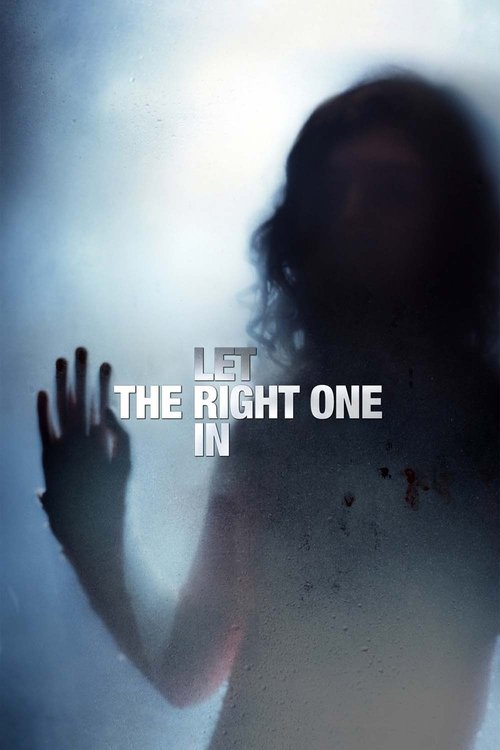
Let the Right One In
2008 · Tomas Alfredson
For when you're craving a real scare with an aching heart inside it — a slow, atmospheric winter watch, best alone at night. A challenge for the patient, and one of the most rewarding horror films you can hand someone who claims to hate horror.
What it's about
In a snowbound Stockholm suburb in the early 1980s, Oskar, a lonely twelve-year-old ground down by bullies, befriends Eli, the strange, pale child who's just moved in next door and only comes out at night. Their tentative friendship deepens into something like first love — but Eli is no ordinary child, and the arrivals in the neighborhood have coincided with a string of dark events.
The experience
Hushed, wintry, and dread-soaked, with sudden shocks that land harder for all the stillness around them. It's a horror film that plays like a tender chamber drama about loneliness — you're unnerved and heartbroken at once, and the mood follows you out into the cold.
Performances
Child leads Kåre Hedebrant and Lina Leandersson are extraordinary — Hedebrant all raw exposed nerve, Leandersson ancient and unreadable behind a child's face. The whole film rests on them and never wobbles.
The craft
Tomas Alfredson strips the vampire film of velvet and fog: concrete, birch trees, sodium light on snow, and a silence so complete every drip and breath registers. The long, level compositions refuse to flinch or gloat, and the sound design is reason alone for good speakers — this is horror by restraint, gorgeous and pitiless on a big screen.
Why it matters
Landing mid-Twilight-craze, it made every other screen vampire look overdressed; it spawned the American remake Let Me In and became a foundation stone for the slow, sorrowful strain of art-house horror that followed.
In the snowbound Stockholm suburb of Blackeberg, circa 1982, a bullied twelve-year-old befriends the strange child who has moved in next door, and the vampire film is quietly reinvented as a chamber drama of loneliness. Tomas Alfredson, adapting John Ajvide Lindqvist's novel with the author himself, strips the genre of velvet and fog: what remains is concrete, birch trees, sodium light on snow, and a silence so complete that every drip and breath registers as an event. The horror is real and occasionally shocking, but it is administered with Scandinavian restraint — long, level compositions that refuse either to flinch or to gloat. Arriving in 2008, in the middle of the Twilight moment, it made every other screen vampire look overdressed; it was remade in America as Let Me In and became a foundation stone for the slow, sorrowful horror of the following decade. Its most indelible exchanges are wordless: two children tapping Morse code to each other through a bedroom wall.
A Deleuzian reading
A wall at night, in a concrete apartment block in a Stockholm suburb.
The full Deleuzian reading of Let the Right One In →
Reception
No reappraisal needed — it arrived a festival darling (it took the top prize at Tribeca 2008) and was instantly hailed as the arthouse antidote to Twilight-era vampire fatigue; nearly two decades on it's only climbed, now a fixture of best-of-the-2000s horror lists.
How Let the Right One In was received, from release to now →
Influences: the films it descends from and the films it influenced
- Vampyr (1932) — Establishes the vampire film built from soft-focus negative space, drifting silence, and off-screen dread rather than gothic spectacle — the atmospheric grammar Alfredson revives instead of fang-and-cape horror.
- The Innocents (1961) — Freddie Francis's deep-focus widescreen frames a child's uncomprehending proximity to the supernatural, sustaining is-it-real ambiguity through composition and hush — the child-POV dread Alfredson inherits.
- The Spirit of the Beehive (1973) — Filters a monster through a solitary child's silent, uncomprehending gaze in a muted honeyed palette with long wordless stretches — the template for Oskar's estranged, near-mute watching.
- The Silence (1963) — Bergman's chamber-drama austerity — cold interiors, near-wordless emotional combat, Nordic restraint — supplies the sparse, silence-weighted register Alfredson applies to a horror premise.
- Martin (1977) — Demythologizes the vampire into a lonely, banal outsider stripped of gothic lore, grounding bloodlust in drab realism — the anti-romantic demystification Alfredson extends.
- Near Dark (1987) — Vampires as unglamorous nomads with no capes, fangs, or mythology, folded into mundane working-class Americana — the naturalized-monster approach Let the Right One In transplants to a Stockholm suburb.
- The Shining (1980) — Snow-bound isolation rendered in symmetrical, level, static wide compositions that make architecture menacing — the cold geometric framing echoed in Alfredson's courtyard tableaux.
- Nosferatu the Vampyre (1979) — Reconceives the vampire as a melancholic, suffering figure moving at a funereal pace, privileging sorrow and slowness over menace — the mournful tempo Alfredson adopts.
- Interview with the Vampire (1994) — Extends the Claudia problem — the immortal fixed in a child's body, played for the horror of unaging appetite rather than cuteness — and keeps the kills largely off-frame or in long shot, refusing the gore beat.
- Cronos (1993) — Alfredson inherits the anti-erotic vampire as a domestic care arrangement between a child and a decaying adult, and shoots the feedings in withheld long takes and off-center framings that push the violence to the edge of the image — Cronos's elliptical grammar transplanted to Blackeberg.
- Let Me In (2010) — A near shot-for-shot Americanized remake that preserves the level compositions, sodium-lit snow, and chamber intimacy, transposing the exact craft blueprint to New Mexico.
- Tinker Tailor Soldier Spy (2011) — Alfredson and DP Hoyte van Hoytema reuse the same glacial framing, muted sodium/period palette, information-withheld editing, and dialogue-sparse staging on a Cold War canvas.
- Only Lovers Left Alive (2013) — Rebuilds the vampire film around mood, melancholy, and near-plotless duration, treating immortality as art-house atmosphere — parallel slow-cinema reclamation of the genre.
- A Girl Walks Home Alone at Night (2014) — Monochrome stillness and long-held wide frames render a lonely female vampire as watchful outsider, extending the art-house, silence-and-composition vampire mode into a stylized register.
- It Follows (2014) — Anchors the slow-horror decade Let the Right One In helped launch — patient wide framing of suburban dead space, synth score, and dread built by tempo rather than shocks.
- Border (2018) — Another John Ajvide Lindqvist adaptation rendering a Nordic supernatural-outsider love story through tactile realism, restraint, and unglamorous physicality — the direct Swedish lineage successor.
- Thelma (2017) — Fuses supernatural horror with repressed-adolescent coming-of-age through clinical control, cold Nordic restraint, and glacial framing — the same emotional-horror hybrid discipline.
- The Witch (2015) — Period-set slow-burn horror accreting dread through natural light, austere composition, and withheld information rather than jolts, extending the mood-first horror craft into folk-tale territory.
- Bones and All (2022) — Tender first-love between an adolescent and a creature who must kill to survive—monstrous compulsion staged as the ache of coming-of-age rather than as spectacle.
- Falcon Lake (2022) — Braids tender first love with a supernatural register in a frigid northern landscape, using restraint and a muted palette so the horror stays submerged beneath the romance.
- Humanist Vampire Seeking Consenting Suicidal Person (2023) — Blueprint for the melancholy vampire love story — muted wintry palette, restrained off-screen violence, and the monster reframed as a lonely outsider seeking one gentle protector.
- Leviticus (2026) — Braids a strictly rule-bound monster (must be invited across the threshold) with a tender coming-of-age, framing the queer-coded outsider child in cold, restrained wide compositions.
- Under the Skin (2013) — Clinical, near-wordless portrait of a predatory outsider learning humanity, carrying meaning through ambient sound design and composition instead of exposition — Alfredson's method pushed to abstraction.
- Thirst (2009) — Alfredson and Hoyte van Hoytema use available winter light and widescreen architectural framing to render vampirism as social alienation rather than supernatural spectacle — a photochemical restraint and practical-light formal register that runs parallel to Thirst's approach, arrived at independently and nearly simultaneously.
- Spectre (2015) — Hoyte van Hoytema's earlier breakthrough establishes the cold, precise, negative-space photographic sensibility he brings to Spectre's symmetrical framing.
- Twilight (2008) — Contemporaneous chaste-vampire romance built on identical craft: desaturated blue-gray palette, glacial pacing, held silences and duration-held looks standing in for consummation.
Similar films
- The Shining (1980) — influence & lineage
- Only Lovers Left Alive (2013) — influence & lineage
- The Witch (2016) — same viewing thread
- Leviticus (2026) — same viewing thread
- Orphan (2009) — same viewing thread
- Bring Her Back (2025) — same viewing thread
- Nosferatu (2024) — shared sensibility
- Fanny and Alexander (1982) — shared sensibility
All the films related to Let the Right One In →
Watch it with: curated runs of related films
- Whatever's Wearing That Face — A run of horror-thrillers where the real terror is that you can't trust what a person appears to be — a double, a shapeshifter, a smiling stranger, the one you desire.