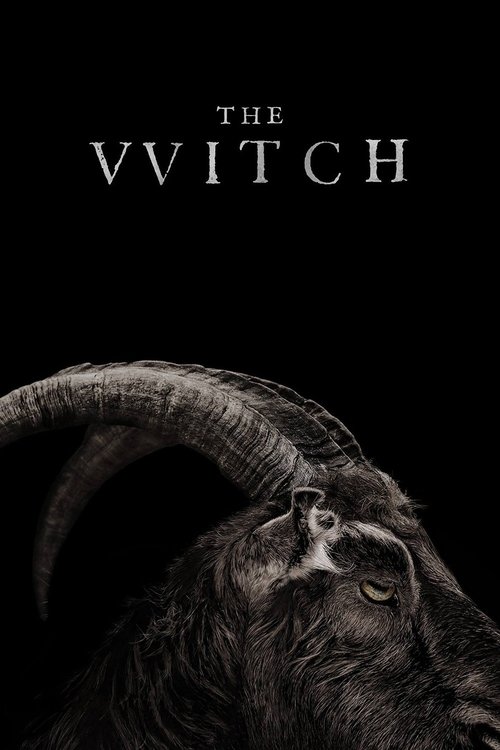
The Witch
2016 · Robert Eggers
Letterboxd-core auteur of obsessive historical authenticity; Nosferatu became a surprise Christmas blockbuster and a goth-culture moment, and his announced Werwulf (in Middle English) is pre-emptively memed as "the most Eggers thing possible." Shorthand for "real cinema" among younger cinephiles.
For when you're craving a real scare of the creeping kind — lights off, phone away, patience on. Made for viewers who like their horror slow, serious, and atmospheric.
What it's about
New England, the 1630s. A devout Puritan family, banished from their colony, tries to farm alone at the edge of a vast primeval forest. Then the newborn son vanishes, the crops fail, and suspicion settles on the eldest daughter, Thomasin — while something in the woods may or may not be watching.
The experience
A slow-burn nightmare told in candlelight and seventeenth-century speech — less about jump scares than a rising tide of isolation, religious terror, and dread. It gets under your skin and stays there.
Performances
Anya Taylor-Joy, in her breakout role, holds the film together as Thomasin — luminous, frightened, and quietly furious — with Ralph Ineson and Kate Dickie bringing granite conviction as her parents.
The craft
Eggers built the period from primary sources — dialogue drawn from seventeenth-century documents, a farmstead raised with era-accurate methods — then shot it in natural light and shivering grays. Mark Korven's score of scraped strings and choral shrieks does half the frightening; good speakers make it worse, in the best way.
Why it matters
A sensational debut that launched both Robert Eggers and Anya Taylor-Joy, and became a flagship for the wave of slow, craft-obsessed arthouse horror that followed it.
Snapshot
Robert Eggers' debut feature is a slow-burn period horror film set in 1630s New England, following a devout Puritan family expelled from their Plymouth Plantation colony and forced to eke out a subsistence existence at the edge of a primordial forest. When the family's infant son vanishes and crops begin to fail, suspicion falls on the eldest daughter Thomasin (Anya Taylor-Joy) — a young woman on the threshold of sexuality, autonomy, and apostasy. The film works simultaneously as historical document, feminist parable, and genuine supernatural horror, leaving deliberately open the question of whether its witchcraft is real or the projection of collective hysteria. Its subtitle — A New-England Folktale — signals its generic and ethnographic allegiances: Eggers treats the Puritan cosmology not as backdrop but as operative reality, fully inhabiting the psychological world his characters inhabit.
Industry & production
The Witch originated as Eggers' thesis film at NYU's Tisch School of the Arts, expanded over roughly four years of development into a feature-length project. The film was produced by Daniel Bekerman at Scythia Films in association with Parts and Labor and RT Features, with funding from the Canadian Media Fund among other sources — accounting for the production's base in Ontario, Canada, despite its New England setting. A24 acquired US distribution rights following the film's world premiere at the Sundance Film Festival in January 2015, where Eggers won the Best Director prize in the NEXT section. The A24 acquisition proved formative: the distributor's marketing campaign was meticulous and literary, positioning the film as art-house horror rather than genre product. The theatrical release in February 2016 generated a modest but commercially viable return on its low budget, and the film's long tail in critical conversation far outpaced its initial theatrical run.
The production's scale was constrained, and that constraint shaped the film's aesthetic. The farmhouse was constructed from scratch in a field in Ontario; the cast, drawn from British and Irish theater, performed against environments painstakingly researched for period accuracy. Eggers has described the project as inseparable from its archival research: the process of writing was, in his account, largely a process of reading — court documents, diaries, sermons, and personal correspondence from seventeenth-century New England, including records from the Essex County witch trials of the 1690s. The dialogue throughout the film is culled or adapted directly from period primary sources, giving even the most mundane exchanges an alienated, ritualistic quality.
Technology
The Witch was shot on 35mm film by cinematographer Jarin Blaschke, a choice that confers texture and grain consistent with the film's antiquarian project — the image surface feels worn rather than pristine. The aspect ratio, approximately 1.66:1, is slightly narrower than the standard 1.85:1 widescreen format, a choice that simultaneously opens vertical space and closes horizontal breathing room, pressing the family against the frame's borders. Lighting design was governed by a strict commitment to plausibility within the 1630s setting: overcast skies, diffuse natural light, and in interiors, candlelight and firelight alone. This was not purely an affectation — Eggers and Blaschke spent considerable pre-production time studying the quality of light available in northern latitudes during winter months, referencing Dutch and Flemish painting of the period as visual reference guides.
The production largely avoided digital augmentation of the image. Visual effects work, where it occurs, is minimal and restrained — the film's supernatural elements are realized through staging and editing rather than CGI enhancement. The result is a film whose texture insists on the possibility of the world it depicts.
Technique
Cinematography
Blaschke's camera tends toward stasis. Pans and tilts are deliberate and sparse; the film favors locked-off compositions that feel more like Flemish genre painting than contemporary genre cinema. Deep focus is deployed to situate figures within landscape, emphasizing the forest's encroachment on domesticity. When the camera does move, it does so with the gravity of ritual — slow tracks toward faces in extremity, a zoom on an eye cresting a threshold. The overcast, flat New England light creates an environment without strong directionality; shadow pools where it gathers rather than cuts. Interior scenes, lit by firelight and candle, use deep blacks and warm amber highlights that sharpen distinction between light and dark — an arrangement that is simultaneously period-accurate and iconographically loaded. Notably, Blaschke occasionally shoots characters from slightly below eye level, a compositional choice that imparts a low-grade uncanniness to even ordinary exchanges; we are not quite at the level of these people, nor above them.
Editing
The film was edited by Louise Ford, whose approach is governed by deliberate withholding. Scenes run longer than genre convention would permit; cuts arrive after the expected beat, letting discomfort settle. This rhythm of extended duration is consistent with the film's strategy of immersing the viewer in the Puritan experience of time — grinding, agricultural, punctuated by prayer and labor rather than event. The editing creates a kind of pressure by refusing release. Sequences of violence or revelation, when they arrive, have been built toward through extended accumulation of quiet wrongness rather than sudden shock. Ford's approach contrasts markedly with the rapid intercutting of mainstream horror; the film's pace is closer to Dreyer than to the contemporary multiplex mode.
Mise-en-scène / staging
The film's spatial logic is organized around two opposing zones: the farmstead, site of patriarchal authority, religious devotion, and slowly accelerating domestic breakdown; and the forest, opaque, non-human, seething with suppressed possibility. Eggers stages much of the film's family drama in confined interiors — the farmhouse's single room functions as both living space and theater of accusation. The family rarely separates and rarely has physical room to separate; their claustrophobic proximity is itself a condition of persecution. The forest is rendered not as adventure space but as void — deep, flat, and lightless at its edges, refusing interiority. The goat Black Phillip occupies the farmyard as a figure of unsettled menace: an ordinary farm animal whose ordinariness becomes increasingly untenable as the film proceeds. Costuming, constructed from period-appropriate materials under the supervision of production designer Craig Lathrop, is drab and functional; bodies are covered entirely, which makes the film's charged treatment of Thomasin's emerging physicality more stark in its displacement onto behavior and glance rather than exposure.
Sound
Mark Korven's score constitutes one of the film's primary horror instruments. Korven drew on early music and world instruments — nyckelharpa, waterphone, hurdy-gurdy, and extended vocal techniques including dissonant chorus work — to produce a sonic texture that is both archaic and viscerally disturbing. The score avoids the conventional horror grammar of stingers and crescendos in favor of sustained tonal and rhythmic unease: drones, microtonal clusters, and irregular rhythms that undercut conventional musical expectation. Wordless vocalizing, particularly by female voices, recurs throughout, linking the film's soundtrack to the body of the persecuted women at its center. Sound design integrates animal sounds, wind, and the ambience of the forest as active presences rather than neutral environment. The film is often near-silent in its interior scenes, which makes the incursions of Korven's score more destabilizing for their contrast.
Performance
Eggers cast principally from British and Irish theater, a decision that secured command of the archaic register of the dialogue and physical comportment consistent with pre-industrial labor. Ralph Ineson (William) brings a voice of almost geological depth to the patriarch; his physical stature and bearing establish authority that the film systematically dismantles. Kate Dickie (Katherine) operates in a register of sustained, barely contained maternal terror and grief that intensifies into accusatory mania. Harvey Scrimshaw (Caleb) carries the film's most overtly supernatural set piece — a long, hallucinatory possession sequence — with a commitment that gives the scene its unsettling power.
Anya Taylor-Joy's performance as Thomasin is the film's center of gravity and her professional breakthrough. Taylor-Joy was nineteen at the time of filming; she plays Thomasin as a young woman whose intelligence and self-possession are in direct, irresolvable conflict with the world her faith and her family have constructed around her. The performance is largely a matter of expression, posture, and eye contact — the film rarely grants Thomasin language adequate to her situation, and Taylor-Joy communicates thought and feeling through the face with unusual economy. Her final scene, in which Thomasin approaches Black Phillip, speaks with him, and accepts his covenant, is played with an eerie calm that refuses both ecstasy and distress — a choice that makes the scene's ambiguity, whether liberation or damnation, genuinely operative.
Narrative & dramatic mode
The film is structured as a slow revelation — a descent in which each scene strips away another layer of the family's cohesion and safety. The narrative mode is closest to the literary Gothic: oppressive atmosphere, constricted setting, a heroine whose social position makes her vulnerable to accusation, and an ending that refuses the conventional comfort of resolution. Eggers has described the film as taking Puritan belief seriously on its own terms — the devil and his servants are real, not metaphorical, within the world of the film — which creates a moral universe in which the horror is not the supernatural incursion but the prior conditions of a world ordered to produce it. The final coda, in which Thomasin joins a witches' sabbath in the forest, has been read variously as genuine supernatural horror, as liberatory feminist fantasy, and as the psychotic break of an abused and traumatized child. The film supports all three readings simultaneously.
Genre & cycle
The Witch occupies a position within the folk horror tradition first theorized by critics in relation to a British cycle from the late 1960s and early 1970s — sometimes called the "unholy trinity": Michael Reeves' Witchfinder General (1968), Piers Haggard's The Blood on Satan's Claw (1971), and Robin Hardy's The Wicker Man (1973). These films share a preoccupation with pre-Christian or anti-Christian folk belief surfacing in rural, isolated settings, and a politics in which institutional authority (the church, the state, the family) is as monstrous as the supernatural forces it claims to suppress. Eggers' film translates this British tradition into an American register, substituting Puritan New England for English countryside. The transposition is not incidental: Puritanism's particular theology of predestination, original sin, and the invisible covenant produces a social world in which witchcraft accusation is not aberrant but structurally available, the inevitable outlet of a community governed by incommensurable demands of faith and survival.
The film also participates in what critics and industry observers began calling "elevated horror" in this period — a contested label for prestige-positioned, art-house-adjacent genre films that prioritized psychological complexity and deliberate pacing over visceral shock. The cohort includes David Robert Mitchell's It Follows (2014) and Jennifer Kent's The Babadook (2014); it would extend forward to Ari Aster's Hereditary (2018) and Midsommar (2019). A24's curatorial identity as a distributor was substantially shaped by this cycle.
Authorship & method
Robert Eggers' authorial signature is defined by extreme archival fidelity — the belief that historical research is not supplemental but constitutive of filmmaking. His subsequent features, The Lighthouse (2019) and The Northman (2022), and his 2024 remake of Nosferatu, each represent obsessive periods of primary source research translated into period-coherent production design, dialogue, and dramatic situation. On The Witch, this meant years of reading seventeenth-century New England documents before a word of screenplay was committed.
Jarin Blaschke has served as Eggers' cinematographer on all subsequent features, making theirs one of contemporary cinema's most consequential director-DP partnerships. Their collaboration is grounded in shared commitment to natural and period-plausible light sources and to extended pre-production research into the visual culture of the period depicted. Blaschke's images consistently honor the constraint that only sources available in the diegetic world could logically produce the film's light.
Mark Korven, whose score for The Witch established the sonic register of Eggers' world, drew on early and world music traditions in ways that have influenced the broader language of prestige horror scores in the subsequent decade. The use of early instruments and extended vocal technique became a template others would imitate.
Louise Ford's editorial collaboration with Eggers on The Witch established the film's uncommonly patient rhythm; the pairing has been less publicly discussed than the Eggers-Blaschke collaboration, though the editing is inseparable from the film's tonal achievement.
Movement / national cinema
The Witch sits at the intersection of several tendencies in American independent cinema circa 2015: the prestige horror cycle associated with A24; a broader trend of period-set independent films engaging with American historical violence and ideology (including works from the Sundance ecosystem more generally); and a renewed critical interest, following Robin Wood's foundational essays, in horror as a socially diagnostic form. Its Americanness is thematic as well as industrial — the Puritan legacy is a distinctly national obsession, and Eggers is working in a tradition that includes Nathaniel Hawthorne's dark allegories of New England conscience (particularly "Young Goodman Brown," whose forest encounter with the devil and subsequent collapse of Puritan certainty anticipates the film's structure closely) and Arthur Miller's The Crucible. The film's funding and production circumstances are technically Canadian, but its cultural and symbolic address is entirely to American historical mythology.
Era / period
Released at the peak of A24's emergence as a brand-identity distributor for prestige independent cinema, The Witch arrived in a cultural moment when horror was being renegotiated as a critically respectable form. The mid-2010s saw a cluster of films — many produced outside the studio system — that insisted on the genre's capacity for psychological and political complexity. The film also emerged in a moment of intensified cultural discourse around gender, patriarchy, and the history of female persecution, which sharpened critical attention to its feminist dimensions. The decision to set the film precisely in 1630 — before the Salem trials, in the period of the earliest Puritan settlements — situates it at the founding moment of the ideological architecture that would produce those trials, locating Eggers' interests in origins rather than famous episodes.
Themes
The film's deepest subject is the Puritan cosmology as a system that produces the conditions it claims to guard against. Predestinarianism — the doctrine that salvation and damnation are fixed before birth, that no act of will can alter God's decree — creates a theology in which moral vigilance is perpetual and futile, in which any person might already be damned and merely awaiting revelation. This produces the film's central irony: William's piety is indistinguishable from the conditions of his family's destruction. His expulsion from the plantation at the film's opening is already an act of isolation that leaves the family defenseless; his refusal to hunt — construed as a failure of manhood and providential failure simultaneously — starves the family of resources while securing his sense of righteous submission.
The film reads the witch as the projection of specifically Puritan anxiety about female independence, sexuality, and religious authority. Thomasin's situation — adolescent, intelligent, female, uncontrolled — makes her the available vessel for accusation. The film neither endorses this projection (Thomasin is evidently innocent throughout) nor resolves it: its ending accepts that the supernatural and the social are not separable, that the witch of Puritan belief is both a product of social violence and a genuine possibility within the film's cosmological frame.
Isolation, paranoia, and the collapse of trust within families under doctrinal pressure are recurring concerns. The siblings' mutual accusation late in the film recapitulates Salem in miniature; the mother's withdrawal of love from Thomasin follows a logic of self-protective scapegoating that is entirely comprehensible within the social pressures the family faces.
Reception, canon & influence
Critical reception at Sundance and in subsequent release was strongly positive, with particular emphasis on Eggers' visual and tonal control, Blaschke's cinematography, Taylor-Joy's performance, and Korven's score. Some genre audiences expressed frustration with the film's pace and ambiguity, a division that became a reference point in critical discussion of the "elevated horror" label — whether films positioned as art-house horror betrayed or transcended the genre's obligations. The film holds a strong position on critical ranking systems and has appeared in several lists of significant horror films of the decade.
The film's primary backward influences are: Carl Theodor Dreyer's Day of Wrath (1943), which deals with witchcraft in seventeenth-century Denmark with comparable formal austerity, inquisitorial piety, and tragic female protagonist; the British folk horror cycle of the late 1960s and early 1970s; Ingmar Bergman's chamber dramas of family in extremity, particularly in the handling of confined space and confrontational face; and the literary tradition running from Hawthorne through Shirley Jackson of American Gothic. Kubrick's The Shining (1980) is occasionally cited as an antecedent for the film's rendering of isolated domesticity as horror environment, though the comparison is more atmospheric than formal.
Its forward influence is substantial. The film is regularly identified as a founding text of the A24 horror aesthetic — a model for subsequent films in that distributor's output that combine formal rigor, period or folkloric settings, and explicitly feminist or psychological concerns. Ari Aster has acknowledged Eggers as a reference; the prestige horror cycle that followed through the late 2010s and early 2020s is legible as operating in a space the film opened or crystallized. Anya Taylor-Joy's career trajectory from this debut — through Split (2016), Emma (2020), and The Queen's Gambit (2020) — has made her one of the defining screen presences of her generation, and The Witch remains the foundational text for understanding her range. Eggers' subsequent body of work has consistently expanded the project of archival horror first realized here, establishing him as one of contemporary cinema's most singular voices in the genre.
A Deleuzian reading
A child plays peek-a-boo with an infant at the edge of a field.
The full Deleuzian reading of The Witch →
Reception
Critics adored it out of Sundance 2015, but its slow-burn Puritan dread earned a notorious C- CinemaScore from audiences expecting a jump-scare machine — a decade on, it's canonized as the film that kicked off the A24 'elevated horror' era and launched Robert Eggers and Anya Taylor-Joy.
How The Witch was received, from release to now →
Influences: the films it descends from and the films it influenced
- Häxan (1922) — Christensen's use of actual Inquisition trial transcripts and woodcut illustrations as direct screenplay source material establishes the archival-document-as-horror-scenario method that Eggers would apply to seventeenth-century New England court records.
- Day of Wrath (1943) — Dreyer's staging of a witchcraft tribunal in Calvinist Denmark — static wide compositions held for expository duration, spiritual guilt made legible through face and posture — is the direct formal model named in the 'Dreyer pacing' facet; Eggers' inquisitorial scenes inherit both the rhythm and the theological severity.
- Witchfinder General (1968) — Reeves established the folk horror precedent of using actual rural locations and documentary-inflected period costuming to ground seventeenth-century Puritan terror, treating historical authenticity as a horror intensifier rather than a costume-drama softener.
- Hour of the Wolf (1968) — Bergman's model of the isolated married couple on an island — wife as witness and confessor to a husband consumed by supernatural dissolution — directly informs the Eggers family dynamic, including the staging of disclosure scenes as confrontational two-shots with the woman's face as an instrument of judgment.
- Blood on Satan's Claw (1971) — Haggard crystallized the spatial binary of cultivated farmstead versus uncontrolled forest as competing moral zones, with the treeline harboring a pre-Christian entity that colonizes the community from without — the precise topographic logic Eggers inherits for the Black Phillip sequences.
- The Wicker Man (1973) — Hardy established the folk horror structure of a believer's cosmology rendered as a self-consistent ritual system, withholding supernatural confirmation until the final act — the ambiguity engine Eggers deploys for Thomasin's compact with the devil, leaving the question of delusion versus genuine encounter unresolved.
- Barry Lyndon (1975) — John Alcott's use of specially modified Zeiss lenses to shoot candlelit interiors without supplemental light established the period-plausible illumination constraint that Blaschke inherits; both productions subordinated every compositional decision to the rule that only sources logically present in the diegetic world could produce the film's light.
- The Shining (1980) — Kubrick developed the isolated homestead as a self-sealing environment in which the family unit becomes the horror architecture itself — the formal premise Eggers literalizes in the farmstead, where the dwelling's geometry and the family's Calvinist order are made structurally identical to the trap.
- Rosemary's Baby (1968) — Eggers inherits the isolated-family-as-conspiracy-vessel structure: a female protagonist surrounded by those who claim to protect her while participating in her destruction, Satanic agency operating through domestic intimacy, and the horror of institutional betrayal — here Puritan religion replacing medicine and marriage — as the primary engine.
- The Exorcist (1973) — Eggers inherits The Exorcist's core genre-formation move of centering horror in a crisis of Christian faith as the drama's actual engine, applying period-authentic research and documentary-style observational framing as the contemporary elevated-horror equivalent of Friedkin's clinical vérité realism.
- Under the Skin (2014) — Austere naturalistic dread built from period available light, thick regional accents and slow-build sensory horror — part of the A24 elevated-horror lineage Under the Skin helped legitimize.
- Onibaba (1964) — Folk-horror staging of the woman-as-demon emerging from a menacing wilderness, with terror generated by elemental landscape and a dissonant, percussive-vocal score rather than narrative monster.
- Hereditary (2018) — Aster explicitly inherits Eggers' A24 template: primary-source demonological research (Paimon grimoire iconography) as production design foundation, slow-burn family dissolution as the supernatural delivery mechanism, and the female protagonist positioned simultaneously as victim and vessel in a matrilineal curse structure.
- The Lighthouse (2019) — Eggers and Blaschke extend the natural-light constraint into a 1.19:1 orthochromatic monochrome format that enforces period-plausible 1890s Maine maritime light; Korven returns to deploy foghorn and fiddle as drone-texture elements, applying the same early-instrument logic as The Witch's score.
- Midsommar (2019) — Aster extends the folk horror template into Scandinavian ritual summer, using authentic Hårga folk art and Swedish textile documentation as archival production design foundation — the same research-constitutes-filmmaking principle Eggers codified — while adopting Eggers' feminist parable structure of a grieving woman's incorporation into a pre-Christian community.
- The Northman (2022) — Eggers' most extensive application of the archival fidelity method, translating years of Old Norse saga research and Viking-age material culture scholarship into production design with Blaschke's natural-light constraint sustained across Icelandic exterior shooting, demonstrating the scalability of the technique first proven on The Witch's farmstead.
- Men (2022) — Garland draws on the same British folk horror archive — Green Man iconography, Morris dance tradition, fertility ritual — that underlies Eggers' English sources, filtering it through a contemporary feminist parable whose protagonist's grief makes her a conduit for folkloric body-horror, extending The Witch's feminist Gothic logic into explicit mythological transformation.
- Nosferatu (2024) — Eggers' own template: research-first period folk horror, natural/candlelit imagery, and a female protagonist whose social and supernatural transgressions are inseparable, ending without clean resolution.
- Emma. (2020) — Anya Taylor-Joy's breakout established the watchful, unsentimental stillness she brings to Emma, where her sharp, minimal reactions carry the dramatic irony without mugging.
- Fear Street: 1666 (2021) — 1666's colonial half adopts Eggers' arthouse folk-horror register — period-accurate diction, candlelit/natural-light framing, and an isolated devout community whose piety curdles into the horror engine itself.
- Split (2017) — Taught Anya Taylor-Joy's held, unblinking stillness against a locked-off frame — the register Shyamalan casts for, where Casey's watchfulness is played in eyelines and withheld reaction rather than dialogue.
- The Wailing (2016) — Released the same year, Na constructs an analogous folk horror structure using authenticated Korean shamanistic ritual performance and indigenous animist cosmology as the credible framework for supernatural dread, arriving independently at the same technique of grounding horror in a coherent pre-modern belief system rather than invented or syncretic mythology.
- Saint Maud (2019) — Glass deploys Eggers' core strategy of rendering a believer's subjective cosmology as literal horror reality — a Welsh nursing home serving as confined domestic purgatory, a Catholic penitent's self-mortification standing in for Puritan bodily discipline — with sound design built around hallucinatory interiority rather than external threat.
- 28 Years Later: The Bone Temple (2026) — Shares the austere, landscape-bound folk-horror dread built from researched period texture and slow-burn pastoral menace.
- Sound of Falling (2025) — A single isolated farmstead lit by daylight and candle, with off-screen menace and period non-naturalistic performance staging dread in the land.
- Get Out (2017) — Eggers's deployment of anamorphic lenses, non-genre scoring, and period-authentic diction to argue that horror could sustain formal rigor established the aesthetic template — later consolidated as A24 prestige horror — that made Get Out's Academy positioning legible; without Eggers demonstrating that the genre could attract serious critical infrastructure, Peele's film would have had a narrower reception path.
- Weapons (2025) — Practical low-light cinematography as the primary horror instrument alongside ensemble naturalism; horror that emerges from the community's own internal epistemological failure — the inability of its members to agree on what is real — rather than from an unambiguous external intrusion.
- The Girl with the Needle (2024) — Eggers's revival of the academy ratio for genre-adjacent historical horror — restrained camera, period-authentic production design, a descent narrative constituted by belief and social isolation rather than monster spectacle — established the contemporary aesthetic category the film occupies and its grammar of dread through formal severity.
- The Green Knight (2021) — The A24 folk-horror template of natural-source light, ritual landscape, and slow dread drawn from period folklore that frames Lowery's unease and forest menace.
- 28 Years Later (2025) — Revived folk horror through period-precise landscape dread and a family undone by the wilderness's pagan menace, part of the same folk-horror resurgence.
- Longlegs (2024) — Parallel art-horror literalization of Satanic-panic material through composed natural-light tableaux and Mark Korven's atonal, dissonant choral score.
- It Follows (2015) — Sibling cornerstone of 'elevated horror': period/anachronistic restraint, deliberate pacing, dread-from-composition, and a curse-allegory ending that validated A24-era art-horror alongside It Follows.
- Antichrist (2009) — Heir to the malign-forest folk horror and period gynophobia: a family undone at a wood's edge, female 'wickedness' literalized, built on slow-burn dread and near-scoreless atmosphere Antichrist legitimized.
Similar films
- The Wailing (2016) — influence & lineage · same viewing thread
- Hereditary (2018) — influence & lineage
- The Lighthouse (2019) — influence & lineage
- Midsommar (2019) — influence & lineage
- Day of Wrath (1943) — influence & lineage
- Heretic (2024) — same viewing thread
- Leviticus (2026) — same viewing thread
- The Conjuring (2013) — shared sensibility
All the films related to The Witch →
Watch it with: curated runs of related films
- Whatever's Wearing That Face — A run of horror-thrillers where the real terror is that you can't trust what a person appears to be — a double, a shapeshifter, a smiling stranger, the one you desire.