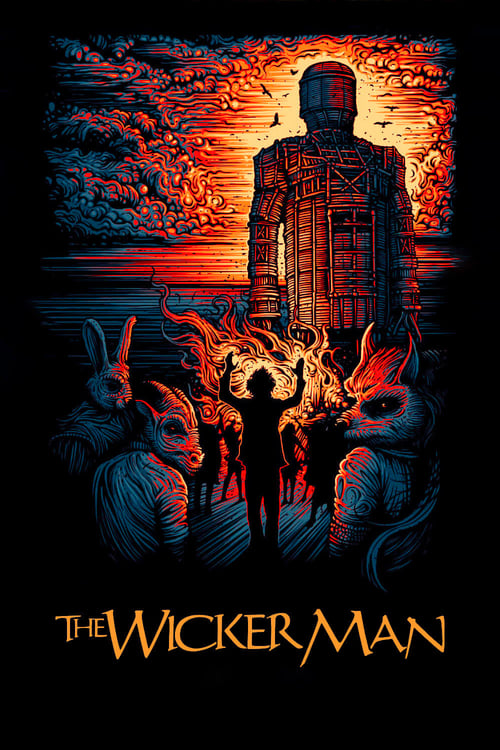
The Wicker Man
1973 · Robin Hardy
When you're craving a slow-burn scare that gets under your skin instead of making you flinch — ideal for an autumn night, and endlessly rewatchable once you know its game. A challenge dressed as a charmer.
What it's about
A devout, buttoned-up police sergeant flies from the Scottish mainland to a remote island to investigate a report of a missing girl — and finds a community that cheerfully insists she never existed. The islanders, led by the urbane Lord Summerisle, have traded Christianity for an old, sunny, song-filled paganism, and the sergeant's rigid faith collides with theirs at every turn. The deeper he digs, the less anything adds up.
The experience
Horror in broad daylight: folk songs, maypoles, and smiling faces that grow steadily more wrong. It's sly, seductive, and darkly funny before it becomes genuinely chilling — unease that seeps rather than jumps.
Performances
Edward Woodward's mounting righteous panic gives the film its spine, and Christopher Lee — who counted Lord Summerisle among his favorite roles — is magnificently silky as the island's laird.
The craft
Anthony Shaffer's screenplay is a beautifully engineered trap, and the film's boldest stroke is its music: real-sounding folk songs woven straight into the story until the whole island seems to be singing you somewhere you don't want to go. Sunlit landscapes doing the work usually left to shadows.
Why it matters
The cornerstone of folk horror — botched on release, rescued by cult devotion, and now one of the most influential British horror films ever made.
Snapshot
The Wicker Man is a British horror film about the collision of two faiths and the patient machinery of a ritual. Sergeant Neil Howie, a devout Protestant policeman from the Scottish mainland, flies to the remote Hebridean island of Summerisle to investigate an anonymous tip about a missing girl, Rowan Morrison. He finds a community that has reverted to a cheerful, organized paganism under its laird, Lord Summerisle — and a population that meets his inquiries with evasions, sexual provocation, and bland denial that the girl ever existed. Howie's investigation is, unknown to him, the bait of a trap: the islanders need a sacrifice to restore a failed harvest, and they have engineered the arrival of a "king," a "fool," a "virgin," and a man who comes of his own free will. The film's terminal image — Howie burning alive inside a giant wickerwork effigy as the islanders sing — is one of the most discussed endings in horror cinema. Made cheaply and released carelessly, the film was nearly lost, then resurrected by cultists into a touchstone of what would later be named "folk horror."
Industry & production
The Wicker Man was a product of British Lion Films at a moment of corporate instability, and that instability shaped both its making and its mauling. The project originated with screenwriter Anthony Shaffer — fresh from the success of his stage and screen play Sleuth — and actor Christopher Lee, who were eager to make an intelligent horror film distinct from the Gothic formulas of Hammer. Shaffer optioned David Pinner's 1967 novel Ritual but, finding it unworkable, discarded most of it and built an original screenplay around the idea of a pagan island and a sacrificial outsider. Peter Snell, then head of production at British Lion, backed the film; Robin Hardy, a friend and business associate of Shaffer's working chiefly in commercials and documentary, directed his first feature.
The shoot took place in late autumn 1972, principally in Dumfries and Galloway in southwest Scotland — Newton Stewart, Creetown, Gatehouse of Fleet, the ruined church at Anwoth, and the cliffs at Burrowhead, with Culzean Castle in Ayrshire standing in for Lord Summerisle's house. The decision to film a story set at May Day in October created the production's signature difficulty: the trees were bare, so the crew wired artificial leaves and blossoms onto branches and brought in greenery to simulate spring. Britt Ekland, cast as the innkeeper's daughter Willow, was pregnant during filming, which necessitated a body double for her nude dance sequence.
The film's troubles deepened after the shoot. British Lion was taken over, and the new management — associated with EMI and producers including Michael Deeley — reportedly held the film in low regard. It was cut down from Hardy's longer assembly to a roughly 87–88-minute version and released in December 1973 as the lower half of a double bill supporting Nicolas Roeg's Don't Look Now. Compounding the indignity, the original negative trims were said to have been lost — by one durable but unverifiable legend, buried as hardcore under a motorway. The exact fate of the missing material remains genuinely uncertain; multiple accounts circulate and none can be treated as settled.
Technology
The Wicker Man was made with conventional early-1970s 35mm color technology and no special-effects ambition beyond its single great practical set piece. The wicker man itself was a physical structure — a towering effigy built on the cliffs at Burrowhead — and the climactic immolation was achieved practically, with the sacrificial animals and the figure of Howie integrated through staging and editing rather than optical trickery. The film's "technology," in the meaningful sense, is musical and folkloric rather than mechanical: its most distinctive production tool is the diegetic song, performed and recorded for narrative use, which functions almost as a second screenplay. There is little in the way of camera or laboratory innovation to report, and the record does not support claims of any.
Technique
Cinematography
Harry Waxman photographed the film in a flat, bright, almost touristic naturalism that is central to its unsettling effect. There is little Gothic shadow; Summerisle is shot in clear daylight, green and pastoral, its horrors conducted in the open air and in good weather. This refusal of conventional horror lighting — the sense that nothing is hidden, that the menace is smiling and sunlit — became one of the film's most influential formal choices. Waxman's location work captures the Scottish landscape as both idyll and trap, and the final sequence sets the burning effigy against a coastal sunset, a deliberately beautiful image for an act of murder.
Editing
Eric Boyd-Perkins edited the film, and editing is bound up with its tangled version history. The released cut interweaves Howie's investigation with the islanders' songs and rituals, building a procedural rhythm that the ending detonates. Because the film was shortened for release and the trims were lost, the editing as audiences first saw it was not entirely the filmmakers' preferred shape; later restorations reassembled longer versions of varying length from surviving prints. The cross-cutting between Howie's mainland piety (glimpsed in his church-going and his fiancée) and the island's licentiousness sharpens the thematic opposition the film is built on.
Mise-en-scène / staging
The film's design is its argument. Summerisle is dressed in the iconography of folk custom — the maypole, hobby-horse and sword dances, masks of animals and the Punch-like fool, gravestones marking pagan burials, the schoolroom teaching phallic symbolism as botany. The May Day procession that occupies the climax is staged as an actual folk pageant, with Howie disguised among the costumed celebrants until he is unmasked as the intended victim. The wicker man looming on the cliff is the ultimate object of mise-en-scène: a structure that has been the film's secret destination all along, withheld until the final minutes.
Sound
Sound is arguably the film's defining technical dimension. Paul Giovanni composed and arranged the score, performing with a band assembled for the production called Magnet, drawing on traditional British folk idiom and original songs. The music is overwhelmingly diegetic — sung by characters within scenes — so that song becomes ritual rather than underscore: "Corn Rigs" (adapted from Robert Burns) over the opening flight, "The Landlord's Daughter" in the pub, "Willow's Song" during the seduction, "Gently Johnny," the children's rhymes, and the "Maypole Song." Britt Ekland's singing was dubbed, a point on which sources have long disagreed about the precise vocalist, and the record here should be treated as uncertain. The cumulative effect is of a community that sings its theology into being.
Performance
Edward Woodward's Sergeant Howie is the film's moral center and its tragic engine: rigid, prudish, genuinely brave, and pitiable — a man whose faith is both his dignity and the lever by which he is destroyed. Woodward plays the final descent into terror and prayer without restraint, and the performance's earnestness is what makes the ending harrowing rather than merely ironic. Christopher Lee's Lord Summerisle is urbane, witty, and entirely persuasive as a charismatic aristocrat-theologian; Lee repeatedly named it among his finest roles. Diane Cilento (the schoolmistress Miss Rose), Britt Ekland (Willow), and Ingrid Pitt (the librarian) fill out an island that is seductive precisely because it is so good-humored.
Narrative & dramatic mode
The film operates as a detective story whose generic machinery is turned against its detective and its audience. Howie's investigation supplies the forward motion — a missing-person inquiry with clues, witnesses, and red herrings — and the viewer is invited to share his rational assumption that a crime is being concealed. The dramatic mode is one of dramatic irony withheld: the islanders know the plot from the start, Howie never does, and the audience only grasps the design in the final reversal, when the "investigation" is revealed as a script the islanders wrote. This makes the film a tragedy in the strict sense — Howie's defining virtue (his chastity, his refusal of Willow) is the very quality that qualifies him as the sacrifice. The ending offers no rescue and no comfort, only the islanders' confidence that the harvest will return.
Genre & cycle
The Wicker Man is the keystone of British "folk horror," a label applied retrospectively but now firmly attached to it. Alongside Witchfinder General (1968) and The Blood on Satan's Claw (1971), it is routinely grouped as the third member of an "unholy trinity" of films in which the English and Scottish landscape, rural superstition, and buried pagan survival generate dread. The cycle's hallmarks — isolation, a community with its own occult logic, the past erupting into the present — are all present, and The Wicker Man arguably defines them more completely than its predecessors because its paganism is not a relic but a thriving, organized society. The term "folk horror" itself gained currency only decades later, popularized in critical and broadcast discussion and theorized in Adam Scovell's writing; the film's canonization as the form's exemplar is a product of that later reappraisal.
Authorship & method
The film is unusually a product of writerly authorship. Anthony Shaffer's screenplay supplies its structure, its theological debate, and its trick architecture, and the project was driven by Shaffer and Christopher Lee as much as by its director. Robin Hardy directed, bringing a documentary-trained eye to the location and ritual material; The Wicker Man remained the achievement that defined his career, and his subsequent filmography is thin by comparison, which complicates any auteurist reading. Harry Waxman's sunlit cinematography, Eric Boyd-Perkins's editing, and above all Paul Giovanni's music are essential collaborators — Giovanni's songs are so structurally load-bearing that the film is sometimes described as a horror musical. Producer Peter Snell's advocacy got the film made; the absence of a strong protective hand at the distributor explains why it was nearly unmade in the cutting room.
Movement / national cinema
The film belongs to British cinema's early-1970s horror moment, when Hammer's Gothic formula was exhausting itself and filmmakers sought new registers of fear rooted in native folklore and landscape rather than Transylvanian import. It is distinctively a film of the British Isles' Celtic fringe — its Scotland is both real geography and imaginative territory, a place where the modern state (embodied by a mainland policeman) finds its writ does not run. In this it participates in a broader cultural preoccupation of the period with paganism, the occult, and pre-Christian survival, visible across British film and television of the era. It is national cinema in the deepest sense: a film about what lies beneath the official map of Britain.
Era / period
Released in 1973, The Wicker Man sits at the close of the British horror boom and within a wider 1970s fascination with cults, alternative religion, and the failure of institutions. Its conflict between a buttoned-down representative of Christian order and a permissive, sexually liberated commune carries the charge of the post-1960s counterculture's aftermath, viewed with deep ambivalence: the island is both utopian and murderous. The film's neglect on release was itself characteristic of an industry in financial disarray, and its slow rehabilitation through the late 1970s and beyond tracks the rise of cult-film culture and revival screenings.
Themes
The governing theme is the war between Christianity and paganism, dramatized without an easy verdict: Howie's faith makes him admirable and absurd, while Summerisle's paganism is charming and monstrous. Around this axis cluster the film's preoccupations — fertility and sacrifice, the body and chastity, the manipulation of the rational mind by ritual, and the seductiveness of belief. Sexuality is weaponized throughout: the island's frank eroticism is both genuine philosophy and tactical assault on Howie's defenses. The film also interrogates authority and certainty — Howie's confidence that he is the investigator, the agent of law, blinds him to his role as the investigated, the chosen victim. Finally, there is the theme of community and complicity: the horror is not a monster but a society acting in cheerful unanimity.
Reception, canon & influence
On release the film was buried — under-distributed, cut, and relegated to a supporting slot — and it received little serious attention. Its reputation was built afterward, by champions in the United States (where Roger Corman's organization handled distribution and a longer print survived) and by critics who began to treat it as a neglected masterpiece; the American magazine Cinefantastique devoted a 1977 issue to it, and the phrase calling it "the Citizen Kane of horror films" attached itself to the film and has followed it ever since. Subsequent decades brought restoration efforts that reassembled longer versions from surviving materials, culminating in a "final cut" released theatrically in 2013, though no version fully recovers Hardy's original assembly and the precise running times of the variants remain a subject of dispute.
Looking backward, the film draws on genuine traditions of British folklore, May Day custom, and the comparative-religion vogue associated with Frazer's The Golden Bough, as well as the immediate precedent of Witchfinder General and Blood on Satan's Claw. Looking forward, its influence has been enormous and growing. It was remade — to broadly poor reception — by Neil LaBute in 2006 with Nicolas Cage, and Hardy himself returned to similar territory with the later companion film The Wicker Tree. More importantly, it became the founding text of the twenty-first-century folk-horror revival: its DNA is visible across films such as Kill List, The Witch, and especially Ari Aster's Midsommar (2019), which transposes its daylight-pagan-commune-as-trap structure to Sweden and which Aster has openly acknowledged as an influence. Its songs, its sunlit terror, and its final image have passed into the common vocabulary of the genre, securing for a film that was nearly lost a place near the center of the horror canon.
A Deleuzian reading
Somewhere in the bare Galloway woods in October 1972, the crew is wiring artificial leaves and blossoms onto naked branches.
The full Deleuzian reading of The Wicker Man →
Reception
Butchered by its own studio — British Lion cut it down and dumped it as the B-feature to Don't Look Now in 1973 — it was later crowned 'the Citizen Kane of horror films' by Cinefantastique and now sits at the very top of the folk horror canon.
How The Wicker Man was received, from release to now →
Influences: the films it descends from and the films it influenced
- Witchfinder General (1968) — Establishes the British folk-horror template of shooting pagan/religious cruelty in unhidden daylight against real rural landscape, the sunlit-naturalism Hardy and Waxman inherit instead of Gothic shadow.
- The Blood on Satan's Claw (1971) — Locates evil in the soil and folk-custom of an isolated English community, supplying the rural-cult-as-organic-society staging that Summerisle's pageantry extends.
- Tales of Hoffmann (1951) — Model for fusing diegetic song-and-dance pageant with narrative dread, the 'horror musical' integration of Giovanni's load-bearing folk numbers into plot mechanics.
- Peeping Tom (1960) — Precedent for British horror staged in bright, banal naturalism with the viewer locked into a perspective the film will betray — the withheld dramatic irony Shaffer weaponizes.
- Häxan (1922) — Quasi-documentary, comparative-religion approach to witchcraft and pagan ritual, the Frazerian/anthropological treatment of folk belief that Hardy's documentary eye revives.
- The Virgin Spring (1960) — Hardy extends Virgin Spring's faith/paganism structural opposition into folk-horror, deploying ritual-duration staging of pagan ceremonies as an iconographic system that methodically displaces the Christian protagonist's assumptions in the same pattern as Bergman's confrontation between Töre's faith and the goatherds' world.
- The Devils (1971) — Stages a British folk collision of faith and state authority climaxing in ritual martyrdom by fire, extending Russell's power-and-belief pageant into pagan horror.
- A Canterbury Tale (1944) — English folk-landscape film embedding pagan continuity and coercive belief in a specific rural place, extending the countryside-as-repository-of-memory-and-menace idea.
- I Know Where I'm Going! (1945) — Strands a rigid mainlander on a self-contained Scottish island where diegetic Gaelic/folk song, Celtic ritual, and threshold-crossing turn the community's spiritual richness into something the outsider cannot survive.
- Night of the Demon (1957) — Expands the investigative-procedural frame: a rationalist officer conducts methodical interviews inside a community whose pagan practice is presented as ordinary domestic hospitality, exactly Karswell's cheerful tea-and-conjuring manner scaled to an island.
- The Wicker Tree (2011) — Hardy's own companion film re-running the Christianity-versus-paganism sacrifice plot with naive outsiders lured into a Scottish fertility rite.
- The Wicker Man (2006) — Direct remake transposing the inverted-detective structure and wicker-effigy climax, inheriting the staging while shedding the diegetic-folk-song scaffolding.
- Kill List (2011) — Revives the folk-horror cult ending in which a protagonist is steered toward an unwitting ritual role, the withheld-irony trap sprung as the final hooded reveal.
- The Witch (2015) — Rebuilds the Christianity-versus-paganism debate from period-authentic folk and religious texts, with damnation arriving via a community's literal belief system rather than monster spectacle.
- Midsommar (2019) — Openly acknowledged transposition of the daylight-pagan-commune-as-trap structure to Sweden — sunlit terror, integrated folk ritual, and an outsider crowned for sacrifice via withheld dramatic irony.
- Apostle (2018) — An outsider infiltrates a remote island cult organized around fertility-sacrifice, replaying the Summerisle structure of investigation that becomes the trap.
- A Field in England (2013) — Extends the British folk-horror lineage's commitment to the rural English landscape and alchemical/occult folk-belief as the engine of dread rather than imported Gothic iconography.
- Blood on Satan's Claw / The Blair Witch Project (1999) — Carries forward the folk-horror premise of outsiders consumed by localized woodland myth, withholding the antagonist entirely and ending on an unexplained ritual tableau.
- 28 Years Later: The Bone Temple (2026) — The directly cited template: an isolated, self-sufficient death-cult community whose pagan folk ritual — not a monster — is the horror, structuring the film's Bone Temple as ceremonial space.
- Rose of Nevada (2026) — The folk-horror parable structure — an outsider drawn into the closed ritual logic of an isolated coastal British community — underpinning Rose's eerie maritime fable.
- The Wailing (2016) — Establishes the procedural-spatial-trap as folk-horror architecture: an outsider investigator is guided by communal ritual logic into a predetermined sacrificial role he cannot read until it is too late — the structural template Na's scapegoat mechanism inherits and complicates.
- Weapons (2025) — Community horror distributed evenly across all social actors rather than concentrated in a single antagonist; the outsider investigator's accumulating epistemological disadvantage within a self-concealing communal structure is the formal template for Weapons' collective-dread mechanism.
- Sleuth (1972) — Anthony Shaffer's other 1972 trick-architecture script — the same writerly machinery of a duel between two men where the audience is sprung a structural trap in the final act.
- Don't Look Now (1973) — Contemporary British art-horror built on inverted-detective dread and an editing structure that withholds its final reveal, ending on a sacrificial image that recontextualizes everything prior.
- Deliverance (1972) — Outsiders absorbed and destroyed by a closed rural society filmed in unstylized natural light — the city-man-as-prey staging without supernatural cover.
- The Texas Chain Saw Massacre (1974) — Same-moment turn toward sun-blasted, naturalistically lit horror in which a normal traveler walks unknowing into a ritualized killing community.
- Heart of Glass (1976) — Both films stage folk horror through the performance of collective ritual belief rather than individual menace, and both deploy ceremonial sound (traditional folk song / Popol Vuh drone) as a formal organizing layer that makes the community's catastrophic worldview audible before it becomes visible.
- Picnic at Hanging Rock (1975) — Codifies folk-horror's pagan-charged landscape in which a rational outsider is quietly undone by a closed community's older order.
- Antichrist (2009) — Folk-horror's foundational move of making the pagan landscape itself malign and ritually hostile underwrites Antichrist's Eden forest, where the ground, the animals and the trees become agents of dread.
- Who Can Kill a Child? (1976) — An outsider investigator walks a sunlit island community whose complicity is total; the conspiracy is withheld by structure rather than by darkness, and the reveal is architectural, not a jump.
- Medea (1969) — Arrives at Medea's material by the same route — Frazer's Golden Bough and the burned year-king who renews the crop — and builds its entire soundtrack from diegetic folk song rather than composed score.
Similar films
- Häxan (1922) — influence & lineage · same viewing thread
- The Texas Chain Saw Massacre (1974) — influence & lineage
- Midsommar (2019) — influence & lineage
- Don't Look Now (1973) — influence & lineage
- Rose of Nevada (2026) — influence & lineage
- Longlegs (2024) — same viewing thread
- The Ritual (2017) — shared sensibility
- The Witch (2016) — shared sensibility
All the films related to The Wicker Man →
Watch it with: curated runs of related films
- Fever-Dream Horror — Watch these when you want horror that runs on dream logic — witches, circuses, crematoria and occult dread rendered as hand-crafted, hallucinatory nightmare rather than jump-scare.