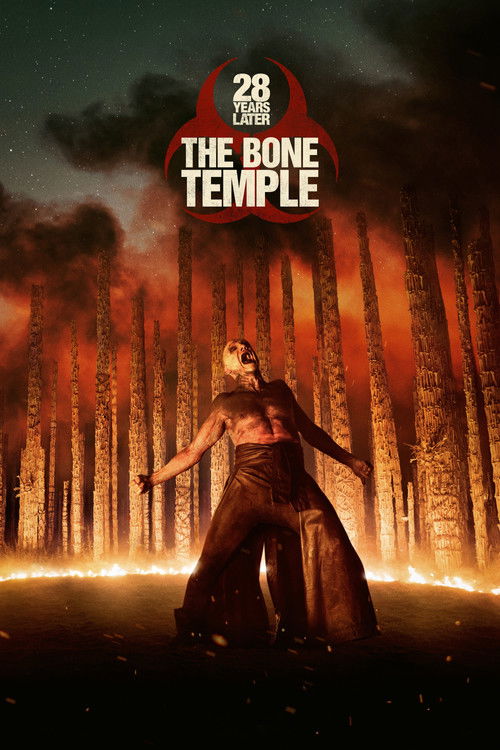
28 Years Later: The Bone Temple
2026 · Nia DaCosta
Candyman made her the youngest Black woman to top the US box office, then The Marvels' failure got unfairly hung on her — making her the era's key case study in how franchise blame flows to rising Black directors. Hedda continued her rehabilitation arc.
For when you're craving a real scare with ideas in it — apocalypse horror that gets under your skin rather than just at your nerves. Definitely a challenge pick, not a cozy one.
What it's about
In a Britain still quarantined decades after the Rage virus fell, the story picks up two threads: Dr. Kelson, the death-haunted physician who built a vast memorial of human bones in the wilderness, enters a relationship with consequences that could reshape the survivors' world, while young Spike is caught in the orbit of Jimmy Crystal, a cult leader whose following turns his life into a waking nightmare.
The experience
Grim, feverish survival horror that trades in cult dread as much as infected mayhem — ritual, menace, and flashes of strange tenderness. It's intense and unnerving, the kind of sequel that wants to disturb you more than jolt you.
The craft
Nia DaCosta takes the director's chair in the trilogy Danny Boyle and Alex Garland conceived, steering its middle chapter into cult-horror territory — bone temples, crucifixes, and folk ritual in the Northumberland wilds. The franchise's raw, immediate visual style meets a new director's sensibility, and the sound design earns good speakers.
Why it matters
The middle panel of the revived 28 Days Later trilogy and the first entry handed to a new filmmaker, making it a test case for how a landmark zombie franchise evolves beyond its creators.
Snapshot
The Bone Temple is the second installment in the resurrected 28 Days Later franchise, conceived by Danny Boyle and Alex Garland as the middle panel of a planned trilogy and the first of those films to pass the director's chair to another filmmaker — here, Nia DaCosta. Where 28 Years Later (2025) reintroduced the Rage-virus Britain through the coming-of-age of a boy named Spike on a tidal-island community, The Bone Temple picks up the threads left dangling at that film's close: Dr. Kelson (Ralph Fiennes), the eccentric, death-obsessed physician who built a vast memorial of human skulls and bones in the wilderness, and Sir Jimmy Crystal (Jack O'Connell), the tracksuited cult leader whose followers descended on Spike in the earlier film's startling final movement. The TMDB logline frames the film around two engines — Kelson entering "a shocking new relationship" with world-altering stakes, and Spike's encounter with Jimmy curdling into "a nightmare he can't escape." The picture is best understood not as a standalone but as the deepening of a serialized arc: Garland wrote it as a continuous narrative with the first film, and the two were developed and shot in close proximity, making The Bone Temple less a sequel than the second act of a single long-form work.
A note on the record: because this film arrives at the very edge of the documented period, granular details — final crew credits, technical specifications confirmed for this installment specifically, and consolidated critical and commercial reception — are thinner and less settled than for an older title. Where I am uncertain whether a creative choice carried over from the first film or was newly determined for the second, I flag it rather than assert it.
Industry & production
The franchise's revival was structured as an unusually large bet. Boyle and Garland returned to the property nearly two decades after 28 Days Later (2002) and its Garland-scripted, Juan Carlos Fresnadillo-directed follow-up 28 Weeks Later (2007), pitching a trilogy rather than a single legacy sequel. The first two films, 28 Years Later and The Bone Temple, were greenlit and produced as a paired venture, with a third installment planned to complete the arc. This back-to-back model — common in fantasy and franchise tentpole production — let the production amortize world-building, locations, and ensemble across two pictures while handing each to a distinct directorial voice.
The most consequential industrial decision was the choice of DaCosta to direct the second film. By the mid-2020s she was an established studio-scale director — Candyman (2021), her Jordan Peele-produced reinvention of the Bernard Rose original, and The Marvels (2023), a major Marvel Studios release, sitting alongside her independent debut Little Woods (2018). Installing her as the trilogy's second author signals the producers' intent to treat the series as a relay rather than a single auteur's project, in the manner that the original 28 Days Later/28 Weeks Later sequence already alternated directors. Garland's continuing authorship as screenwriter, and Boyle's continuing presence as producer (and director of the bracketing films), provide the connective tissue.
The film was positioned for an early-2026 theatrical release, following the first film's mid-2025 run. Hard figures — budget, marketing spend, opening grosses — sit outside what I can reliably confirm at this date, and I will not invent them; the commercial performance of The Bone Temple should be treated as provisional until the box-office record settles.
Technology
The defining technological gambit of the revived franchise belongs in the first instance to 28 Years Later, which Boyle and cinematographer Anthony Dod Mantle shot substantially on consumer iPhone hardware — Pro-model smartphones — rigged into custom multi-camera arrays that allowed bullet-time-style "poor-man's-process" arcs around action and let the crew place expendable cameras in places a heavy cinema rig could not go. This was continuous with Boyle and Dod Mantle's long history of embracing prosumer and lightweight digital capture, stretching back to 28 Days Later's pioneering use of the Canon XL1 MiniDV camcorder, whose smeary, low-resolution texture became inseparable from that film's apocalyptic immediacy.
Whether The Bone Temple reproduced the iPhone-array methodology wholesale, or whether DaCosta's installment adopted a modified or more conventional digital-cinema package, is a detail I cannot state with confidence and will not fabricate. What can be said is that the trilogy's house style was established as one of radical capture flexibility — small, mobile, sometimes disposable cameras prioritized over the heft and polish of traditional 35mm or large-format digital. Any continuity of that approach in the second film would be a deliberate aesthetic inheritance; any departure would itself be a meaningful authorial signature on DaCosta's part.
Technique
Cinematography
The visual grammar the franchise hands to The Bone Temple is one of jagged, in-the-moment immediacy: handheld restlessness, aggressive wide-angle distortion, stutter-cut and ramped frame rates, and a willingness to let images degrade into pixelated or motion-blurred abstraction at moments of violence. The first film paired this with a strikingly painterly use of the English landscape — wide vistas of Northumbrian countryside, tidal causeways, and overgrown ruins that recast post-apocalyptic Britain as a pastoral as much as a horror space. The Bone Temple's central image — Kelson's ossuary, a cathedral-like structure assembled from human remains — is by its nature a production-design and lighting set piece, and one expects the cinematography to lean on it for awe-and-dread tableaux. I cannot confirm the director of photography of record for this specific installment; if Dod Mantle did not return, the look would necessarily bear another hand's inflection.
Editing
The series' editorial signature, inherited from Boyle's long collaboration with cutters such as Jon Harris, is propulsive and disjunctive — montage that fractures continuity, intercuts archival and found imagery (the first film notably wove in older war-film and historical footage to mythologize its violence), and uses rhythm itself as a source of unease. Whether The Bone Temple sustains that maximalist, associative cutting or whether DaCosta, whose own films favor a more classical tension-building economy, tempers it, is one of the more interesting open questions about the picture. I'll note the franchise tendency without asserting the specific editor's identity here.
Mise-en-scène / staging
The title set piece dictates the film's spatial imagination. A "bone temple" — a memorial architecture of skulls and bones — is at once a horror-genre memento mori, a real-world echo of ossuaries and charnel houses (the Sedlec Ossuary, the Paris Catacombs, Capuchin crypts), and a thematic statement: in this Britain, the dead are not buried and forgotten but stacked, counted, and consecrated. Against that, the Jimmy Crystal cult supplies a contrasting register of staging — the tracksuited "Jimmies," whose deliberately tasteless visual coding (drawn from a notorious British media figure's iconography) made the cult one of the first film's most discussed and divisive elements. The film's mise-en-scène is therefore likely organized around two poles: the sacred, contemplative space of the temple and the profane, performative theater of the cult.
Sound
The franchise's sonic identity has been built on abrasive, percussive scoring and an uneasy mix that swings between near-silence and overwhelming attack. The first film's score by the Scottish group Young Fathers gave it a distinctive contemporary pulse, departing from John Murphy's now-iconic "In the House — In a Heartbeat" theme from 28 Days Later while preserving that motif's place in the series' DNA. Whether The Bone Temple retained Young Fathers or engaged a different composer I cannot confirm; the trilogy's established practice favors a strong, non-orchestral, rhythmically aggressive sound signature over conventional horror underscore.
Performance
The performances anchor the film's shift from survival-horror to something closer to grief-drama. Ralph Fiennes's Dr. Kelson — introduced late in the first film as a figure of unsettling serenity, a man who has made peace with mass death by ritualizing it — is positioned by the logline as a co-lead, his "shocking new relationship" driving the plot. Alfie Williams, the young actor whose Spike carried the first film, returns as the audience's point of identification, now thrust into direct collision with the cult. Jack O'Connell's Sir Jimmy Crystal moves, on the evidence of the logline, from a closing-scene shock into a sustained antagonist. The presence of Jodie Comer and Aaron Taylor-Johnson in the trilogy's ensemble carries over from the first film, though the degree of their involvement in The Bone Temple specifically is something I'd treat cautiously rather than overstate.
Narrative & dramatic mode
The Bone Temple operates in a serialized, novelistic mode rather than the self-contained survival structure of the original 28 Days Later. Garland conceived the trilogy as continuous, and this installment's drama is built on relationships and consequences seeded earlier: Spike's journey, Kelson's philosophy of death, and the menace of the Jimmies. The dual logline structure — Kelson's transformative relationship on one axis, Spike's inescapable nightmare on the other — suggests a braided narrative alternating between contemplative, almost theological drama and pursuit-driven horror. The franchise's characteristic tonal mode is one of whiplash: tenderness and brutality, lyricism and shock, held in deliberate tension. This is horror used as a vehicle for elegy.
Genre & cycle
The film sits at the confluence of several cycles. It is, first, a late entry in the post-millennial "fast zombie" / infection-horror cycle that 28 Days Later itself helped inaugurate in 2002 — a cycle that ran through Dawn of the Dead (2004), World War Z (2013), the Train to Busan films, and countless others, and that 28 Years Later explicitly returned to reclaim and complicate. Strictly, the franchise has always insisted its Infected are living humans driven by the Rage virus, not the undead, aligning it with viral-outbreak science fiction as much as zombie horror. Second, The Bone Temple participates in the 2020s wave of "elevated" or art-horror franchise filmmaking, in which prestige directors are handed genre properties and encouraged toward formal ambition — a context in which both Garland's authorship and DaCosta's Candyman are legible. Third, the cult-horror strain embodied by Jimmy Crystal connects it to the folk-horror and charismatic-leader subgenres that flourished in the same decade.
Authorship & method
The film's authorship is genuinely distributed, which is itself the point. Alex Garland, as screenwriter and a producer, is the trilogy's narrative architect; his preoccupations — collapse, the thin membrane between civilization and savagery, masculine violence, the ethics of the post-human — run continuously from 28 Days Later through Sunshine, Ex Machina, Annihilation, Men, and Civil War into this series. Danny Boyle, directing the first and (as planned) third films and producing throughout, sets the visual and tonal template. Nia DaCosta, directing this installment, brings a sensibility shaped by Candyman's interest in trauma, memory, and the way violence is mythologized and passed down — concerns strikingly congruent with a film literally built around a temple of the dead. The collaboration is thus a deliberate matching of a director to material that rhymes with her existing themes. On the specific identities of The Bone Temple's cinematographer, editor, and composer I have declined to assert names I cannot verify; the trilogy's established collaborators (Dod Mantle, Young Fathers, and Boyle's regular editorial team) are the natural reference points, but their carry-over to this installment should not be assumed without confirmation.
Movement / national cinema
This is emphatically a work of contemporary British cinema, and its Britishness is thematic, not incidental. The franchise has always read its apocalypse as a national allegory — 28 Days Later as millennial-anxiety Britain, 28 Weeks Later as occupation-and-security-state Britain, and 28 Years Later as a pointedly post-Brexit fable of an island nation sealed off from the European mainland, quarantined and turned inward, cultivating a mythologized, insular Englishness. The Jimmy Crystal cult, with its grotesque appropriation of a disgraced British celebrity's image, sharpens this into satire of national memory and the rot beneath nostalgic self-image. The Bone Temple extends a lineage of British apocalyptic and folk-horror imagination running from the BBC's catastrophe dramas through The Wicker Man to the films of Ben Wheatley.
Era / period
Released in early 2026, the film belongs to a moment of franchise reanimation in which studios revived dormant horror properties with prestige ambitions, and to a film culture still metabolizing the COVID-19 pandemic. The infection-horror genre's resurgence in the mid-2020s cannot be separated from the lived experience of quarantine, contagion anxiety, and social fracture; 28 Years Later and The Bone Temple arrive as the most prominent vehicles for that processing, their "28 years" timeline allowing a portrait of a society that has fully reorganized itself around permanent catastrophe — a generation that has never known the old world.
Themes
Death and its memorialization sit at the film's literal and figurative center. Kelson's bone temple proposes a way of living with mass death — not denial, not forgetting, but ritual accounting — and the film appears to test that philosophy against Spike's youth and the cult's nihilism. Adjacent themes cluster around it: grief and inheritance (what the dead leave the living); the manufacture of meaning and myth in a broken society, where Jimmy Crystal's cult offers belonging through grotesque performance; the loss and recovery of innocence in Spike's arc; and the persistent franchise concern with the rage and violence latent in human beings, virus or no virus. National memory — who is honored, who is forgotten, which images a culture clings to — runs beneath all of it.
Reception, canon & influence
On reception I must be candid about the limits of the record. The Bone Temple arrives at the boundary of what I can reliably document, and any consolidated critical consensus or box-office verdict would be premature for me to characterize; I will not invent review quotations, scores, or grosses. What can be situated is the backward influence on the film: the Romero zombie tradition; the Garland/Boyle original and Fresnadillo's 28 Weeks Later; the British folk-horror and apocalyptic lineage; real-world ossuary and memorial architecture; and DaCosta's own Candyman, with its themes of trauma transmitted across time. The first film's polarizing reception — admiration for its formal daring and emotional reach, alongside genuine controversy over the Jimmy Crystal material — forms the immediate critical context into which The Bone Temple steps, since this installment foregrounds exactly that divisive element.
Its forward influence is, by definition, not yet legible. The most concrete thing to say is structural: The Bone Temple is engineered as a bridge to a planned third film, and its lasting significance will be measured substantially by whether it sustains the trilogy's momentum and by what the concluding installment makes of the groundwork it lays. As the first film in the revived series directed by someone other than Boyle, it also functions as a test case for the relay-authorship model — a question whose answer belongs to a record still being written.
A Deleuzian reading
Begin with the wall of skulls.
The full Deleuzian reading of 28 Years Later: The Bone Temple →
Reception
Opened January 2026 to the best reviews in the entire 28-verse — critics called it the franchise peak — yet it underperformed in theaters, falling short of its ~$63M budget; by spring it was climbing Netflix's streaming charts, and the 'why did nobody see this?' reappraisal is already underway.
How 28 Years Later: The Bone Temple was received, from release to now →
Influences: the films it descends from and the films it influenced
- 28 Days Later (2002) — The trilogy's origin point: Boyle and Dod Mantle shot the depopulated-London footage on consumer Canon XL-1 MiniDV camcorders, whose degraded low-res texture and the reinvention of the fast 'rage'-infected are the formal DNA this film inherits wholesale.
- 28 Weeks Later (2007) — Established the series' disjunctive montage grammar — strobe-cut, near-subliminal handheld attack sequences and the brutal cold-open abandonment of a loved one — that The Bone Temple's editing extends.
- Night of the Living Dead (1968) — Source of the siege-of-the-living structure and the newsreel-raw, reportage monochrome that the infection genre still cites as its documentary-horror posture.
- Dawn of the Dead (1978) — Tom Savini's tactile practical splatter and the use of the undead horde as direct social allegory set the gore-as-meaning standard the rage films work within.
- The Wicker Man (1973) — The directly cited template: an isolated, self-sufficient death-cult community whose pagan folk ritual — not a monster — is the horror, structuring the film's Bone Temple as ceremonial space.
- Witchfinder General (1968) — Originated the painterly English-pastoral framing of ritual cruelty — wide countryside as a serene stage for violence — that underwrites the film's 'painterly landscape' cinematography facet.
- Kill List (2011) — The named Wheatley debt: fractured, elliptical editing that withholds the hooded cult reveal until a gut-punch, fusing kitchen-sink realism with folk-ritual dread.
- A Field in England (2013) — Hallucinatory disjunctive montage and stark, depth-flattened landscape horror in the English-folk register — a formal precedent for the film's percussive, non-naturalistic editing.
- Candyman (2021) — DaCosta's own method carried over: violence mythologized and transmitted across generations through memorial and urban-legend architecture, congruent with a narrative built around a temple of the dead.
- Sunshine (2007) — The earlier Boyle–Garland apocalypse, scored by John Murphy with propulsive, percussive non-orchestral rhythm — the score-as-pulse approach Young Fathers extends for the series.
- Tangerine (2015) — The proof-of-concept that a feature could be shot on rigged iPhones, legitimizing the iPhone-multicamera capture technology this film foregrounds.
- Slumdog Millionaire (2008) — Anthony Dod Mantle's lightweight digital, multi-format cameras and saturated, on-the-run kinetic montage define the trilogy's house cinematographic style of mobile immediacy.
- Midsommar (2019) — Extends the same elevated folk-horror into blanching daylight: communal death-ritual rendered as ornamented, ceremonial staging rather than nocturnal shock.
- The Witch (2015) — Shares the austere, landscape-bound folk-horror dread built from researched period texture and slow-burn pastoral menace.
- Annihilation (2018) — Garland-authored sibling whose painterly, uncanny landscapes and bodily transformation-as-spectacle rhyme with the film's death-memorialization and painterly-landscape facets.
- Men (2022) — Garland's explicit pagan-English-countryside folk-horror, with foliate/Green Man iconography and ritual repetition, the closest authorial cousin to the Bone Temple's cult material.
- Civil War (2024) — Garland's embedded-photojournalist handheld treatment of national collapse, a sibling in war-reportage immediacy and the ethics-of-witnessing that braids through the series.
Similar films
- 28 Days Later (2002) — influence & lineage · same viewing thread
- 28 Weeks Later (2007) — influence & lineage
- Night of the Living Dead (1968) — influence & lineage
- Evil Dead Rise (2023) — same viewing thread
- 28 Years Later (2025) — shared sensibility
- The Conjuring: Last Rites (2025) — shared sensibility
- Mandy (2018) — shared sensibility
- Evil Dead Burn (2026) — shared sensibility
All the films related to 28 Years Later: The Bone Temple →
Watch it with: curated runs of related films
- Trapped in the Dark — Watch these as a run of survival horror where the place itself — a chained-shut bathroom, a cabin cellar, a lightless cave, an endless fluorescent nowhere, an emptied city — turns into the thing hunting you.