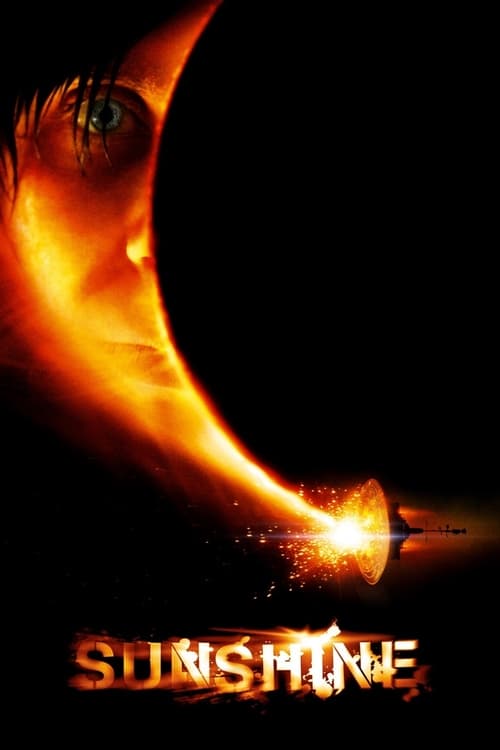
Sunshine
2007 · Danny Boyle
For when you want space to feel dangerous and holy again — a serious, immersive sci-fi night, lights off, sound up, not a casual background watch. Challenge over comfort, but the payoff is real.
What it's about
Fifty years from now the sun is failing, Earth is freezing, and a first mission to reignite it has already vanished without explanation. A second crew of eight astronauts sets out carrying a bomb the size of a city — humanity's last stockpile of fissile material — with orders to deliver it into the star itself. The film follows them through the long approach: the ship, the payload, the physicist whose finger will be on the trigger, and the growing pull of the thing they're flying toward.
The experience
Slow-burning dread laced with genuine awe — the sun here is beautiful the way a predator is beautiful, and every decision the crew makes tightens the screws a little more. It starts contemplative and procedural, then keeps shifting registers until you're gripping the armrest, and the ending leaves people arguing on the walk home.
Performances
Cillian Murphy anchors it as the quiet physicist the whole mission depends on, and Chris Evans — years before his superhero fame — is the surprise: flinty, pragmatic, the crew member willing to say the unsayable. Michelle Yeoh and Hiroyuki Sanada give the ensemble real gravity.
The craft
Danny Boyle and screenwriter Alex Garland treat hard sci-fi hardware with reverence and then aim it at the sublime: the light itself becomes a character, rendered in searing golds against the cold blues of the ship. John Murphy's score — especially its soaring central adagio — has been borrowed by trailers ever since. This one genuinely demands the biggest screen and best speakers you can find.
Why it matters
A commercial disappointment on release that became one of the defining cult sci-fi films of its century, its imagery and music echoing through the genre for years; it also cemented the Boyle–Garland partnership as one of British sci-fi's most fertile.
Snapshot
A dying star, a second ship sent to finish what the first could not, and eight astronauts carrying a fission device with the mass of Manhattan Island into the corona. Sunshine is Danny Boyle and Alex Garland's second original collaboration after 28 Days Later (2002), and their most formally ambitious: a 107-minute chamber piece that begins as procedural hard science fiction, deepens into a metaphysical study of the sublime, and then — in a swerve that has divided viewers for nearly two decades — collapses into blood-flecked slasher horror. Shot in Britain on a mid-range budget with a deliberately half-Anglophone, half-Asian ensemble, it failed commercially on release and has since become one of the most durable cult objects of twenty-first-century science fiction, its imagery and its score circulating far beyond the film itself.
Industry & production
Sunshine was produced by Andrew Macdonald for DNA Films, the London company Macdonald co-founded with Duncan Kenworthy and the vehicle for Boyle's post-Trainspotting work. DNA's financing sat inside a slate arrangement with Fox Searchlight, which meant the film was made with studio money but under a specialty-label logic — a British production with an international cast, released through Fox in the UK (April 2007) and rolled out by Searchlight in the United States that July. The commonly reported budget of roughly $40 million made it by some distance the most expensive film Boyle had directed to that point, and its worldwide theatrical gross did not recover it.
The mismatch between scale and marketing was structural. A hard-SF picture with no stars of blockbuster wattage, a downbeat premise, and a final act that resists trailer-cutting was handed to a distributor built for awards-season specialty titles. Boyle has spoken in interviews since about the difficulty of the production and his reluctance to return to the genre; the film's reputation as a "troubled" or at least exhausting shoot rests mostly on such recollections rather than documented crises, and the record here is thin enough that it should be treated as testimony, not fact.
Principal photography took place largely at 3 Mills Studios in East London, on standing sets that allowed the Icarus II to be shot as a continuous, navigable interior. Boyle put the cast through an extended preparatory period — communal living, physics tutoring from the film's science consultant, diving instruction, exposure to confined-crew environments — a rehearsal method he has used before and one whose purpose was less technical accuracy than the manufacture of a real group dynamic among actors who had to read as seven years' worth of colleagues within minutes of the first scene.
Technology
The film was shot photochemically on 35mm and finished in scope, at the last moment before digital capture became the default for genre production. Its central technical problem was not the ship but the star: how to render an object that cannot be looked at, in a medium built on looking. The solution was distributed across departments. Visual effects were led by the Moving Picture Company in London under supervisor Tom Wood, whose solar surface work drew on the vocabulary of real heliophysics imaging — granulation, prominences, the writhing plasma of solar observatory footage — rather than the flat orange disc of earlier screen suns.
The digital intermediate is doing as much work as the effects. Sunshine is graded to the edge of legibility: the sun-facing side of the ship blows out to white and gold with no recoverable detail, while the interiors sit in a cold cyan-gray. The exposure is not neutral; it is the film's argument, staged as a photographic condition.
Mark Tildesley's production design gives the Icarus II a single governing idea — a vast gold heat shield with the crew tucked in its shadow — so that the ship's geometry encodes the film's theme of proximity and protection. Science consultancy came from the particle physicist Brian Cox, who supplied the premise's fig leaf (a Q-ball, a hypothetical supersymmetric particle, disrupting the solar core) and who worked directly with Cillian Murphy on the bearing of a working physicist. The film's science is not rigorous, and Cox has been candid about that; what the consultancy bought was texture, not proof.
Technique
Cinematography
Alwin H. Küchler, a Boyle collaborator with roots in the British art-cinema of Lynne Ramsay and Michael Winterbottom, shoots Sunshine as a study in the failure of the image. Light in this film is corrosive. Küchler works constantly with flare, refraction, prismatic breakup and diffraction, letting the source contaminate the frame rather than illuminate it; the observation-deck sequences, in which Searle steadily reduces the filter and stares into the star, are constructed so that the audience shares his optical damage. Interiors are close, wide-lensed, and often handheld, with Boyle's characteristic tilted framings and low angles; exteriors are silent, sparse, and enormous.
The most radical photographic decision concerns Pinbacker. When the burned captain of the Icarus I finally boards, he is rendered in shots deliberately degraded — smeared, over-exposed, strobing, stripped of focus — so that the film's antagonist is never fully resolved as an image. It is a formal solution to a narrative problem: a figure who has been consumed by light cannot be photographed by a camera that depends on it. Whether the effect reads as inspired or as evasion is precisely the fault line along which the film's critical reception splits.
Editing
Chris Gill, who had cut 28 Days Later and Millions for Boyle, builds the film in two distinct rhythms. The first two-thirds are patient and legible: long-ish takes, clear geography, procedural cause and effect — a shield miscalibration, a cascading failure, a repair, a death. The last third accelerates into fragmentation, with subliminal flash frames, superimpositions of earlier images, and cuts that arrive fractionally before the eye can parse them. Gill also threads Pinbacker's presence into the earlier acts as near-imperceptible inserts, so that the film has been infected before it announces the infection.
The 107-minute runtime is tight for the material, and the compression is felt: the ensemble is thinned faster than the script has time to mourn each loss, which is either the point (attrition as arithmetic) or the film's principal structural weakness, depending on the reading.
Mise-en-scène / staging
The Icarus II is staged as a machine with a moral topology. Forward is the payload; aft is the oxygen garden; between them lie the airlock, the flight deck, and the observation room — each of which hosts a decision about who lives. Tildesley's sets are functional and unglamorous, closer to Alien's working vessel than to 2001's white boutique, but the film reserves one space for pure spectacle: the observation lounge, a viewing chamber whose only function is contemplation of the thing that will kill everyone aboard. Building a room for looking, on a ship where looking is fatal, is the film's design thesis in miniature.
Costuming (Suttirat Anne Larlarb) reinforces the same split: soft, worn, civilian-adjacent interior clothing against the gold, insectile, radically non-humanoid EVA suits, which read less as protective gear than as reliquaries.
Sound
The score is credited to John Murphy and Underworld, the latter Boyle's collaborators since Trainspotting. The film's sonic architecture is near-continuous, with electronic drone, ship hum and orchestral swell braided so tightly that the boundary between score and sound design dissolves. The signature cue — Murphy's slow, building adagio, deployed at the film's deaths and at its final approach — became one of the most licensed pieces of trailer and television music of its era, a curious afterlife in which the film's emotional climax was detached from the film and resold as generic uplift.
Against this, Sunshine uses silence with unusual discipline. The exterior sequences drop the mix almost entirely, and the film's most extreme moment of physical peril — an unprotected transit between ships — is played largely without sound, so that the audience is placed in the vacuum rather than watching it. Glenn Freemantle's sound work supplies the countervailing detail: breath, hull stress, the small mechanical noises that make the ship feel occupied.
Performance
The ensemble is built to read as a crew rather than a cast of protagonists. Cillian Murphy plays Capa, the physicist, with an inwardness that withholds heroism until the last possible moment; Chris Evans, several years before Captain America, gives Mace a hard, unsentimental utilitarian anger that turns out to be the film's most reliable moral instrument. Cliff Curtis's Searle is the film's mystic, addicted to the star; Michelle Yeoh's Corazon carries the film's only sustained tenderness, directed at plants; Hiroyuki Sanada's Kaneda supplies a captaincy defined entirely by the terms of his death; Rose Byrne, Troy Garity and Benedict Wong fill out a crew whose fractures are professional before they are personal. Mark Strong's Pinbacker is less a performance than a texture — voice, silhouette, ruined skin — by design.
Narrative & dramatic mode
The film's dramatic engine is a sequence of forced arithmetic. Should the Icarus II divert to recover the first ship's payload, doubling the chance of success at unquantifiable risk? Does the oxygen support four people or five? Who is expendable, and who decides? Garland structures the screenplay as a chain of these calculations, each one correct and each one catastrophic, so that the crew is destroyed not by malice or incompetence but by rational choice under uncertainty. It is a mode closer to tragedy than to thriller: the fatal decision is made in the first act by the most sympathetic character, for the best reasons.
The third-act arrival of Pinbacker breaks this mode deliberately. A film governed by reason is invaded by a figure who represents its total negation — a religious surrender to the sun, refusing the mission on the grounds that extinction is God's instruction. Read as a genre failure, it is an unmotivated slasher graft. Read as a formal argument, it is the film insisting that the sublime cannot be metabolized by procedure, and that something in the encounter must come back as unreason.
Genre & cycle
Sunshine belongs to the small, prestigious category of the "mission film" — a crew, a payload, a star, a deadline — and to a specific 2000s cycle of serious science fiction made outside the American blockbuster system: Soderbergh's Solaris (2002), Cuarón's Children of Men (2006), and, two years later, Duncan Jones's Moon (2009). Within the genre's internal history it is a late entry in the "sacrificial voyage" line running from Silent Running (1972) through Solaris (1972) and Alien (1979), and its hybridity — hard SF fused to horror — descends directly from Scott's precedent.
The film's ancestry is unusually legible, and the naming is a signal: Pinbacker is a near-explicit nod to Sergeant Pinback of John Carpenter's Dark Star (1974), the other great film about bombs sent into stars, and Icarus supplies the myth in the ship's registry.
Authorship & method
Boyle's authorship here is one of kinetic imposition: wide lenses, canted frames, flash cuts, saturated grading, and music used maximally rather than sparingly. It is a style developed for Trainspotting and 28 Days Later and applied, sometimes against the grain, to material that also wants the stillness of Tarkovsky. That tension — a hyperactive stylist directing a contemplative script — accounts for much of what is thrilling and much of what is unstable in the film.
Alex Garland's screenplay carries the concerns that would define his own directorial career: intelligence confronting something that exceeds it, the ethics of the small isolated group, and the annihilation of the observer by the observed. Küchler's photography supplies the film's visual thesis, Chris Gill's editing its two-speed structure, Mark Tildesley's design its governing geometry, and Murphy and Underworld its emotional register. Andrew Macdonald's producing kept a genuinely difficult idea inside a studio pipeline. The film is best understood as the product of a stable repertory company — Boyle's — briefly attempting a scale it would not attempt again.
Movement / national cinema
This is British science fiction in the tradition of internationally-financed, London-crewed genre filmmaking: 2001 and Alien were both made in British studios, and Sunshine draws on the same infrastructure of workshops, model shops and post houses. It also belongs to a distinctly British apocalyptic strain — Nigel Kneale's Quatermass serials, John Wyndham's catastrophes, the BBC's cold-war nuclear dramas — in which the end of the world arrives as a technical problem handled by professionals rather than as a spectacle for generals.
Its casting is a deliberate geopolitical statement. The crew is split between Anglophone and East Asian performers on the premise that a mission of this scale, fifty years out, would be mounted by the United States and China together. In 2007 that was a forecast; the film's demographic imagination has aged better than its physics.
Era / period
Sunshine sits at several hinges at once. Technologically it is among the last major science fiction films shot on film before digital capture and Avatar-era performance pipelines redrew the field. Industrially it is a specimen of the vanishing $40-million adult genre picture — too expensive for the specialty market, too strange for the multiplex. Thematically it belongs to the mid-2000s climate imagination, though it performs a characteristic inversion: rather than a warming Earth, a cooling one, with the crisis relocated to the sun itself and the political content displaced into physics. And it arrives at the tail of the post-9/11 cycle of sacrificial-collective narratives, in which small teams absorb catastrophe on behalf of populations who never appear on screen.
Themes
The dominant theme is the sublime in something close to its eighteenth-century sense: an object so large that contemplation of it destroys the contemplator. Searle's addiction to the star, Pinbacker's conversion, and Capa's final descent are three grades of the same experience — aesthetic, religious, and instrumental — and the film refuses to rank them.
Beneath that sits a sustained inquiry into utilitarian ethics under scarcity, staged as oxygen budgets and payload probabilities, and a quieter meditation on human insignificance: the film's most affecting idea is that the crew's deaths will leave no record, and that the light of their success will reach Earth eight minutes after they cease to exist. Secular sacrifice, sun-worship, entropy, the mission as substitute for faith, and the recurring Icarus figure — proximity as both the means of salvation and the cause of destruction — complete the cluster.
Reception, canon & influence
Contemporary reviews were mixed-to-positive, with a consistent shape: admiration, often strong, for the first two acts' rigor, atmosphere and design, and division bordering on hostility over the third-act turn to horror. The commercial performance was poor in both territories, and the film's awards profile was slight. It found its audience afterwards, on disc and then in streaming and repertory, where the third act's supporters — who read it as a deliberate rupture rather than a capitulation — have gradually become the louder party.
Backward, the influences are explicit and acknowledged in broad terms by the filmmakers: 2001: A Space Odyssey for the mission's monumentality, its calm shipboard AI, and its light-storm finale; Tarkovsky's Solaris for the encounter with an unknowable celestial object that reads its observers; Alien for the working-crew realism and corridor dread; Silent Running for the small crew, the garden, and the moral crack-up; Dark Star for the premise and the naming; and Event Horizon (1997) for the derelict ship and the burned survivor, a comparison drawn by critics more often than by the filmmakers.
Forward, its clearest legacy runs through Garland's own directing career — Ex Machina, Annihilation, Devs — which takes up the same subject of intelligence dissolved by contact with something larger, in a related idiom of shimmer, refraction and overwhelming light; Annihilation's climax is legible as a direct descendant of Capa's. The film also anticipated the late-2010s cycle of grave, star-facing science fiction — Interstellar, High Life, Ad Astra — and its solar-catastrophe premise recurs, on a vastly different scale, in The Wandering Earth (2019). Its most pervasive influence, though, is aural: Murphy's adagio has been licensed into trailers, television and other films so widely that a generation encountered the sound of Sunshine long before the film, an inversion that suits a story about light arriving after its source is gone.
A Deleuzian reading
Searle sits alone in the observation room and asks the ship to lower the filter.
The full Deleuzian reading of Sunshine →
Reception
A box-office flop in 2007 that critics half-embraced and audiences skipped, Sunshine has since been steadily reclaimed as one of the great modern sci-fi films — the 'underrated Boyle' pick that gets more passionate defenses every year.
How Sunshine was received, from release to now →
How to watch Sunshine: what to notice on a first viewing
- Notice the ship's one room built only for looking at the sun. The Icarus II is built for function everywhere else — payload, garden, airlock — but Tildesley gives one space no purpose but contemplation of the thing that will kill everyone aboard. A ship built for survival keeps one room for nothing but watching danger, which tells you what the film is really about.
- Listen for when the soundtrack drops out almost entirely. Boyle and sound designer Freemantle cut the mix to near-silence during the film's most physically dangerous exterior sequence, replacing dialogue and score with almost nothing. The silence puts you inside the vacuum instead of letting you watch it from safety.
- Track the color split: gold sun-side, cold cyan-gray interiors. Küchler grades every sun-facing surface toward blown-out white and gold while the crew's living spaces stay cold blue-gray, and even their spacesuits go gold and insectile. The palette turns proximity to light into a visible danger, not just a plot fact.
- Notice how patiently the first hour holds its shots. Chris Gill cuts the early film in clear, legible cause-and-effect: a failure, a repair, a cost. Watch for when that patience starts to change. The editing rhythm itself tells you when the mission's logic starts to break down.
- Watch how the eight actors move around each other, easy. Boyle put the cast through communal living and training so they read as seven years' colleagues within minutes, not strangers introduced by a script. The crew's ease together makes every later loss land as the loss of a specific person.
The whole guide to watching Sunshine, with the keys for a rewatch →
Influences: the films it descends from and the films it influenced
- 2001: A Space Odyssey (1968) — Supplies both the flat-affect shipboard AI addressed by name in conversational close-up and the terminal light-corridor — Kubrick's slit-scan abstraction rewritten by Küchler as blown-out solar overexposure that erases the actor's face in the same way.
- Solaris (1972) — Donates the observation-lounge as a psychological instrument: a crew member sits alone before an unknowable celestial body in long, near-static held takes, and the object looks back and edits its observer's mind rather than the reverse.
- Alien (1979) — The working-crew register — overlapping technical dialogue, tool-marked functional interiors, and corridor dread built from a stalking handheld camera in cramped practical sets rather than from creature reveals — is the template for Icarus II's first two acts.
- Silent Running (1972) — Establishes the oxygen garden as a shipboard set that doubles as the crew's moral ledger, and the small-crew mission whose sole idealist crosses into homicide to protect it — Sunshine reruns both, including the garden's destruction as the film's structural hinge.
- Dark Star (1974) — Direct source of the premise (a bored long-haul crew delivering a bomb to a star) and of the antagonist's name, lifted from Sgt. Pinback — Garland inverts Carpenter's slacker deadpan into theological derangement while keeping the same ship-and-payload architecture.
- Event Horizon (1997) — Contributes the derelict-sister-ship rendezvous and the burned, self-immolated survivor delivering a degraded, artefacted video message — a corrupted-recording horror device Boyle reprises in Pinbacker's transmission and in the frame-rate-broken glimpses of his body.
- 28 Days Later (2002) — Boyle's own prototype for the third act: deliberately degraded low-resolution image, smeared handheld pursuit, subliminal single-frame inserts of the attacker, and John Murphy's building string-and-guitar adagio — 'In the House, In a Heartbeat' is the direct compositional parent of 'Sunshine (Adagio in D Minor)'.
- Altered States (1980) — Model for the sublime rendered as an assault on the celluloid itself — flash-frame montage, chemical over-saturation and solarised light dissolving a scientist's body — the photochemical vocabulary Boyle deploys for Capa's final approach to the surface.
- Ex Machina (2014) — Garland's directing debut rebuilds the observation-lounge as Ava's glass chamber, shooting intelligence-meets-intelligence through refractive surfaces and answering Murphy/Underworld with Salisbury and Barrow's identical electronic-orchestral hybrid.
- Annihilation (2018) — The lighthouse climax is Capa's dissolution restaged: an ensemble expedition film that pivots into horror, then ends with a scientist annihilated inside a prismatic light event scored by a swelling synthetic-orchestral drone.
- Life (2017) — Reproduces the hard-SF-to-horror hybrid turn on the same schedule — procedural ensemble realism in modular ship interiors, then attrition — and closes on the same tragic rational choice, a crew member deliberately flying the threat away from Earth.
- The Wandering Earth (2019) — Recycles the solar-catastrophe premise into a terminal manual-ignition sacrifice: a crew member overrides the AI's survival logic and flies a vessel into a fusion event, staged as the same annihilating wall of light that ends Capa's approach.
- Kick-Ass (2010) — The most literal transmission of Sunshine's craft: Murphy's 'Adagio in D Minor' is licensed wholesale for the warehouse sequence, beginning the trailer-and-needle-drop afterlife by which the film's score became more widely known than the film.
- 28 Years Later: The Bone Temple (2026) — The earlier Boyle–Garland apocalypse, scored by John Murphy with propulsive, percussive non-orchestral rhythm — the score-as-pulse approach Young Fathers extends for the series.
- Interstellar (2014) — Shares the tragic-rational-choice engine — a crew member coldly computes that his own death buys the mission its delta-v — and matches Sunshine's practically-lit cockpit photography and its use of a maximalist, near-continuous score as narrative pressure rather than accompaniment.
- High Life (2018) — Keeps the shipboard garden as the vessel's only organic space and stages a doomed one-way crew against an annihilating gravitational object, but strips Boyle's kinetic cutting down to the silence-as-vacuum discipline he only uses in the airlock sequences.
- Ad Astra (2019) — Takes up the derelict-vessel boarding, the psychological-evaluation voiceover of a crew member losing coherence, and van Hoytema's anamorphic lens flare and crushed-to-white solar highlights as the primary expressive tool of a sunward mission film.
- Aniara (2018) — Builds its entire structure around an observation chamber — the Mima — in which passengers commune with an image that consumes them, and splits into two tonal halves at a hard mid-point rupture exactly as Sunshine does at the Icarus I docking.
- Gravity (2013) — Systematises Sunshine's vacuum acoustics into a rule — sound exists only where it can be conducted through suit, hull or body — and extends the helmet-interior POV shots Boyle uses in the unshielded spacewalk into the film's governing camera position.
- Moon (2009) — Contemporaneous British contemplative-space film built on crew isolation, a single vessel and an electronic chamber score as emotional undertow.
- 28 Years Later (2025) — The prior Boyle–Garland–Dod Mantle reunion, fusing genre spectacle with mortality, sacrifice, and mysticism beneath the action surface.
- Prometheus (2012) — Pairs a serene, awe-struck score and sun-worshipping contemplation against a third-act turn to brutal horror — the same serene-vs-brutal tonal whiplash and theological reach Prometheus attempts.
- Ikarie XB 1 (1963) — Descendant in its restrained international mission-crew and humanist voyage-toward-a-cosmic-object structure, with psychological strain accumulating episodically over the transit.
Similar films
- 2001: A Space Odyssey (1968) — influence & lineage · same viewing thread
- Interstellar (2014) — influence & lineage · same viewing thread
- Gravity (2013) — influence & lineage
- Solaris (1972) — influence & lineage
- Annihilation (2018) — influence & lineage
- Ad Astra (2019) — influence & lineage
- 28 Days Later (2002) — influence & lineage
- Event Horizon (1997) — influence & lineage
All the films related to Sunshine →
Watch it with: curated runs of related films
- Alone in the Void — A run of films about a single mind pitted against the vastness — rationing air, doing the math, reaching across impossible distance — best watched together for how survival keeps tipping into awe.