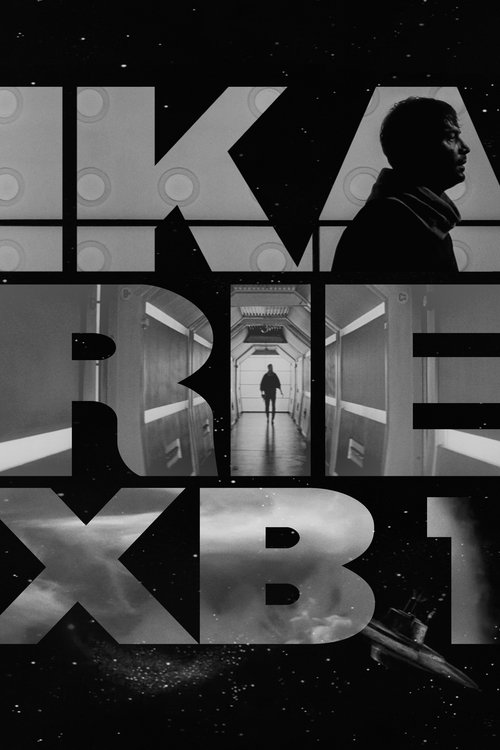
Ikarie XB 1
1963 · Jindřich Polák
For when you're craving thoughtful, atmospheric science fiction — a film to watch attentively, preferably late at night, and marvel that it was made in 1963. Catnip for anyone who loves the archaeology of the genre.
What it's about
The year is 2163, and the starship Ikarie XB-1 is deep into a years-long voyage toward a distant star system in search of alien life. The film follows its large crew of scientists and technicians — working shifts, falling in love, celebrating birthdays, quarreling — as the mission throws real dangers at them: a derelict relic of the twentieth century, a malignant dark star whose radiation gnaws at body and mind, and the slow psychological grind of being years from home.
The experience
Cool, eerie, and strikingly serious — space travel as routine labor and creeping dread rather than adventure. Its black-and-white calm makes the moments of menace genuinely unsettling, and its ideas give you plenty to chew on.
The craft
Made at Prague's Barrandov studios from a story loosely drawn from Stanisław Lem, it boasts clean modernist ship interiors, elegant widescreen black-and-white photography, and an unnerving early-electronic score — production design and sound that still look and sound remarkably ahead of their time. It rewards a dark room and good speakers.
Why it matters
Widely regarded as the most serious space-travel film made before 2001: A Space Odyssey and a clear stylistic forerunner of it — a cornerstone of Eastern Bloc science fiction that was long known in the West only through a mangled recut, and has since been restored to classic status.
Snapshot
Ikarie XB 1 is a Czechoslovak science-fiction feature produced at the Barrandov studios in Prague and released in 1963, directed by Jindřich Polák from a screenplay he wrote with Pavel Juráček. Loosely adapted from Stanisław Lem's 1955 novel The Magellanic Cloud (Obłok Magellana), it follows the crew of a large interstellar ship in the year 2163 as they voyage toward a distant star system in search of extraterrestrial life. The film is remembered today as one of the most technically and intellectually serious space-travel films made before Stanley Kubrick's 2001: A Space Odyssey (1968): it treats deep-space travel as a matter of routine labor, ethical dilemma and psychological endurance rather than of monsters and ray-guns. Its clean, brightly lit modernist ship interiors, its ensemble of scientists and technicians, and its contemplative tone made it an outlier in the international genre landscape of its moment. It circulated in the West in a substantially altered English-dubbed version, Voyage to the End of the Universe (1964), which has long complicated its reputation and its reception history.
Industry & production
The film was made within the nationalized Czechoslovak film industry, whose production hub was the Barrandov Studios in Prague — a large, well-equipped facility with a long tradition in genre and effects work. Working inside a state-planned system meant access to substantial studio resources, extensive sets and specialist craft departments, but also production within the ideological and institutional norms of an early-1960s socialist cinema. Ikarie XB 1 belongs to a brief, comparatively liberalizing window in Czechoslovak culture just before the ferment of the mid-decade Czechoslovak New Wave. Notably, the screenplay was co-written by Pavel Juráček, who would shortly become one of the New Wave's most distinctive and troubled figures; his early presence here connects an ostensibly mainstream genre production to the more experimental currents forming around him. Precise production budgets and shooting-schedule figures are not something I can state reliably from the established record, and I will not invent them; what is clear is that the film was mounted as an ambitious, effects-heavy studio undertaking rather than a modest programmer.
Technology
The picture was shot in black-and-white on 35mm and composed for a widescreen frame, a format choice that suited its emphasis on large interior spaces and horizontal crew movement. Its technological ambition lies less in any single novel process than in the sustained integration of studio-built sets, miniatures, optical effects and matte work to sell the illusion of a self-contained ship in transit. The production leaned on the established Barrandov effects and design infrastructure to realize consoles, corridors, viewing ports and the exterior of the vessel. The result is a film in which the "technology" on screen — automated systems, a mechanical servant robot, medical and communications apparatus — is presented as lived-in and functional rather than spectacular, an aesthetic of plausible near-future engineering that anticipated the procedural hardware realism later associated with Kubrick and, on television, with Star Trek.
Technique
Cinematography
The cinematography, credited to Jan Kališ (with Saša Rašilov also associated with the camera work), is one of the film's most admired elements. Kališ exploits the widescreen black-and-white frame to render the ship's interiors as gleaming, high-key, almost antiseptic environments, then modulates that brightness toward shadow and disorientation as the crew's ordeal deepens. Deep, wide compositions place figures within the architecture of the ship, emphasizing scale and the collective nature of the enterprise; the camera favors clean geometry, reflective surfaces and the rhythmic repetition of circular and rectilinear design motifs. This visual strategy — the starship as a luminous modernist habitat — is precisely the quality most often cited when the film is discussed as a forerunner of later, more famous space cinema.
Editing
The film's construction is episodic and cumulative, built around a series of incidents that test the crew: the discovery of a derelict vessel, an encounter with a hazardous stellar phenomenon, and the mounting psychological strain that follows. The editing serves this measured, exploratory rhythm, allowing sequences to develop patiently rather than through rapid genre cutting, and reserving sharper, more disorienting montage for moments of crisis and breakdown. This pacing is central to the film's contemplative reputation and to the sense that its true subject is duration and endurance in deep space.
Mise-en-scène / staging
Staging is dominated by Jan Zázvorka's production design, which is arguably the film's signature achievement. The ship is realized as a suite of bright, spacious, austerely modern interiors — long corridors, rounded doorways, banks of instruments, a recreation and social area — that read as a coherent designed world rather than a set of disconnected sets. Polák stages his large ensemble within these spaces so that work, leisure and conflict all unfold in believable communal geography; crew members are frequently shown going about routine tasks, which naturalizes the futuristic environment. The obsolete robot and the recovered 20th-century derelict provide pointed contrasts of design register — the archaic against the sleek — that carry thematic weight.
Sound
The score is by Zdeněk Liška, one of the most important and inventive Czech film composers of the century, later celebrated for his work with František Vláčil and Jan Švankmajer. For Ikarie XB 1 Liška supplies an atmosphere of electronic and orchestral textures that reinforce the film's sense of the strange and the vast; his music is a key agent in shifting the film's mood from serene routine toward dread. The soundscape more broadly treats the ship as an acoustic environment of hums, signals and mechanical presence, consistent with the film's overall commitment to plausibility.
Performance
The film is built on an ensemble rather than on star turns, casting distinguished Czech stage actors — among them Zdeněk Štěpánek and Radovan Lukavský, both figures of the national theatrical tradition — as scientists and officers. The performances are correspondingly restrained and professional in register: the crew are competent adults doing difficult work, and the acting emphasizes collegial exchange, deliberation and the gradual erosion of composure under stress rather than heroics. I will not assign specific character names to individual actors beyond this, as I am not certain enough of the exact mappings to state them as fact. The overall effect is an unusually mature, un-sensational mode of genre performance.
Narrative & dramatic mode
The dramatic mode is that of a serious, humanist voyage narrative: a mission story organized around discrete trials, in which the antagonist is not a creature or an enemy but circumstance, radiation, time and the fragility of the human mind. Two set-pieces anchor the structure. In one, the crew boards a derelict ship drifting from the 20th century and finds its long-dead occupants and a cargo that indicts the violence of the era from which it came. In another, the ship passes near a hazardous "dark star" whose radiation induces a creeping sickness and mental collapse, pushing at least one crew member toward madness and endangering the whole company. The film's arc moves from confident departure through crisis toward a resolution touched by renewal — famously, the register of the ending was altered for foreign release, so the "canonical" final note depends on which version one sees. Throughout, the tone is reflective and ethically engaged rather than action-driven.
Genre & cycle
Ikarie XB 1 is a work of "hard," idea-centered science fiction: it is interested in the plausible mechanics and human consequences of interstellar travel rather than in the invasion, monster or gadget cycles that dominated much Anglo-American SF of the 1950s. It belongs to a distinct Eastern European strand of screen science fiction — informed by literary sources such as Lem and by a more philosophical, less militarized conception of the genre — that would later produce works like the Soviet adaptations of Lem and the cosmic cinema of Andrei Tarkovsky. Within that cycle, Ikarie XB 1 is an early and unusually complete example of the "generation-ship / long-voyage" film, prizing routine, community and endurance.
Authorship & method
Jindřich Polák (1925–2003) directed and co-wrote the film, and it stands as the work for which he is best known internationally, though his broader career ran through popular Czech film and television. His method here is one of restrained realism applied to fantastic material: he grounds the speculative premise in credible human behavior and designed environments, trusting atmosphere and idea over spectacle. He was supported by an exceptional team of collaborators, and the film is very much a product of their combined craft: co-writer Pavel Juráček, whose literary sensibility and coming association with the Czechoslovak New Wave lend the script its ambition; cinematographer Jan Kališ, responsible for the luminous widescreen imagery; production designer Jan Zázvorka, who built the film's persuasive future world; and composer Zdeněk Liška, whose score shapes its emotional and uncanny dimensions. The film's source material — Stanisław Lem's novel The Magellanic Cloud — supplies its intellectual DNA, even where the adaptation departs from the book.
Movement / national cinema
The film is a landmark of Czechoslovak cinema and, specifically, of Czech genre filmmaking's capacity to operate at an international standard. It sits on the threshold of the Czechoslovak New Wave: it is not itself a New Wave film in the manner of Forman, Chytilová or Menzel, but its co-writer Juráček would soon become central to that movement, and the picture shares the era's seriousness and craft. As national cinema, it demonstrates how the Barrandov system could marshal design and technical resources toward a confident, cosmopolitan science-fiction statement that traveled well beyond its borders.
Era / period
Produced in 1963, Ikarie XB 1 is a Cold War artifact in the most direct sense: its recovered 20th-century derelict, with its dead crew and destructive cargo, functions as an explicit reckoning with the violence and weaponry of the century that produced it, viewed from the vantage of an imagined enlightened future. The film's optimism about a collective, scientifically advanced humanity is characteristic of a certain strain of early-1960s futurism, while its anxieties about radiation and annihilation are unmistakably of the atomic age. It predates 2001 by five years and arrives at a moment when serious cinematic science fiction was still comparatively rare, which sharpens its historical significance.
Themes
The film's central themes are the survival of human community under extreme conditions; the moral inheritance of the 20th century and the shadow of nuclear violence; the psychological limits of the human mind isolated in the void; and the tension between rational, collective progress and the fragility of the individuals who must carry it out. The encounter with the derelict ship crystallizes a judgment on the destructive "legacy of the 20th century," while the dark-star crisis dramatizes sanity itself as the frontier the crew must survive. Underlying all of this is a humanist faith — qualified but genuine — in reason, cooperation and the continuation of life, an emphasis the film's original ending underlined and which its foreign re-edit notoriously undercut.
Reception, canon & influence
Critically, Ikarie XB 1 has come to be regarded as a significant and somewhat under-recognized landmark of science-fiction cinema, its stature rising considerably in later decades as restored versions of the original Czech film became accessible and audiences could compare it with the compromised export cut. Its most consequential reception problem was that version: the film was released in the United States in 1964 by American International Pictures as Voyage to the End of the Universe, dubbed, shortened, with anglicized character names and — most controversially — an altered ending, which for years distorted Western understanding of what Polák had actually made.
Its influences run backward to Stanisław Lem's fiction and to the broader mid-century literary tradition of serious, extrapolative science fiction, filtered through the design and effects capacities of Barrandov. Looking forward, the film is frequently discussed as an anticipation of — and in the view of many commentators, a likely influence on — the clean, functional starship aesthetic and philosophically inclined mode of later works, above all Kubrick's 2001: A Space Odyssey and the ensemble-crew, procedural texture of Star Trek. Direct, documented lines of causal influence on those specific productions are debated rather than settled, and I will not overstate them; what can be said firmly is that Ikarie XB 1 arrived early at an aesthetic and a sensibility that the genre's most celebrated later works would share, and that its rehabilitation has secured its place in the canon of serious space cinema.
Reception
For decades the West only knew it as 'Voyage to the End of the Universe' — a dubbed, cut, re-ended American International Pictures hack-job. The 2016 Czech restoration (premiered at Cannes Classics) flipped its reputation: now it's routinely called the missing link between Forbidden Planet and 2001.
How Ikarie XB 1 was received, from release to now →
How to watch Ikarie XB 1: what to notice on a first viewing
- Notice how bright and clean the ship's interiors are. Jan Kališ shoots the ship in gleaming, high-key widescreen, almost antiseptic light, a look the film gradually lets slip toward shadow as the voyage wears on. The lighting itself tracks the crew's composure, bright while things hold together, darker as they don't.
- Watch the crew perform ordinary tasks around the ship. Polák stages the large ensemble going about routine work and leisure in long corridors and rounded doorways, a coherent designed world rather than a set of separate rooms. The routine is what makes the future feel lived in, not just built for the camera.
- Listen for electronic tones creeping into the orchestra. Zdeněk Liška's score moves between orchestral warmth and strange electronic texture, shifting the ship's mood from serene routine toward something more unsettled. The music tells you the atmosphere is changing before anything on screen confirms it.
- Watch how calmly the crew discusses difficult decisions. The cast plays scientists and officers as competent adults, restrained and professional, with composure shown in small gestures rather than heroic outbursts. The performances stay believable, so the crew's composure reads as real.
- Notice the recreation and social spaces built into the ship. Jan Zázvorka designs a recreation area, a social space, and banks of instruments alongside the workstations, giving the ship a domestic texture beyond pure function. The ship reads as a place people actually live, not just a machine they operate.
The whole guide to watching Ikarie XB 1, with the keys for a rewatch →
Influences: the films it descends from and the films it influenced
- Aelita (1924) — Establishes the Constructivist-abstract vocabulary of angular, geometric spacecraft interiors that Zázvorka's rationalized modernist starship sets refine into functional realism.
- Metropolis (1927) — Model for scaling human bodies against monumental machine architecture — the towering instrument-banks and screens that Ikarie's control-room staging inherits as credible工作 environments rather than pure ornament.
- Things to Come (1936) — Pioneers the clean, streamlined, rationally-extrapolated future presented through episodic time-jumps, the same 'serious design + cumulative episodic structure' Polák adopts over pulp spectacle.
- Destination Moon (1950) — Introduces procedural, technically-plausible spaceflight — crews performing methodical operational routine — which Ikarie extends into the 'lived-in daily labor aboard ship' texture.
- Forbidden Planet (1956) — Barron's all-electronic 'tonalities' score and its self-contained crew aboard a saucer prefigure Liška's electronic-orchestral scoring and the film's restrained mission-ensemble.
- Late August at the Hotel Ozone (1967) — Sibling Czech New Wave speculative film built from Pavel Juráček's austere, humanist screenwriting on nuclear aftermath — the same post-atomic moral gravity and spare tone.
- Marketa Lazarová (1967) — Sibling in Zdeněk Liška's authorship: his layered choral-electronic textures and dissonant vocal effects here are the same uncanny sound-design signature that shapes Ikarie's emotional register.
- The Cremator (1969) — Sibling via Liška's method — the composer's disorienting, processed and electronic sonorities used to unsettle rather than illustrate, the technique he pioneered scoring Ikarie.
- A Case for a Rookie Hangman (1970) — Sibling in authorship: Juráček's philosophical-absurdist literary sensibility, the intellectual ambition he brought as Ikarie's co-writer, driving character-interiority over plot mechanics.
- 2001: A Space Odyssey (1968) — Descendant of the high-key white, clean, functional starship interior and the rotating-centrifuge depiction of crew routine and exercise that Ikarie staged five years earlier.
- Star Trek (1966) — Extends Ikarie's multinational, professionalized ensemble crew and episodic-procedural texture of ship-board life on an ongoing humanist voyage.
- Solaris (1972) — Descendant through the shared Stanisław Lem source-tradition, foregrounding psychological endurance and moral crisis in the confined starship over external spectacle.
Similar films
- 2001: A Space Odyssey (1968) — influence & lineage
- Forbidden Planet (1956) — influence & lineage
- Solaris (1972) — influence & lineage
- Alien (1979) — influence & lineage
- Metropolis (1927) — influence & lineage
- Sunshine (2007) — influence & lineage
- On the Silver Globe (1989) — shared sensibility
- Project Hail Mary (2026) — shared sensibility