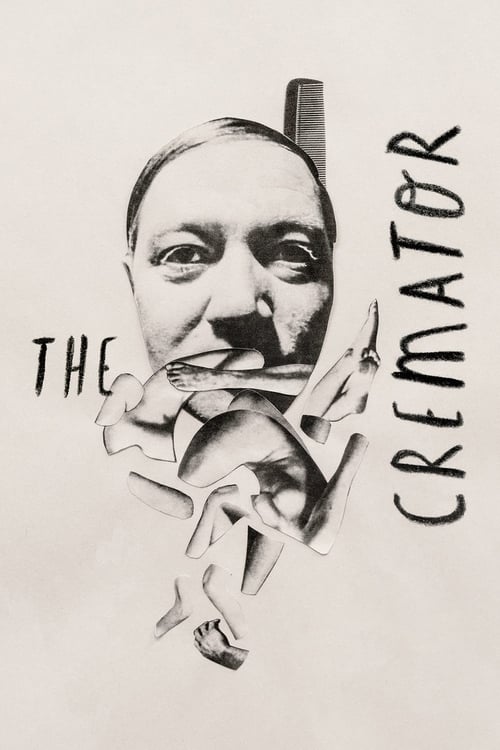
The Cremator
1969 · Juraj Herz
For when you want a horror film that gets under your skin through ideas rather than jump scares — a challenging, chew-on-it-for-days watch, not a comfort one. Perfect if you're drawn to villains who explain themselves too well.
What it's about
Prague, late 1930s. Karel Kopfrkingl runs a crematorium and genuinely believes his furnaces free souls from earthly suffering — he's a gentle family man, a connoisseur of music and fine funerals. As Nazi influence seeps into Czechoslovakia, that tidy philosophy begins to bend toward something monstrous, and the film watches a devoted husband and father talk himself, step by reasonable step, into the unthinkable.
The experience
Queasy and hypnotic — a black comedy that keeps purring pleasantly while the floor tilts under you. Fish-eye lenses and scenes that melt into each other make it feel like a nightmare narrated by its most polite resident; you laugh, then catch yourself.
Performances
Rudolf Hrušínský gives one of the screen's great monster performances — soft-spoken, unctuous, forever tending to the dead — chilling precisely because he never stops being courteous.
The craft
Juraj Herz, trained in puppetry, builds a hermetic visual nightmare: distorting wide lenses, predatory close-ups, and match cuts that dissolve one scene into the next as if reality were losing its seams. It's black-and-white filmmaking of unnerving precision, worth watching somewhere dark where the images can really work on you.
Why it matters
A landmark of Czech cinema made just as Soviet tanks ended the country's brief thaw, and now widely regarded as one of the most disturbing portraits of how ordinary people slide into fascism.
Karel Kopfrkingl, proprietor of a Prague crematorium, is a soft-spoken aesthete who believes his furnaces liberate souls from suffering — a conviction that curdles, with horrible logic, as Nazi influence seeps into late-1930s Czechoslovakia. Juraj Herz, a Slovak Holocaust survivor trained in puppetry alongside Jan Švankmajer, stood slightly apart from the Czechoslovak New Wave, and this adaptation of Ladislav Fuks's novel shows why: where his peers favored vérité looseness, Herz built a hermetic nightmare of fish-eye lenses, predatory close-ups, and match cuts that dissolve one scene into the next as if reality itself were losing its seams. Rudolf Hrušínský gives one of cinema's great monster performances — unctuous, purring, forever combing the hair of the dead — a portrait of how self-regard becomes complicity. Completed as Soviet tanks ended the Prague Spring, the film was soon shelved by the normalization regime, and Herz's career never fully recovered. Rediscovered decades later, it now sits among the essential horror films: a comedy of damnation played entirely straight.
A Deleuzian reading
He combs their hair.
The full Deleuzian reading of The Cremator →
Reception
A hit of the Czechoslovak film wave's dark fringe on release, it was banned for two decades under post-1968 'normalization' and largely invisible outside Czechoslovakia — then rediscovered via festival retrospectives, a Second Run DVD and a 2020 Criterion release, and now sits comfortably among the great European horror-adjacent films.
How The Cremator was received, from release to now →
Influences: the films it descends from and the films it influenced
- The Cabinet of Dr. Caligari (1920) — Establishes the horror grammar of externalizing a diseased mind through warped architectural space — Herz swaps Caligari's painted-flat distortions for lens distortion, but the principle (the frame itself is sick) is identical.
- M (1931) — The sympathetic-monster portrait built on a killer's soft-spoken self-justification; Kopfrkingl's serene, rationalizing monologue descends directly from Lang's letting the murderer plead his own interior case.
- Peeping Tom (1960) — Pioneers the predatory subjective camera fused to a gentle, professionally composed killer — the viewer implicated by looking through the murderer's own apparatus, exactly Herz's complicit gaze.
- Citizen Kane (1941) — Gregg Toland's wide-angle deep focus that bulges faces and stretches rooms is the optical vocabulary Herz's cinematographer Stanislav Milota pushes to its fish-eye extreme.
- Seconds (1966) — James Wong Howe's fish-eye and body-mounted distorting lenses turn ordinary faces monstrous — the immediate technical precursor to Milota's warped, looming predatory close-ups.
- Repulsion (1965) — The apartment-as-psychological-prison, tracking a mind's collapse via wide-angle facial distortion and swelling interior space — the hermetic-nightmare staging Herz adopts wholesale.
- Faust (1994) — Extends the tactile Czech surrealism Herz drew on (Švankmajer is a named influence) into the animate-grotesque, carrying forward the movement's object-fetish and match-cut morphology.
- Angst (1983) — Intensifies the killer's-eye technique — relentless body-rigged distorting camera welded to a murderer's confessional voiceover — the direct heir to Herz's predatory-POV-plus-monologue method.
- Eraserhead (1977) — Monochrome hermetic-domestic nightmare built from an oppressive soundscape and a passive man's slow horror — the monster-portrait staged as airless enclosed dread that Herz prefigures.
- Delicatessen (1991) — Grotesque black comedy of a genteel professional-turned-killer shot in caricaturing wide-angle — the tonal fusion of fastidious politeness and cannibal horror that Herz's cremator originates.
- The Lighthouse (2019) — A hermetic monochrome two-hander of madness, shot on wide/distorting vintage optics with a rising monologue delirium — the sealed-nightmare-plus-lens-distortion craft carried into contemporary horror.
- Morgiana (1972) — Herz's own earlier film establishes the wide-angle/fish-eye distortion, roving snorkel-lens glides through decor, and match-cut editing grammar he re-deploys in Morgiana.
- Beauty and the Beast (1979) — Herz's own precedent — the wide-angle grotesque subjective lens and the interior monologue that seats us inside a monstrous, self-justifying mind, carried forward into the Beast.
- Diamonds of the Night (1964) — Czechoslovak New Wave's subjective/hallucinatory montage rendering the Holocaust from inside a fracturing consciousness — the interior-terror editing register Herz shares.
- The Shop on Main Street (1965) — Makes the ordinary man's passive complicity in genocide the moral engine of the film — the exact theme Herz metabolizes into horror through Kopfrkingl.
- Daisies (1966) — The movement's collage editing and staccato match-cut rhythm wielded for absurdist black comedy — the same New Wave montage energy Herz channels into cremation-furnace cutting.
- Closely Watched Trains (1966) — Black comedy staged against the Occupation and adapted from a canonical Czech literary source — the tonal and source-material sibling to Herz's Fuks adaptation.
- Valerie and Her Week of Wonders (1970) — Surrealist literary adaptation (Nezval) governed by dream-logic and sensuous nightmare imagery — the same Czech surrealist adaptation stream Herz works in.
- A Report on the Party and the Guests (1966) — Allegory of eager conformity and self-recruited complicity under authoritarian pressure, staged in hermetic, closed-world tableaux — Herz's political subtext in a parallel key.
- Witchhammer (1970) — A Czech allegory in which an ordinary functionary's bureaucratic diligence becomes the instrument of mass murder, dramatizing the same banal machinery-of-terror through procedure.
- Ikarie XB 1 (1963) — Sibling via Liška's method — the composer's disorienting, processed and electronic sonorities used to unsettle rather than illustrate, the technique he pioneered scoring Ikarie.
- The Firemen's Ball (1967) — Same-movement political allegory-by-the-concrete: critique of complicity delivered through grotesque everyday ritual instead of slogan, trusting the audience to read the code.
Similar films
- The Cabinet of Dr. Caligari (1920) — influence & lineage
- Closely Watched Trains (1966) — influence & lineage
- The Third Part of the Night (1972) — same viewing thread · often watched together
- Valerie and Her Week of Wonders (1970) — influence & lineage · same viewing thread
- Witchhammer (1970) — same viewing thread
- Repulsion (1965) — influence & lineage · often watched together
- Nosferatu the Vampyre (1979) — often watched together
- The Hourglass Sanatorium (1973) — often watched together
All the films related to The Cremator →
Watch it with: curated runs of related films
- Fever-Dream Horror — Watch these when you want horror that runs on dream logic — witches, circuses, crematoria and occult dread rendered as hand-crafted, hallucinatory nightmare rather than jump-scare.