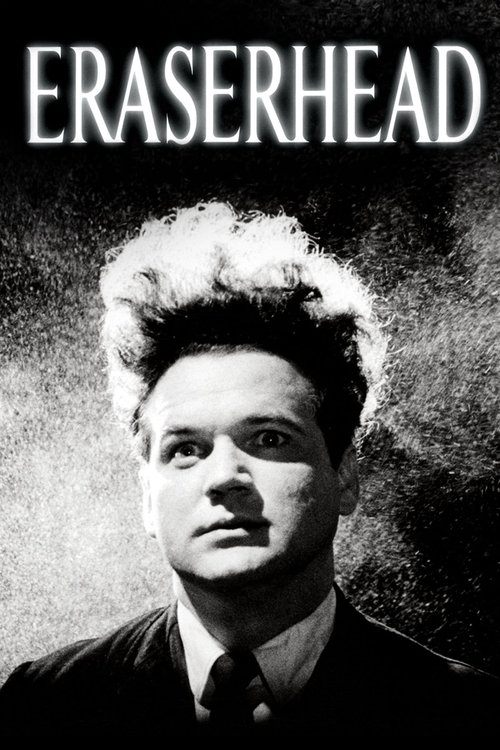
Eraserhead
1977 · David Lynch
His January 2025 death was a global grief event that revealed how central he'd become to young cinephile identity; "Fix your hearts or die" and the daily weather reports became memorial memes. The reference point for everything called "Lynchian."
For when you want to be genuinely unsettled rather than jump-scared — a midnight movie in the truest sense, best met alone, late, with the lights off. Firmly on the challenge end of the dial; not date-night material unless your date is a very particular person.
What it's about
In a blighted industrial nowhere of hissing pipes and gray light, a timid printer named Henry Spencer learns he's fathered a child — if the swaddled, mewling creature waiting in his one-room apartment can be called that. Left to care for it as his girlfriend frays and the walls close in, Henry drifts between waking dread and visions that make no promise of being dreams.
The experience
Less watched than endured: a black-and-white fever of industrial drone, clammy textures, and dream logic that bypasses your brain and goes straight for the nervous system. It's slow, hypnotic, frequently repulsive, and impossible to shake — nightmare anxiety about parenthood made physical.
Performances
Jack Nance's Henry — all vertical hair, frozen politeness, and mounting silent panic — is one of cult cinema's indelible faces; he barely speaks and you can't look away.
The craft
Shot in luminous black and white over roughly five years on almost no money, it's a triumph of handmade texture: grotesque practical effects nobody has fully explained, and an industrial soundscape of hums, hisses, and distant machinery that does as much work as the images. Good speakers or headphones are essential — the sound is half the film.
Why it matters
It launched David Lynch, defined the midnight-movie circuit, and became a foundational influence on generations of horror and art-film directors; its DNA is all over modern surreal and body-horror cinema.
Snapshot
David Lynch's debut feature is a black-and-white surrealist nightmare set in an unnamed industrial wasteland where a timid factory worker, Henry Spencer (Jack Nance), is left to care for a grotesque, perpetually screaming infant after his girlfriend abandons him. Conceived and executed almost entirely within Lynch's own obsessive interiority, the film operates through texture, sound, and dread rather than conventional story logic. At 89 minutes it is dense with implication and almost entirely free of conventional exposition. Shot intermittently over approximately five years on 35mm stock at the American Film Institute's facilities in Los Angeles, it entered distribution in 1977 as an object with no real precedent in American cinema and gradually became one of the most influential cult films ever made.
Industry & production
Lynch enrolled in the AFI's Center for Advanced Film Studies in Los Angeles in 1970 and received an initial institutional grant — reported in various accounts at around $10,000, though the precise figure has not been definitively established in the public record — to develop what became Eraserhead. Production began in earnest around 1971–72 and stretched across roughly five years of fitful, financially precarious work. Lynch lived on the AFI lot for a period of the shoot, reportedly occupying a stable or outbuilding on the grounds, an arrangement that intensified the film's hermetic, claustrophobic worldview.
Funding came in small and irregular tranches. Sissy Spacek and her husband, production designer Jack Fisk — who appears in the film in a small role — are among those credited with providing financial assistance during production's later phases, though the full accounting of the budget has never been made public by Lynch. The cumulative cost is generally estimated at somewhere between $100,000 and $120,000, with considerable uncertainty at both ends. When footage or equipment became unavailable, Lynch simply waited, sometimes for months, before resuming. The extended hiatus between shooting sessions became, paradoxically, one of the film's structural features: it was assembled not with a normal production rhythm but almost archaeologically, layer by layer.
The film premiered at the Los Angeles International Film Exposition (Filmex) in March 1977. Wider exposure came when distributor and exhibitor Ben Barenholtz, who had been central to establishing the midnight movie circuit through his programming at the Elgin Theatre in New York, booked the film into late-night weekend slots. Midnight screenings — the same circuit that had built audiences for Alejandro Jodorowsky's El Topo (1970) and John Waters's Pink Flamingos (1972) — gave Eraserhead a sustained run across American cities for several years.
Technology
The film was shot on 35mm black-and-white stock, a choice that placed it deliberately against the grain of 1970s color filmmaking. The high-contrast, heavily shadowed image Lynch and his cinematographers achieved pushed available-light and in-camera optical effects as far as the format allowed. The production had no special-effects budget to speak of; practical effects were built on set from materials Lynch sourced himself.
The central practical secret of the film — how the infant creature was constructed — Lynch has guarded for nearly fifty years and continues to refuse to discuss. Speculation has circulated widely and includes the use of an embalmed animal fetus, but Lynch has neither confirmed nor denied any specific account. Whatever its manufacture, the prop required careful lighting and handling to maintain its uncanny half-alive quality across months of intermittent shooting.
Sound recording was done under relatively primitive conditions, with the elaborate final soundtrack assembled entirely in post-production, often using gear that Lynch and sound designer Alan Splet built, modified, or improvised themselves.
Technique
Cinematography
Herbert Cardwell served as director of photography during the early phase of production; Frederick Elmes took over the role for later portions of the shoot and is the principal credited cinematographer. The visual grammar they developed with Lynch relies on extreme tonal contrast: figures are frequently silhouetted or half-dissolved in shadow, the industrial environment rendered in blacks so deep they threaten to consume the frame entirely. The camera moves infrequently and deliberately, favouring locked-off compositions and slow, dream-weighted pans or pushes. Close-ups on hands, faces, and textures — the pocked surface of the planet in the opening sequence, the membrane-like skin of the infant — give the film a tactile, almost clinical intimacy that makes its grotesque imagery more rather than less disturbing. There is no attempt at naturalistic lighting; every frame reads as constructed, as interior space made visible.
Editing
Lynch edited the film himself over the extended production period. The cutting is slow by any standard, with scenes permitted to run to lengths that exhaust narrative function and push into a purely durational unease. Transitions follow dream logic rather than causal sequence: spatial continuity is selectively maintained or abandoned without announcement. The editing does not resolve ambiguity so much as institutionalize it — sequences cannot always be placed in temporal relation to one another, and the question of what is "really" happening versus what is Henry's fantasy or projection is never answered because the film treats both registers as equally material.
Mise-en-scène / staging
The production design — realized largely by Lynch himself, with Fisk's assistance — constructs an environment drained of identifying markers of time or place. The industrial setting recalls mid-century American manufacturing zones, but nothing is locatable. Pipes, smoke, grime, and the geometry of institutional interiors dominate. Domestic spaces are made sinister by scale and disposition: the Spencer apartment is both cramped and somehow vast, its proportions subtly wrong. The "Lady in the Radiator" sequences — in which a round-cheeked woman (Laurel Near) performs on a small stage inside Henry's radiator, stamping on worm-like organisms that fall from above — represent the film's most theatrically concentrated staging, a pocket surrealist performance within the already surrealist frame. Lynch's staging throughout is governed by an unspoken spatial logic that keeps the viewer disoriented without ever feeling arbitrary; positions and distances carry psychic weight.
Sound
Alan Splet's sound design is arguably the film's most radical formal achievement. Working with Lynch from the mid-1970s onward in a close collaboration that would continue through several subsequent features, Splet built the film's soundscape from recordings of industrial machinery, doctored ambient noise, and layered synthetic textures that render the industrial environment as a permanent condition of the film's consciousness rather than as background. The sound mix is not naturalistic: hissing, rumbling, and mechanical drone pervade even interior and supposedly quiet scenes, establishing a baseline of dread that the occasional silences violate rather than relieve. The infant's cry — a sound Lynch and Splet worked to make as unbearable as possible — functions almost as a musical motif, its rhythm and pitch varying to register emotional pressure in the narrative.
The film contains one musical performance: Laurel Near singing "In Heaven (Everything Is Fine)," a song credited to Peter Ivers and Lynch. The song's gentle, almost childlike melody operates as an ironic counterweight to the surrounding horror, and has acquired a significant afterlife in Lynch's mythology.
Performance
Jack Nance's performance as Henry is a study in passive bewilderment executed at a level of physical commitment that its minimal dialogue obscures. Nance, who would go on to appear in numerous Lynch projects until his death in 1996, inhabits Henry's characteristic stillness without making it inert; his body reads as perpetually braced, perpetually failing to brace enough. Charlotte Stewart as Mary X, Jeanne Bates as the grotesque Mrs. X, and the supporting cast are directed in a mode somewhere between naturalistic and expressionistic — their performances carry the uncanny quality of people in a dream who are almost but not quite behaving credibly.
Narrative & dramatic mode
Eraserhead is structured as a waking nightmare rather than as a plot. A thin causal spine — Henry learns he has fathered a child, is pressured into a domestic arrangement he cannot manage, and is eventually undone by it — is present but functions primarily as scaffolding for the film's real work: the sustained materialization of anxiety. The film proceeds through accumulation and repetition rather than development. It has no climax in the conventional sense; it has, instead, an ending that feels like a transformation or dissolution rather than a resolution. Dialogue is sparse and often absurdist in register, closer to Beckett than to naturalistic film writing.
Genre & cycle
The film is most often categorized as surrealist horror or body horror, though neither label fully accounts for its tonal range, which includes dark comedy and a kind of alienated tenderness. Its emergence in 1977 places it within the first wave of explicitly graphic body-horror cinema — alongside early Cronenberg, notably Shivers (1975) and Rabid (1977) — though Lynch's approach to the body is more expressionistic than biological. As a midnight movie it formed part of a cycle that included El Topo, Pink Flamingos, The Rocky Horror Picture Show (1975), and Phantasm (1979), a loose circuit of transgressive, cult-oriented films that discovered audiences through late-night communal screenings rather than conventional theatrical runs.
Authorship & method
Lynch functions here as a near-total auteur: writer, director, production designer, editor, and co-architect of the sound design. The film's coherence — and it is, beneath its strangeness, rigorously coherent — derives from a single sensibility governing every formal decision. Alan Splet's contribution is substantial enough to constitute a genuine co-authorship of the film's sonic dimension; Lynch has consistently acknowledged the centrality of their collaboration. Frederick Elmes brought technical competence and considerable aesthetic sympathy to the cinematography, but accounts of the production suggest Lynch directed the image at a level of specificity that left relatively little interpretive latitude to his collaborators. Jack Nance's physical and temperamental fit with Henry Spencer was apparently evident from the earliest stages; Lynch cast him and, over the years of production, worked with him to sustain a character across discontinuous shooting conditions.
Movement / national cinema
Eraserhead belongs to American independent cinema of the post-Easy Rider era while remaining almost entirely outside that movement's dominant concerns — it has no interest in the countercultural road movie, the revisionist genre, or the social realism of early 1970s American film. Its more direct ancestors are in European modernist and surrealist cinema. As an AFI production it exists within an institutional framework of American arts patronage, but its sensibility is resolutely sui generis. It contributed to a loose formation of American artists — many of them working at the margins of genre — who were absorbing European surrealism and finding local, often industrial-American, inflections for it.
Era / period
The film is a product of the long 1970s American crisis — post-Vietnam, post-industrial, post-optimism — and carries that atmosphere in its landscape and emotional temperature even without addressing any of it directly. It anticipates the Reagan-era anxieties about family, body, and masculine inadequacy that would mark the body-horror cycle of the 1980s.
Themes
The film's central preoccupation is dread of parenthood and of bodily generation more broadly — the infant is the literal externalization of Henry's inability to inhabit adult responsibility. Industrial modernity appears not as critique but as environment: the factory, the pitted lunar landscape of the opening sequence, the radiator, and the apartment are all extensions of the same psychic territory, a world in which organic and mechanical life have exchanged properties. Sexuality is rendered as threat and contamination. The domestic space, conventionally a site of refuge, is here the primary location of horror. Lynch draws on his own stated terror of Philadelphia — where he lived during an earlier, formative period — to animate the film's sense that the city itself is a source of existential dread.
Reception, canon & influence
Initial critical response was mixed to indifferent, with reviewers uncertain how to place the film. Its reputation built slowly through the midnight circuit and through word-of-mouth among filmmakers. By the early 1980s it had acquired canonical status within cult cinema; Mel Brooks, whose production company Brooksfilms backed Lynch's next feature, The Elephant Man (1980), is among those who saw in Eraserhead a filmmaker of extraordinary and bankable originality. The story that Stanley Kubrick screened the film for cast and crew during the production of The Shining (1980) as a reference point for sustained atmospheric dread has circulated widely; it appears in multiple accounts but has not been confirmed by primary documentation, and should be treated as plausible but unverified.
The influences on Eraserhead are legible if not always directly acknowledged by Lynch. Luis Buñuel and Salvador Dalí's surrealist provocations — Un Chien Andalou (1929), L'Age d'Or (1930) — established the template for narrative rupture and bodily grotesque that Lynch extends into an American idiom. German Expressionist cinema (Murnau, Lang, Wiene) underlies the film's visual grammar of shadow and distorted space. Lynch has explicitly cited the paintings of Francis Bacon — their simultaneous beauty and horror, their dissolution of the human figure — as a formative influence on his visual sensibility. Franz Kafka's fiction is a persistent critical comparison, though Lynch has discussed it more as a parallel temperament than a direct source.
The film's forward influence has been enormous. Tim Burton has repeatedly named it as a formative work. Darren Aronofsky's Pi (1998) and the general aesthetic of low-budget American art horror in the 1990s and 2000s are unthinkable without it. The body-horror tradition — Cronenberg's maturation into Videodrome (1983) and The Fly (1986), the work of Stuart Gordon, the Italian extreme cinema of the period — shares its fascination with the body as site of transformation and disgust. Industrial music and post-punk visual culture absorbed its aesthetic directly; Nine Inch Nails's visual identity, among many others, is clearly downstream of Eraserhead's palette. The Criterion Collection's release has cemented its place in the canon of world cinema. It remains, nearly fifty years after its completion, a film that new viewers encounter as a shock: entirely itself, entirely unplaceable, and impossible to forget.
A Deleuzian reading
Henry opens the little door in his radiator the way you'd check an oven.
The full Deleuzian reading of Eraserhead →
Reception
Variety called it 'a sickening bad-taste exercise' in 1977, and it found its audience only through years of midnight screenings; now it's National Film Registry canon and the founding document of everything we call 'Lynchian'.
How Eraserhead was received, from release to now →
Influences: the films it descends from and the films it influenced
- The Cabinet of Dr. Caligari (1920) — Lynch's production design — an unnamed industrial environment that functions as pure psychological projection with no referential geography — directly inherits the Expressionist principle established here: the built set externalizes the protagonist's inner state rather than representing physical reality, and every architectural choice communicates pathology rather than place.
- Un Chien Andalou (1929) — Buñuel and Dalí established dream-logic editing as a complete formal method — spatial and temporal continuity abandoned without narrative justification, the cut as free-associative leap rather than causal link — which Lynch absorbed as the structural basis for Eraserhead's refusal to anchor sequences in chronological or causal relation to one another.
- The Blood of a Poet (1930) — Cocteau built a waking-dream film from hand-crafted in-camera optical effects and staging that renders the impossible as a material fact available to the camera; Lynch's approach to practical effects — constructing the infant creature through undisclosed physical means rather than optical post-production — follows this Cocteau precedent of materialist surrealism where the impossible must be literally present on set.
- Freaks (1932) — Browning used the spectacle of genuinely deformed human bodies as the primary generator of cinematic dread, establishing body horror as a mode grounded in biological rather than supernatural difference; Lynch's monstrous infant directly extends this strategy of making the exposed, uncontrollable biological body itself the irreducible source of horror.
- Meshes of the Afternoon (1943) — Deren developed locked-off compositional grammar and a cyclical nightmare structure in which the same spatial configuration is revisited with altered meaning — the foundational American avant-garde codification of the first-person waking-nightmare film whose staging and editing logic Eraserhead directly inherits.
- The Night of the Hunter (1955) — Stanley Cortez's cinematography here — silhouetted figures dissolving into deep blacks, illumination used to sculpt psychological dread rather than reveal narrative space — is the most direct precedent for the extreme tonal contrast Frederick Elmes and Lynch developed across Eraserhead's five-year shoot, where light is treated as a carving instrument on darkness rather than a source of visual information.
- Carnival of Souls (1962) — This micro-budget American horror built its dread almost entirely through industrial organ and layered ambient noise assembled in post-production rather than through scored music, and left the protagonist's subjective and objective reality permanently unresolved — the two specific strategies Eraserhead would push to their logical extreme in Splet's sound design and in Henry's unanswerable dream sequences.
- El Topo (1970) — Ben Barenholtz booked El Topo and Eraserhead into the same midnight-weekend circuit slots; beyond shared exhibition, both films deploy surrealist body imagery — dismemberment, grotesque physical spectacle — as the primary visual register rather than as punctuation within a realist narrative frame, establishing the midnight movie as a form that demanded total formal commitment.
- Pink Flamingos (1972) — Waters and Lynch shared the midnight movie circuit and a formal strategy of weaponizing transgressive physical spectacle — coprophagia here, the monstrous infant there — as confrontational gestures that defined the cult film as an object soliciting complicity in the viewer's own disturbed response, making audience discomfort the primary aesthetic experience rather than a side effect.
- Rosemary's Baby (1968) — Lynch adopts Polanski's structural device of the subjective rupture embedded in otherwise clinical realism — the apartment block, anxiety of impending parenthood rendered as horror — and extends the dream-sequence grammar into a sustained hypnagogic register that refuses to snap back to normalcy.
- Even Dwarfs Started Small (1971) — Lynch extends Even Dwarfs' diegetic mechanical drone into a sustained industrial soundscape — not score but ambient machinery maintained at threshold-of-endurance levels — while the grotesque ceremony in an institutional setting and the anti-narrative entropy that refuses catharsis continue the formal project Even Dwarfs established.
- The Trial (1962) — Builds the nightmare-parable on post-synchronized industrial sound and dream-continuous editing, the dislocating montage-plus-soundscape method Welles assembled from dubbing and found noise.
- Tetsuo: The Iron Man (1989) — Tsukamoto shot in high-contrast black-and-white and built his post-industrial body-horror — flesh literally merging with metal machinery — from the same cinematographic grammar Lynch and Elmes codified, while his layered industrial noise soundtrack extends Splet's principle that environmental sound should constitute the film's psychological register rather than accompany it.
- Begotten (1990) — Merhige extended Eraserhead's high-contrast black-and-white to near-abstraction by bleaching and re-photographing each frame of the negative, eliminating dialogue entirely, and constructing his soundtrack from elemental noise — a maximalist application of Lynch's principle that image texture and sound design can carry the weight that narrative and character cannot.
- Pi (1998) — Aronofsky shot on high-contrast black-and-white 16mm reversal stock and layered a paranoid industrial ambient soundscape from mechanical noise, directly citing Lynch's film as a formal reference for the waking-nightmare structure and for using the protagonist's accelerating physical deterioration as the primary dramatic arc in place of conventional plot.
- Under the Skin (2013) — Mica Levi's score functions as environmental dread rather than dramatic underscoring — the same Splet-derived logic of sound as atmosphere rather than commentary — while Johansson's locked-off, expressionistically still performance and the film's body-horror defamiliarization of human flesh descend directly from Eraserhead's staging and performance vocabulary.
- Rose of Nevada (2026) — Demonstrated post-built, heightened-artificial sound design — drones, room-tone and detached Foley — as the constitutive atmosphere of a monochrome film, the approach Jenkin's punishing soundtrack pursues.
- Being John Malkovich (1999) — Lynch's production methodology — building practical surrealist environments rather than compositing them, and using dense layered diegetic sound as a form of psychological compression — established the formal vocabulary BJM inherits for the portal's muffled, pressurized sound design and for K.K. Barrett's built-not-faked approach to impossible spaces.
- Mulholland Drive (2001) — Establishes Lynch's own industrial-subsonic sound design template — an omnipresent mechanical hum functioning as the film's unconscious — that Mulholland Drive's sound team inherits and recalibrates for Los Angeles, replacing factory noise with the city's electrical organism.
- The Elephant Man (1980) — Lynch's debut established the specific industrial ambient soundscape — layered hums, mechanical hiss, and diegetic drones functioning as psychological pressure — and the body-horror close-up grammar that The Elephant Man transplants into a studio period picture, proving the method could survive contact with Paramount distribution and an eight-Oscar campaign.
- Jacob's Ladder (1990) — Alan Splet's sound design — industrial hum and contaminated ambient noise treated as psychological environment rather than atmospheric background — and Frederick Elmes's desaturated high-contrast industrial palette together constitute the grammar of institutional alienation and sonic dread that Jacob's Ladder inherits wholesale.
- Blue Velvet (1986) — Alan Splet's layered subsonic industrial drone — developed across Eraserhead's five-year production — is carried forward directly into Blue Velvet's ambient sound bed, establishing the physical unease that persists beneath Lumberton's images of apparent tranquility.
- Barton Fink (1991) — Pioneers the continuous ambient/industrial sound-bed of dread and the sickly, decaying interior world that Skip Lievsay's mosquito-whine design and the Earle's atmosphere extend.
- Synecdoche, New York (2008) — Direct collaborator lineage: Frederick Elmes' deadpan-uncanny naturalistic photography, treating grotesque and surreal events with flat documentary calm, is the visual method he brings to Synecdoche.
- The Shining (1980) — Kubrick explicitly screened Eraserhead for his cast and crew as a tonal reference for the kind of dread he wanted; The Shining shares Lynch's use of durational slow cutting and ambient industrial sound design — the Overlook's mechanical hum, Wendy Carlos's sustained electronics — to generate unease through textural accumulation rather than through narrative event or jump-cut shock.
- Possession (1981) — Żuławski's film shares Eraserhead's expressionistic performance mode — actors calibrated between near-catatonic stillness and extreme physical convulsion — and its central structural move of externalizing psychological breakdown as a literal body-horror object that colonizes domestic space, making the apartment and the creature interchangeable as projections of the protagonist's dissolution.
- Rumble Fish (1983) — Deploys percussive industrial sound design — mechanical rhythm, ambient drone, non-musical noise — as direct psychological externalization of a disturbed male protagonist's inner state, working from identical logic to Stewart Copeland's score.
- The Tenant (1976) — Locates horror in domestic banality and oppressive sound design within a single squalid dwelling, the slow-burn dread-from-the-mundane aesthetic developing in parallel to Polanski's.
- Gozu (2003) — The template for flat-lit industrial banality sliding into bodily nightmare — Gozu borrows its deadpan dread, its grotesque births/lactations, and its refusal to mark where waking ends and dream begins.
- The Texas Chain Saw Massacre (1974) — Parallel use of continuous industrial noise-as-score and musique-concrète sound construction substituting for melodic music to build sustained unease.
- Mad God (2021) — Its near-wordless dread carried by an unbroken machine-drone soundscape and monochrome industrial gloom is the tonal template for Tippett's scored, dialogue-free horror.
Similar films
- The Cabinet of Dr. Caligari (1920) — influence & lineage · often watched together
- The Shining (1980) — influence & lineage · often watched together
- Possession (1981) — influence & lineage · same viewing thread · often watched together
- Pi (1998) — influence & lineage
- Mulholland Drive (2001) — same viewing thread · often watched together
- House (1977) — same viewing thread · often watched together
- Videodrome (1983) — often watched together
- Freaks (1932) — influence & lineage · often watched together
All the films related to Eraserhead →
Watch it with: curated runs of related films
- Doubles, Dreams, and Dissolving Selves — Watch these when you want the floor to give way — dream machines, hypnotists, doppelgängers, and haunted houses where perception and identity quietly come undone.