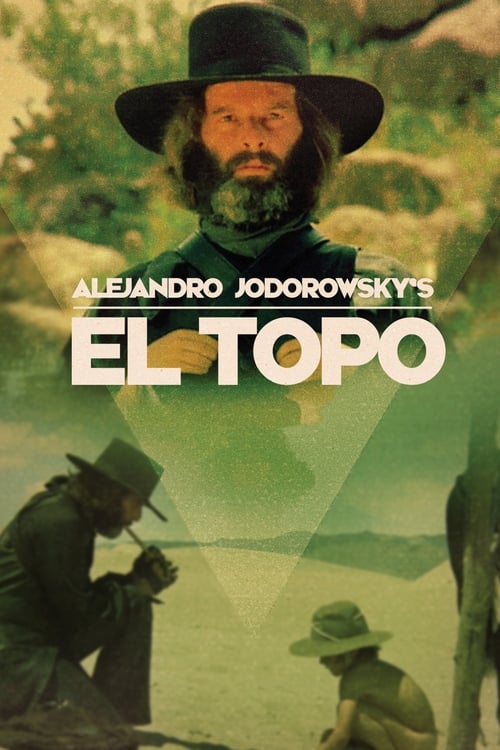
El Topo
1970 · Alejandro Jodorowsky
For when you want cinema as a mind-altering experience — a late-night deep end, not a casual watch. This is challenge viewing, and fair warning: it's graphically violent and genuinely strange.
What it's about
A black-clad gunfighter called El Topo rides into the desert with his young son and sets out to defeat four legendary Master gunmen in ritual single combat, each duel a test not just of skill but of spirit. What begins as a violent Western quest curdles and transforms into something else entirely — a hallucinatory pilgrimage through sin, ego, and the possibility of rebirth.
The experience
Overwhelming and deliberately disorienting: gorgeous desert imagery, shocking brutality, religious visions, and dream logic in place of plot. You don't follow it so much as submit to it — some viewers come out transfixed, others baffled, most a bit of both.
The craft
Jodorowsky conceived, wrote, directed, scored, and stars in it, taking the look of the spaghetti Western — lone gunman, sun-blasted sand, ritual duels — and exploding it into surreal allegory. Every frame is composed like a tarot card; the desert has rarely looked this mythic or this menacing.
Why it matters
It essentially invented the midnight-movie circuit, running for months to packed late-night crowds and counting John Lennon among its champions, and it made Jodorowsky a permanent icon of cult cinema.
Snapshot
El Topo ("The Mole") is the film that effectively invented the American midnight-movie circuit and announced Alejandro Jodorowsky as one of cinema's most provocative and idiosyncratic mythmakers. A Mexican production conceived, written, directed, scored, and starred in by Jodorowsky himself, it takes the visual grammar of the Italian "spaghetti" Western — the lone black-clad gunfighter, the sun-blasted desert, the ritualized duel — and detonates it from within, transforming the genre into a surreal allegory of spiritual seeking, ego death, and rebirth. Its first half follows El Topo, a leather-clad gunslinger who rides into the desert with his naked young son and, after a series of atrocities and a fateful seduction, sets out to defeat four Master gunfighters in symbolic single combat. Its second half, after a violent betrayal and a kind of death, finds a transformed El Topo living among a community of deformed cave-dwellers, laboring as a clown to free them, in a parable of penance and self-immolation. Saturated with Old Testament imagery, Zen koans, tarot symbolism, Buñuelian surrealism, and graphic violence and nudity, El Topo was a scandal and a sensation. Championed by John Lennon, it became a cult phenomenon at New York's Elgin Theatre and a foundational text of underground and countercultural film. The "acid Western" — Jonathan Rosenbaum's later coinage — has no purer or more influential example.
Industry & production
El Topo was produced in Mexico in 1970, outside the structures of both the Hollywood studio system and the official Mexican film industry, as a fiercely personal vehicle for Jodorowsky. He had already detonated his reputation with the surrealist provocation Fando y Lis (1968), whose screening at the Acapulco Film Festival reportedly provoked a riot and led to the film being banned in Mexico — a notoriety that shaped the conditions under which El Topo was made and received. The film was a low-budget independent enterprise shot on Mexican locations, drawing on Jodorowsky's background in avant-garde theater and the Panic Movement rather than on conventional industrial filmmaking craft.
The decisive event in the film's commercial life occurred not at production but at distribution. El Topo came to New York and was programd by exhibitor Ben Barenholtz at the Elgin Theatre in Greenwich Village, where, beginning in late 1970, it ran as a recurring late-night attraction. The midnight slot allowed a difficult, unrated, explicit art film to find its audience by word of mouth among the counterculture — establishing the very template of the "midnight movie" as an exhibition and marketing model. The film's fortunes were transformed when John Lennon and Yoko Ono saw it and became enthusiasts; Lennon's advocacy led Allen Klein, the Beatles' business manager and head of ABKCO Records, to acquire the film's rights and to finance Jodorowsky's far more lavish follow-up, The Holy Mountain (1973).
That same Klein relationship later froze El Topo out of circulation. A falling-out between Jodorowsky and Klein meant that ABKCO, holding the rights, kept both El Topo and The Holy Mountain largely unavailable for legitimate home release for decades; the films circulated for years chiefly as bootlegs. Only after a reconciliation did the films receive a restored theatrical reissue and DVD release through ABKCO in the mid-2000s, returning El Topo to legal availability after a long underground exile.
Technology
El Topo is, in technical terms, a modest 35mm color production with no claim to technological innovation; its astonishing imagery is achieved through staging, costume, makeup, and location rather than through optical or mechanical novelty. The film's power is essentially photochemical and theatrical — the rendering of vivid desert light, blood, sand, and elaborately grotesque tableaux on color film stock. What is striking is how much spectacle Jodorowsky extracts from limited means: massed bodies, real animals, practical effects, and the natural extremity of the Mexican desert landscape substitute entirely for any process or effects technology. The record offers no indication of unusual technical apparatus, and it would be invention to claim otherwise; the film belongs to a tradition of resourceful low-budget independent filmmaking in which imagination and physical staging do the work that money and machinery might elsewhere supply.
Technique
Cinematography
The cinematography is by Rafael Corkidi, a key collaborator of Jodorowsky's early period who also shot The Holy Mountain. Corkidi's camera renders the desert as a vast metaphysical stage — wide compositions that isolate El Topo and his son as tiny figures against immense emptiness, alternating with carefully arranged frontal tableaux that recall religious painting and the iconography of the tarot. The visual approach is frankly pictorial and emblematic: characters and objects are placed for symbolic legibility rather than naturalistic plausibility, and the framing repeatedly composes the image as a kind of living mural. Color is exploited for shock and signification — the black of El Topo's costume against bleached sand, sudden eruptions of red. The film's beauty is deliberately uneasy, yoking the grandeur of the Western landscape tradition to images of cruelty, deformity, and ecstatic suffering.
Editing
The editing organizes the film as a sequence of discrete symbolic episodes rather than a continuous causal narrative — most explicitly in the structured progression through the four Master gunfighters, each duel functioning as a self-contained parable. The cutting tends to favor the held tableau and the ritual gesture over conventional action coverage, so that even the gunfights register as ceremonial rather than kinetic. Documentation of the film's below-the-line craft credits is comparatively thin, and rather than attribute the editing to a specific hand without certainty, it is more accurate to describe its method: an episodic, almost liturgical structure that proceeds by accretion of meaning, with abrupt tonal shifts between violence, comedy, and contemplation that refuse the smoothing logic of classical continuity.
Mise-en-scène / staging
Staging is the heart of Jodorowsky's art, and El Topo is above all a film of tableaux. Drawing directly on his theatrical formation — mime, the Panic Movement, ritual performance — Jodorowsky composes the screen as a stage on which symbolic actions are enacted: the burial of the child's toy and photograph of his mother to mark the end of childhood; the massacres discovered in the desert; the elaborately conceived dwellings and rituals of the four Masters; the grotesque, pitiable community of the deformed in the cave. Real bodies, including performers with physical disabilities and dwarfism, are deployed in ways that are both confrontational and, in the film's own terms, compassionate, raising enduring ethical questions about representation that critics continue to debate. The mise-en-scène is dense with religious and esoteric iconography — crucifixions, baptisms, beehives, mirrors — assembled less for realism than for the cumulative weight of myth.
Sound
Jodorowsky composed the film's music himself, and the score is integral to its incantatory effect — by turns sparse and grandiose, drawing on a wide and eclectic palette to underline the film's ritual register; an ABKCO soundtrack release later gave the music an independent life. The dialogue is spare, aphoristic, and frequently delivered as paradox or koan, in keeping with the film's debt to Zen and to mystical traditions in which spiritual truth is conveyed obliquely. The overall sound design is in service of the film's hieratic tone, privileging the declarative line and the musical cue over naturalistic ambience.
Performance
Jodorowsky himself plays El Topo, dominating the film with a performance that is at once stylized and physically committed — the gunfighter's swagger giving way, after his death and rebirth, to the humility of the cave-dwelling penitent and clown. The performance is rooted in his mime training: gesture and bodily attitude carry as much meaning as speech. Crucially, the young son is played by his own son, Brontis Jodorowsky, then a small child, whose presence — including the film's notorious nudity in the opening passages — has been among its most discussed and controversial elements. The casting of family and of non-professional and physically distinctive performers throughout reflects Jodorowsky's conception of cinema as ritual rather than as conventional dramatic realism, and the acting style across the film is deliberately presentational, closer to sacred theater than to psychological naturalism.
Narrative & dramatic mode
El Topo's dramatic mode is allegory cast in the shell of the Western. It is structured as a two-part spiritual progress, recalling the bipartite form of religious narrative and the journey-toward-enlightenment of mystical tradition. The first movement is a quest of mastery and ego: El Topo, the supreme gunfighter, sets out — at the urging of a woman he has taken — to find and defeat the four Master gunfighters of the desert, each of whom embodies a different spiritual or philosophical stance. He wins each duel by trickery as much as skill, and his victories prove hollow; betrayed and shot, he undergoes a symbolic death. The second movement is one of penance and self-effacement: resurrected and tended by the deformed outcasts of the cave, the once-invincible killer becomes a clown and laborer who vows to dig a tunnel to free them, an act of redemptive sacrifice that ends in fresh catastrophe. The narrative proceeds not by psychological causation but by symbolic transformation, each episode operating as a parable; meaning is conveyed through emblem, paradox, and ritual rather than through conventional plot mechanics. It is melodrama and myth fused — a drama of the soul's death and rebirth told in the iconography of the gunfighter.
Genre & cycle
El Topo is the foundational example of what the critic Jonathan Rosenbaum would later name the "acid Western": a strain of countercultural filmmaking that took the conventions of the Western and refracted them through psychedelia, mysticism, and radical politics. Its immediate generic substrate is the Italian Western of Sergio Leone and his imitators — the laconic, near-mythic gunfighter, the operatic violence, the morally desolate landscape — which Jodorowsky absorbs and then estranges, replacing the genre's nihilism with esoteric spiritual content. It also participates in the broader late-1960s and early-1970s revisionist Western, the cycle in which American and international filmmakers were dismantling the genre's classical certainties. But El Topo belongs even more squarely to a different cycle: the underground and midnight-movie phenomenon it helped originate. As the inaugural midnight attraction at the Elgin, it opened the exhibition pathway later traveled by Pink Flamingos, The Rocky Horror Picture Show, Eraserhead, and Night of the Living Dead — the cult-film circuit that became one of the defining film cultures of the 1970s.
Authorship & method
El Topo is among the most total expressions of single authorship in cinema: Jodorowsky directed, wrote, scored, and starred in it, and its world is continuous with his work across other media — avant-garde theater, the Panic Movement he co-founded with the playwright Fernando Arrabal and the artist Roland Topor, mime (he had studied with Marcel Marceau), and later the landmark comics he created with the artist Mœbius. His method treats film as ritual and as a vehicle for spiritual transformation, both of the audience and, by his own account, of himself; the imagery is drawn from a personal synthesis of the Bible, Zen Buddhism, the tarot, alchemy, and Western and Eastern mysticism. The most important on-screen collaborator is his son Brontis, whose casting as the child binds the film's themes of fatherhood, inheritance, and the death of childhood to Jodorowsky's own life. Among technical collaborators, cinematographer Rafael Corkidi was central, translating Jodorowsky's theatrical tableaux into the film's startling pictorial language; the partnership continued on The Holy Mountain. Because the film is so thoroughly the product of one sensibility, its authorship questions are less about attribution than about the ethics and coherence of a vision that fuses the sacred and the transgressive — a vision that would prove remarkably consistent across Jodorowsky's subsequent career.
Movement / national cinema
El Topo occupies an unusual position in national-cinema terms. It is a Mexican film, made in Mexico in Spanish by a director long resident there, yet it stands largely apart from the mainstream traditions of Mexican cinema, belonging instead to an international avant-garde and countercultural current. Jodorowsky himself was a transnational figure — born in Chile to Ukrainian-Jewish émigré parents, formed artistically in Paris in the orbit of surrealism and the Panic Movement, and working in Mexico — and his cinema reflects that rootless, syncretic formation. The film is best understood as part of the worldwide ferment of late-1960s radical and underground filmmaking, kin to the international surrealist tradition (above all Luis Buñuel, himself a long-term resident of Mexico) and to the broader counterculture's appetite for spiritually and politically transgressive art. Its truest "movement" was the one it helped create on the exhibition side: the cult and midnight-movie culture of the American underground.
Era / period
El Topo is a quintessential artifact of the turn of the 1970s, the moment when the energies of the 1960s counterculture — psychedelia, Eastern spirituality, sexual frankness, anti-authoritarianism, and a fascination with extreme states of consciousness — were flowing into cinema. Its embrace of mysticism and ego-death, its drug-culture resonance (encoded in the very label "acid Western"), and its readiness to violate taboos around violence, nudity, and the body all locate it precisely in that countercultural moment. Its reception history is equally of the era: the John Lennon endorsement, the Allen Klein/ABKCO involvement, and the Elgin Theatre midnight runs together situate the film at the intersection of rock culture, the underground, and a New York avant-garde scene that treated transgressive cinema as a communal, ritual experience. The subsequent decades-long rights freeze, which turned the film into a bootlegged legend, is itself a period story about the precarious afterlife of independent and underground work.
Themes
The film's governing theme is spiritual transformation through the death of the ego. El Topo's trajectory — from invincible, prideful gunfighter to humbled penitent — enacts a passage from mastery to surrender, from killing to sacrifice, structured as a mystical rebirth. Around this orbit the film's other concerns. There is fatherhood and inheritance: the opening ritual in which the son must bury the totems of his childhood to become a man establishes a meditation on what fathers pass to sons and on the violence latent in that transmission. There is the critique of mastery itself: the four Master gunfighters embody philosophies of power and detachment that El Topo must defeat, learning that triumph by force is spiritually bankrupt. There is sacrifice and redemption, embodied in the second half's tunnel-digging penance among the outcasts, and the film's persistent, ambivalent engagement with Christian iconography of crucifixion and resurrection. There is the body as a site of both degradation and grace, in the film's confrontational use of deformity, nudity, and wounding. And running through all of it is a syncretic religiosity — Zen, the Bible, the tarot, alchemy — that treats the gunfighter myth as raw material for a parable of enlightenment, however blood-soaked the path to it.
Reception, canon & influence
On its underground emergence, El Topo provoked both fervent acclaim and revulsion — precisely the polarized response its transgressions courted. Embraced by the counterculture and amplified by John Lennon's advocacy, it became the original midnight-movie cult hit and a touchstone of underground film, even as its violence, its treatment of disabled and child performers, and its sheer strangeness drew condemnation. The subsequent rights dispute paradoxically deepened its mystique, sustaining its reputation through bootleg circulation until the mid-2000s restoration returned it to view and prompted critical reassessment. It is now firmly canonized as a landmark of cult and surrealist cinema and as the defining "acid Western."
Influences on the film run backward to several traditions: the Italian Western of Sergio Leone for its iconography; the surrealism of Luis Buñuel and the broader Surrealist movement for its dream-logic and anticlerical provocation; the avant-garde theater of the Panic Movement and Antonin Artaud's notion of a theater of cruelty and ritual; and the religious and esoteric sources — the Bible, Zen, the tarot, alchemy — that furnish its symbolic vocabulary. Jodorowsky's mime training under Marcel Marceau underlies its gestural style.
Its influence forward is broad and durable. Most immediately, it created the midnight-movie exhibition model that defined a whole stratum of 1970s film culture and made cult cinema commercially viable. It established Jodorowsky as a singular auteur and led directly to The Holy Mountain. Beyond cinema, the film became a touchstone for generations of musicians and filmmakers drawn to its imagery and its fusion of the sacred and the transgressive; Jodorowsky's wider influence on contemporary cult and art cinema, and on figures who cite him as a formative inspiration, is widely acknowledged, even where specific lines of debt are best stated with caution. As the progenitor of the acid Western and a model for how genre can be hollowed out and refilled with myth and metaphysics, El Topo retains a secure and unique place in the canon of countercultural and surrealist film.
A Deleuzian reading
A man on a black horse rides into white sand, a naked boy behind him in the saddle.
The full Deleuzian reading of El Topo →
Reception
It exploded as an underground word-of-mouth sensation at midnight screenings in New York in 1970–71, then spent decades nearly impossible to see legally thanks to a rights war between Jodorowsky and Allen Klein — which only made its legend grow until the 2007 restoration finally let people watch the thing everyone had been mythologizing.
How El Topo was received, from release to now →
Influences: the films it descends from and the films it influenced
- The Good, the Bad and the Ugly (1966) — El Topo lifts Leone's mythic gunslinger iconography and the ritualized standoff — the long approach, the held tableau before violence — then hollows the duel of its genre payoff and refills it with metaphysical trial.
- Django (1966) — Corbucci's grotesque spaghetti-western imagery of mutilation, mud, and sadistic spectacle supplies the catalog of bodily cruelty that El Topo recasts as Artaudian ritual rather than shock.
- L'Age d'Or (1930) — The Surrealist tactic of anticlerical blasphemy delivered through non-sequitur dream-logic editing — sacred objects profaned without narrative justification — is the editing grammar Jodorowsky inherits.
- Simon of the Desert (1965) — Buñuel's desert ascetic, his sainthood mocked and tempted in austere wide shots, models El Topo's structure of a holy seeker exposed as fraud across episodic spiritual stations.
- The Seventh Seal (1957) — Bergman's allegorical quest staged as a series of emblematic tableaux — the human figure set against the void to enact a reckoning with death — prefigures El Topo's episodic morality-play architecture.
- Fando y Lis (1968) — Jodorowsky's own first feature established his template: a pilgrimage across a desert peopled by grotesques, Panic-Movement provocation, and mime-rooted gesture, all carried directly into El Topo.
- The Holy Mountain (1973) — The direct sequel-in-method: cinematographer Rafael Corkidi again translates Jodorowsky's theatrical tableaux into startling symbolic-color compositions, extending the alchemical-tarot iconography and ritual-as-cinema project.
- Santa Sangre (1989) — Jodorowsky reprises his signatures — mime-based performance, family casting (his sons play the protagonist), and surreal symbolic color — now grafted onto giallo, proving the El Topo authorship-as-ritual model durable.
- Dead Man (1995) — Jarmusch perfects the acid western El Topo originated: an episodic westward pilgrimage toward death, the protagonist guided through spiritual stations by a mystic, the genre's iconography turned into a psychedelic death-journey.
- Eraserhead (1977) — El Topo invented the commercially viable midnight-movie exhibition slot Eraserhead rode to cult status, and shares its method of surreal, near-wordless tableaux where dread is built from symbolic image rather than plot.
- Valhalla Rising (2009) — Refn extends El Topo's near-silent mystic-warrior structure: a near-mute killer crosses an allegorical landscape in titled episodic chapters, violence punctuating a wordless spiritual ordeal scored for trance.
- A Field in England (2013) — Wheatley builds a hallucinatory quest explicitly out of alchemy and tarot symbolism, using stark tableau compositions and ritual transformation — the esoteric-vocabulary-as-structure that El Topo pioneered.
- Mandy (2018) — Cosmatos inherits El Topo's acid-western DNA — a revenge pilgrimage drenched in saturated symbolic color, cult-religious antagonists, and violence staged as ritualized, near-liturgical spectacle.
- The Mysterious Gaze of the Flamingo (2025) — Imports the Chilean-rooted acid-western — surreal allegory staged across arid desert vistas — that licenses Céspedes's blend of spaghetti-western landscape iconography with magical realism.
- Only God Forgives (2013) — The Western-as-spiritual-ordeal structure — in which the protagonist's ritual submission to a superior force is the narrative destination rather than the dramatic conflict, and violence is coded as sacrament rather than action — is the direct generic template for Julian's subordination to Chang; Refn has cited Jodorowsky explicitly as a foundational influence throughout his career.
- Dune: Part Two (2024) — The mystic-Western desert pilgrimage and messianic-violence iconography that fed Jodorowsky's unmade Dune, whose design lineage (Giger, Moebius, Foss) seeded the visual grammar Villeneuve's production design inherits.
- Endless Poetry (2016) — Establishes Jodorowsky's own frontal, procession-based tableau staging and ceremonial mise-en-scène that Endless Poetry inherits and softens through Doyle's camera.
- Antonio das Mortes (1969) — Rocha's mystical political western fuses messianic folk-religion, the lone gunman as redeemer, and frieze-like tableau staging in a contemporaneous Latin American reinvention of the western as myth.
- Teorema (1968) — Pasolini's parable of a sacred stranger who transforms everyone he touches shares El Topo's method of treating cinema as scripture — symbolic figures enacting a theology in stripped, allegorical scenes.
- Greaser's Palace (1972) — An almost simultaneous acid-western that drops a zoot-suited Christ into the frontier, matching El Topo's tactic of staging biblical allegory through absurdist desert vignettes and deadpan blasphemy.
- Zachariah (1971) — Marketed as the 'first electric western,' it shares El Topo's countercultural hollowing-out of the genre into a mystical coming-of-age quest where the gunfighter renounces the gun.
- Bring Me the Head of Alfredo Garcia (1974) — The grindhouse-meets-art-cinema fusion set in a surreal violent Mexican desert — sibling 'acid western' pushing exploitation extremity toward metaphysical pathos.
Similar films
- The Holy Mountain (1973) — influence & lineage · same viewing thread
- Santa Sangre (1989) — influence & lineage · often watched together
- Antonio das Mortes (1969) — influence & lineage
- The Good, the Bad and the Ugly (1966) — influence & lineage
- Mandy (2018) — influence & lineage
- Django (1966) — influence & lineage
- Theorem (1968) — influence & lineage · often watched together
- Entranced Earth (1967) — often watched together
All the films related to El Topo →
Watch it with: curated runs of related films
- Midnight Movie Provocations — Watch these when you want cinema at its most gorgeously deranged — cult objects that turn desire, violence, and pure anarchy into their own strange grace.