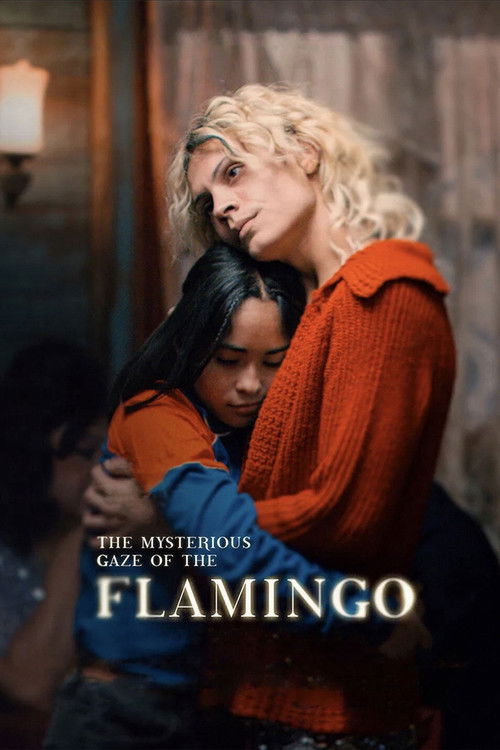
The Mysterious Gaze of the Flamingo
2025 · Diego Céspedes
For when you want a film to chew on for days — one that breaks your heart gently rather than loudly. More challenge than comfort, but full of love; reach for it when you're in the mood for something strange, humane, and unlike anything else on your list.
What it's about
In a copper-mining settlement deep in Chile's Atacama desert in 1982, a queer found family — trans women and the men who love them — lives on the fringe of a hostile company town. A young girl named Lidia has grown up in their care, and when a mysterious wasting illness begins to spread, local superstition takes root: the disease passes between two men through a single glance, at the moment they fall in love. As the town turns its blame on her family, Lidia sets out to learn whether the myth is real.
The experience
Tender and eerie at once — desert light, folklore, and dread braided together, seen through a child's eyes so the menace stays half-understood. It moves at a deliberate pace but holds you with warmth for its characters even as the world around them hardens.
The craft
Céspedes filters an epidemic story through myth and a child's perspective rather than headlines, which keeps the film intimate where it could have been grim. The remote Atacama setting does real work — vast, sun-bleached emptiness pressing in on one small, defiant household — and it rewards a big screen for that landscape alone.
Why it matters
The feature debut of Chilean writer-director Diego Céspedes, it premiered at Cannes 2025 in Un Certain Regard and took the section's top prize, instantly marking him as a major new voice in Latin American cinema.
Snapshot
The Mysterious Gaze of the Flamingo (Spanish: La misteriosa mirada del flamenco) is the feature debut of Chilean writer-director Diego Céspedes, a 107-minute drama that premiered in the Un Certain Regard section of the 78th Cannes Film Festival on 15 May 2025 and won that section's top prize. Set in a remote copper-mining settlement in the Atacama desert of northern Chile in 1982, the film watches a queer found family — trans women and the men who love them, living on the margins of a hostile company town — through the eyes of an eleven- or twelve-year-old girl, Lidia, raised among them. A mysterious wasting illness is spreading, and local superstition holds that it passes between two men through a single loving glance, transmitted at the moment they fall in love. As neighbors begin to blame Lidia's adoptive family for the contagion, she sets out to learn whether the myth is true. The film is plainly an allegory of the AIDS epidemic and of the social panic that surrounded it, but Céspedes refracts that history through magical realism, the spaghetti-Western landscape, and a coming-of-age structure rather than realist reportage. The result was one of the most acclaimed debuts of the 2025 festival year and Chile's submission for the Academy Awards' international feature category.
Industry & production
The film is a five-country European-Latin American co-production, assembled across Chile, France, Belgium, Spain, and Germany — a financing pattern now standard for ambitious Latin American art cinema, which routinely braids together national film funds, European co-production money, and festival-linked development support. The credited production and co-production companies include Quijote Films (the Chilean outfit run by Giancarlo Nasi, a prolific producer of festival-facing Chilean and Latin American work), France's Les Valseurs, Germany's Weydemann Bros., Spain's Irusoin, and Belgium's Wrong Men. This consortium is characteristic of how a first-time director from a smaller national industry reaches the Cannes Official Selection: the project is effectively pre-vetted by a chain of co-producers and funds before it shoots. North American distribution was taken by Altered Innocence, a distributor specializing in queer and coming-of-age art cinema, with a release rolled out in late 2025 and into early 2026 (Spain in January 2026, Chile in March 2026), positioning the film for the international awards and arthouse calendar following its Cannes win. The desert mining-town setting is not only thematic but economical — remote, low-cost locations that, as critics noted, the production exploited to make limited resources read as scale.
Technology
There is no indication that The Mysterious Gaze of the Flamingo is a technically experimental film at the level of capture format or post-production pipeline; the public record on its specific camera and lens packages is thin, and I will not invent those credits. What can be said with confidence is that it belongs to the contemporary regime of digital-cinema production: a mid-budget international co-production shot on location, where the "technology" of interest is less the apparatus than the disciplined use of natural desert light and saturated color grading. The film's stated visual ambition — a "pared-down but colorful" look that turns an arid, near-monochrome environment into something painterly — is achieved through controlled exposure of harsh high-altitude sunlight and a deliberately heightened palette in the grade, rather than through technical novelty. Its surreal conceit (a disease transmitted by the gaze) is handled dramaturgically and through performance and staging, not through visual-effects spectacle, which is itself a meaningful production choice: the supernatural is kept low-tech and bodily.
Technique
Cinematography
The film was photographed by Angello Faccini, and the cinematography is the most frequently praised craft element in early reception. Faccini and Céspedes lean into the iconography of the Western — the wide, dust-blown desert vistas, the isolated outpost, the human figure dwarfed by mineral emptiness — explicitly evoking the spaghetti Western's sun-scorched mise-en-scène. Against that "spaghetti-Western" expanse, the camera holds the queer community in pockets of vivid color: costume, makeup, and interior decor become chromatic resistance to the bleached landscape. The approach is economical by design, making picturesque, low-cost locations carry production value, while the controlled palette gives the magical-realist register a grounded, tactile surface so that the fantastical premise reads as folklore rather than fantasy.
Editing
The specific editing credit is not reliably established in the sources available to me, and I will not attribute it. The film's cutting strategy is, however, legible from its reception: it is built on a tonal modulation that critics singled out, opening in a comedic, folkloric, almost frivolous register and then turning abruptly tragic in the final act. The structure is anchored to Lidia's point of view, so the editing's central task is to braid the child's perspective — her partial understanding, her investigation of the myth — into the ensemble's collective experience of fear and loss, with the late shift in rhythm and weight retroactively recoloring the earlier lightness as elegy.
Mise-en-scène / staging
The world Céspedes stages is a community of trans women and sex workers and the miners who are their clients and lovers, a closed social ecology set apart from the company town that fears it. The staging foregrounds tenderness as a counter-grammar to the surrounding masculine aggression: scenes are repeatedly built around care, ornament, and performance within the family's domestic and quasi-cabaret spaces. The single most-cited set piece is a lip-sync — the character Flamenco performing a Latin ballad in full drag before a room of hardened miners — a sequence that condenses the film's thesis that spectacle, beauty, and chosen kinship can momentarily disarm hostility. The supernatural premise is staged intimately and corporeally: the "gaze" as vector of contagion turns looking, desire, and recognition into the film's charged physical acts.
Sound
The score is by the Uruguayan-French composer Florencia Di Concilio, and the music is unusually wide-ranging for a film of this scale, reportedly moving between jazz-inflected trumpet textures and songs carrying a Latin and Western feel. That stylistic breadth supports the film's genre hybridity, the trumpet and Western coloration reinforcing the desert-Western surface while the Latin balladry roots the emotional and performative scenes in the community's own cultural idiom. Diegetic music — above all the lip-sync performance — is integral rather than decorative, making song one of the film's primary languages of feeling and defiance.
Performance
The film rests on an ensemble of largely Chilean actors. Tamara Cortés plays Lidia, the child through whom the story is focalized, and the film depends on her watchfulness — the audience learns the rules of this world at the pace she does. Matías Catalán plays Flamenco, a trans mother figure whose declining health forms the emotional spine of the narrative, and Paula Dinamarca plays the matriarch Mama Boa, with further roles taken by Pedro Muñoz, Luis Dubó, Claudia Cabezas and others. Reviewers credited the performances — and the community's collective response of "tenderness" rather than recrimination — with grounding the surreal premise in genuine emotional stakes and delivering the late-act tragic turn with real force.
Narrative & dramatic mode
The dramatic mode is a coming-of-age fable crossed with allegory. Its engine is a child's investigation: Lidia wants to know whether the myth — that the disease passes between men through a loving glance — is literally true, and that quest organizes the plot as a kind of folkloric detective story. But the film withholds the consolations of realism. By rendering the epidemic as a curse of the gaze, Céspedes converts the historical AIDS crisis into legend, so that the "truth" Lidia seeks is less epidemiological than moral: what fear does to a community, who gets blamed, and what love costs. The mode is therefore allegorical and mythic on the surface and intimate underneath, and the much-discussed tonal pivot — from folkloric comedy to tragedy — is itself the dramatic argument: the film lets us mistake the world for whimsy before it makes us grieve.
Genre & cycle
Generically the film is a hybrid: queer drama, coming-of-age story, magical realism, and Western all at once. It sits within a contemporary cycle of Latin American art films that use genre frames and the fantastic to address political and historical trauma — the lineage of magical realism reimagined for cinema, and a regional vein of queer and trans storytelling that has gained festival prominence over the past decade. Its desert-Western surface aligns it with films that repurpose the Western's mythic American landscape for postcolonial or marginal subjects. Within the specific cycle of AIDS-crisis cinema, it is a notably oblique entry: where many films in that tradition are realist memorials, this one is allegory and folklore, closer in spirit to a parable than to testimony.
Authorship & method
Céspedes is both writer and director, and the film is a debut feature that arrived with the imprimatur of Cannes — he had previously been associated with the festival's short-film and emerging-talent ecosystem, the path by which many Latin American auteurs reach the Official Selection, though I will not overstate biographical specifics that the public record does not firmly support. His method, as evidenced on screen, is to fuse a strong conceptual premise (contagion by gaze) with location-rooted realism about a specific Chilean place, period, and marginalized community. His key collaborators are central to that method: cinematographer Angello Faccini, whose color-against-desert imagery defines the film's look; composer Florencia Di Concilio, whose genre-spanning score carries its emotional and performative register; and an ensemble of Chilean performers led by Tamara Cortés, Matías Catalán, and Paula Dinamarca. The editor and other below-the-line authors are not reliably documented in the sources available to me, and I decline to attribute them rather than guess.
Movement / national cinema
The film belongs to the ongoing renaissance of Chilean cinema, the wave that has made Chile one of Latin America's most internationally visible film cultures in the twenty-first century — a context shaped by producers like Quijote Films and by a generation of directors working in documentary, memory cinema, and increasingly genre-inflected art film. It also exemplifies the now-dominant model of the pan-European/Latin American co-production, in which Chilean authorship is realized through French, German, Belgian, and Spanish financing. Within Chilean cinema specifically, it joins a strand preoccupied with historical memory and with bodies excluded from official national narratives, here transposed to the early-1980s desert and to a trans and queer community during the dictatorship era — a political subtext the film holds quietly beneath its fable.
Era / period
The film is set in 1982, at the early edge of global awareness of AIDS and within the Pinochet dictatorship, though the regime is not the explicit subject. That dating is essential: it places the story at the historical moment when the disease was genuinely "mysterious," its transmission poorly understood and freely mythologized, which is precisely the social condition the film literalizes through the legend of the gaze. The period setting also lets the desert mining economy and its rigid masculinity stand for an entire social order against which the queer family defines itself. As a 2025 production, the film looks back on that moment from four decades' distance, framing it as recovered history and folk memory rather than current events.
Themes
Its core themes are queer resistance, found family, and the triumph — or at least the moral priority — of empathy over fear. The myth of contagion-by-love makes desire itself the thing the community fears and punishes, so the film is centrally about how societies convert love among the marginalized into a threat, and how scapegoating follows. Against that, it sets tenderness, chosen kinship, and the protective labor of raising a child within a stigmatized community. Looking, gazing, and recognition run through the film as both danger and intimacy — the same act that supposedly spreads the disease is also the act of being truly seen. And as a coming-of-age story, it is about a child's acquisition of knowledge: the loss of innocence not through a single event but through learning what cruelty and mortality mean.
Reception, canon & influence
Critical reception was strongly positive. The film won the Un Certain Regard top prize at Cannes 2025, the clearest institutional endorsement available to a debut outside the main competition, and it accumulated high aggregate scores (reported around 95% on Rotten Tomatoes and in the high-70s on Metacritic, in the "generally favorable" band). Reviewers praised Faccini's cinematography, the ensemble's emotional conviction, and the audacity of the central conceit, while some — including The Hollywood Reporter's Jordan Mintzer — cautioned that the film occasionally "goes overboard on the surrealism," even as they granted that it lands a genuine emotional blow through Lidia's reckoning with the epidemic. Backward, its influences are legible: magical realism as a regional literary and cinematic inheritance; the spaghetti Western's landscape iconography; the broader tradition of AIDS-crisis art cinema; and the festival-driven Chilean New Wave that prepared its path. Forward, its legacy is necessarily still forming. As a Cannes-laurelled, internationally distributed debut and Chile's Oscar submission, it raises Céspedes's profile considerably and adds momentum to a cycle of trans- and queer-centered Latin American festival cinema; whether it becomes a durable reference point or a celebrated one-off cannot yet be judged, and it would be premature to claim a settled influence. What can be said is that it arrived as one of 2025's signal debuts and entered the conversation about how the fantastic can carry political and historical grief.
A Deleuzian reading
A look passes between two men, and that look is the disease.
The full Deleuzian reading of The Mysterious Gaze of the Flamingo →
Reception
Came out of nowhere at Cannes 2025 — a debut feature that took Un Certain Regard's top prize — and has spent the year since climbing: rave reviews (95% on Rotten Tomatoes), Chile's official Oscar entry, and a MUBI release turning festival buzz into a genuine audience.
How The Mysterious Gaze of the Flamingo was received, from release to now →
How to watch The Mysterious Gaze of the Flamingo: what to notice on a first viewing
- Watch bright costume colors against the bleached desert. The queer community's clothes, makeup, and rooms hold saturated color while the surrounding landscape stays sun-bleached and dusty. The color itself marks out a chosen world standing apart from the hostile company town around it.
- Notice you're seeing events at a child's height and pace. The story stays anchored to Lidia's point of view, so you learn the rules of this world exactly as fast as she does. You watch and wait alongside her rather than getting ahead of what she herself can piece together.
- Watch how a held gaze functions like a held breath. Close shots linger on eyes and faces at the instant of recognition or desire, treating a look as a loaded, almost dangerous event. A glance here carries the weight a whole scene of dialogue would carry in another kind of film.
- Listen for trumpet and Latin balladry sharing the same score. The music moves between Western-tinged instrumental textures and songs rooted in the community's own culture, especially during performance scenes. The score's range mirrors the film's own mix of desert myth and a lived, specific community.
The whole guide to watching The Mysterious Gaze of the Flamingo, with the keys for a rewatch →
Influences: the films it descends from and the films it influenced
- The Spirit of the Beehive (1973) — Establishes the template of focalizing a fascist-dictatorship allegory through a child's uncomprehending gaze at a 'monster,' the exact narrative engine Céspedes adopts for the contagious-gaze conceit under Pinochet.
- Cría Cuervos (1976) — Filters political dread and mortality through a watchful child whose interiority reorganizes adult reality, the child-POV focalization Céspedes uses to make epidemic grief legible.
- El lugar sin límites (1978) — Pioneers the rural-brothel drag performer as a figure of defiant lip-sync spectacle and locus of communal violence, the staging logic behind the film's cabaret-drag numbers and found-family house.
- El Topo (1970) — Imports the Chilean-rooted acid-western — surreal allegory staged across arid desert vistas — that licenses Céspedes's blend of spaghetti-western landscape iconography with magical realism.
- Once Upon a Time in the West (1968) — Supplies the spaghetti-western grammar of monumental desert widescreen vistas and the loaded held close-up on the eyes that Faccini's cinematography reworks into 'the gaze as contagion.'
- Eréndira (1983) — Adapts García Márquez's magical realism into a desert-set tale of a marginalized adolescent and a coercive matriarchal household, the regional literary-cinematic inheritance Céspedes draws on directly.
- Cabaret (1972) — Models the diegetic cabaret stage as ironic commentary on encroaching authoritarian terror, the tonal-modulation device that lets the drag numbers carry the political register of 1982.
- Blue (1993) — Defines AIDS-crisis art cinema's use of saturated monochrome color as the embodied texture of illness and loss, an antecedent for the saturated grading tied to the film's epidemic reckoning.
- Pan's Labyrinth (2006) — Shares the method of letting a child's fantastical vision carry the historical grief of a fascist regime, fusing allegory and the fantastic to political testimony exactly as Céspedes does.
- A Fantastic Woman (2017) — Extends the Chilean New Wave's festival-driven, internationally co-produced trans-centered cinema, building the marginalized-community realism and ensemble register Céspedes inherits.
- Tangerine (2015) — Advances the found-family ensemble of trans and queer outsiders as the film's emotional core, the same kinship-staging principle organizing Céspedes's household.
- 120 BPM (Beats per Minute) (2017) — Carries AIDS-crisis cinema forward by binding collective queer mourning to a genre-spanning, performance-driven score and bodily spectacle, paralleling Di Concilio's scoring of grief.
- La Llorona (2019) — Deploys Latin American magical realism as the vehicle for reckoning with a dictatorship's historical crimes, the precise 'fantastic carrying political grief' move Céspedes makes.
- Beasts of the Southern Wild (2012) — Anchors magical realism in a marginalized community seen through a child's mythologizing eyes, the child-POV-plus-fantastic synthesis the seed shares.
- Embrace of the Serpent (2015) — Represents the contemporary Colombian/Latin American art-cinema lineage of Céspedes's cinematographer Angello Faccini, foregrounding landscape-as-character imagery in a pan-Latin-American co-production frame.
- Tony Manero (2008) — Codifies the Chilean New Cinema strategy of refracting the Pinochet dictatorship through performance, pop-cultural spectacle, and allegory rather than direct depiction, the festival path Céspedes follows.
Similar films
- 20,000 Species of Bees (2023) — same viewing thread
- Sound of Falling (2025) — same viewing thread
- The Little Sister (2025) — same viewing thread
- The Currents (2025) — shared sensibility
- Birds of Passage (2018) — shared sensibility
- The Metamorphosis of Birds (2021) — shared sensibility
- Romería (2025) — shared sensibility
- Deaf (2025) — shared sensibility
All the films related to The Mysterious Gaze of the Flamingo →
Watch it with: curated runs of related films
- What the Mothers Left — A run of daughters and young women — grieving lost mothers, wary of surrogate ones, unearthing the family's secrets — where a house or a legacy keeps shaping who a girl becomes.