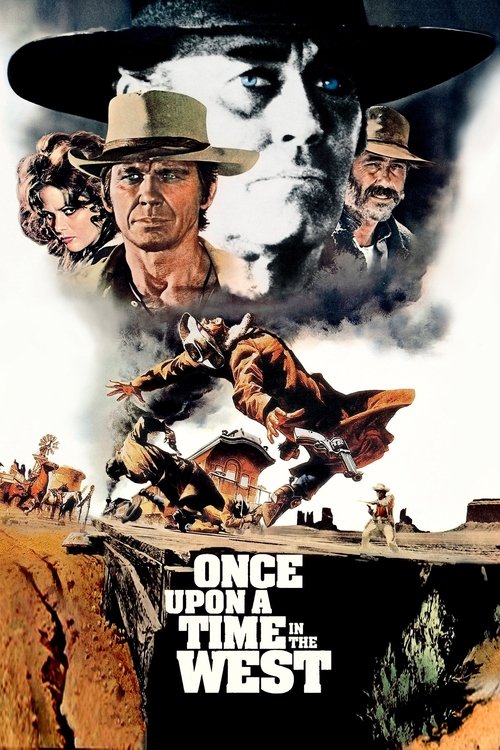
Once Upon a Time in the West
1968 · Sergio Leone
For a night when you want to surrender to something grand and unhurried — an epic to sink into rather than snack on. This is a challenge-and-reward film: give it your full attention and a dark room, and it repays you tenfold.
What it's about
As the railroad pushes west through the Arizona desert, a widow named Jill arrives in the frontier town of Flagstone to start a new life — and finds herself at the center of a land grab worth killing for. Around her circle three dangerous men: a nameless drifter who announces himself with a harmonica, a wanted outlaw with a rough code of honor, and a railroad baron's ice-cold hired gun. Their paths tighten around one patch of desert as the old West gives way to money and machines.
The experience
Slow-burning and operatic — Leone stretches silences until they ache, then detonates them. It's less a shoot-'em-up than a funeral march with gunfights, and the nearly three hours feel earned; you settle into its rhythm the way you settle into a great piece of music.
Performances
Henry Fonda, Hollywood's eternal good guy, is chilling cast against type as the killer Frank — those famous blue eyes turned reptilian. Claudia Cardinale gives the film its heart and moral weight, while Charles Bronson's near-silent harmonica man and Jason Robards's scruffy outlaw round out a perfectly balanced quartet.
The craft
Ennio Morricone's score — written before shooting, with a musical theme for each main character — is one of the most famous in movie history, and Leone directs to it like a conductor. Vast desert widescreen slams against extreme close-ups of eyes and hands; the opening sequence builds almost entirely from creaks, drips, and a buzzing fly. Absolutely demands the biggest screen and best speakers you can find.
Why it matters
Widely considered the crowning achievement of the spaghetti Western and one of the most influential Westerns ever made — its patient, mythic style echoes through decades of crime films and revisionist Westerns that followed.
Snapshot
Once Upon a Time in the West stands as the fullest expression of Sergio Leone's operatic ambition and the apex of the Spaghetti Western as a form. Where the Dollars Trilogy had deconstructed the Hollywood Western with irreverence and violence, this film mourns it — a two-and-three-quarter-hour elegy for a mythological America that never existed, filmed almost entirely by Italians on Spanish and American soil. Four figures — a mysterious harmonica player, a fugitive bandit, a railroad baron's hired killer, and a recently widowed woman — converge on a small Arizona town as the railroad drives westward, and Leone uses their collision to stage nothing less than the birth of American capitalism over the bones of the old frontier. It is among the most formally deliberate films in world cinema.
Industry & production
By the late 1960s, Leone had transformed from a mid-tier Italian genre director into an international phenomenon. The Man with No Name films — made cheaply in Spain with Clint Eastwood on loan — had grossed spectacularly worldwide and created a new template for the Western. Paramount Pictures, recognizing both the commercial and artistic potential, offered Leone a substantial Hollywood budget and access to major American stars for the first time.
The genesis of the project was collaborative and film-historical in method. Leone enlisted two young cinephiles — Bernardo Bertolucci and Dario Argento, both on the verge of their own directorial careers — to help construct the story by immersing themselves in Western cinema. Together the three watched hundreds of films, cataloging motifs, figures, and situations, then built a treatment that was, in part, a deliberate synthesis and transfiguration of the genre's iconographic archive. The screenplay was then shaped in collaboration with Sergio Donati, who brought the structural and dialogue elements into a filmable form.
Casting was as conceptually charged as the script. For the villain Frank, Leone sought Henry Fonda — an actor whose entire persona was built on the Lincoln Memorial face, the decent lawman, the righteous frontier hero. Leone wanted to exploit that image brutally: Frank enters the film killing a child. Fonda accepted and had his contact lenses removed to let his distinctive blue eyes register fully. Charles Bronson — not Leone's first or only choice for the harmonica player, after negotiations with other actors fell through — brought to the role a stillness and physical weight that proved exactly right. Claudia Cardinale anchored the film's moral and narrative center as Jill McBain, and Jason Robards played the bandit Cheyenne with a wry, lived-in authority.
The production shot in two main locations: the dramatically arid landscape around Almería in southern Spain, which had served the Dollars films; and Monument Valley, Utah — Ford country, chosen deliberately. For Leone to plant his camera in the same red rock formations where John Ford had built the mythological West was a deliberate act of succession and commentary.
Technology
Once Upon a Time in the West was photographed in a standard anamorphic widescreen format at an aspect ratio of 2.35:1, a shift from the Techniscope two-perf process Leone had used on the Dollars films. The change expanded the image's visual luxury — richer grain, more tonal range — appropriate for what was, by Leone's standards, a prestige production. Ennio Morricone composed the film's score before principal photography began, a working method Leone had developed across the Dollars Trilogy and refined here into a fully systematic practice: music was played on set during filming, shaping performances and rhythms in real time rather than being added in post-production.
Technique
Cinematography
Tonino Delli Colli, replacing Massimo Dallamano who had shot the earlier trilogy, brought a more painterly, controlled sensibility to the image. Leone's signature optical extremity reaches its fullest development here: extreme telephoto lenses flatten space and draw distant figures into the same plane as close foreground elements, compressing landscape into abstraction; extreme wide-angle lenses, pressed close to faces, distort and amplify, turning the human face into a landscape in its own right. The film's grammar is built on the productive tension between these two modes. The Almería desert and Monument Valley are rendered with a grandeur that is simultaneously documentary and mythological — the camera clearly loves the light, the scale, the geological violence of these places. The opening sequence, in which three gunmen wait at a rail depot for an arriving train, is a masterclass in how to build menace from ordinary sensory information: a fly crawling on a cheek, water dripping on a hat, a windmill's creaking rhythm.
Editing
Nino Baragli had edited Leone's earlier Westerns and developed with him a cutting style that treats time as plastic material. The rhythmic logic of OUATITW's editing is operatic rather than classical: scenes expand far beyond narrative necessity to accumulate emotional pressure, then release through sudden, violent compression. The juxtaposition of extreme close-up and extreme wide shot is an editing principle as much as a photographic one — Baragli's cuts between eyes and horizons, between a trigger finger and a face registering recognition, become the film's primary expressive instrument. The extended opening sequence (approximately twelve minutes before the credits) contains virtually no exposition and almost no dialogue; it earns its duration through the sheer accumulation of charged detail.
Mise-en-scène / staging
Leone choreographs space with a theatrical formalism closer to opera or ballet than to classical Hollywood naturalism. Bodies in frame are held in precisely calculated relationships; movement across the widescreen rectangle is deliberate and meaningful. The standoff is his central theatrical unit — figures at distance, closing incrementally, faces filling the frame — and he elongates and ritualizes it to the point of abstraction. The decision to film in Monument Valley carries specific mise-en-scène weight: by staging his Italian Western in Ford's sacred geography, Leone literalizes the film's argument that the myth of the American West is a construction, available for dismantling and reimagining.
Sound
The film's sound design is inseparable from Morricone's score, and from Leone's systematic practice of building the soundtrack as a pre-existing emotional landscape into which the actors moved. Individual instruments are assigned to individual characters — the harmonica to Bronson's figure, a woman's voice for Cardinale, a guitar motif for Robards — creating a leitmotif structure more typical of Wagner than of Hollywood genre cinema. In the opening sequence, diegetic sound is amplified and foregrounded: the creak of wood, the grinding of the windmill, ambient silence broken by small events. This hyperattentiveness to environmental sound, as a carrier of tension and meaning, prefigures later developments in sound design and has been widely noted as a distinct contribution to cinema's sonic vocabulary.
Performance
Leone's direction of actors is slow and physiognomic — he is interested in faces and bodies as much as in behavior. Fonda plays Frank with a cheerful ease that is far more disturbing than conventional menace; the coldness is in the lightness, and Fonda understood that. Bronson's performance is structured around minimal expression and maximum physical presence — the harmonica becomes a prosthetic extension of his psychic wound. Cardinale brings a naturalistic warmth that grounds the film's more mythological registers. Robards' Cheyenne is the film's most accessible figure, loquacious and ironic, and Robards plays him with a comfortable authority that makes his eventual fate genuinely affecting.
Narrative & dramatic mode
The film operates in an interlocking, multi-strand narrative mode that converges structurally on the town of Sweetwater and thematically on the question of historical succession. The mystery at its center — who is the harmonica player and what is his relationship to Frank — is withheld until a climactic flashback that reframes all preceding events. This delayed revelation is not a thriller device but an emotional one: the film makes you wait for understanding as the character has waited for revenge, and when the memory surfaces it arrives with the force of a repressed trauma finally named. The dramatic mode is consistently operatic — Leone is uninterested in naturalistic psychology and entirely interested in archetypal function, mythological weight, and the staging of feeling at the largest possible scale.
Genre & cycle
OUATITW belongs to the Spaghetti Western cycle that Leone himself had largely created, and simultaneously represents the cycle's critical self-consciousness. Where the Dollars films had energy and irreverence, this film has gravity and elegy. It knows it is at the end of something: the frontier is closing, the railroad is the future, and the men who live by the gun have no place in the order being built. The film is also a compendium and critique of the American Western as genre — the opening sequence quotes and hyperbolizes countless Western conventions, including direct visual references to films Leone and his collaborators had studied, while the casting of Fonda against type is a deliberate destruction of one of the genre's most durable hero-images.
Authorship & method
Leone is the film's dominant authorial intelligence, but his practice is fundamentally collaborative. Bertolucci and Argento's research-driven story construction shaped the film's genetic material. Morricone's scores — composed first, performed on set, shaped during editing — are not accompaniment but constitutive elements of the film's structure; it is not possible to separate the image from the music in the way that more conventionally scored films allow. Delli Colli's photography realized Leone's optical and tonal concepts with a richness the earlier films had not achieved. Nino Baragli's editing built the temporal architecture that makes Leone's extended sequences bearable and then devastating. Sergio Donati's screenplay gave the mythological structure a workable dramatic form.
Movement / national cinema
The film is Italian in financing, creative personnel, and sensibility; it is American in subject matter, iconography, and several of its stars. This productive contradiction — an Italian's meditation on American mythology, shot largely in Spain — is not incidental to the Spaghetti Western as a form but constitutive of it. The outsider's distance enabled a freedom from the genre's own ideological investments that American directors of the period rarely achieved. The film belongs to the broader international art cinema moment of the late 1960s while remaining fully committed to popular genre form — a combination that characterizes Leone's achievement more broadly.
Era / period
Made and released in 1968, the film arrives at a historically overdetermined moment: the Western as a dominant American cultural form was in crisis, challenged by the revisionism of directors like Arthur Penn (Bonnie and Clyde, 1967) and Sam Peckinpah, by the cultural upheavals of the late 1960s, and by the Spaghetti Western cycle's success in demonstrating that the genre's mythology was portable and transformable. Leone's film both participates in and transcends this moment — its concerns with historical transition, the violence underlying American capitalism, and the obsolescence of the frontier hero have not dated with their era.
Themes
The film's central thematic concern is historical supersession: the replacement of one order by another, and the violence that transition requires. The railroad is not an antagonist but a force of history; the real antagonist is the specific human brutality — embodied in Frank — that capital requires to clear the land. Jill, the woman from New Orleans who arrives as the old West is dying, is the film's future-figure: she will outlast all the gunmen and oversee the building of Sweetwater as a station on the transcontinental line. The film understands the birth of American modernity as inseparable from the dispossession and killing that preceded it.
Time itself is a thematic obsession. The film is permeated by the sense of a world running out of time, by the elongated temporality of men who have nothing to do but wait, and by the traumatic structure of the revenge plot — a past wound that determines a present action deferred across decades.
Reception, canon & influence
Influences on the film: Leone and his collaborators were explicit about the Western canon they were working through — John Ford above all, but also Howard Hawks and the full range of Hollywood genre production from the 1930s through the 1960s. Akira Kurosawa's influence on Leone is well-documented; the debt was partly returned through the Dollars films' influence on Japanese genre cinema. The film also draws on operatic convention — Italian opera's dramaturgy of elongated feeling, leitmotif, and set-piece confrontation — in ways that are structural rather than merely decorative.
Initial reception: The film opened in Italy in late 1968 to strong response; its US release in 1969 was more fraught. Paramount cut the film significantly for American distribution — removing approximately twenty minutes, including backstory material for both Cheyenne and Frank. American critics of the period were largely dismissive or ambivalent; the prevailing view was that Leone was a skilled but excessive stylist working in a disreputable genre. The film performed modestly at the US box office.
Canon and legacy: Reassessment was gradual but comprehensive. By the 1980s and 1990s, Once Upon a Time in the West had become a touchstone in critical discourse on the Western, on genre cinema generally, and on the relationship between European and American film cultures. It now appears regularly on critics' polls and is widely taught as a masterwork of formal cinema. The director's cut — restoring the removed footage — circulated through repertory and home-video channels and became the standard version through which later generations encountered the film.
The film's forward influence is vast and varied. Quentin Tarantino has cited Leone repeatedly and the structural DNA of Leone's approach — elongated standoffs, the productive use of diegetic silence, leitmotif scoring, genre mythology made self-aware — runs through Kill Bill, Django Unchained, and The Hateful Eight. George Lucas has acknowledged Leone's visual grammar as one source for Star Wars, and the influence is visible in the staging of waiting, the wide-angle planetary vistas, and the mythological simplicity of characterization. The pre-composed, on-set score method Morricone developed with Leone influenced subsequent scoring practice. More broadly, the film established a template for the "revisionist Western" that American directors would work through in the 1970s and beyond — the genre as meditation on American historical violence rather than celebration of it.
A Deleuzian reading
A fly worries at a gunman's face.
The full Deleuzian reading of Once Upon a Time in the West →
Reception
Cut by Paramount and shrugged off in America in 1969, it was a phenomenon in France — running for years in Paris — and has since been fully canonized as Leone's masterpiece and one of the greatest westerns ever made.
How Once Upon a Time in the West was received, from release to now →
Influences: the films it descends from and the films it influenced
- Stagecoach (1939) — Leone chose Monument Valley as a deliberate visual citation of Ford's founding mythologizing act; Ford's low-angle setups making the buttes tower as natural cathedrals are the precise grammar OUATITW quotes and then interrogates, using the same landscape to mourn the mythology Ford erected.
- Shane (1953) — Stevens's widescreen compositions staging the gunfighter's historical obsolescence — framed against encroaching domesticity and capital — are the elegiac template Leone adopted and amplified into OUATITW's two-and-three-quarter-hour funeral for the mythological West.
- Johnny Guitar (1954) — Ray's casting of Joan Crawford as the Western's moral center and Sterling Hayden as its passive reactive figure demonstrated character-type inversion as a political device — the model Leone borrowed when he cast Fonda's Lincoln-Memorial face against its own iconographic grain as a child-killer.
- Vera Cruz (1954) — Aldrich's double-protagonist structure — two cynical mercenaries (Lancaster and Cooper) allied against each other — established the amoral dual-hero model Leone developed across the Dollars Trilogy and refined in the harmonica player/Cheyenne pairing.
- The Searchers (1956) — Ford's VistaVision compositions that simultaneously pin extreme foreground figures and deep-space landscape in a single frame prefigure Leone's two-register grammar of telephoto compression and wide-angle distortion operating across the same spatial field.
- For a Few Dollars More (1965) — Leone introduced the character leitmotif as structural and emotional hinge — Mortimer's musical pocket watch — establishing the device he then deepened into Harmonica's theme as the central delayed-revelation mechanism in OUATITW.
- The Good, the Bad and the Ugly (1966) — The three-strand convergent narrative and the fully expanded time-dilation standoff — the nine-minute Ecstasy of Gold into Mexican Standoff sequence — constitute the formal laboratory from which OUATITW's more controlled, elegiac register directly evolved.
- Seven Samurai (1954) — Leone's opening sequence — three men waiting in sustained absolute silence broken only by ambient sound, stillness held past the audience's comfort before explosive physical release — extends Kurosawa's stillness-vs-physicality staging principle into pure durational cinema where the waiting itself is the performance event.
- A Fistful of Dollars (1964) — Leone's self-conscious extension of his own formal grammar: the opening twelve-minute sequence of ambient sound, near-silence, and accumulated environmental details before a shot is fired applies the temporal extension principle without music, testing the limits of anticipatory duration as pure film form.
- Lawrence of Arabia (1962) — Tonino Delli Colli's extreme telephoto compression of figures in arid landscape — making distance a tactile weight — and Ennio Morricone's score built on strategic silence broken by sudden orchestral violence both directly adapt Lawrence's visual-sonic grammar to the Western; Leone's pre-title sequence of sustained ambient sound building toward a single violent event is a formal transposition of Young and Jarre's desert restraint.
- The Hidden Fortress (1958) — Leone pushes Kurosawa's long-lens bas-relief technique to abstraction: extreme telephoto compression stacks figures into a nearly flat plane against a distant background, flattening space into graphic strata; simultaneously, Leone's systematic use of prolonged silence punctuated by sudden sonic event directly extends Hidden Fortress's silence-as-punctuation grammar into operatic Western form.
- The Third Man (1949) — Ennio Morricone assigns each character a solo instrumental theme — harmonica, electric guitar — used as ironic counterpoint to their screen presence, extending Anton Karas's structural principle of a single non-orchestral instrument that simultaneously comments on and undermines the dramatic action rather than scoring it.
- Pat Garrett and Billy the Kid (1973) — Peckinpah adopted the Leone/Morricone model of a pre-integrated score functioning as structural argument, deploying Dylan's music as both diegetic character expression and extra-diegetic commentary on capital's historical supersession of the outlaw frontier.
- Heaven's Gate (1980) — Cimino adopted Leone's operatic duration and anamorphic widescreen grandeur to mount a critique of American capitalism's violent displacement of immigrant settlers — the first major Hollywood Western to inherit both OUATITW's political argument and its formal excess.
- Once Upon a Time in America (1984) — Leone transposed his full technical vocabulary — Morricone score pre-composed and played on set, extreme time dilation, multi-strand delayed-revelation flashback structure — wholesale from the Western genre into the American gangster film.
- Unforgiven (1992) — Eastwood built a Western elegy around the physiognomic weight of aging faces, treating wrinkled skin and failing bodies as documentary evidence of a mythology's collapse — directly inheriting Leone's practice of reading moral history through human physiognomy.
- The Assassination of Jesse James by the Coward Robert Ford (2007) — Roger Deakins used extreme telephoto focal lengths and selective focus to compress mythological landscape into intimate portraiture, building scenes through elongated ritualized anticipation toward sudden violent resolution — Leone's two-register optical grammar re-encoded in a post-classical register.
- There Will Be Blood (2007) — Anderson had Jonny Greenwood compose and record much of the score before and during principal photography, integrating music into the filmmaking process rather than post-scoring — a direct application of the Leone/Morricone working method — applied to capital's violent conquest of the American frontier.
- Django Unchained (2012) — Tarantino deployed pre-existing Morricone cues — including music from the Leone spaghetti Western cycle — as character leitmotifs within a revisionist Southern Western built around delayed revelation, applying the Leone model of thematic music as structural hinge.
- The Hateful Eight (2015) — Morricone composed his first original Western score since GBU; Tarantino shot in 70mm ultra-widescreen; the film's entire grammar of enclosed standoff building toward a Mexican showdown derives directly from Leone's ritualized confrontation structure, transposed into a chamber setting.
- The Mysterious Gaze of the Flamingo (2025) — Supplies the spaghetti-western grammar of monumental desert widescreen vistas and the loaded held close-up on the eyes that Faccini's cinematography reworks into 'the gaze as contagion.'
- Gladiator (2000) — Leone's structural template of the grief-defined, near-silent stranger crossing alien territory toward a single predetermined act of revenge — combined with Morricone's choral, wordless vocal scoring as an expressionist register of interiority — is the western grammar Gladiator transposes wholesale into Rome.
- The Untouchables (1987) — Morricone developed his operatic scoring methodology here — leitmotifs as character armor, brass-and-choir climaxes synchronized to violence — which he transplanted wholesale into The Untouchables, applying the same mythic register to Capone's rise that he had used for Frank's villainy.
- The Godfather Part II (1974) — Leone's use of Morricone's score as a structural and ironic counterpoint to images — themes arriving before their subjects, music commenting on what the image has not yet shown — is the direct model for Rota's deployment in the Godfather films, where the waltz foreshadows and ironizes action.
- Django (1966) — Corbucci developed in parallel to Leone the spaghetti Western's amplified diegetic sound design — mud, chains, material texture as sonic event — and the mournful invulnerable antihero, forming the movement's shared formal vocabulary that OUATITW simultaneously absorbed and transcended.
- The Wild Bunch (1969) — Peckinpah independently synthesized slow-motion as a temporal-dilation tool to extend violent action into operatic duration, arriving at the same elegiac mourning of the frontier from an American interior vantage point — a parallel formal invention, not a derivation.
- Harakiri (1962) — Leone's extended-duration opening — three gunfighters waiting in silence, the camera holding spatial geometry through sustained takes — applies the same formal pressure-building strategy as Harakiri's courtyard scenes; both films use the period genre's own ritual choreography to prosecute the mythology that ritual sustained.
- Bacurau (2019) — Leone's anamorphic scope, extreme telephoto framing of arid landscape, and operatic use of the zoom to isolate faces against emptiness are the compositional grammar Sotero's camera adopts for the sertão.
- The Great Silence (1968) — Same-year turn toward the elegiac: Morricone's shift to mournful, string-and-voice lyricism over brass bombast, and violence formalized as slow ritual — parallel evolution of the score-as-lament.
Similar films
- Django (1966) — influence & lineage · same viewing thread · often watched together
- The Good, the Bad and the Ugly (1966) — influence & lineage · same viewing thread
- For a Few Dollars More (1965) — influence & lineage · same viewing thread
- The Hateful Eight (2015) — influence & lineage · same viewing thread
- Once Upon a Time in America (1984) — influence & lineage · often watched together
- Stagecoach (1939) — influence & lineage · often watched together
- Unforgiven (1992) — influence & lineage · often watched together
- Shane (1953) — influence & lineage
All the films related to Once Upon a Time in the West →
Watch it with: curated runs of related films
- The Operatic West — A run of operatic gunfighter cinema — Leone's mythic widescreen scale, Corbucci's colder cruelty, and the Tarantino homages that quote both — best watched close together to hear the same Morricone-scaled myth mutate.
Film essays and courses that include it
- Blood, Dust & Opera: How Leone Reinvented the Western
- The Magnificent Loop: Ford, Kurosawa, Leone, and the Western That Ate Itself
- What the Ear Sees: A Century of Cinematic Sound
- Print the Legend: The Western from Myth to Memory
- From the Ruins: Italian Cinema's Century of Reinvention
- Blood Will Have Blood: Cinema's Long Reckoning with Revenge
- No One Gets Away Clean: The Arc of Revenge Cinema
- Commanded Vision: The Auteur Epic
- The Myth Made in Italy
- The Genre That Aged With America
- The Voice in the Score