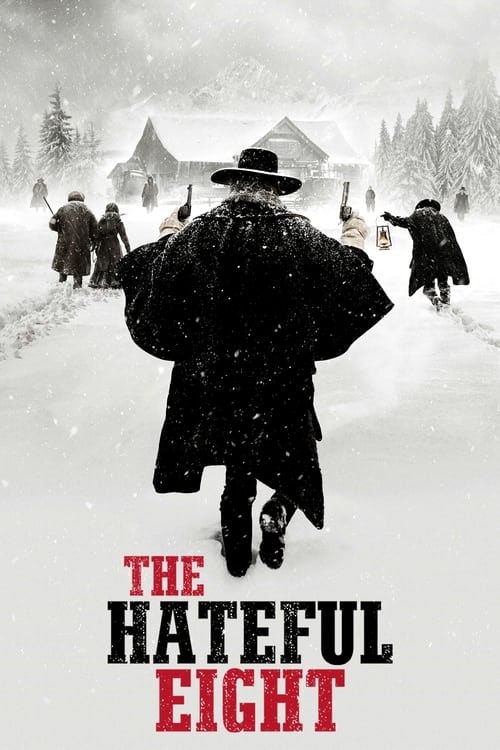
The Hateful Eight
2015 · Quentin Tarantino
Generates discourse without releasing anything: the abandoned Movie Critic "final film," podcast hot takes (dunking on Marvel actors as "not movie stars," snubbing Toy Story 3), and the eternal "what will the tenth film be" watch. The industry's loudest opinion-haver.
For a snowed-in night when you want to settle into something big, wicked, and conversation-heavy — a three-hour commitment that plays like a stage thriller with teeth. Not one for the squeamish or the impatient.
What it's about
Wyoming, some years after the Civil War: a blizzard forces a bounty hunter and his dangerous prisoner into a remote mountain waystation already occupied by six other strangers — among them a hangman, a lawman, a cowboy, and an unrepentant Confederate general. Nobody's story quite adds up, the war's hatreds are still smoldering, and the real question isn't who will survive the storm but who inside is lying. Part Western, part locked-room whodunit.
The experience
Long, talky, and simmering — Tarantino lets the tension build through monologues and sly looks for a good while before the violence arrives, and when it does it's shocking. It's nasty, funny, and confrontational, a film that enjoys making you squirm.
Performances
Samuel L. Jackson commands the room as bounty hunter Major Warren, Jennifer Jason Leigh is feral and fearless as the prisoner Daisy Domergue, and Walton Goggins steals scene after scene as the sheriff-to-be.
The craft
Shot in Ultra Panavision 70mm — a super-wide format dormant since the 1960s — and paradoxically used mostly indoors, turning one room into a landscape of suspicious faces. Ennio Morricone's ominous original score, his first full Western score in decades, won him an Oscar. The bigger the screen and the better the sound, the more it pays off.
Why it matters
Its 70mm roadshow release, complete with overture and intermission, became a cultural event and an argument for celluloid itself, while the film sharpened debates about how Westerns reckon with America's racial history.
Snapshot
Quentin Tarantino's eighth feature is a post-Civil War chamber Western set almost entirely inside a single snowbound waystation in the Wyoming mountains. Eight strangers — bounty hunters, a Confederate general, a lawman, a hangman, a cowboy, and a dangerous prisoner — are stranded together, and the film's central dramatic question is not who will survive but who among them is lying. Part locked-room mystery in the tradition of Agatha Christie, part Jacobean revenge play, part racial allegory, The Hateful Eight is simultaneously Tarantino's most theatrical and most politically blunt film. It was released in December 2015 in a 70mm roadshow version before a wider digital release, and the format gamble — restoring projection equipment across the United States to screen a format dormant since the 1960s — was as audacious as anything in the film itself.
Industry & production
The project had an unusual and well-documented origin. In January 2014, Tarantino's first-draft screenplay was leaked online; the director initially declared the film dead and filed a lawsuit against Gawker Media for publishing a link to the document. Within months, however, he reconsidered. He staged a live script-reading at Film Independent in Los Angeles in April 2014, with an ensemble that overlapped partially with the eventual cast, and the enthusiasm for that event apparently persuaded him to proceed. The experience also led him to revise the script substantially before production.
The film was financed and distributed by The Weinstein Company, Tarantino's longtime domestic partner since Pulp Fiction, with international distribution handled by various partners. Production took place in two primary phases: exterior sequences were shot in the San Juan Mountains near Telluride, Colorado, where the production encountered genuinely brutal winter conditions that informed the authenticity of the snowbound sequences. The interior of Minnie's Haberdashery — where the bulk of the narrative unfolds — was constructed as a purpose-built set. The controlled environment of the set was a deliberate artistic choice, allowing Tarantino and cinematographer Robert Richardson to design every angle and light source in advance.
A roadshow version of the film ran 187 minutes and was screened in 70mm at approximately one hundred specially equipped theaters in the United States and abroad, with an overture, an intermission, and intermission music. The standard digital release ran approximately 168 minutes. A six-episode Netflix miniseries cut, assembled from the longer roadshow footage and expanded with additional scenes, appeared in 2019.
Technology
The defining technological choice of The Hateful Eight was the decision to shoot in Ultra Panavision 70, an anamorphic format that had not been used on a major American production since Khartoum in 1966. The format produces an aspect ratio of 2.76:1 — among the widest ever used in commercial filmmaking — through the use of a 65mm negative in conjunction with anamorphic squeeze lenses originally manufactured in the 1960s. Panavision technicians refurbished the surviving lenses for the production, an undertaking that required significant restoration work.
Tarantino and Richardson's decision to deploy this extravagant wide-gauge format on an essentially interior film struck many observers as paradoxical, and the filmmakers addressed this directly in press materials, arguing that the extreme width allowed for the simultaneous framing of multiple characters across a shared space in ways that conventional Academy or widescreen ratios would not permit. The format also demanded that theaters projecting the roadshow version install or refurbish 70mm projectors, and Tarantino was publicly involved in efforts to restore projection capability at partner venues. This campaign contributed meaningfully to the broader 70mm revival of the 2010s, a movement in which filmmakers including Paul Thomas Anderson and Christopher Nolan also participated, though The Hateful Eight was unusual in its use of the older, wider Ultra Panavision system rather than spherical 70mm.
Technique
Cinematography
Robert Richardson, serving on his third collaboration with Tarantino after Kill Bill and Inglourious Basterds, designed the interior photography around the paradox of using one of the widest lenses ever made to film essentially a stage play. The result is a visual grammar that exploits the extreme horizontal field to compose characters in long relational tableaux: suspects arrayed against a wall, the occupants of the haberdashery visible from one end of the frame to the other in a single shot. Close-ups, when they finally arrive, carry intensified weight precisely because they have been withheld.
The exterior sequences lean into the format's epic associations — snowfields receding to mountains, the stagecoach a tiny moving object in an immense white expanse — before the film seals itself inside and inverts the expectation. Richardson lit the interior primarily through period-plausible sources: the fireplace, lanterns, and windows. The transition from daylight to firelight across the film's first half registers the gradual sealing of the trap.
Editing
Fred Raskin, who had edited Django Unchained for Tarantino and would go on to cut Once Upon a Time in Hollywood, structured the film according to Tarantino's chapter-based screenplay. The film is divided into six named chapters plus an epilogue, a formal device Tarantino had deployed in earlier work but which here carries the structural weight of a Christie novel's section breaks — each chapter reframing what has come before. Raskin's pacing is notably deliberate by genre standards; extended scenes of dialogue run without conventional interruptive cutting, letting tension accumulate through performance and blocking rather than montage. The sudden intrusions of violence are therefore experienced as ruptures in a fabric the editing has worked to keep taut.
Mise-en-scène / staging
Tarantino's most overtly theatrical staging choices dominate the interior sequences. The haberdashery functions as a proscenium stage: characters occupy positions along a lateral axis, move between foreground and background, and frequently address one another across the full width of the frame. The film is conscious of its own theatrical nature; Tarantino's own voice appears in voice-over narration to provide backstory exposition, a Brechtian acknowledgment that what we are watching is being told to us.
The geography of the set — the main room, the bar, the back room, the crawl space beneath the floorboards — is meticulously established early and becomes a site of strategic significance as the mystery develops. Props, particularly a letter attributed to Abraham Lincoln that is central to a key deception, are introduced and revisited with the deliberate economy of stage direction.
Sound
The score for The Hateful Eight represents one of the most celebrated of Ennio Morricone's late career. Tarantino had long drawn on Morricone's existing catalog for temp tracks in his earlier films, but this was the first time Morricone composed original music for a Tarantino picture. The score ranges from spare, anxiety-inducing string figures to large orchestral set pieces. Notably, several cues from Morricone's score for John Carpenter's The Thing (1982) — compositions that had been rejected or left unused by Carpenter — were incorporated into The Hateful Eight, giving the film an intertextual sonic uncanny: music written for a different snowbound siege narrative of paranoia and concealed malevolence turns out to fit the new context almost too well.
Morricone won the Academy Award for Best Original Score for the film at the 2016 ceremony — his first competitive Oscar win, though he had received an honorary Academy Award in 2007 after multiple nominations without a competitive prize. The award was widely understood as a career recognition as much as a judgment on any single score.
The film's sound design outside the score is similarly purposeful: the howling blizzard is a persistent presence, and the haberdashery's acoustic quality — its creaks, its silences — is managed with care. Gunshots, when they come, are loud in the abrupt, undramatic way favored by Tarantino since Reservoir Dogs.
Performance
The ensemble is structured around Samuel L. Jackson's Marquis Warren, a Black Union veteran turned bounty hunter whose manipulation of white characters drives the narrative. Jackson had worked with Tarantino across five films at this point, and his performance here is among the most extended and demanding of their collaborations — a long scene in which Warren psychologically destroys General Smithers (Bruce Dern) is a sustained monologue that functions as a kind of poisonous aria. Kurt Russell, playing the cartoonishly macho bounty hunter John Ruth, gives a performance pitched toward a kind of reflexive Western masculinity that the film gradually empties out. Jennifer Jason Leigh's Daisy Domergue, bloodied and beaten throughout much of the film, earned an Academy Award nomination for Best Supporting Actress; her performance sustains a register of barely contained menace beneath victimhood that the final revelation vindicates. Walton Goggins, Tim Roth, Michael Madsen, and Demián Bichir round out the ensemble, each sustaining a character whose apparent archetype the film either confirms or destroys.
Narrative & dramatic mode
The Hateful Eight operates in the mode of the classic locked-room mystery: a closed set of suspects, a crime (or a conspiracy), and a revelation that recontextualizes what came before. But it departs from classic mystery conventions in crucial ways. The revelation does not produce justice or closure; it produces further violence, and the final scene of two men dying together — one Black, one white, both enforcers of law in some degraded sense — is offered without triumphalism or irony stabilization.
Tarantino constructs the film's first half almost entirely through conversation: lies, stories, credentialing, and the performance of identity. The second half, triggered by the intermission in the roadshow cut, shifts into a different register as the backstory of what happened at Minnie's Haberdashery before the main characters arrived is revealed through flashback, reframing the preceding action. The chapter structure makes this retrospective revision feel formally announced rather than merely clever.
Genre & cycle
The film sits at the intersection of the revisionist Western and the chamber thriller, two generic traditions Tarantino synthesizes without fully inhabiting either. The Western elements — the landscape, the period setting, the bounty hunter mythology — are consciously invoked and then spatially negated when the film seals itself inside. The whodunit elements — the Christie-esque ensemble of potential suspects, the chapter breaks, the retrospective revelation — are played out with genre literacy. What distinguishes the film generically is its insistence on treating the post-Civil War Western as a site of unresolved racial violence rather than national myth-making, a move that places it in conversation with Django Unchained (2012) and with a broader revisionist cycle that includes films like John Sayles's Lone Star (1996) and Kelly Reichardt's work, though Tarantino's approach is far more operatic than Reichardt's and more explicitly theatrical than Sayles's.
Authorship & method
Tarantino wrote the screenplay himself, as is his consistent practice, and the film exhibits his characteristic screenplay-as-primary-document approach: the chapter divisions, the retrospective narration, and the theatrical spatial organization are all built into the script before production. His working method emphasizes extended rehearsal and the establishment of ensemble chemistry before cameras roll, a theatrical model that suited the chamber format.
Robert Richardson has spoken about the Ultra Panavision choice as emerging from extended conversations with Tarantino about how to make the enclosed setting cinematically productive rather than merely adaptive; the format decision was thus not a technological novelty for its own sake but a response to a genuine compositional problem.
Fred Raskin's editorial approach honored the architecture of the screenplay's chapter structure while sustaining the rhythmic consistency of Tarantino's long-take, dialogue-centered sequences. Morricone's compositional collaboration — though conducted at a remove given Morricone's European base — was mediated through Tarantino's specific thematic briefs and, reportedly, through Tarantino's provision of the finished screenplay rather than a locked cut, a reversal of standard practice that Morricone has described as unusual and productive.
Movement / national cinema
The Hateful Eight is an American film in the tradition of Hollywood genre filmmaking, produced by a major American independent company and distributed through established theatrical channels. It participates in no national cinema movement in the auteur-collectivist sense. It is, however, deeply engaged with American national mythology — specifically with the founding violence of race and the question of what the Civil War settled and what it did not — and in this sense is a work of cultural auto-critique operating within the genre machinery that has traditionally suppressed that critique.
The film's engagement with the Spaghetti Western through Morricone's score and through the period iconography acknowledges the transnational constitution of the Western as a genre: the American West filtered through Italian genre cinema and returned, in this film, as a denaturalized critique.
Era / period
The film arrived at the midpoint of the 2010s prestige-film era, a period characterized by the co-existence of franchise dominance and a robust market for challenging, auteur-driven adult drama. The Weinstein Company's awards strategy had supported Tarantino's prior films through this model, and The Hateful Eight was positioned for the same awards campaign. Its release coincided with a period of heightened public discourse on racial violence in the United States — the summer of 2015 had seen the Charleston church shooting and the continuation of public reckoning with police violence — and critics widely noted the film's racial themes as both historically grounded and contemporaneously resonant.
The 70mm roadshow strategy also positioned the film as part of a period of film-format nostalgia, aligning it with a broader cultural interest in analog media and artisanal production processes that characterized certain strands of 2010s aesthetics.
Themes
The film's central thematic concern is the persistence of racial hierarchy across a nominal legal transformation. The post-Civil War setting stages the question of what emancipation actually meant in practice: Warren carries a letter from Lincoln as a credential, but finds that his legal status does not protect him from the racism of those he encounters. The letter is eventually revealed as a forgery, which does not undercut the theme but deepens it: even the credential that should guarantee equality is a fiction. Warren's strategic use of his war record and his manipulation of white characters' racism against them is portrayed as a form of survival intelligence, not triumphalism.
The film's other major theme is the unreliability of performance and testimony: every character in the haberdashery is performing an identity, and the revelation of the truth does not produce a stable ground beneath the performances but merely another layer. Justice, in the world of the film, is exercised through violence and is therefore indistinguishable from revenge. The final act — Warren and Mannix, a Black Union soldier and a white Confederate sympathizer, hanging Daisy Domergue together — is a grotesque parody of interracial solidarity, the only form of national reconciliation the film believes in.
Reception, canon & influence
Critical reception was largely positive but notably divided along lines of what critics expected from a Tarantino film. Those who valued the formal ambition — the roadshow presentation, the Ultra Panavision experiment, Morricone's score — placed it among his major works. Those who found the film's racial violence aestheticized to the point of irresponsibility, or who found the nearly three-hour runtime insufficiently justified by the narrative mechanics, were more skeptical. Jennifer Jason Leigh's Oscar nomination was broadly considered deserved; Morricone's win was treated as a corrective to his long competitive shutout.
The film's primary backward influences are multiple and acknowledged. The paranoid group dynamic — strangers in a confined space, one or more of whom is hiding something catastrophic — clearly descends from John Carpenter's The Thing (1982), a connection the Morricone score makes explicit. Howard Hawks's Rio Bravo (1959) and its model of a diverse group sheltering together under siege is a tonal antecedent. The Christie locked-room mystery structure is evident, and Tarantino has cited Christie directly in interviews. Sergio Leone's staging of tension through stillness and close-ups, and his use of Morricone as dramaturgical force, are present throughout.
Its forward influence has been felt primarily in two areas. The 70mm roadshow campaign contributed substantially to the revival of the format as a viable exhibition choice for prestige releases; subsequent years saw multiple high-profile 70mm runs at dedicated venues. More broadly, the film's insistence on the Western as a space for engaging American racial history — rather than resolving it — sits alongside Django Unchained and other revisionist Westerns in establishing a template that subsequent filmmakers have drawn on. Whether The Hateful Eight will be regarded as a canonical Tarantino work on the level of Pulp Fiction or Jackie Brown remains a matter of critical disagreement; it is his most formally daring picture and his most politically direct, which makes it resistant to easy consensus.
A Deleuzian reading
A letter passes from a coat pocket into gloved hands inside a lurching stagecoach.
The full Deleuzian reading of The Hateful Eight →
Reception
Landed in 2015 as 'divisive Tarantino' — critics split on its length and cruelty even as the 70mm Roadshow made it an event — but a decade on it's the go-to pick for the 'underrated Tarantino' take, with the Morricone score and snowbound paranoia doing a lot of the reappraisal work.
How The Hateful Eight was received, from release to now →
Influences: the films it descends from and the films it influenced
- The Thing (1982) — Tarantino reuses Morricone's actual The Thing cue "Bestiario" in the film's opening, and Carpenter's confined-space paranoid-ensemble structure — strangers who cannot trust each other in a sealed location, any one of whom may be the threat — is the direct formal model for the Minnie's Haberdashery scenario.
- Rio Bravo (1959) — Hawks's model of a heterogeneous ensemble forced to coexist under siege in a single frontier location — with character chemistry and extended dialogue sustaining tension in the absence of action — provides the chamber Western template Tarantino scales toward its chamber-thriller extreme.
- The Good, the Bad and the Ugly (1966) — Leone's tripartite chapter structure (each segment named for a character) and his systematic alternation between extreme wide shots and extreme close-ups to build confrontational geometry are the compositional devices Tarantino inherits and institutionalizes as a directing grammar.
- Once Upon a Time in the West (1968) — Leone's use of Morricone's score as structural dramaturgy — motifs assigned to individual characters, silence weaponized, music entering as revelation rather than mood accompaniment — is the compositional philosophy Tarantino cites explicitly and replicates in his collaboration with Morricone on the original score.
- Lawrence of Arabia (1962) — Lean's 70mm roadshow exhibition — reserved seats, overture, intermission, a cinematic event rather than a release — is the specific format Tarantino explicitly revives as the model for The Hateful Eight's roadshow campaign, restoring a theatrical presentation language dormant since the 1970s.
- The Ox-Bow Incident (1943) — Wellman's chamber Western establishes the genre as a vehicle for American racial and moral allegory — a group of men in an enclosed frontier space deciding who lives and dies — with theatrical ensemble staging and collective moral indictment that The Hateful Eight extends and radicalizes into Reconstruction-era racial violence.
- Murder on the Orient Express (1974) — Lumet's Christie adaptation fixes the ensemble locked-room whodunit as prestige cinema procedure: the confined vehicle, the retrospective revelation architecture, the detective's extended monologue that reconstructs off-screen events for an assembled audience — the precise procedural template for the film's Chapter 6 revelation sequence.
- Reservoir Dogs (1992) — Tarantino's debut establishes his own chamber thriller grammar — criminals in a confined interior, extended monologue as narrative engine, chapter-based temporal scrambling with retrospective revelation — and The Hateful Eight is a deliberate return to and formal expansion of that template at roadshow scale.
- Inglourious Basterds (2009) — Tarantino extends IB's chamber-drama mode into a full feature and commissions an original Morricone score, building a single-location film driven entirely by the extended-scene behavioral performance logic first fully realized in IB's tavern sequence, now shot in Ultra Panavision 70mm.
- Heaven's Gate (1980) — Roadshow-format Ultra Panavision anamorphic Western that treats expansive widescreen duration and overture/intermission scale as deliberate maximalism, consciously reviving the super-production ambition Heaven's Gate made notorious.
- Django (1966) — Models its snowbound enclosure and downbeat massacre directly on Corbucci's Great Silence nihilism, with a Morricone score, extending Django's lull-and-paroxysm rhythm of violence.
- Hamlet (1996) — Revives the 65/70mm roadshow presentation — overture, intermission, large-gauge format applied to a dialogue-dense chamber drama — the same movement-reviving gambit Branagh staged for Hamlet two decades earlier.
- Hostiles (2017) — Cooper deploys the revisionist Western as an ensemble interrogation of American racial violence and contested historical memory, working directly in the formal and political lineage The Hateful Eight established for serious revisionist Western production post-2015.
- Knives Out (2019) — Johnson directly inherits the Christie-derived locked-room whodunit ensemble architecture — a confined domestic space, suspects with competing motives, retrospective revelation that reframes earlier scenes — explicitly building on the formal template Tarantino restored to genre cinema, extended to a more comfortable suburban register.
- Once Upon a Time... in Hollywood (2019) — Carries forward the chapter-based screenplay architecture, retrospective omniscient narration, and ensemble character dynamics of The Hateful Eight, extending the formal template into a longer-form chamber nostalgia structure where Tarantino's theatrical blocking and monologue-driven performance are sustained across a wider geography.
- The Power of the Dog (2021) — Campion deploys the revisionist Western as psychological chamber thriller, with Ari Wegner's 2.39:1 anamorphic framing that traps characters in confrontational horizontal tableaux — a proscenium blocking model formally descended from The Hateful Eight's staging grammar — and the widescreen Western space functions as a containing frame rather than an expansive one.
- Sinners (2025) — Tarantino's revival of roadshow 70mm photography for a racially inflected period genre narrative — using large-format photochemical capture to insist on the historical gravity of a racially violent American mise-en-scène — establishes the formal argument that Arkapaw's 65mm work extends to the Jim Crow Delta.
- Strange Darling (2024) — Combines explicit chapter-title structure with militant photochemical (70mm) capture in the digital era, the chaptered-plus-celluloid commitment Strange Darling adopts on anamorphic 35mm.
- Django Unchained (2012) — Shares the revisionist Western-as-racial-reckoning framework, Morricone intertextual score reuse, and Tarantino's chapter-segmented screenplay architecture; the two films form a deliberate diptych interrogating antebellum slavery and Reconstruction-era violence as unresolved American history rather than genre backdrop.
- The Revenant (2015) — Part of the same 2015 large-format prestige Western moment: Emmanuel Lubezki's 65mm-digital-large-format exhibition strategy and the Western as site for interrogating American violence — both films marked a simultaneous critical rediscovery of format as meaning-making device rather than novelty.
- Bone Tomahawk (2015) — Zahler builds a chamber Western on extended dialogue tableaux, slow formal accumulation, and deliberately provocative racial politics, sharing The Hateful Eight's insistence that the Western genre is a space where American violence is anatomized rather than aestheticized, and where genre pleasure is deliberately withheld.
- True Grit (2010) — Shot in Ultra Panavision 70mm anamorphic as an explicit engagement with the expressive potential of wide-format composition that True Grit's Deakins imagery demonstrated; both films structure their drama through the spatial power negotiation of armed characters with competing legal claims, and both use hymn-adjacent sacred music as underscore.
- Glass Onion: A Knives Out Mystery (2022) — Tarantino uses specific architectural geography — the haberdashery's floor plan — as a narrative constraint in a sealed-cast whodunit, staging revelation through spatial logic; Glass Onion similarly deploys the island compound's geography as both dramatic device and production-design spectacle requiring the audience to map the space.
- Murder on the Orient Express (2017) — A contemporaneous revival of 65mm large-format stock (Ultra Panavision 70) deployed for a single-confined-location whodunit of trapped, mutually suspicious suspects.
- The Master (2012) — Part of the 70mm photochemical revival The Master rallied — an Ultra Panavision roadshow that, like The Master, deploys large-format width for confined, dialogue-bound interiors rather than landscape spectacle.
- The Odyssey (2026) — Contemporary revival of large-format 65/70mm capture and roadshow exhibition as a theatrical event, the same industrial argument that premium format can anchor a mass audience.
Similar films
- Django Unchained (2012) — influence & lineage · same viewing thread
- The Good, the Bad and the Ugly (1966) — influence & lineage · same viewing thread
- Once Upon a Time in the West (1968) — influence & lineage · same viewing thread
- Reservoir Dogs (1992) — influence & lineage
- The Revenant (2015) — influence & lineage
- Once Upon a Time... in Hollywood (2019) — influence & lineage
- Hostiles (2017) — influence & lineage
- Rio Bravo (1959) — influence & lineage
All the films related to The Hateful Eight →
Watch it with: curated runs of related films
- The Operatic West — A run of operatic gunfighter cinema — Leone's mythic widescreen scale, Corbucci's colder cruelty, and the Tarantino homages that quote both — best watched close together to hear the same Morricone-scaled myth mutate.