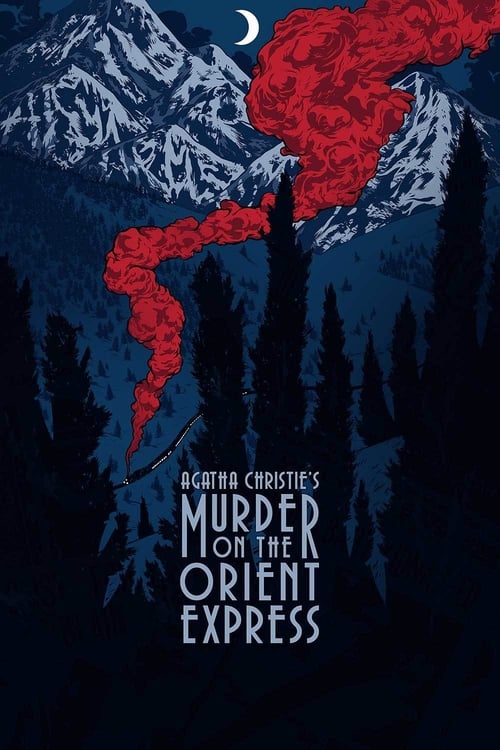
Murder on the Orient Express
1974 · Sidney Lumet
For a snowy night in when you want a proper puzzle and a parade of movie stars — comfort viewing with a brain. Perfect with company and a drink, and ideal if you want to play armchair detective.
What it's about
In 1935, the famed detective Hercule Poirot boards the Orient Express for what should be a routine crossing — until the train is trapped in a snowdrift and a passenger is found stabbed to death in his locked compartment. Every elegant stranger in the sleeping car has something to hide, and Poirot works through them one interview at a time. It's the classic snowbound whodunit, played as glamorous event entertainment.
The experience
Plush, talky, and quietly delicious — the pleasure is in watching great actors fence with a detective in close quarters, one suspect at a time, while the mystery tightens. It's cozy on the surface with something genuinely mournful underneath.
Performances
Albert Finney disappears into Poirot under prosthetics, accent, and fuss — a total transformation. Around him sits one of the starriest ensembles ever gathered, with Ingrid Bergman's brief, trembling turn as a timid missionary the standout that won her an Oscar.
The craft
Sidney Lumet, best known for gritty New York realism, pivots to pure luxury: burnished period design, a train that gleams like jewelry, and a waltzing score that treats the whole affair as grand entertainment. The staging keeps a dozen stars alive in a corridor barely wide enough for two.
Why it matters
It invented the prestige Agatha Christie adaptation — the all-star ensemble mystery as event picture — and every glossy whodunit revival since is working from its playbook.
Snapshot
Murder on the Orient Express is the film that taught the postwar industry how to turn Agatha Christie into a prestige event. Adapted from Christie's 1934 novel, Sidney Lumet's picture takes the most famous of all locked-room conceits — a man stabbed twelve times in a sleeping car marooned in a snowdrift — and stages it as a gleaming, star-saturated entertainment. Albert Finney, buried under prosthetics and a fastidious accent, plays Hercule Poirot; arrayed around him is one of the densest constellations of name actors ever assembled for a single ensemble: Lauren Bacall, Ingrid Bergman, Sean Connery, John Gielgud, Vanessa Redgrave, Anthony Perkins, Wendy Hiller, Michael York, Jacqueline Bisset, Rachel Roberts, Richard Widmark, Martin Balsam, Jean-Pierre Cassel and others. The film's pleasures are double: the formal satisfaction of a fair-play mystery worked through to its audacious solution, and the spectacle of celebrated performers taking turns in the interrogation chair. It was both a critical success and a substantial commercial hit, and it effectively founded the all-star Christie cycle that ran through the rest of the decade.
Industry & production
The project was the work of producers John Brabourne and Richard Goodwin, made through the British company EMI Films, with the train interiors and much of the production built and shot at EMI's Elstree Studios. The central commercial gamble was the casting model: rather than building around one or two stars, the production recruited a large roster of established names for relatively brief, sharply defined roles. This had practical advantages — most performers worked limited schedules — and a marketing logic, since the poster could promise an event rather than a single attraction.
A frequently cited piece of the film's history is that Agatha Christie, who had long been wary of screen adaptations after earlier treatments she disliked, gave this production her cooperation and was reportedly pleased with the result; it is often described as the Christie adaptation she was happiest with. The exact contours of her involvement are the kind of detail that has hardened into anecdote, so it is worth noting plainly that her approval is well attested while the finer points are less firmly documented. The film's commercial success — it performed strongly in both Britain and the United States — confirmed that a glossy, faithful, star-led Christie could be a major theatrical proposition, and EMI and the Brabourne–Goodwin team would return to the formula repeatedly.
Technology
Technically the film belongs to the mature world of 1970s studio production rather than to any frontier of innovation. It was shot on 35mm in color, with the period recreated almost entirely through built sets, costume, and lighting rather than location or optical trickery. The principal technological "instrument" of the film is the sleeping-car set itself — a confined, repeatable space designed so that the camera could move along corridors and into compartments, and so that the same geography could be returned to again and again as Poirot reconstructs the night. The snowbound exterior and the train's departure are achieved through model and stage work integrated with the studio interiors. There is nothing experimental here; the achievement is one of controlled, classical craft applied to a deliberately enclosed world.
Technique
Cinematography
Geoffrey Unsworth's photography is the film's most immediately seductive element. Unsworth — whose credits include 2001: A Space Odyssey and Cabaret — brings a soft, diffused, glamorizing light that flatters the ensemble and lends the period a burnished, slightly dreamlike sheen. The look is luxurious without tipping into mere prettiness: the confined compartments are modeled with warm pools of light against darker surrounds, and the famous boarding-and-departure sequence at the Istanbul platform is photographed as pure romance of travel. Within the cramped geometry of the carriage, Unsworth and Lumet keep the image legible and elegant, using the train's mirrors, glass, and corridor lines to organize space and to let the camera glide between interrogations.
Editing
The cut is by Anne V. Coates, whose reputation rests substantially on Lawrence of Arabia. The editorial problem of the film is unusual: a very large cast must each be given a distinct interrogation, and the audience must retain a clear mental map of who said what, so that the final solution lands as fair play rather than confusion. Coates's work serves clarity and rhythm — pacing the sequence of interviews so the film does not stall, and reserving its most concentrated cutting for the reconstruction, in which testimony, flashback, and Poirot's deductions are braided together. The structure depends on the editing's discipline; the pleasure of the ending is that the viewer feels the pieces were all available.
Mise-en-scène / staging
Production design by Tony Walton, who also designed the costumes, gives the film its texture: the brass, wood, and upholstery of the Compagnie Internationale des Wagons-Lits, and the precise period dress that helps distinguish a dozen characters at a glance. The staging is essentially theatrical in the best sense — Lumet, a director steeped in actors and confined drama, treats the carriage as a stage on which entrances, seating, and proximity all carry meaning. The film's most celebrated staging is its climax: Poirot assembles the suspects in the dining car and delivers his solution to the whole company at once, a long, blocked, ensemble set-piece that recalls the chamber drama Lumet handled so well elsewhere.
Sound
Richard Rodney Bennett's score is integral rather than incidental. Its signature is a buoyant, waltzing theme attached to the train's departure — a lush, propulsive piece of music that turns the mechanical business of a locomotive pulling out of a station into a swooning romantic flourish, and that has become one of the film's most remembered features. Elsewhere the music modulates toward unease and mystery as the investigation darkens. The sound design otherwise leans on the textures of the train itself — the rhythm of the rails, the hush of the snowbound halt — to create the sealed, suspended atmosphere on which the plot depends.
Performance
Performance is the film's true subject. Finney's Poirot is a deliberately mannered creation — physically transformed, precise, faintly comic, but anchored by genuine moral gravity in the final movement. The ensemble works as a series of vivid miniatures: each actor is handed a self-contained scene and asked to make an impression quickly. Ingrid Bergman, cast against her glamour as the timid, halting Swedish missionary Greta Ohlsson, delivers a near-monologue in a single sustained take that became the film's most awarded turn. Around them, the strategy is to let recognizable star presences — Bacall's brassy Mrs. Hubbard, Connery's clipped colonel, Perkins's twitchy secretary, Gielgud's impeccable valet, Redgrave and York as the elegant couple — each register and recede. The film is, among other things, a showcase of how much a fine actor can do with a few minutes.
Narrative & dramatic mode
The film is a pure example of the classical detective structure: a closed circle of suspects, a sealed setting, a brilliant outsider, and a fair-play solution that the audience is in principle equipped to reach. A sepia-toned prologue establishes the backstory — the kidnapping and death of a child, the Armstrong case, whose contours deliberately echo the real Lindbergh kidnapping of the early 1930s. The present-tense narrative then proceeds in three movements: the journey and the murder of the odious passenger Ratchett (in fact Cassetti, the man behind the Armstrong child's death); the methodical round of interviews as Poirot extracts each passenger's account; and the salon revelation, in which Poirot offers not one but two solutions and leaves the choice of justice to the company. The dramatic mode is investigative and retrospective — the story is reconstructed rather than witnessed — and its moral force comes from the collision between procedural truth and a deeper, collective idea of justice.
Genre & cycle
The picture sits at the intersection of the country-house mystery and the prestige period film. It is a "drawing-room" detective story relocated to a train, and it belongs to the long tradition of Christie adaptation while substantially redefining it. Before 1974, Christie on screen was associated with modestly budgeted pictures, including the comic Miss Marple series of the 1960s. Murder on the Orient Express reconceived the property as upmarket, lavishly mounted, and star-driven. In doing so it launched a distinct cycle — the EMI/Brabourne–Goodwin all-star Christies — that continued with Death on the Nile (1978), The Mirror Crack'd (1980), and Evil Under the Sun (1982), with Peter Ustinov inheriting the role of Poirot. The 1974 film is the template against which all subsequent screen Poirots, including later television and cinema versions, have positioned themselves.
Authorship & method
The film is a meeting of strong, specialized authors. Sidney Lumet was, by 1974, identified with morally serious, performance-centred American films often set in New York — 12 Angry Men, Serpico, and soon after Dog Day Afternoon and Network. Orient Express looks, on its surface, like a departure into glossy escapism, but its deep affinities with Lumet's work are real: it is a confined-space ensemble drama, dependent on actors and on a final reckoning with justice, much like the jury room of 12 Angry Men. The screenplay is by Paul Dehn, an experienced screenwriter whose task was to preserve Christie's intricate clockwork while distributing screen time fairly across an enormous cast. The key collaborators — Unsworth on camera, Bennett on music, Coates in the cutting room, and Walton on design and costume — each operate at a high level of established craft, and the film's authorship is best understood as the disciplined coordination of these distinct hands around a single, classical problem of construction.
Movement / national cinema
Murder on the Orient Express is a British production, made within the EMI studio system at a moment when British cinema was searching for commercially durable, internationally exportable forms. It is not aligned with any avant-garde or new-wave tendency; on the contrary, its identity is consciously traditional, drawing on Britain's literary heritage and its deep bench of stage and screen actors. The film's transatlantic character — an American director, a British studio and crew, and a cast mixing British, American, and Continental European stars — is itself characteristic of the internationalised European production landscape of the period. It is national cinema as heritage export: a film that sells a particular idea of inter-war European glamour to a global audience.
Era / period
The film is set in the mid-1930s and made in the mid-1970s, and both dates matter. The diegetic period is the high era of luxury rail travel, evoked with affection as a world of order, ceremony, and class distinction shortly before the catastrophes of the later decade. The backstory's resonance with the Lindbergh kidnapping ties the fiction to a real, era-defining American trauma. The production date places the film within the 1970s vogue for star-studded spectacle and for nostalgic period filmmaking, a moment when audiences were receptive both to glossy recreations of the past and to large ensemble casts. The film's tone — knowing, elegant, faintly elegiac about a vanished world — is the product of that double vantage.
Themes
Beneath the puzzle, the film is concerned with justice and its limits. Its central moral provocation is the gap between legal truth and retributive justice: the crime is, in the film's framing, the punishment of a man the law had failed to convict, carried out by those his earlier crime had bereaved. Poirot, the apostle of order and method, is forced to choose between the truth he has uncovered and a mercy that truth would destroy, and the film's quiet power lies in his decision to let the alternative, exculpatory account stand. Secondary themes cluster around class and performance — the carriage is a cross-section of inter-war society, and nearly every passenger is, in some sense, playing a role — and around grief: the entire machinery of the plot is set in motion by the death of a child and the long shadow it casts. The film's surface is luxurious, but its core is a meditation on collective guilt and shared sorrow.
Reception, canon & influence
Critically and commercially, the film was a notable success and was recognized at the major awards. Ingrid Bergman won the Academy Award for Best Supporting Actress for her brief, indelible turn — her third Oscar — and the film received several further nominations, including for Finney's performance, Dehn's adapted screenplay, Unsworth's cinematography, and Bennett's score; it was likewise honored at the BAFTAs. Contemporary reception praised its elegance, its star ensemble, and its faithful, satisfying handling of Christie's plot, even as some critics found the all-star format more an exercise in glamour than in depth — a tension that has followed the film and its successors since.
The influences on the film run backward to Christie's 1934 novel and, behind it, to the classical golden-age detective tradition of the closed circle and the fair-play solution; stylistically, it draws on the prestige-period and chamber-drama traditions that Lumet and his collaborators each knew intimately. Its influence forward is considerable and specific. Most directly, it established the commercial and aesthetic template for the all-star Christie adaptation, spawning the Ustinov-led EMI sequence of the late 1970s and early 1980s and shaping the long afterlife of Poirot on screen and television. More broadly, it stands as a defining example of the star-ensemble whodunit — a model later filmmakers have repeatedly revisited and reinterpreted whenever they have assembled a famous cast inside a sealed setting for a single, intricate crime. Where the historical record on the film's making is thin or anecdotal — particularly around the precise nature of Christie's personal endorsement — that thinness is worth acknowledging; but the film's place in the canon, as the picture that made Christie a prestige proposition, is not in doubt.
A Deleuzian reading
A pocket watch, stopped at a quarter past one, its glass starred by the blow that froze the hands.
The full Deleuzian reading of Murder on the Orient Express →
Reception
A genuine event-movie hit in 1974 — six Oscar nominations and huge box office — it's since settled into 'gold standard Agatha Christie adaptation' status, and gets fondly cited as proof that Sidney Lumet, king of gritty New York dramas, could do plush all-star glamour too.
How Murder on the Orient Express was received, from release to now →
Influences: the films it descends from and the films it influenced
- 12 Angry Men (1957) — Lumet's own template of a confined single-set ensemble whose drama is a methodical, seat-by-seat verbal reconstruction of evidence — the chamber-staging discipline he ports directly into the dining carriage.
- And Then There Were None (1945) — Established the screen grammar of the sealed-circle Christie adaptation, working a fixed roster of trapped suspects through clues to a fair-play solution.
- The Lady Vanishes (1938) — Codified the moving train compartment as a self-contained mystery box, staging investigation laterally along a corridor of sliding doors and adjoining berths.
- Witness for the Prosecution (1957) — Model for the Christie two-solutions reveal — withholding the true reconstruction behind a decoy until a final theatrical reversal delivered as set-piece oratory.
- Grand Hotel (1932) — Invented the all-star portmanteau in which marquee names play interlocking miniatures inside one luxe confined setting, each given a calibrated single scene to register.
- 2001: A Space Odyssey (1968) — Geoffrey Unsworth's signature glare-softened, diffused front-light, the glamour-veiling technique he carries into the film's haloed star close-ups.
- Cabaret (1972) — Unsworth's fog-filtered inter-war glamour lighting and Weimar-era period sheen, the immediate stylistic rehearsal for the carriage's nostalgic luxe.
- Lawrence of Arabia (1962) — Anne V. Coates' editing hand — the braided, cross-cut assembly of fragmentary testimony she brings to the film's reconstructed-flashback murder.
- Shanghai Express (1932) — Directly continues the confined-train-as-microcosm-society ensemble thriller, the claustrophobic-corridor staging of strangers sealed in a moving compartment.
- Becket (1964) — Reunites both Geoffrey Unsworth (camera) and Anne Coates (editing) on another all-star, lushly appointed literary adaptation — a near-complete transplant of Becket's technical team into the prestige whodunit.
- Death on the Nile (1978) — The direct EMI successor that cloned the all-star Christie template — Ustinov's Poirot, a sealed pleasure-transport setting, and a closing salon reconstruction of the suspects.
- Evil Under the Sun (1982) — Continued the Ustinov EMI cycle's closed-circle holiday whodunit, again distributing screen time across a glamour ensemble around one elaborately timed crime.
- The Mirror Crack'd (1980) — Same EMI all-star Christie production line, recasting the marquee-name miniatures inside a sealed English-village suspect pool.
- Clue (1985) — Country-house ensemble whodunit that literalized the two-solutions ending into a sequence of fully staged alternate reconstructions of the same murders.
- Gosford Park (2001) — British-heritage country-house ensemble that arrays a vast star cast around a single crime, extending the export-prestige whodunit into overlapping upstairs/downstairs scrutiny.
- Knives Out (2019) — Revived the star-ensemble fair-play whodunit built to climax in a detective's standing salon reconstruction that re-reads earlier clues for the assembled suspects.
- Glass Onion (2022) — Sealed-setting all-star whodunit engineered around an explicit two-solutions structure, replaying the crime a second time once the decoy reading collapses.
- The Hateful Eight (2015) — Lumet's Christie adaptation fixes the ensemble locked-room whodunit as prestige cinema procedure: the confined vehicle, the retrospective revelation architecture, the detective's extended monologue that reconstructs off-screen events for an assembled audience — the precise procedural template for the film's Chapter 6 revelation sequence.
- Glass Onion: A Knives Out Mystery (2022) — Finney's Poirot establishes the Christie-derived eccentric detective's climactic theatrical revelation — gathering the full cast in a single room to perform a spoken reconstruction — as cinematic set-piece; Craig's Blanc inherits this specific rhetorical mode in the poolside monologue.
- Murder on the Orient Express (2017) — Defined the all-star single-set Christie event as a chain of one-on-one suspect interrogations; Branagh inherits this closed-circle interrogation pacing and ensemble-casting architecture wholesale.
- Wake Up Dead Man: A Knives Out Mystery (2025) — The template of the all-star Christie ensemble built around a single flamboyant star detective (Finney's Poirot), fixing the affectionate period-pastiche tone and the touring set-piece interrogation rhythm.
- The Girl with the Dragon Tattoo (2009) — The closed-circle whodunit worked methodically through a fixed roster of suspects sealed off from the world — the exact locked-room logic applied to the isolated Vanger family island.
- The Last of Sheila (1973) — A near-contemporary star-ensemble puzzle-plot whodunit sealing its famous cast aboard a single vessel with rigorously fair-play, gameable clueing.
Similar films
- The Lady Vanishes (1938) — influence & lineage
- Witness for the Prosecution (1957) — influence & lineage
- Murder on the Orient Express (2017) — shared sensibility
- Strangers on a Train (1951) — shared sensibility
- Laura (1944) — shared sensibility
- Charade (1963) — shared sensibility
- The Maltese Falcon (1941) — shared sensibility
- The Long Goodbye (1973) — shared sensibility