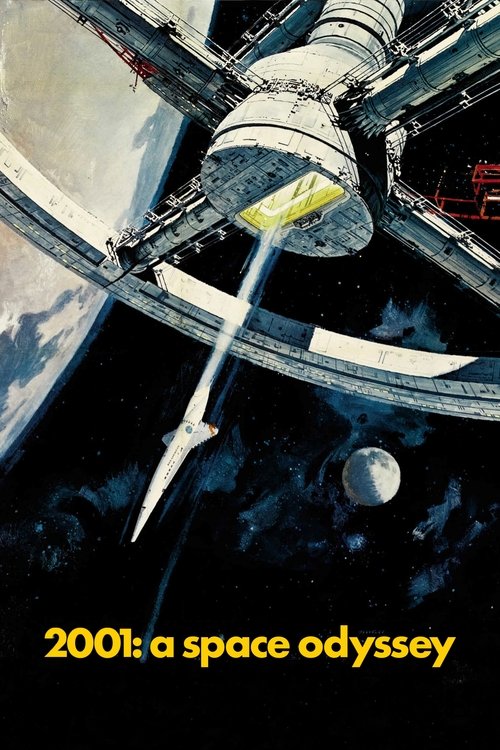
2001: A Space Odyssey
1968 · Stanley Kubrick
For a patient, lights-off night when you want cinema as an event — something to experience and then argue about at 1 a.m. Definitely a challenge, never a background watch.
What it's about
A mysterious black monolith appears at the dawn of humankind, then again beneath the surface of the Moon, and a mission is sent toward Jupiter to find out what it means. Aboard the ship: two astronauts, a crew in hibernation, and HAL 9000, a soft-spoken computer trusted with everything. The story spans from the first tool ever used to the far edge of human understanding.
The experience
Slow, vast, and hypnotic — it replaces plot with awe, letting images and music carry you somewhere films almost never go. Long stretches are eerily quiet, and the ending is designed to be wondered about, not explained; it leaves some viewers transformed and others baffled, often both.
The craft
Kubrick's effects were so far ahead of their time they still look real, and his pairing of spacecraft with classical music created some of the most famous images and sounds in film history. Every frame is composed like an artwork; the ship interiors, the silence of space, the machine's calm voice — all of it demands the biggest screen and best sound you can find.
Why it matters
It permanently raised the ceiling of what science fiction — and film itself — could attempt; virtually every serious space movie since lives in its shadow.
Snapshot
Stanley Kubrick's 2001: A Space Odyssey is the paradigm-shifting work that redefined what science fiction cinema could be and, arguably, what cinema itself could attempt. In four loosely connected movements — the prehistoric "Dawn of Man," a near-future lunar excavation, a deep-space mission aboard the Discovery One, and the hallucinatory "Jupiter and Beyond the Infinite" — the film traces the human species from its first tool-use to a confrontation with something beyond comprehension. It refuses conventional exposition, subordinates plot to image and sound, and ends without resolution in any classical sense. Released in April 1968, it divided critics, transfixed the counterculture, and permanently altered the visual and intellectual horizon of popular filmmaking.
Industry & production
Kubrick's route to 2001 began in 1964, when he sought out Arthur C. Clarke in New York to discuss the possibility of "the proverbial good science-fiction film." Clarke's 1951 short story "The Sentinel" provided the seed — a crystalline pyramid on the Moon that signals humanity's readiness to some unknown agency — but the screenplay expanded far beyond it into a philosophical cosmology. Kubrick and Clarke developed the script and novel simultaneously; the novel appeared in paperback near the time of the film's release, though the two texts diverge in significant ways and neither should be taken as explanatory gloss on the other.
MGM funded the production, which shot almost entirely at MGM-British Studios in Borehamwood, England, beginning in late 1965. The budget escalated during production to approximately $10.5 million — substantial for its era — as Kubrick's obsessive methods stretched the schedule across nearly four years from conception to release. He maintained unusual creative control, serving as producer, director, and effectively the head of an in-house special effects unit. No separate visual effects company was contracted; Kubrick supervised the effects work directly, a structural decision that allowed unprecedented integration between practical photography and optical compositing but also extended the timeline considerably.
The film won a single Academy Award — Best Special Visual Effects — with Kubrick as the sole credited winner, a reflection of his proprietary control over the film's most technically demanding element.
Technology
2001 is among cinema's most consequential moments of technological invention. The film's special-effects supervisors — Wally Veevers, Douglas Trumbull, Con Pederson, and Tom Howard — developed or substantially advanced several techniques that became industry standards.
For the "Dawn of Man" prologue, Kubrick and Howard refined the front-projection process, using a Scotchlite retroreflective screen and a beam splitter to combine live foreground action with photographic backgrounds at a precision impossible under conventional rear projection. The result was clean enough to pass as location photography.
The most technically novel contribution was Douglas Trumbull's slit-scan technique, developed for the "Star Gate" sequence. By moving an opaque sheet with a narrow aperture across illuminated artwork while the camera executed a long exposure on slow-moving film, Trumbull produced streaked corridors of light conveying velocity and infinite depth simultaneously. The process was laborious — Trumbull worked largely alone during late shifts at Borehamwood — and it was subsequently adopted widely in motion graphics, title sequences, and broadcast design.
The Discovery One centrifuge set — a 38-foot diameter rotating wheel — was one of the most expensive single sets constructed to that date. It could rotate at controlled speeds, allowing Kubrick to shoot Keir Dullea walking its full circumference while the camera remained stationary in the frame, creating the illusion of artificial gravity without optical trickery. Mounting and exposing the camera correctly as actors moved from floor to ceiling required custom rigging of both camera and lighting equipment within the rotating structure.
Technique
Cinematography
Geoffrey Unsworth receives the principal Director of Photography credit, with John Alcott serving as camera operator and taking on portions of the photography during production. (Alcott would subsequently shoot Kubrick's Barry Lyndon, The Shining, and Full Metal Jacket.) The film was photographed on 65mm Super Panavision, printed to 70mm for roadshow exhibition, giving the image an architectural resolution and scale.
The cinematographic approach is characterized by rigorous geometric formality. Camera movements are predominantly slow and deliberate: the orbital ballet set to Johann Strauss II's "Blue Danube" is structured around smooth tracking shots and matched eyeline cuts that preserve the waltz's mathematical symmetry. In the space sequences, shots are often static or near-static, presenting spacecraft with the same dispassionate attention given to documentary objects. The consistent avoidance of handheld camera work reinforces the film's cool, observational register. The "Dawn of Man" sequence uses intense, high-contrast light — simulated in studio via photographic backdrops and front projection — to suggest the alien harshness of the prehistoric Namib Desert location the film evokes without ever visiting.
Editing
Ray Lovejoy edited the film. Its most celebrated cut — the prehistoric bone hurled skyward matching to an orbital weapons satellite — compresses approximately four million years in a single frame change and has become one of cinema's canonical examples of associative montage. The cut does not merely ellide time; it equates the bone-as-weapon with nuclear deterrence, establishing the film's central argument about the inseparability of tool-use and aggression before a word of dialogue has been spoken.
Kubrick made significant cuts after the initial roadshow engagements. The roadshow version ran approximately 160 minutes; Kubrick removed roughly 19 minutes shortly after the premiere, primarily from the Jupiter mission section. The current canonical version runs approximately 141 minutes.
Mise-en-scène / staging
The production design — credited to Tony Masters, Harry Lange, and Ernie Archer — reflects direct consultation with aerospace engineers and industrial designers. The interiors of the Discovery One are plausibly functional rather than theatrical, and the film's furniture, food service, and interface design were developed with enough rigor that several elements anticipated actual aerospace design directions. This documentary-style approach to dressing extends to the Hilton Space Station V lobby and the lunar Clavius base, both staged as corporate environments in which the extraordinary is treated as routine — the bureaucratization of wonder is itself a theme.
Kubrick stages the Discovery's centrifuge in ways that exploit the disorientation of a frameless environment: characters stand on what visually registers as a ceiling, and the camera is rotated to normalize their orientation, making gravity a matter of perspective rather than physics.
Sound
The decision to replace Alex North's commissioned original score with pre-existing classical and contemporary art music is one of the most consequential acts of musical curation in film history. North — a highly regarded Hollywood composer who had scored Kubrick's Spartacus — wrote a complete score and was not informed that Kubrick had elected not to use it until the film's premiere. North described the experience of learning of the substitution at the screening as devastating. His score was eventually recorded and released separately in 1993, conducted by Jerry Goldsmith.
Kubrick used Richard Strauss's Also Sprach Zarathustra for the film's overture and structural turning points; Johann Strauss II's "Blue Danube" for the docking sequences; Aram Khachaturian's Adagio from the Gayane Ballet Suite for the early Discovery passages; and four works by György Ligeti — Atmosphères, Lux Aeterna, Requiem, and Aventures — for the film's mysterious and horrific passages. Kubrick's use of Ligeti's music without initially securing proper clearance became a legal matter; Ligeti's publisher later settled with MGM, and Ligeti himself expressed complicated feelings about the association even as it introduced his music to enormous audiences.
HAL 9000's voice was provided by Douglas Rain, a Canadian stage actor whose calm, affectless baritone Kubrick selected after auditioning other candidates — reportedly including Martin Balsam. The voice's absence of emotional inflection generates much of HAL's menace: it is a voice that cannot be read for intent, which is precisely the horror the film constructs around it.
The film opens in silence — before the MGM logo, the screen is black — and its first 25 minutes contain no dialogue. This radical omission trains the audience to receive the film as a visual and sonic experience rather than a conventional narrative.
Performance
The acting is deliberately affectless, Kubrick evidently directing his cast toward a register of professional vacancy. Keir Dullea as David Bowman and Gary Lockwood as Frank Poole are often characterized as flat, but the film appears to argue that this flatness is the point: the astronauts are functionaries of a system that has rationalized the human out of its operators. William Sylvester as Dr. Heywood Floyd — a bureaucratic emissary whose primary social function is managing information and performing authority — embodies the film's most satirical register. The ape-men of the "Dawn of Man" sequence were performed by mime artists and movement performers, trained by Daniel Richter, who also plays the lead ape, "Moonwatcher."
Narrative & dramatic mode
2001 operates as a philosophical parable delivered in the mode of phenomenological cinema. Its four-part structure is episodic rather than causal: each section is bound to the others by the monolith as recurring catalyst, but no character bridges all four, and cause-and-effect logic is consistently subordinated to the logic of revelation. The film withholds backstory, withholds explanation, and withholds resolution — it ends with an image (the Star Child) that is suggestive rather than conclusive.
The film's most celebrated structural gambit is its treatment of HAL's malfunction. HAL's decision to kill the crew is never explicitly explained; Kubrick and Clarke leave the contradiction between HAL's programming imperatives — accurate information processing, and the cover-up of the mission's true purpose — as an inference the viewer must assemble. This ellipsis is characteristic: the film trusts the audience to close its gaps.
Genre & cycle
Before 2001, science fiction in cinema was predominantly a B-picture genre: low-budget, visually modest, narratively simple. The form's prestige exceptions — Fritz Lang's Metropolis (1927), Forbidden Planet (1956) — were exceptional precisely for their isolation from the norm. 2001 initiated a revaluation. By demonstrating that science fiction could carry the formal ambitions and philosophical weight of art cinema, it opened conditions that made Star Wars (1977), Close Encounters of the Third Kind (1977), and Alien (1979) commercially viable as prestige productions rather than programmer fare.
The film belongs to a cycle of late-1960s philosophical art films that treated technological modernity as both subject and aesthetic problem. But its specific genre transformation has no close parallel: 2001 alone remade what science fiction cinema imagined it could be.
Authorship & method
Kubrick's authorship of 2001 is unusually total. He produced and directed; he oversaw effects development; he selected the music; he controlled marketing and the post-premiere edit. Clarke collaborated extensively on the screenplay but acknowledged that the film is Kubrick's vision rather than a shared one.
Geoffrey Unsworth's cinematographic contributions to the visual grammar of space — particularly the management of deep-field focus and large-format exposure in novel shooting conditions — are significant and often underacknowledged, given Kubrick's tendency to absorb collaborators into his authorial signature. Tony Masters's production design shaped the film's institutional aesthetic in ways that outlasted the production. Costume designer Hardy Amies contributed the film's distinctive space-age civilian wardrobe, grounding the near-future in a recognizable corporate formality.
Kubrick's method was characterized by obsessive iteration, extensive pre-production research, and a preference for in-house solutions over contracted services. His simultaneous development of the screenplay alongside Clarke's novelization was structurally unusual; the two texts differ in significant ways.
Movement / national cinema
2001 resists clean national-cinema classification. Financed by American MGM and directed by an American director, it was shot entirely in England with predominantly British crews. It appeared at the moment when the New Hollywood was establishing itself through Bonnie and Clyde and The Graduate (both 1967) and Rosemary's Baby (1968), but its aesthetic owes more to European art cinema — Antonioni's affectless figures, Resnais's temporal disorientation, Bresson's stripped performance — than to the American New Wave's vernacular energy.
It belongs most usefully to 1960s international modernism in cinema: the body of films that treated the medium's formal resources as inseparable from their philosophical ambitions, and that positioned the audience as participant in the construction of meaning rather than recipient of pre-digested narrative.
Era / period
The film arrived during the Space Age's most culturally charged period. NASA's Apollo program was preparing for the lunar landing that would occur the following year, and space exploration saturated Western popular culture with images, anxieties, and aspirations. Kubrick's film was in dialogue with this cultural moment while refusing to celebrate it: its Space Age is bureaucratic, lonely, and haunted by the sense that humanity's most sophisticated technology has not resolved the problem of what humanity is.
The late-1960s counterculture received the film with particular intensity, in part because the "Star Gate" sequence's visual grammar had kinship with psychedelic experience, and in part because the film's rejection of conventional plot structure resonated with the period's broader suspicion of institutional authority and received meaning. The film reportedly performed especially well among younger audiences, whose responses diverged sharply from the bafflement of mainstream critics.
Themes
The film's central preoccupation is with the relationship between tool-use and consciousness — or more precisely, with whether the two can be meaningfully separated. The bone-as-weapon that becomes a weapons satellite, HAL's intelligence that becomes a murder weapon, Bowman's pod that becomes a vehicle of transcendence: the film argues that every technology is simultaneously a prosthesis and a trap.
Evolution — biological, cognitive, and ontological — is the film's structural spine. The monolith appears at moments of transformation, but whether it causes transformations or merely marks them is left deliberately open. Human identity under technological mediation is examined through HAL's inversion of the human-machine hierarchy: HAL is the most emotionally expressive entity in the film; the humans appear robotic. This inversion is not a trick but an argument about what the rationalization of human behavior produces. The film's engagement with Nietzsche's concept of the Übermensch — signaled by the use of Also Sprach Zarathustra — runs through its structure without being reducible to it.
Reception, canon & influence
Initial critical reception was mixed to hostile among establishment critics. Renata Adler, reviewing for the New York Times, found the film intermittently beautiful but dramatically inert. Pauline Kael was sharply critical of what she characterized as the film's pretension. Andrew Sarris was initially dismissive, though he revised his assessment in subsequent years. The film nonetheless became a commercial success, earning substantially more than its production and marketing costs through sustained repeat business.
Backward influences: The astronomical paintings of Chesley Bonestell, which had shaped American popular imagery of space since the 1940s, were both a resource and something the film consciously superseded. Fritz Lang's Frau im Mond (1929) established conventions of scientific seriousness in science fiction cinema that 2001 inherited and transformed. Eisenstein's associative montage — particularly the argument-as-cut — is the direct ancestor of the bone match. The film's intellectual architecture draws on Nietzsche's Also Sprach Zarathustra, on Freudian and Jungian frameworks of the unconscious, and on early cybernetics literature that had begun circulating in popular form during the early 1960s. Kubrick has cited the influence of experimental filmmakers, though the specific record of his direct engagement with the American avant-garde is thin.
Forward legacy: Andrei Tarkovsky's Solaris (1972) was in explicit dialogue with 2001: Tarkovsky sought to make a more humanistic, interior science fiction where Kubrick had emphasized exteriority and cosmic scale. Ridley Scott's Alien (1979) owed its institutional spacecraft aesthetic and its reticent, professional crew directly to the Discovery One. George Lucas's Star Wars (1977) was partly a reaction against 2001's austerity — Lucas wanted adventure where Kubrick had made philosophy — but the ambitions of both films for the genre would not have been legible without 2001's prior transformation of what science fiction cinema could command.
The film established the viability of slow cinema within genre framework, the possibility of a film that refuses to explain its premise, and a visual vocabulary for space travel that remained authoritative for decades. Alfonso Cuarón's Gravity (2013), Christopher Nolan's Interstellar (2014), and Duncan Jones's Moon (2009) all operate within a tradition of serious, visually ambitious science fiction that 2001 founded. Kubrick's unfinished project A.I. Artificial Intelligence was completed by Steven Spielberg in 2001 — the year of the film's titular date — a small sign of how deeply the film had embedded itself in the cultural imagination of what the future looked like.
In the decades since its release, 2001: A Space Odyssey has consistently appeared at or near the top of critics' and scholars' polls of the greatest films ever made, including the British Film Institute's Sight & Sound surveys. The debate about what it means has never closed, which is the surest evidence that Kubrick achieved what he set out to do.
A Deleuzian reading
The bone hangs at the top of its arc.
The full Deleuzian reading of 2001: A Space Odyssey →
Reception
Critics walked out of the 1968 premiere and Pauline Kael dismissed it as 'monumentally unimaginative,' while the counterculture crowd embraced it as 'the ultimate trip' — MGM even re-marketed it that way. Now it sits near the top of nearly every greatest-films-ever list, including Sight & Sound's critics poll.
How 2001: A Space Odyssey was received, from release to now →
Influences: the films it descends from and the films it influenced
- Battleship Potemkin (1925) — Eisenstein's intellectual montage — pairing dissimilar images to produce an argumentative third meaning beyond either — is the direct formal precedent for the bone-to-satellite cut; the edit does not merely elide time but equates tool-use with nuclear deterrence, executing in one frame change the argument the film argues across its entire length.
- Metropolis (1927) — Lang's monumental geometric model sets and precise miniature cinematography — the Babel tower, the Machine-City strata — established the visual vocabulary of SF production design as architectural spectacle that Kubrick's in-house effects unit at Borehamwood systematized and brought to photographic plausibility.
- Fantasia (1940) — The 'Toccata and Fugue in D Minor' segment is the earliest major instance of using pre-existing orchestral music as the sole organizing principle for non-narrative abstract imagery — the structural logic Kubrick inherits for both the Strauss orbital ballet and the Ligeti-scored Star Gate, where music replaces plot as the editing unit.
- Destination Moon (1950) — The film's insistence on technical accuracy — correct zero-gravity staging, Chesley Bonestell astronomical paintings as production reference, procedural depictions of suit operations — established scientific plausibility as an aesthetic ideal for SF cinema that Kubrick elevated into a total production philosophy.
- La Jetée (1962) — Marker's film compresses a twenty-year span through pure montage with near-zero connective tissue, establishing the radical temporal ellipsis as a formally viable SF device; Kubrick extends the principle to a four-million-year cut executed in a single match, making Marker's narrative compression into a cosmological argument.
- Dr. Strangelove (1964) — Kubrick's immediately preceding film established the flat, bureaucratic performance register — Sellers and Hayden delivering military protocol as deadpan absurdity — and the wide-angle distortion of institutional interiors that carry directly into the Discovery One's diagnostic communications and HAL's inflectionless threat.
- Alphaville (1965) — Godard's Alpha 60 delivers exposition in the same calculated, uninflected voice Kubrick assigned to HAL 9000 — establishing the convention that machine intelligence is dangerous precisely because its tone never deviates from logical courtesy; both films use the SF framework as a vehicle for philosophical essay rather than genre plot.
- Spartacus (1960) — Kubrick brings the geometric overhead framing and formal abstraction he pushed against industrial constraint in Spartacus to its apotheosis; Alex North composed and fully recorded a score Kubrick rejected at the last minute — a direct continuation and deliberate rupture of the Spartacus-North collaboration.
- Woman in the Moon (1929) — Douglas Trumbull's scale model effects — built around controlled studio lighting and precise camera-to-model ratios to achieve photographic solidity — directly extend the miniature-photography methodology Woman in the Moon pioneered; Kubrick's geometric staging of astronauts as tiny figures within the Discovery's vast white corridors inherits and formalizes Lang's compositional principle of human bodies dwarfed by their technological architecture.
- Last Year at Marienbad (1961) — Kubrick stages the finale in a white Louis XVI room furnished with baroque antiques that have no narrative explanation, with a figure who ages discontinuously across cuts without any conventional temporal signal — a direct citation of Marienbad's baroque hotel-space and its temporal indeterminacy, transplanted from memory to the threshold of transcendence.
- Becket (1964) — Carries forward Geoffrey Unsworth's large-format, light-sculpting cinematography — the same painterly control of color and scale he brought to Becket's cathedral interiors.
- A Canterbury Tale (1944) — The bone-to-satellite graphic match cut is the most-cited heir of the falcon-to-Spitfire cut, extending the technique of compressing millennia across a single edit.
- Solaris (1972) — Tarkovsky constructed his deep-space film as a conscious formal response to 2001, adopting the integration of pre-existing classical music (Bach's chorale, Dvořák) as emotional architecture rather than conventional underscore, and matching Kubrick's commitment to extended contemplative duration as a replacement for plot mechanics.
- Close Encounters of the Third Kind (1977) — Spielberg hired Douglas Trumbull — who had developed the slit-scan process for Kubrick — to design the mothership's light effects; the climactic wordless contact sequence extends 2001's method of using light, scale, and pre-existing musical structure to convey transcendence without any verbal or narrative scaffolding.
- Alien (1979) — Scott adopted 2001's staging of spacecraft interiors as institutional workplaces — crew eating, arguing wages, performing routine maintenance under fluorescent light before narrative threat emerges — extending Kubrick's principle that deep-space labor should look and feel like industrial employment rather than adventure.
- The Shining (1980) — Kubrick's own subsequent film extends the Discovery One's corridor sequences directly: the Steadicam tracking shots through the Overlook's bilaterally symmetric hallways employ the identical principle of slow architectural traversal through geometric symmetry to produce ontological unease, transposing the method from outer space to domestic interior.
- Koyaanisqatsi (1982) — Reggio extends 2001's organizational principle of pairing non-narrative images with a pre-existing composed score — Philip Glass rather than Ligeti — as the sole editing logic, building a non-verbal argument about technological civilization through the same structure in which music functions as both pacing and meaning.
- The Tree of Life (2011) — Malick adopts 2001's episodic parable structure — interspersing domestic narrative passages with non-narrative sequences set to pre-existing orchestral music (Brahms, Berlioz) that address geological and cosmic deep time — and the affectless voiceover register, extending Kubrick's formal device of using music-over-image as a container for philosophical scale.
- Gravity (2013) — Cuarón's commitment to physical plausibility — no sound in vacuum, correct Newtonian debris trajectories, accurate equipment placement and suit mechanics — continues 2001's documentary-realist production philosophy in which zero-gravity depiction is a foundational constraint that all other creative decisions serve.
- Interstellar (2014) — Hans Zimmer's score, built around a dissonant pipe organ in a tradition of sacred texture descending from Ligeti, consciously echoes Kubrick's use of György Ligeti's choral works; additionally, the Gargantua black-hole visualization was the first major attempt since the Star Gate to render a cosmological phenomenon through physically accurate simulation rather than conventional effects convention.
- Annihilation (2018) — Garland inherits the affectless performance register under conditions of mounting ontological dread — researchers delivering lines of scientific protocol as alien agency escalates around them — and the refusal to explicate the entity's motives, reproducing the formal strategy Kubrick used for both HAL's deterioration and the unexplained events of 'Jupiter and Beyond the Infinite.'
- Project Hail Mary (2026) — Hard-SF discipline of depicting the isolated crew member and a non-anthropomorphic alien intelligence through formal restraint and silence rather than expository dialogue.
- Blade Runner (1982) — Douglas Trumbull carried the practical-miniature-and-optical-printing pipeline directly from 2001 into Blade Runner's Hades landscape sequences; Kubrick's template of science fiction as sustained philosophical meditation — with contemplative pacing that refuses thriller momentum — establishes the formal register that Scott's director's cut fully inhabits.
- Star Wars (1977) — Douglas Trumbull's slit-scan and front-projection effects work here was the motion-control precedent John Dykstra's Dykstraflex explicitly improved upon; the concept that space hardware should be photographed with practical weight and physical plausibility (if not the weathering) is the technical baseline ILM reacted against.
- Playtime (1967) — Tati shot in 65mm to construct precisely geometric architectural environments where the camera habitually recedes to observe human movement through designed space without privileging any single figure — the same principle governing 2001's space-station sequences, where the built environment is the film's true subject and the actors are elements of its composition.
- Red Desert (1964) — Kubrick's deployment of Ligeti's micropolyphonic textures and Khachaturian's cool orchestral surfaces as industrial-alienation instruments—sound design that withholds emotional identification while amplifying spatial dread—extends the logic of Gelmetti's electronic Ravenna score to a corporate-modernist technological environment.
- Star Wars: The Last Jedi (2017) — Origin of the absolute-silence-in-vacuum device that Johnson deploys for the Holdo lightspeed ram, cutting all sound at the moment of maximum spectacle.
- Death in Venice (1971) — Kubrick's needle-drop of pre-existing classical works (Strauss, Ligeti) as the film's structural emotional engine models the 'curated score,' which Visconti applies to Mahler's Adagietto as authorship-by-selection.
- Tron (1982) — The Star Gate's abstract corridor of streaming light pioneered non-representational, high-contrast graphic travel through space, the exact register in which Tron stages light-cycle runs and beam-traffic.
- Ikarie XB 1 (1963) — Descendant of the high-key white, clean, functional starship interior and the rotating-centrifuge depiction of crew routine and exercise that Ikarie staged five years earlier.
Similar films
- Interstellar (2014) — influence & lineage · same viewing thread
- Project Hail Mary (2026) — influence & lineage · same viewing thread
- The Shining (1980) — influence & lineage · often watched together
- Solaris (1972) — influence & lineage
- Metropolis (1927) — influence & lineage
- Close Encounters of the Third Kind (1977) — influence & lineage
- Alien (1979) — influence & lineage
- Arrival (2016) — same viewing thread · often watched together
All the films related to 2001: A Space Odyssey →
Watch it with: curated runs of related films
- Alone in the Void — A run of films about a single mind pitted against the vastness — rationing air, doing the math, reaching across impossible distance — best watched together for how survival keeps tipping into awe.
Film essays and courses that include it
- How Cuts Think: From Soviet Montage to New Hollywood Rhythm
- Impossible Made Visible: One Hundred Years of Engineered Spectacle
- Stanley Kubrick
- After the Monolith: Science Fiction's Formal Inventions
- The Disappearing Self: A Cinema of Estrangement
- God Is Silent, Death Is Certain: Existentialism in World Cinema
- Commanded Vision: The Auteur Epic
- Built to Think, Made to Feel
- The Immense Frame: Cinema's 70mm Obsession from VistaVision to IMAX
- Light Made Visible: Cinema's Great Image
- The Screen That Thinks
- What Comes After the Time-Image?
- The Frame as a Trap
- The Fear That Moved From the Machine to the Self
- The Meaning Is in Your Head
- The Measure of Us
- The Thing We Build in Our Image
- The Seven-and-a-Half Floor of the Self