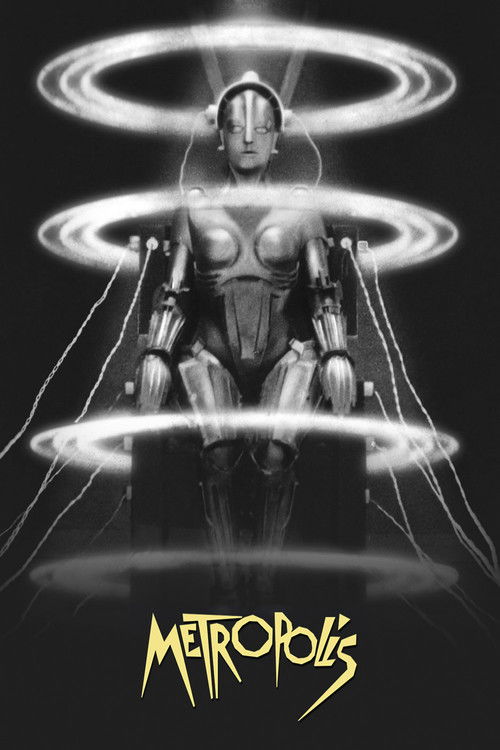
Metropolis
1927 · Fritz Lang
For when you want spectacle with a monumental feel — event viewing, ideally with a great score turned up loud. A commitment, but the kind you brag about afterward.
What it's about
In a towering future city, the rich live in sunlit skyscrapers while workers toil underground feeding the machines that keep it all running. The ruler's sheltered son ventures below, falls for a young woman preaching hope to the workers, and stumbles into a scheme — involving his father and a sinister inventor — that could set the whole city ablaze.
The experience
Overwhelming in the best way — a torrent of colossal sets, surging crowds, and images so iconic you'll recognize them from films made ninety years later. It's operatic, feverish, and strange, and its scale still produces genuine awe.
Performances
Brigitte Helm, in her debut, is astonishing — a performance of wild physical range that swings from radiant stillness to something genuinely unnerving.
The craft
The most ambitious production of the silent era: cathedral-sized sets, thousands of extras, and effects innovations that filmmakers borrowed for decades. Lang's compositions — the city skyline, the machine halls, the laboratory — invented the visual language of the cinematic future. See it as big as possible, with the strongest restoration and score you can find.
Why it matters
The foundation stone of science fiction cinema — its towers, robots, and divided city echo through virtually every screen dystopia made since.
Snapshot
Fritz Lang's Metropolis is the foundational text of cinematic science fiction — a two-hour-plus vision of a future city stratified into heavenly towers and subterranean machine-halls, in which class antagonism, messianic prophecy, and the fear of the artificial body are threaded into a single, overwhelming spectacle. Shot over the better part of two years at UFA's Neubabelsberg studios, it remains the most ambitious production of the silent era by almost any measure: scale of sets, technical invention, and sheer number of extras and shooting days. Its influence reaches forward through every major science-fiction film of the twentieth century and into the visual grammar of corporate dystopia that now circulates as common cultural property.
Industry & production
Metropolis was produced by Universum Film AG (UFA), the German studio conglomerate formed in 1917 and by the mid-1920s the most technically advanced production house in Europe. Erich Pommer, UFA's head of production and the presiding intelligence behind much of Weimar cinema's international ambition, initiated the project; he was removed from his post during production as the costs mounted and UFA's financial crisis deepened. The film is estimated to have cost somewhere in the range of five million Reichsmarks — the precise figure is disputed in the historical record and should not be stated with false precision — but by any measure it was the most expensive German film to that point and came close to bankrupting UFA entirely. The studio was subsequently forced into a rescue agreement with Paramount and MGM (the "Parufamet" deal), which ceded considerable editorial control over the film for its American release. Channing Pollock, a playwright engaged by Paramount, prepared a shortened version for the United States, cutting roughly a quarter of the film and altering intertitles. This truncated print became the dominant circulating version for decades and shaped the film's early critical reputation, since reviewers in both Europe and America often saw substantially different cuts.
Production extended over approximately 310 shooting days and 60 night shoots — a span of roughly seventeen months from 1925 to 1926, with postproduction carrying into early 1927. The film premiered at the Ufa-Palast am Zoo in Berlin on 10 January 1927. Its restoration history is as dramatic as its production history: for most of the twentieth century a complete version was considered lost. In 2008, a 16mm reduction print containing approximately twenty-five minutes of previously missing footage was discovered at the Museo del Cine Pablo Ducrós Hicken in Buenos Aires, Argentina. This discovery enabled the Friedrich Wilhelm Murnau Stiftung to assemble the most complete version available to date (released 2010), restoring subplots, character arcs, and transitional passages that had been absent from scholarly and public consciousness for over eighty years.
Technology
The film's central technological achievement is the Schüfftan process, developed by special-effects technician Eugen Schüfftan specifically for this production. The technique uses a half-silvered mirror placed at a 45-degree angle to the camera: portions of the mirror's reflective coating are scraped away, allowing a miniature model to be reflected into the frame while live actors, visible through the cleared sections, appear to inhabit the miniature environment. This permitted Lang and his cinematographers to place human figures convincingly within scale-model versions of the massive architectural sets without physically building them at full size. The Schüfftan process was subsequently adopted across the European and American industry; it remained in use well into the sound era.
Beyond the process shot, the production relied on extensive practical miniature work for the city exteriors, on glass paintings, and on massive constructed sets — including the full-scale workers' underground and the partial tower exteriors — that required months of construction. The costume and prop work for the Maschinenmensch (Machine Human, the robot figure) was executed by sculptor Walter Schulze-Mittendorff, who cast a suit of lacquered wood and metal over a plaster mold of actress Brigitte Helm's body. The result established the visual vocabulary of the humanoid robot that has not meaningfully been superseded.
Technique
Cinematography
The credited cinematographers are Karl Freund and Günther Rittau, with additional contributions from Walter Ruttmann (who shot the city montage sequences). Freund, already the most celebrated operator in German cinema through his work on The Last Laugh (1924) and Variety (1925), brought to Metropolis his characteristic command of mobile and expressive camera. The film deploys a range of focal approaches: wide establishing shots that reduce workers to geometric masses, medium compositions that isolate individual faces in expressionist pools of light, and close framings — particularly of eyes and hands — that carry expressive weight the intertitles do not supply. The famous shot of the worker-crowds marching in lockstep, shot from overhead or extreme low angles to dehumanize and geometrize them, is among the most copied images in the medium's history.
Editing
The editing follows a rhythm calibrated to the film's tonal registers: the opening machine sequences cut in quick, percussive rhythms that mimic industrial tempo, while the narrative scenes in the upper city move at a more expansive, theatrical pace. The intercutting during the flooding sequence — one of the film's climactic set-pieces — coordinates multiple spatial and dramatic strands with considerable sophistication for the period. No definitive record of the editing credits has survived in a form that assigns precise responsibility; the editorial work is generally attributed to Lang's collaborative process with his cutters under his direct supervision.
Mise-en-scène / staging
Lang's staging draws on both the expressionist theater tradition (the distorted geometry, the symbolic extremity) and on the operatic tradition of mass spectacle. The deep-focus compositions in the workers' city allow architectural scale to overwhelm the human figure systematically. The upper city, by contrast, uses open space and light to suggest the leisured ease of the ruling class, though Lang's framing consistently hints at the artificiality and fragility of this comfort. The Maschinenmensch's unveiling scene — lit from below, surrounded by the ring of men in formal dress — is staged as a demonic epiphany, with Helm's body language calibrated through Lang's extremely detailed rehearsal process. Lang was notoriously exacting with actors, insisting on repeated takes and, in some documented instances, directing extras into physically grueling conditions; the flooding sequence required child extras to wade in cold water for extended periods, a fact that became part of the production's troubled mythology.
Sound
Metropolis is a silent film. It was accompanied in its original roadshow release by a commissioned orchestral score by Gottfried Huppertz, performed live. Huppertz's score is a late-Romantic orchestral work that moves between Wagnerian leitmotif writing and lighter dance idioms for the upper-city sequences; it is the closest thing available to an "original" sonic text and is the score used in the most authoritative modern restorations. The film has attracted several unauthorized rescorings, most notably Giorgio Moroder's 1984 version, which replaced Huppertz with a pop and electronic soundtrack featuring tracks by Freddie Mercury, Pat Benatar, and others. The Moroder version, though it introduced Metropolis to a new generation, is now regarded by scholars primarily as a historical curiosity and a period document of 1980s image culture rather than an interpretive restoration.
Performance
Brigitte Helm, then nineteen years old and making her screen debut, carries the film on a dual performance of remarkable range: Maria the prophet is played in a register of luminous stillness and spiritual authority, while the robot Maria is performed in stylized, mechanistic movement that draws on both expressionist dance vocabulary and Lang's own choreographic instruction. The contrast is the film's central dramatic engine. Alfred Abel as Joh Fredersen, the city's master, gives a controlled, patrician performance; Gustav Fröhlich as Freder is more conventional in the romantic-hero mold. Rudolf Klein-Rogge, a recurring figure in Lang's Weimar work (he also played Mabuse), brings unhinged intensity to Rotwang the inventor.
Narrative & dramatic mode
The screenplay, by Thea von Harbou from her own 1926 novel, structures the narrative on a triangular symbolic schema: Head (the ruling intellect, Fredersen), Hands (the workers), and Heart (the mediating figure who must unite them, initially Maria, then Freder). This schema is explicitly articulated in intertitles and has attracted considerable critical attention for its ideological ambiguity — whether the film endorses this essentially paternalist-reformist resolution or whether Lang's visual treatment ironizes it is a question the scholarly literature has not resolved to consensus. The narrative mode is broadly melodramatic: conflict is externalized, moral categories are bold, the love plot operates as both personal story and political allegory. The film borrows heavily from biblical typology (the Tower of Babel prologue, the Flood, the figure of the prophet), from Gothic literature (the mad scientist, the double), and from Romantic opera.
Genre & cycle
Metropolis is the originating text of the dystopian science-fiction film as a distinct genre. It synthesizes the technological spectacle of earlier "trick films" and fantasy pictures (the Méliès tradition), the social allegory of industrial-era stage melodrama, and the visual vocabulary of German Expressionism into a form that subsequent science fiction would return to repeatedly. Its specific innovations — the vertical city divided by class, the humanoid robot as threat and object of desire, the alliance between corporate power and mad science — constitute the genre's foundational iconography. The film belongs to the Weimar cycle of "Zukunftsfilme" (future-films), which includes lesser-known works such as Alraune (1928), but Metropolis is by far the most technically ambitious and culturally durable entry.
Authorship & method
Fritz Lang (1890–1976) brought to the project the architectural training of his early years in Vienna, his operatic sense of scale, and his characteristic preoccupation with fate, entrapment, and the machinery of social control. His collaborating screenwriter and wife, Thea von Harbou, was the primary author of the narrative; the extent to which the film's ideological conservatism (if that is what it is) belongs to her vision rather than Lang's has been a persistent critical question. Lang consistently distanced himself from the film's politics in later interviews, though these retrospective accounts should be read with the awareness that they were given after von Harbou's 1933 entry into the Nazi Party and after Lang's own departure from Germany under disputed circumstances.
Karl Freund's contribution to the cinematographic grammar is substantial and probably underweighted in Lang-centered auteurist accounts. Gottfried Huppertz's score was commissioned from the outset as an integrated element, not an afterthought, making Metropolis an unusually unified audio-visual project for the late silent era. Art directors Otto Hunte, Erich Kettelhut, and Karl Vollbrecht designed the sets — the records suggest this was a genuinely collaborative process — and their achievement in synthesizing Art Deco, Constructivist, and Expressionist architectural vocabularies into a coherent visual world is foundational to the entire tradition of designed-screen environments in science fiction.
Movement / national cinema
Metropolis belongs to Weimar cinema, the body of German film produced between 1919 and 1933 — one of the most intensively studied national film movements in scholarship. The Weimar cinema is characterized by its engagement with Expressionist visual style (though not all Weimar films are expressionist), its thematic preoccupations with tyranny, mass psychology, and social fragmentation, and its technical sophistication. Siegfried Kracauer's influential 1947 study From Caligari to Hitler reads the Weimar cinema as a prophetic symptom of the German national psyche's susceptibility to fascism — an argument that has been much contested but that shaped Metropolis's critical reception for decades. The film's UFA context also places it in a specifically industrial-commercial framework, distinct from the independent or state-supported contexts of some other national cinemas.
Era / period
The film belongs to the final years of the international silent era (roughly 1924–1928), when silent filmmaking had reached its fullest technical and artistic development in the years just before synchronized sound became commercially dominant. This is also the period of the Weimar Republic's relative stabilization (the "Golden Twenties"), during which UFA undertook its most ambitious productions in deliberate competition with Hollywood. Metropolis premiered in January 1927; The Jazz Singer, generally cited as the first commercially successful sound film, opened in October of that year. The transition to sound would render the visual ambitions of Metropolis both a culmination and almost immediately a monument.
Themes
The film's dominant thematic concern is the mediation between capital and labor — but this conflict is systematically displaced onto a symbolic and quasi-religious register rather than analyzed as a structural one. The workers are masses, not individuals; their liberation is framed as a gift from above rather than a self-emancipation. The robot Maria functions as an embodiment of male anxiety about female sexuality and autonomous femininity, deploying the woman's body as both instrument of social control and object of erotic spectacle. The Tower of Babel allegory frames the class conflict as a spiritual problem of hubris and communication rather than a material one. The figure of Rotwang — the mad scientist whose creation escapes his intentions — introduces what will become one of the genre's most persistent anxieties: the technology that inverts the master-servant relation. Questions of the double, of authentic versus artificial personhood, and of the city as an organism that both sustains and destroys its inhabitants run through every sequence.
Reception, canon & influence
Backward influences: Lang drew visibly on the German Expressionist stage — the angular, distorted sets of The Cabinet of Dr. Caligari (1920) are a direct precedent — and on the Italian Futurist enthusiasm for machine aesthetics. H.G. Wells was a clear literary antecedent; the Marxist literature of industrial capitalism provided a social vocabulary even if the film ultimately refuses its political logic. The architectural drawings of Sant'Elia and the skyscraper imagery of contemporary New York (which Lang visited in 1924 and which he cited as a catalyst for the film's visual conception) are documented sources.
Initial critical reception was mixed. Wells himself reviewed the film negatively in a 1927 piece, finding its social thinking muddled and its spectacle disproportionate to its intelligence — a critique that remains in the air. German critics were divided; the film was a commercial disappointment relative to its cost. The political resonances of the film's mediating-Heart resolution were read differently by left and right reviewers, a polysemy that is probably structural rather than accidental.
Canon formation was gradual and accelerated significantly in the latter half of the twentieth century. The UNESCO designation as a Memory of the World in 2001 — the first film to receive it — formalized a status that film scholars had been constructing for decades. The 2010 restoration made possible a reassessment of the film's full scope.
Forward influence is pervasive. The robot Maria's visual design is the direct ancestor of C-3PO in Star Wars (1977), as George Lucas and the production team have acknowledged. The vertical, class-stratified city is the template for Blade Runner (1982), The Fifth Element (1997), and the entire vocabulary of corporate-dystopia production design. The Maschinenmensch influenced the android figures of Terminator, Ex Machina, and countless others. Batman (1989) and Dark City (1998) draw directly on the Expressionist-art-deco synthesis of the film's visual world. Beyond science fiction, the film's mass-choreography sequences influenced Busby Berkeley's musical numbers, and its use of architectural scale to diminish the individual has been absorbed into the visual rhetoric of countless political spectacles on film. Metropolis does not merely belong to the canon; in significant respects, it established the canon's categories.
A Deleuzian reading
The shift changes, and a column of men in dark caps shuffles toward the cage elevator, heads bowed, all moving at the same defeated tempo, packed so tightly they stop reading as separate bodies and become a single gray substance being poured underground.
The full Deleuzian reading of Metropolis →
Reception
A notorious flop in 1927 — it nearly bankrupted the Ufa studio, got hacked down by distributors, and H.G. Wells trashed it as 'the silliest film' — yet it's now the towering urtext of screen sci-fi and the first film ever added to UNESCO's Memory of the World register.
How Metropolis was received, from release to now →
Influences: the films it descends from and the films it influenced
- Intolerance (1916) — Griffith's Babylon sequence — craned shots flattening thousands of extras into decorative human mass within architecturally overwhelming sets — establishes the mass-spectacle grammar Lang directly scales for the worker-city and rally sequences, including the overhead angle that geometrizes crowds into ornamental pattern.
- The Cabinet of Dr. Caligari (1920) — Wiene's system of painted-set expressionism — jagged architectural geometry, raked planes, hard-edged shadow deployed as psychological externalization rather than naturalistic light — is the visual grammar Lang's art directors Otto Hunte and Erich Kettelhut adapted for the underground machine-halls and Rotwang's anachronistic house.
- The Golem: How He Came Into the World (1920) — Wegener's cast-body-double costume animating a figure of artificial flesh imbued with dangerous life is the direct iconographic and narrative template for the Maschinenmensch; his staging of the created being's community-threatening revolt also establishes the plot structure — artificial body turned weapon of destruction by its maker — that Lang replicates beat for beat.
- Dr. Mabuse, the Gambler (1922) — Lang's own immediately preceding major work establishes his signature multi-strand parallel-editing architecture — intercutting across simultaneous criminal events in separate spaces to build suspense — that he scales up in Metropolis for the flooding-of-the-workers'-city intercutting climax, coordinating Maria with the children, Freder at the cathedral, and Joh at the tower in a single sequence.
- The Last Laugh (1924) — Karl Freund's development of the entfesselte Kamera on this film — freeing the camera from the tripod to glide through corridors and substitute for intertitle exposition through visual expressiveness alone — is the specific technique Freund carries directly into Metropolis, where he is again director of photography, particularly in the fluid transition shots moving between the upper and lower cities.
- Variety (1925) — Freund's overhead and vertiginous framings for the trapeze sequences — reducing human figures to geometric ornamental patterns against the void below — are the formal prototype for Metropolis's overhead worker-crowd shots; the specific camera placement logic of looking straight down at synchronized bodies to strip them of individuality and convert them into design is identical.
- Intolerance: Love's Struggle Throughout the Ages (1916) — Weds monumental constructed-set spectacle to a didactic social-problem allegory of capital versus labor, inheriting Intolerance's fusion of scale and thesis.
- Die Nibelungen: Siegfried (1924) — Shares Huppertz, Rittau and the design team, extending human-figure-as-ornament into worker choreography and carrying forward Rittau's matte and multiple-exposure effects craft.
- Die Nibelungen: Kriemhild's Revenge (1924) — Direct continuation reuniting Lang, von Harbou, Rittau, Hunte, Kettelhut, Vollbrecht and composer Huppertz, scaling the human-ornament massing of Kriemhild's crowds into the worker columns and the Moloch machine.
- Woman in the Moon (1929) — Lang's direct follow-up deploys the same Zukunftsfilm conventions — technical consultation from Hermann Oberth, detailed scientific hardware rendered with documentary specificity, the future-city aesthetic — and introduces the rocket-launch countdown sequence that subsequently became a global communication standard, extending Metropolis's strategy of lending fiction the rhetorical authority of engineering.
- Frankenstein (1931) — The electrical-equipment laboratory in which the artificial body receives animating current — arcing Jacob's ladders, gleaming machinery on multiple levels, the scientist-as-creator's ecstatic cry at the moment of animation — is architecturally and rhetorically derived from Rotwang's laboratory in Metropolis and became the Hollywood genre's canonical template for the created-life scene.
- Triumph of the Will (1935) — Riefenstahl's aerial and ground-level framings that reduce assembled rally crowds to geometric human mosaics — bodies as interchangeable ornamental units in a vast pattern, shot from cranes at angles that deny individual identity — directly apply the formal vocabulary of Metropolis's worker-crowd overhead shots to political glorification rather than dystopian critique.
- Things to Come (1936) — Production designer Vincent Korda builds the future society using the same stratified-city architectural logic as Lang — gleaming towers and aerial vistas for the technocratic rulers, functional underground spaces for the laboring masses — directly extending Metropolis's system in which social hierarchy is expressed through vertical position in the built environment.
- Modern Times (1936) — Chaplin's factory sequence choreographs the human body within and against industrial machinery — gears, pulleys, synchronized assembly lines — using the same visual vocabulary as Metropolis's machine-hall, while converting Lang's horror register into slapstick to pursue the identical capital-labor displacement argument through an opposite emotional mode.
- Alphaville (1965) — Godard and cinematographer Raoul Coutard photograph existing Paris brutalist architecture in hard high-contrast black-and-white to construct a contemporary dystopia without built sets, directly invoking Metropolis's stratified-city logic while stripping out expressionist décor to reveal the real-world equivalents of Lang's future already embedded in the present.
- 2001: A Space Odyssey (1968) — Douglas Trumbull's front-projection compositing for the Dawn of Man sequence is a direct technological descendant of the Schüfftan process — both systems use mirror-and-optical-trick compositing to place live actors convincingly inside environments that cannot otherwise be filmed — while HAL 9000's murderous artificial intelligence extends the Maschinenmensch's created-being-exceeds-and-destroys-creator plot into the computer age.
- THX 1138 (1971) — Lucas's white-city underground surveillance dystopia — identical-costumed citizens moving through featureless corridors as interchangeable units, laboring in a state-controlled economy — adapts Metropolis's worker-underground visual logic and spatial grammar while extending its capital-labor displacement theme into a behaviorist-control register stripped of the expressionist architectural excess.
- Star Wars (1977) — Ralph McQuarrie's concept sketches for C-3PO explicitly cite the Maschinenmensch as their visual source, and the final costume by John Mollo is an acknowledged derivation of the golden humanoid robot's form, making the most globally distributed film robot in history a direct copy of Walter Schulze-Mittendorff's 1926 lacquered-suit design.
- Blade Runner (1982) — Production designer Lawrence G. Paull and cinematographer Jordan Cronenweth build Los Angeles 2019 on the same stratified-city logic as Lang — gleaming corporate towers above, rain-soaked degraded streets below — while the Replicant's uncertain humanity and legal non-personhood is the direct philosophical continuation of the Maschinenmensch's dual-nature problematic: the artificial body that has acquired desires its status as property will not permit.
- Koyaanisqatsi (1982) — Reggio and cinematographer Ron Fricke extend Metropolis's percussive industrial editing — the proposition that human movement synchronized with mechanical tempo creates simultaneous aesthetic pleasure and existential dread — into feature-length non-narrative form, with Philip Glass's score functioning as a contemporary leitmotif structure that assigns recurring musical phrases to recurring images of mass human-mechanical integration.
- The Fifth Element (1997) — Besson's future New York megacity directly extends Lang's layered-miniature vertical city logic — stacked traffic arteries, crowd-filled shafts — which Digital Domain's composite work explicitly homages at the scale Lang could only approximate with models and superimposition.
- Battleship Potemkin (1925) — Lang and Karl Freund's choreography of worker masses in the underground city treats human bodies as interchangeable geometric units of visual composition — the same constructivist principle Eisenstein theorized as typage — arrived at through German expressionist stylization rather than Soviet materialist casting doctrine.
- Spies (1928) — Produced in immediate succession by the same Lang-von Harbou partnership, Metropolis and Spies share the architectural logic of underground command spaces as expressions of totalizing surveillance-and-control — the functional design of Haghi's bank headquarters mirrors the Machine City's panoptic infrastructure.
- Faust (1926) — Contemporary UFA superproduction sharing Faust's reliance on in-camera optical effects, miniature/model cityscapes, and engineered studio environments built rather than filmed.
- 1984 (1956) — Anderson's staging of the lone protagonist swallowed by uniformed, geometrically marshaled crowds descends directly from Lang's choreography of worker masses dwarfed by monumental totalitarian architecture.
- Tron (1982) — Lang's stylized depiction of the worker-machine as monumental architectural abstraction supplies the visual grammar Tron uses to render the inside of a computer as a vast geometric cathedral-city.
- Coco (2017) — Source of the vertiginous stacked-city cinematography — the vertical, terraced megastructure shot from dizzying angles — that Coco quotes in its towering, tiered City of the Dead.
- Ikarie XB 1 (1963) — Model for scaling human bodies against monumental machine architecture — the towering instrument-banks and screens that Ikarie's control-room staging inherits as credible工作 environments rather than pure ornament.
- Mayabazar (1957) — Its Schüfftan-process mirror-and-miniature compositing established how to fuse actors with impossible built space in high-contrast monochrome, the optical logic underlying Mayabazar's illusory bazaar.
- Fury (1936) — Establishes Lang's architectural staging of human masses as deterministic machinery, individuals dwarfed and swept by geometric compositional forces — the visual grammar Fury applies to a townsfolk mob surging toward the jail.
Similar films
- Blade Runner (1982) — influence & lineage
- 2001: A Space Odyssey (1968) — influence & lineage
- Woman in the Moon (1929) — influence & lineage
- Dr. Mabuse, the Gambler (1922) — influence & lineage
- Triumph of the Will (1935) — influence & lineage
- Modern Times (1936) — influence & lineage
- Alphaville (1965) — influence & lineage
- The Last Laugh (1924) — influence & lineage
All the films related to Metropolis →
Film essays and courses that include it
- Impossible Made Visible: One Hundred Years of Engineered Spectacle
- After the Monolith: Science Fiction's Formal Inventions
- Painted Shadows: German Expressionism and the Grammar of Dread
- The Game and Those Outside It: A Century of Class on Film
- The Machinery of Greed: Cinema's Anatomy of Capital
- The Architecture of Ruin: Ninety Years of Dystopian Cinema
- Built to Think, Made to Feel
- Light Made Visible: Cinema's Great Image
- The Shadow That Outlived the Light
- The Engineer of the Trap
- The Fear That Moved From the Machine to the Self
- The Organism Made of Strangers
- The Architecture of Above and Below
- The Thing We Build in Our Image