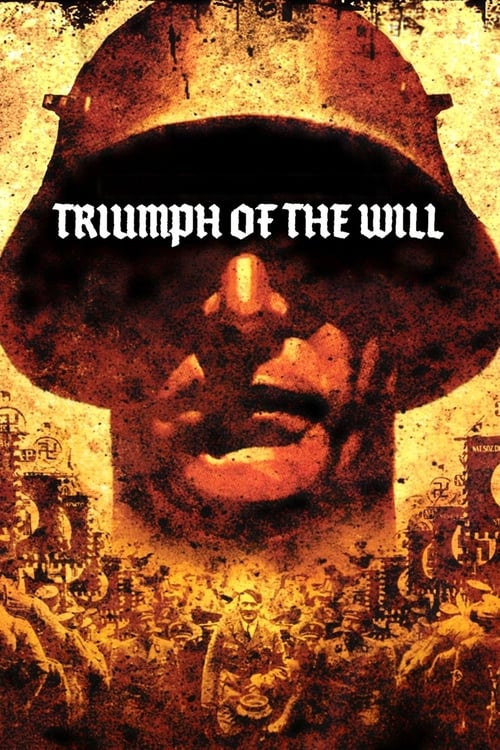
Triumph of the Will
1935 · Leni Riefenstahl
Not a night-in movie — reach for it when you want to understand how images seduce and how power dresses itself up, ideally with your critical guard fully raised. Pure challenge, zero comfort; best watched as study, and worth discussing afterward.
What it's about
A feature-length record of the 1934 Nazi Party rally at Nuremberg, commissioned by the regime itself and staged for the camera on an enormous scale. There is no plot and no narrator — just Hitler's arrival by plane, torchlit parades, vast geometric formations of soldiers, and speech after speech, all arranged as political theater. It is the most infamous propaganda film ever made, and it makes no pretense of being anything else.
The experience
Cold, hypnotic, and deeply disturbing — not because of what it shows but because of how persuasively it shows it. You can feel the machinery of spectacle working on you, and that is exactly what makes it chilling rather than boring.
The craft
Riefenstahl deployed resources no documentary had ever had — dozens of cameras, moving rigs, aerial shots, monumental low-angle compositions — and cut it all to a liturgical rhythm that turns a political rally into ritual. The technique was so effective it has been analyzed, borrowed, and deliberately inverted by filmmakers ever since, which is precisely the problem: the craft cannot be separated from the atrocity it served.
Why it matters
The permanent case study in cinema's power to glorify the indefensible — its imagery has been echoed, parodied, and warned against for ninety years, and it remains required viewing in film schools and history courses for reasons that have nothing to do with pleasure.
Snapshot
Triumph of the Will (Triumph des Willens) is a feature-length documentary record of the Sixth Nazi Party Congress, held at Nuremberg in September 1934 and attended by an estimated 700,000 party functionaries, soldiers, and supporters. Commissioned with Adolf Hitler's direct involvement and directed by Leni Riefenstahl, it remains the most technically accomplished and morally notorious propaganda film ever produced — a work whose formal mastery is inseparable from the totalitarian project it was built to glorify. The film has no narration, no expository intertitles beyond its opening, and no conventional plot. Instead it stages the rally as a quasi-liturgical spectacle: Hitler descending from the clouds by aircraft, torchlit processions, vast geometric formations of massed bodies, and a sequence of speeches that build toward the closing party anthem. It is at once a documentary, a constructed pageant, and an act of political mythmaking. Studied for nearly a century in film schools, ethics courses, and propaganda analysis, Triumph of the Will poses the foundational problem of whether — and how — aesthetic achievement can be separated from the ends it serves. The consensus answer, reached repeatedly across the literature, is that it cannot.
Industry & production
The film was produced under the auspices of the NSDAP itself, with the party leadership functioning as both subject and patron. This was Riefenstahl's second Nuremberg commission: she had shot a shorter, troubled film of the 1933 congress, Der Sieg des Glaubens (Victory of Faith), which was effectively suppressed after the 1934 Night of the Long Knives purge eliminated Ernst Röhm, who appeared prominently in it. Triumph of the Will was conceived partly to replace that compromised earlier effort with a definitive, polished document.
Production resources were extraordinary by documentary standards. Riefenstahl commanded a large crew — figures in the range of well over a hundred personnel, including roughly sixteen to eighteen camera operators, are commonly cited, though exact counts vary across sources. The rally itself was, to a degree historians have long emphasized, organized with the film in mind: Albert Speer's architecture, the placement of flagpoles, the choreography of marching columns, and the timing of events were coordinated so that the event and its filmic record reinforced one another. The distinction between "documenting" a spectacle and "staging" one for the camera collapses here, which is central to the film's enduring critical interest.
The film premiered in Berlin in March 1935 and was distributed by Universum Film AG (UFA), Germany's dominant studio. It received official state honors and was widely exhibited within Germany. Precise box-office or attendance figures are not reliably established in the accessible record, and claims about its commercial performance should be treated with caution. Riefenstahl maintained for the rest of her long life that she was an artist rather than a propagandist — a self-exculpating account that most scholars have found unpersuasive given the film's commissioning, content, and function.
Technology
Triumph of the Will was shot on 35mm black-and-white film using the standard sound-era equipment of mid-1930s German cinema, which was among the most advanced in the world. The production's significance lies less in any single new device than in the scale and ingenuity with which existing tools were deployed. Riefenstahl's team built or adapted an array of camera-mounting solutions to escape the fixed, frontal viewpoint typical of newsreel coverage: tracks were laid (including, famously, a track and elevator system installed on a flagpole or mast to allow vertical movement), cameras were placed on cranes and elevated platforms, and operators were positioned among the crowds and formations rather than confined to a press stand. Roller-skating camera operators and concealed pits have been described in accounts of the production, reflecting a determination to render motion and mass dynamically. The synchronized-sound apparatus of the period allowed direct recording of speeches and ambient roar, though much of the soundtrack was shaped and mixed in post-production rather than captured cleanly live.
Technique
Cinematography
The cinematography — credited principally to Sepp Allgeier alongside a large camera unit — is the film's most celebrated and most imitated achievement. Riefenstahl's operators sought constant variation of angle and elevation: low angles that monumentalize Hitler and the party standards against open sky; high and aerial views that convert crowds into abstract patterns; tracking shots that glide along ranks of bodies. The opening sequence, in which Hitler's plane descends through clouds over Nuremberg with its shadow crossing the medieval city below, is a textbook example of how camera placement alone can encode a political idea — here, the leader as a descending deity. Throughout, the camera treats human beings as both individuals (cutaways to faces, children, onlookers) and as ornamental mass, an oscillation Siegfried Kracauer influentially diagnosed in his concept of the "mass ornament."
Editing
Riefenstahl is credited with the editing herself, and the film's construction in the cutting room is arguably its decisive artistic act. From an enormous quantity of footage — the rally lasted days — she assembled roughly two hours of rhythmic, escalating montage. The editing is musical in conception, building and releasing tension through cross-cutting between scale (vast formations) and intimacy (single faces), between stillness and movement, between the leader speaking and the crowd responding. The film's structure is not chronological reportage but a designed crescendo, culminating in Rudolf Hess's introduction, Hitler's closing speech, and the Horst-Wessel-Lied. This montage technique owes a clear, if politically inverted, debt to Soviet practice (see Authorship & Movement below).
Mise-en-scène / staging
The crucial peculiarity of Triumph of the Will is that its mise-en-scène was largely pre-built by the event's organizers. Speer's monumental architecture, the searchlight "cathedral of light," the symmetrical alignment of banners and columns, and the choreographed marching all constitute a staging designed for the camera. Riefenstahl's contribution was to select, frame, and edit this designed reality into legibility. The result is a closed aesthetic system in which content (order, unity, submission to the leader) and form (symmetry, repetition, verticality) say the same thing. The recurring visual motifs — the eagle, the swastika standard, the diagonal of an outstretched arm — function as a controlled vocabulary.
Sound
The soundtrack combines recorded speech, crowd noise, marching bands, and Herbert Windt's original score (which incorporates Wagnerian idioms and party songs such as the Horst-Wessel-Lied). Sound is used architecturally: silence and swelling music are deployed to sculpt the emotional arc, and the cadence of Hitler's oratory — its pauses, builds, and the answering roar of the crowd — is shaped in the mix into a call-and-response liturgy. The film demonstrates early and sophisticated understanding of how synchronized sound could intensify visual propaganda rather than merely accompany it.
Performance
"Performance" here is unusual: there are no actors, but the film is saturated with performance in the political sense. Hitler, Hess, Goebbels, Streicher, and other party figures perform their roles before both the assembled masses and the camera; the crowds perform devotion. The most analyzed "performance" is Hitler's oratory, presented as charismatic spectacle. Riefenstahl's framing flatters these performances systematically — she selects expressions of rapture, attention, and unity, and excludes whatever would undercut the image. The film thus blurs documentary observation and directed performance to a degree that makes the very category of "documentary" problematic.
Narrative & dramatic mode
The film abandons conventional narrative for ritual structure. There is no protagonist's journey in the dramatic sense, no conflict and resolution; instead there is arrival, gathering, communion, and consecration. If it has a "story," it is the mythic one the Nazi movement told about itself: a wounded nation redeemed and unified under a providential leader. The dramatic mode is closer to liturgy or pageant than to either fiction or reportage — a procession of tableaux building toward a sacralized climax. This is precisely why critics describe the film as the aestheticization of politics, Walter Benjamin's term for fascism's characteristic gesture.
Genre & cycle
Formally, Triumph of the Will belongs to the documentary tradition, and more specifically to the sub-genres of the event film, the newsreel, and the official state record. But it transcends and corrupts these categories: it is the definitive example of the propaganda film as art object. Within the cycle of Nazi-era cinema it sits alongside Riefenstahl's own subsequent Olympia (1938), the two-part record of the 1936 Berlin Olympics, with which it shares a monumental aesthetic. More broadly it belongs to the international interwar cycle of state-sponsored documentary, which ranges from Soviet revolutionary cinema to the public-information films of democracies — a comparison that throws its specific moral character into relief.
Authorship & method
Authorship is the central controversy of the film. Riefenstahl directed and edited it and shaped its aesthetic decisively; her talent is not in serious dispute. The dispute concerns responsibility. Her postwar defense — that she was an apolitical artist captivated by form, ignorant of or indifferent to the politics — has been widely rejected as inconsistent with the documented facts of the commission, the film's content, and her access to the regime's highest levels. The film is best understood as a collaboration between an exceptional filmmaker and a totalitarian state that supplied both subject and resources.
Key collaborators sharpen this picture. Cinematography was led by Sepp Allgeier, a veteran of the German "mountain film" (Bergfilm) genre in which Riefenstahl herself had starred and trained, heading a large unit. The score was composed by Herbert Windt, whose Wagner-inflected music is integral to the film's emotional engineering. The editing was Riefenstahl's own, the locus of her authorship. There is effectively no conventional screenwriter, since the film has no scripted dialogue; its "writing" is its structure. Riefenstahl's method — vast coverage from many cameras, followed by long, intensive editing that imposes rhythm and meaning on raw spectacle — became her signature and is most fully realized in Olympia.
Movement / national cinema
The film stands at the intersection of two currents. It is a product of German national cinema at the moment of its Nazification — the UFA system and the technical sophistication of Weimar filmmaking turned to the service of the new regime. It also draws, paradoxically, on the montage theory of Soviet revolutionary cinema (Eisenstein, Vertov, Pudovkin): the rhythmic juxtaposition of shots to produce emotional and ideological effect. Triumph of the Will thus represents the appropriation of an aesthetic born of left revolution by its political opposite, a fact that has fueled long debate about whether montage technique carries any inherent politics or is a neutral instrument available to any ideology. It belongs to no avant-garde movement; rather it is a state cinema, the official self-image of a totalitarian party.
Era / period
The film is a document of 1934–35, the consolidation phase of Nazi power following Hitler's 1933 accession and the 1934 purge. It captures the regime at the moment it was constructing the mythology of unity and permanence (the "thousand-year Reich") that would underwrite the catastrophes to come. Made before the Nuremberg Laws, the remilitarization of the Rhineland, and the war, it is a portrait of fascism in its triumphant, self-confident ascent — which lends the film, viewed historically, a chilling irony its makers could not have intended.
Themes
The film's explicit themes are unity, rebirth, leadership, sacrifice, youth, and the fusion of party, nation, and people into a single will — the meaning of the title, drawn from Nazi rhetoric. Its implicit and now dominant theme, for later viewers, is the seduction of the image: how beauty, order, and emotional grandeur can be marshaled to render an evil project alluring. The recurrent motifs — light and shadow, the individual subsumed into the mass, verticality and descent, the leader as redeemer — all serve a single argument: submission as transcendence. The film offers no counter-voice, no doubt, no interior life; this totality is itself thematic.
Reception, canon & influence
On release within Nazi Germany the film was honored by the state and exhibited as a national achievement; it also won prizes at international venues in the late 1930s before the war hardened opinion. Reliable independent box-office data is scarce. After 1945 the film became legally and morally radioactive: it has long been restricted in Germany, screenable chiefly in educational or contextualized settings, and abroad it entered film history through the back door of analysis rather than appreciation.
Influences on the film (backward): Riefenstahl drew on the German Bergfilm tradition (its monumental landscapes and heroic bodies), on Soviet montage theory, on Wagnerian opera and its Gesamtkunstwerk ideal of total artwork, and on the visual conventions of the newsreel and the mass spectacle.
Legacy (forward): The film's influence is double-edged and pervasive. Its visual grammar — low-angle hero shots, aerial views of crowds, rhythmic montage of mass and individual, the descending leader — was absorbed into Hollywood, into Allied wartime filmmaking (Frank Capra's Why We Fight series notoriously repurposed its footage to indict the enemy), and into the everyday vocabulary of political advertising, sports broadcasting, and the spectacle film. Sequences have been quoted, parodied, and reworked endlessly, most famously in the throne-room finale of Star Wars (1977). At the same time the film became the permanent case study in the ethics of form: the touchstone for Susan Sontag's essay "Fascinating Fascism," for Kracauer's and Benjamin's analyses of mass aesthetics, and for every subsequent argument about propaganda, documentary truth, and the responsibility of the artist. Its enduring place in the canon is therefore singular: it is studied not as a film to admire but as the most powerful demonstration that technical and aesthetic brilliance can be turned entirely to the service of barbarism — and that this possibility is itself one of cinema's permanent dangers.
A Deleuzian reading
Begin with the shadow.
The full Deleuzian reading of Triumph of the Will →
Reception
Feted at the time — a gold medal at the 1937 Paris World Exposition — it's now the ultimate cautionary text: taught everywhere, admired nowhere, the film that made 'great technique in service of evil' a permanent category.
How Triumph of the Will was received, from release to now →
Influences: the films it descends from and the films it influenced
- The Battleship Potemkin (1925) — Riefenstahl's collision-and-crescendo cutting — intercutting individual faces against advancing masses to build emotional rhythm — adapts Eisenstein's dialectical montage from the Odessa Steps to the Nuremberg ranks.
- The Holy Mountain (1926) — The Bergfilm grammar Fanck trained Riefenstahl in — low-angle worship of heroic bodies against sky, sunlit silhouettes, mist and backlight as ennobling filters — is transferred wholesale from alpine peaks to the figure of Hitler descending through clouds.
- Napoleon (1927) — Gance's liberated camera — strapped to bodies, swung over crowds, multiplied across screens to make a leader's arrival kinetic — anticipates Riefenstahl's sweeping crane and tracking moves that turn a static rally into surging movement.
- Metropolis (1927) — Lang's geometric choreography of identical workers into architectural patterns supplies the 'mass ornament' Riefenstahl shoots from above — human beings arranged as abstract design rather than individuals.
- Berlin: Symphony of a Great City (1927) — Ruttmann's editing of documentary footage to a musical-rhythmic structure — montage governed by tempo rather than narrative — models how Riefenstahl and composer Herbert Windt synchronize cut and crescendo into emotional engineering.
- October: Ten Days That Shook the World (1928) — Eisenstein's restaging and re-editing of a mass political event into mythic spectacle — intellectual montage that builds an icon from crowd and monument — is the Soviet propaganda method Riefenstahl inverts for the opposite regime.
- The Birth of a Nation (1915) — Griffith's marshalling of large-scale crowd mobilization and parallel cutting into a film engineered as political persuasion establishes the feature-length spectacle-as-propaganda form Riefenstahl perfects.
- The Blue Light (1932) — Riefenstahl's own directorial debut develops the mystical low-angle, filtered-light treatment of landscape and a chosen figure that she carries directly into the leader-imagery of the rally film.
- Die Nibelungen: Siegfried (1924) — Renders symmetrical, ritualized massed ranks as ornament from an elevated frontal geometry — the spectacle-politics visual language Kracauer read forward from Siegfried's ornamental crowds.
- Die Nibelungen: Kriemhild's Revenge (1924) — Realizes Kracauer's proto-fascist reading of the film by massing human figures into rigid geometric ornament within monumental architecture as political spectacle.
- Olympia (1938) — Riefenstahl fully realizes her signature method here — vast multi-camera coverage followed by intensive rhythmic editing — extending the aestheticization of the heroic body into slow-motion, pit-dug, and tracked athletic forms.
- Why We Fight (1943) — Capra literally recut Triumph's own footage, reversing its low-angle monumentalization and crescendo montage to indict rather than glorify — the clearest case of inheriting the technique to weaponize it back.
- The Great Dictator (1940) — Chaplin parodies the film's call-and-response oratory and architectural staging of the speaking leader, mimicking the rally's spatial theater to deflate the spectacle Riefenstahl built.
- Star Wars (1977) — The medal-ceremony finale directly quotes Triumph's composition — heroes processing down a central aisle between massed, motionless symmetrical ranks toward an elevated dais shot from a low angle.
- The Lion King (1994) — The 'Be Prepared' number restages Triumph's iconography wholesale — goose-stepping ranks of hyenas in rigid formation, low-angle worship of the leader on a monumental rock against searchlight beams.
- Starship Troopers (1997) — Verhoeven reverse-engineers Riefenstahl's propaganda-documentary grammar — newsreel call-and-response, uniformed mass formations, heroic low angles — as satire that makes the audience feel the seduction it critiques.
- Lessons of Darkness (1992) — Established aerial cinematography as the opening formal gambit of documentary spectacle — camera descending through clouds to unveil the subject below — a device Lessons of Darkness inherits and inverts, applying the identical movement to wreckage rather than triumph.
- The Hunger Games: Catching Fire (2013) — Originates the fascist mass-pageant grammar — uniformed ranks, monumental architecture, the leader above the crowd — that the Capitol's rallies and Snow's staging quote as costume-and-design politics.
- Zack Snyder's Justice League (2021) — Source of the low-angle vertical monumentality and mass iconographic tableau — backlit figures shot as monuments against sky — that Snyder repurposes for heroic deification framing.
- Alexander Nevsky (1938) — Its frieze-like ordering of massed bodies into ornamental ranks supplied the fascist visual vocabulary Eisenstein deliberately quoted to render the Teutonic order as a modern enemy.
- Richard III (1995) — Supplies the Nuremberg vocabulary — banners, podium framing, massed-rally geometry — directly quoted to make Richard's coronation read as fascist spectacle.
- 300 (2007) — The monumental low-angle framing of the idealized body and ranked masses — the fascist-classical compositional grammar 300 deliberately mobilizes for its Spartan iconography.
- Citizen Kane (1941) — Welles deploys the same low-angle monumentalization and the towering campaign-rally backdrop with the diminished leader before a giant projected image of himself — political-spectacle staging in dialogue with Riefenstahl's grammar.
- Hero (2002) — Zhang choreographs vast color-coded armies into abstract geometric ornament filmed from above and head-on, extending the same submission-as-transcendence staging of the individual dissolved into ordered mass.
Similar films
- The Birth of a Nation (1915) — influence & lineage
- Metropolis (1927) — influence & lineage
- The Great Dictator (1940) — influence & lineage
- Napoleon (1927) — influence & lineage
- Citizen Kane (1941) — influence & lineage
- Hitler: A Film from Germany (1978) — shared sensibility
- Battleship Potemkin (1925) — shared sensibility
- Night and Fog (1956) — shared sensibility
All the films related to Triumph of the Will →