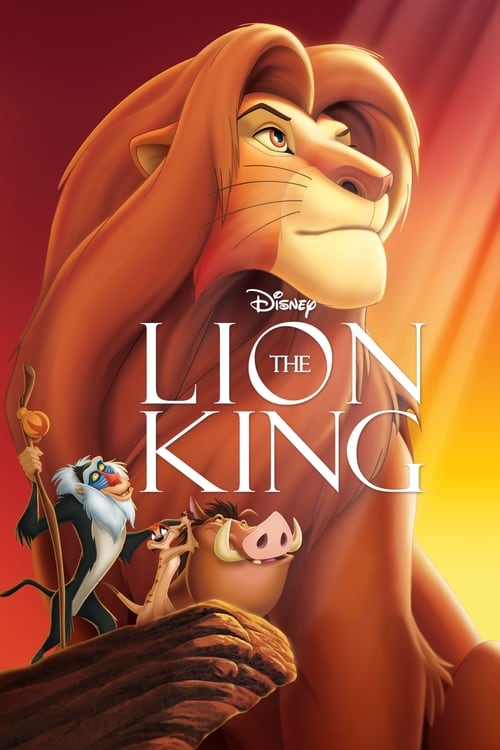
The Lion King
1994 · Roger Allers
For family movie night, nostalgia night, or whenever you want a story with the shape of a legend — comfort viewing that still isn't afraid to break your heart on the way.
What it's about
Simba, a lion cub who can't wait to be king, grows up adoring his father Mufasa while his uncle Scar schemes for the throne. Betrayal and tragedy drive the young prince into exile, where easy living and new friends let him hide from who he is — until his past comes looking for him. A coming-of-age story played out across the African savanna, with songs.
The experience
Sweeping and mythic one minute, goofy and singalong the next — it hits genuine grief harder than almost any family film, then earns its way back to triumph. Kids feel it as adventure; adults feel it as loss and return.
Performances
The voice cast is iconic: James Earl Jones gives Mufasa the weight of a mountain, and Jeremy Irons makes Scar one of animation's great silken villains.
The craft
Hand-drawn animation at its confident peak — the wildebeest stampede was a landmark of the era — set to Elton John and Tim Rice songs and a Hans Zimmer score that opens with maybe the most famous sunrise in movies. Play it loud; the opening alone justifies good speakers.
Why it matters
The commercial summit of the Disney Renaissance and for years the highest-grossing traditionally animated film ever, it spawned one of the most successful stage musicals in history and remains a first-movie rite of passage for generations of kids.
Snapshot
The Lion King stands as the commercial and cultural apex of the so-called Disney Renaissance, the studio's late-1980s-through-1990s creative and financial resurgence. Directed by Roger Allers and Rob Minkoff and produced by Don Hahn, it was the first Walt Disney Animation Studios feature built from an original story rather than adapted from an existing fairy tale, novel, or legend—a fact that shaped both its production anxieties and its eventual mythic ambition. Following the young lion Simba from birth through exile to reclamation of his throne, the film fuses African savanna imagery, a coming-of-age narrative freighted with Shakespearean and biblical resonance, and a songbook by Elton John and Tim Rice atop an orchestral score by Hans Zimmer. On release it became, for a time, the highest-grossing traditionally animated film ever made, and it seeded a franchise—Broadway musical, direct-to-video sequels, a 2019 photorealistic remake, and a 2024 prequel—that has few equals in animation history.
Industry & production
The film emerged from a Disney feature-animation division riding the momentum of The Little Mermaid (1989), Beauty and the Beast (1991), and Aladdin (1992). Development began around 1988–1991 under the working title King of the Jungle, with the concept credited in studio lore to executives including Jeffrey Katzenberg, Roy E. Disney, and Peter Schneider. It is well documented that within the studio the project was initially regarded as the lesser of two simultaneous productions, with Pocahontas considered the prestige "A" picture that more senior artists gravitated toward; The Lion King was, by numerous first-hand accounts, staffed in part by those who took a chance on the riskier, dialogue-and-animal-driven original story. That framing—the underdog production that outperformed expectations—has become a durable part of its history.
Don Hahn produced. The directorial reins passed through several hands; George Scribner was attached early before departing over creative-direction differences, after which Roger Allers and Rob Minkoff took over. Development was famously turbulent: the story went through extensive reworking, songs were added and cut, and the tone shifted from a looser nature-comedy toward the operatic tragedy of the finished film. Research trips to East Africa, including Kenya's Hell's Gate National Park, are credited with grounding the Pride Lands' landscapes. The film was made across Disney's Burbank studio and its Florida animation facility at Walt Disney World.
Technology
The Lion King was produced primarily through traditional hand-drawn cel animation, but by 1994 that process was fully mediated by CAPS—the Computer Animation Production System developed with Pixar—which handled digital ink-and-paint, multiplane camera compositing, and color. The most celebrated technological set piece is the wildebeest stampede in the gorge: a herd generated with 3D computer animation, then given a hand-drawn look and multiplied and choreographed by computer so that dozens of animals could move with individualized, non-repeating paths. Studio accounts describe a small team spending a substantial period developing the simulation software for that sequence alone. The film thus sits at a hinge point in the medium—still fundamentally a drawn film, but one whose signature moment depended on digital tools that would, within a decade, displace hand animation as the studio's dominant mode. (Deep Canvas and other later 3D-painting innovations postdate this film; here the CGI is more localized.)
Technique
Cinematography
Though animated, the film deploys a deliberately "photographed" visual language, with a virtual camera that borrows from live-action epic and nature documentary. The opening "Circle of Life" is staged as a single sustained crescendo of establishing shots—sunrise over the savanna, migrating animals, the gathering at Pride Rock—building to the presentation of the infant Simba. Elsewhere the film favors dramatic low angles that monumentalize Mufasa and Pride Rock, expressionist lighting for Scar and the elephant graveyard, and sweeping crane-like moves through the stampede. Color functions almost tonally: warm golds for the Pride Lands in balance, sickly greens and grays for the graveyard and Scar's blighted kingdom, lush jungle saturation for Simba's exile in Hakuna Matata. The compositional debt to David Lean-style widescreen vistas is frequently noted.
Editing
The editing (credited to Ivan Bilancio and Tom Finan) modulates between long, lyrical musical montages and sharply cut dramatic beats. The "I Just Can't Wait to Be King" and "Hakuna Matata" numbers are constructed as montage set pieces that compress time and geography; "Hakuna Matata" in particular carries Simba visibly from cub to adult in a single song. Against these, the film's tragic core—Mufasa's death in the stampede—is cut for maximum shock and then held on Simba's grief, allowing stillness after velocity. This alternation of propulsion and pause is central to the film's emotional architecture.
Mise-en-scène / staging
Staging leans on theatrical, almost operatic tableaux: the presentation of Simba on Pride Rock, Scar's fascistic "Be Prepared" rally amid the hyenas and rising geysers, Mufasa's ghostly manifestation in the stars and clouds. Pride Rock itself is a monumental set piece, a natural throne that visually equates geography with sovereignty. The elephant graveyard and the gorge are designed as zones of danger set against the ordered kingdom. This strong, poster-like staging is part of why the material translated so readily to Julie Taymor's stage adaptation.
Sound
The soundscape braids Hans Zimmer's orchestral-and-African-choral score with the Elton John/Tim Rice songs and vivid sound design for the natural world. Lebo M.'s vocal contributions and the use of South African choral textures give the score a distinctive identity; the wordless vocal that opens "Circle of Life" is among the most recognizable sound cues in animation. Zimmer's score won the Academy Award for Best Original Score, and "Can You Feel the Love Tonight" won Best Original Song (three of the film's songs were among the nominees in that category).
Performance
The voice cast is unusually strong and was clearly cast for vocal authority as much as celebrity. James Earl Jones lends Mufasa a gravitas that anchors the film's moral universe; Jeremy Irons gives Scar a sardonic, theatrically menacing wit widely regarded as one of Disney's finest villain performances. Matthew Broderick voices adult Simba, with Jonathan Taylor Thomas as the cub; Nathan Lane and Ernie Sabella supply the comic double act of Timon and Pumbaa; Rowan Atkinson voices the officious hornbill Zazu, Whoopi Goldberg and Cheech Marin lead the hyenas, Robert Guillaume voices the mandrill shaman Rafiki, and Moira Kelly voices adult Nala. Animators are documented as studying the voice actors' physical performances, and the animals' expressive faces are keyed closely to the vocal characterizations.
Narrative & dramatic mode
The dramatic mode is tragedy-into-restoration: a prince's fall through guilt and abdication, followed by a return that heals a disordered kingdom. Its most cited literary template is Hamlet—a murdered king, a usurping uncle, a hesitant heir, a paternal ghost urging remembrance—though the film swaps Shakespeare's fatalism for a redemptive arc. Commentators also point to biblical structures, particularly the Joseph and Moses stories of exile and return, and to Bambi (1942) as the studio's own precedent for animal life, paternal loss, and the passage of seasons. The screenplay (credited to Irene Mecchi, Jonathan Roberts, and Linda Woolverton) organizes the film around the "Circle of Life" as both cosmology and plot engine: kingship as ecological stewardship, and Simba's maturation as the acceptance of responsibility over the escapist creed of "Hakuna Matata."
Genre & cycle
The film belongs to the Disney animated-musical cycle codified by The Little Mermaid and Beauty and the Beast: the Broadway-inflected book-musical structure, the "I want" song, the comic sidekicks, the show-stopping villain number. But it distinguishes itself within that cycle by dispensing with human characters entirely and with a conventional romance-centered plot, foregrounding instead a father-son and dynastic drama. It also participates in a longer lineage of anthropomorphic-animal storytelling and of the coming-of-age epic. Its blend of nature-film spectacle, mythic quest, and stage-musical form is central to its identity within the Renaissance cycle.
Authorship & method
Authorship is genuinely collaborative and studio-distributed rather than singular. Roger Allers and Rob Minkoff shared direction, with Allers also deeply involved in story. Don Hahn produced, coming off Beauty and the Beast. The screenplay credit goes to Irene Mecchi, Jonathan Roberts, and Linda Woolverton, though the film passed through many story hands in Disney's iterative story-department method. Supervising animators shaped the principal characters as quasi-authors of performance—Andreas Deja is well documented as the supervising animator of Scar, and other supervising animators led Simba, Mufasa, Timon, Pumbaa, and the rest; the drawn "performance" of each character is as much theirs as the voice cast's. Hans Zimmer composed the score, with Elton John and Tim Rice writing the songs and Lebo M. contributing the African choral dimension. The absence of a single controlling cinematographer or editor in the auteur sense reflects the collective, pipeline-based authorship characteristic of studio animation.
Movement / national cinema
The film is a product of American studio animation and specifically of the Disney Renaissance—a movement defined by the return of the Broadway-style musical to feature animation, the integration of computer-assisted production, and a run of blockbuster commercial success from roughly 1989 to the end of the 1990s. Its imagery draws on East African landscapes and its music on South African choral traditions, but it remains a Hollywood product; scholars have long debated its representation of Africa, its use of accent and characterization, and questions of cultural appropriation and authenticity, and those debates are part of the film's critical record.
Era / period
Released in 1994, the film arrived at the height of Disney's box-office dominance in animation and at the threshold of the computer-animation era—Pixar's Toy Story, the first fully CGI feature, followed in 1995. The Lion King thus marks a peak of the hand-drawn tradition even as it demonstrates, through the stampede, the tools that would supersede it. It also belongs to the mid-1990s moment of aggressive franchise and merchandising strategy, and its commercial performance helped underwrite Disney's expansion into stage theater and consumer products.
Themes
Its central themes are the acceptance of responsibility and identity ("Remember who you are"); mortality, grief, and inheritance across generations; the moral order of nature figured as the Circle of Life; and the contrast between escapism (Hakuna Matata) and duty. Guilt and self-forgiveness drive Simba's arc, while Scar embodies tyranny, resentment, and the ecological ruin that follows illegitimate rule—his blighted Pride Lands making explicit the film's equation of just kingship with a healthy natural world. The father-son relationship, and the persistence of the parent in memory, gives the film its enduring emotional weight.
Reception, canon & influence
Critically, the film was broadly praised on release for its animation, its music, and especially James Earl Jones's and Jeremy Irons's vocal performances, though some critics found its mythic solemnity and its politics of monarchy and nature open to question; the debates over its representation of Africa and over the disputed resemblances to Osamu Tezuka's Kimba the White Lion have followed it for decades, and both remain genuinely contested rather than settled. It won Academy Awards for Best Original Score and Best Original Song and was among the most commercially successful films of its year and the highest-grossing traditionally animated film of its era; I'm summarizing its standing rather than citing exact figures, which vary by source and re-release.
Looking backward, the film's influences are well established: Hamlet and Shakespearean tragedy; biblical exile-and-return narratives; Disney's own Bambi; the nature-documentary and widescreen-epic traditions; and the Broadway musical form imported by the preceding Renaissance films. Looking forward, its legacy is vast. It anchored a franchise of direct-to-video sequels and the spin-off The Lion King 1½ and television series, and above all Julie Taymor's 1997 Broadway adaptation, whose inventive puppetry and staging became one of the most successful stage musicals in history. Jon Favreau's 2019 "live-action"/photorealistic-CGI remake and the 2024 prequel Mufasa: The Lion King extended the property into a new technological register. More broadly, the film cemented the commercial template of the animated musical, demonstrated the viability of original (non-adapted) mythic storytelling in mainstream animation, and, through its stampede, helped normalize the CGI tools that would soon remake the medium entirely. Its songs and images have passed into general cultural literacy to a degree matched by very few films of any kind.
A Deleuzian reading
A brown seam shows along the lip of the gorge.
The full Deleuzian reading of The Lion King →
Reception
A monster hit on release — the highest-grossing traditionally animated film ever — and unlike many 90s blockbusters it never needed a reappraisal; if anything, the drab 2019 remake retroactively made the hand-drawn original look even more like the untouchable peak of the Disney Renaissance.
How The Lion King was received, from release to now →
How to watch The Lion King: what to notice on a first viewing
- Watch how low the camera sits when Mufasa stands on Pride Rock. Allers and Minkoff keep putting Mufasa above the horizon line, held in poster-flat silhouettes and low angles. James Earl Jones matches it, letting every line land like bronze. Authority in this film is a matter of where the camera is placed, not what anyone says about it.
- Notice the color shift: warm gold, sickly green, then jungle saturation. The Pride Lands in balance are gold. The elephant graveyard goes green and gray. Simba's exile is drenched, lush color. The palette tells you the state of the kingdom before the plot does. Color here is information. You can read the health of the land off the screen at any moment.
- Listen for the wordless voice that opens the film before any dialogue. Lebo M.'s call arrives over the sunrise, and Zimmer's orchestra and South African choir carry the whole prologue. Nobody speaks for minutes. Picture is cut to music, not to a protagonist. The film sets its terms with sound and image alone, so you accept the world before you meet anyone in it.
- Watch Simba grow from cub to adult inside one song. "Hakuna Matata" is built as a montage set piece. Time passes, geography compresses, and nothing happens except that Simba gets older and stops acting on what he knows. The film's warmest stretch is also its most passive one, which is exactly the trap it sets.
- Listen to how slowly Jeremy Irons lets Scar's lines drop. Irons plays every sentence as a bored aside, drawling past the beat. The animators keyed Scar's droop, his shoulders and his half-closed eyes, straight to that delivery. The drawn face and the recorded voice were built together, so the performance reads as one thing.
The whole guide to watching The Lion King, with the keys for a rewatch →
Influences: the films it descends from and the films it influenced
- Bambi (1942) — Disney's own template for naturalistic quadruped animation drawn from live animals brought into the studio for anatomical study, plus the offscreen death of a parent used as the story's emotional load-bearing pivot — both inherited almost directly.
- Beauty and the Beast (1991) — Supplied the CAPS digital ink-and-paint pipeline and the first sweeping CGI 'virtual camera' move (the ballroom), the exact toolset and swooping-camera grammar the stampede and Pride Rock reveals extend — with Don Hahn carrying the producing method straight over.
- The Little Mermaid (1989) — Established the Renaissance's Broadway book-musical spine — the 'I Want' song and integrated song placement that 'I Just Can't Wait to Be King' and 'Be Prepared' follow beat for beat.
- Fantasia (1940) — Model for wordless image-cut-to-orchestra montage (notably 'Rite of Spring'), the technique the 'Circle of Life' prologue uses to open the film with pure picture edited to score and no dialogue.
- Triumph of the Will (1935) — Source of the low-angle monumentalizing and mass-rally choreography that 'Be Prepared' openly quotes — goose-stepping hyena legions filing past Scar reviewing them from a rocky rostrum above.
- Lawrence of Arabia (1962) — Widescreen epic landscape grammar — the lone figure dwarfed against monumental sunrise vistas — that Pride Rock's presentation staging and the film's savanna panoramas borrow wholesale.
- Kimba the White Lion (1965) — The persistently contested debt in lion-cub-becomes-king iconography and specific character-design and staging resemblances (the mandrill mentor, the wise-father-in-the-clouds motif) that critics have never fully settled.
- The Jungle Book (1967) — A Kipling-descended animal coming-of-age with a wise-mentor/comic-sidekick pairing (Timon & Pumbaa as the Baloo carefree-philosophy heirs, 'Hakuna Matata' echoing 'Bare Necessities') voiced by comedians.
- The Hunchback of Notre Dame (1996) — Scales up the African-choral gambit into full Latin liturgical choral scoring and pushes the operatic-tableaux staging further, while using CGI crowd generation to fill the cathedral square.
- Mulan (1998) — The Hun cavalry charge over the ridge was built with crowd-simulation software cloning thousands of individually-varied figures — the direct technical descendant of the wildebeest stampede's simulated CGI herd.
- Tarzan (1999) — Its Deep Canvas system lets a virtual camera travel through painted 3D jungle environments — a direct extension of the Lion King's virtual-camera experiments into a fully navigable space.
- Spirit: Stallion of the Cimarron (2002) — Carries a naturalistically-animated, largely non-speaking animal protagonist on a sweeping Hans Zimmer pop-choral score — extending the animal-epic-scored-like-a-drama formula the Lion King crystallized.
- The Lion King (2019) — Re-stages the identical shots through photoreal CGI and game-engine virtual production, converting the 1994 virtual camera into literal virtual cinematography with VR-scouted lensing.
- Mufasa: The Lion King (2024) — Extends the property and its photoreal virtual-production register into a prequel, reprising the low-angle monumentalizing and choral-epic scoring within the same technological pipeline.
- Black Panther (2018) — Disney's Hamlet adaptation mediated the succession-tragedy structure — African royal family, waterfall ceremonial challenge site, a charismatic rival's murder of the father-king, exile followed by spiritual summons and return — through which Black Panther routes its Shakespearean architecture without direct debt to Olivier or Branagh.
- How to Train Your Dragon 2 (2014) — Codified the animated coming-of-age epic where a young heir loses a father-leader and must accept the burden of rule — the leadership-and-grief arc Hiccup inherits after Stoick.
- Transformers One (2024) — Supplies the origin-tragedy of fraternal betrayal mapped onto succession and social order—two bonded figures split by ambition and station into mythic hero and mythic villain.
- Zootopia 2 (2025) — Pioneers Disney's animal-fur rendering and its landmark early crowd-simulation (the wildebeest stampede), the direct forebear of the studio's mammal-fur and stampeding-crowd techniques.
- Kirikou and the Sorceress (1998) — The negative model Kirikou answers point-for-point: against Hollywood's Broadway-orchestral, Hamlet-plotted Africa, Ocelot substitutes N'Dour's living West African score, folk-tale cadence, and the unclothed African body treated with dignity.
- Hercules (1997) — Its CG crowd-simulation breakthrough (the wildebeest stampede) supplies the hand-drawn-on-CG mass-action technique Hercules deploys for the hydra coils and the Titans' assault on Olympus.
- Aladdin (1992) — Immediately-preceding Renaissance film that made marquee celebrity voice casting (Robin Williams) a performance draw and folded CGI set pieces (the carpet, the Cave of Wonders tiger) into hand-drawn frames — both moves the Lion King's star cast and CGI stampede parallel.
- Pocahontas (1995) — The following Renaissance entry that pushes the same low-angle nature-mysticism and monumentalized landscape staging into an original-myth register, extending the operatic-tableaux approach.
- The Prince of Egypt (1998) — Runs the same playbook at a rival studio: a Hans Zimmer choral-epic score under a mythic exile-and-return, operatic monumental tableaux, and CGI-blended crowds and effects proving the model portable.
Similar films
- Aladdin (1992) — influence & lineage · same viewing thread
- Fantasia (1940) — influence & lineage · same viewing thread
- Beauty and the Beast (1991) — influence & lineage · same viewing thread
- Mulan (1998) — influence & lineage · same viewing thread
- The Prince of Egypt (1998) — influence & lineage
- The Jungle Book (1967) — same viewing thread
- Tangled (2010) — same viewing thread
- The Princess and the Frog (2009) — same viewing thread
All the films related to The Lion King →
Watch it with: curated runs of related films
- Disney's Animated Golden Ages — Watch these together to trace Disney's storybook house style across three eras — the 1940 concert experiment, the hand-drawn renaissance, and the CG revival — and hear how each generation quotes the last.