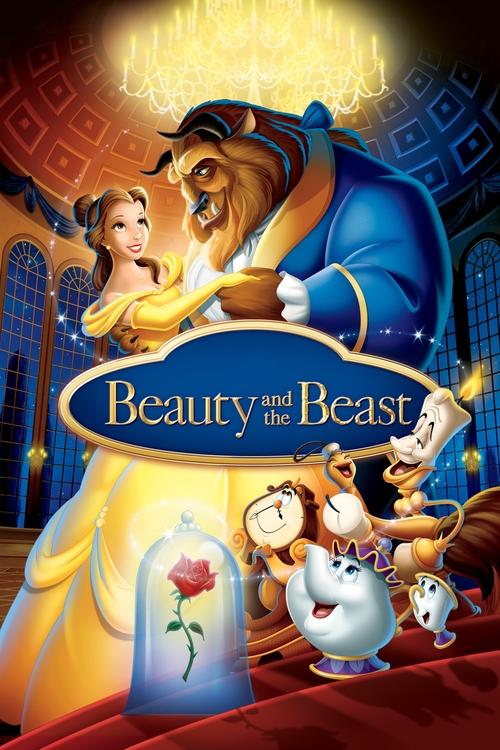
Beauty and the Beast
1991 · Gary Trousdale
For a cozy night in when you want to fall in love — with a story, a song, a whole world. Pure comfort, whether you're introducing it to a kid or revisiting it yourself.
What it's about
Belle, a book-loving young woman stifled by her small French town, trades her freedom for her father's when he's imprisoned in an enchanted castle ruled by a fearsome Beast — a cursed prince running out of time to earn someone's love. With a household staff transformed into candlesticks, clocks, and teapots playing matchmaker, a wary captivity slowly thaws into something neither expected, while a vain hometown suitor plots to bring Belle back.
The experience
Warm, sweeping, and paced like the best Broadway show — big comic numbers, a swooning central waltz, and real menace at the edges. It's the rare family film that plays completely sincerely to adults.
Performances
The voice cast is stacked: Paige O'Hara gives Belle wit and spine, Angela Lansbury's rendition of the title song is an all-timer, and Jerry Orbach's Lumière turns a candlestick into the film's showman.
The craft
Alan Menken and Howard Ashman's songs are structured like genuine musical theater — every number advances character — and the animation peaks in the ballroom sequence, an early marriage of hand-drawn figures and computer-generated space that still dazzles on a big screen. The opening stained-glass prologue alone announces the film's ambition.
Why it matters
The first animated feature ever nominated for the Best Picture Oscar, it redefined how seriously the industry took animation, crowned the Disney Renaissance, and stands as a monument to lyricist Howard Ashman, who died before its release.
Snapshot
Beauty and the Beast is the thirtieth feature in the Walt Disney Animated Classics canon and the film most often named as the summit of the "Disney Renaissance." Directed by Gary Trousdale and Kirk Wise — their first feature — and produced by Don Hahn, it adapts the eighteenth-century French fairy tale into a Broadway-styled musical about Belle, a bookish provincial girl who trades her freedom for her father's and, imprisoned in an enchanted castle, learns to see the man inside a cursed Beast. Its historical significance is disproportionate to its modest running time: it was the first animated feature nominated for the Academy Award for Best Picture, a distinction that reframed how the industry and critics regarded feature animation as an art form. The film is also inseparable from loss — its lyricist Howard Ashman, who shaped its dramatic architecture, died of complications from AIDS in March 1991, months before release, and the finished film carries a dedication to him.
Industry & production
The project emerged during Disney animation's abrupt commercial revival. After a fallow stretch in the 1970s and early 1980s, The Little Mermaid (1989) demonstrated that the Broadway-musical model could reanimate the studio's fairy-tale tradition, and Beauty and the Beast was greenlit into that momentum under the Michael Eisner–Jeffrey Katzenberg regime, with Roy E. Disney overseeing the animation division. Disney had circled the property for decades — attempts date back to the studio's classic era — but a viable version proved elusive.
The film's development is a well-documented case of a production reversing course mid-flight. An initial treatment, developed in London under director Richard Purdum, conceived the story as a darker, largely non-musical drama; Katzenberg rejected this approach and directed the team to build a musical in the mode of The Little Mermaid, bringing in Ashman and composer Alan Menken. Ashman, then gravely ill, worked with the story team from New York, and his contribution extended well beyond lyrics into structure and character — the decision to animate the enchanted household objects as a supporting ensemble, and to make Gaston a comic-menacing antagonist, bears his theatrical sensibility. The compressed schedule that resulted from the restart became part of the film's lore; the crew delivered under acute time pressure.
The production is notable for the prominence of Linda Woolverton's screenplay credit — she was the sole credited screenwriter and the first woman to receive that credit on a Disney animated feature — and for a Belle deliberately conceived as more active and literate than earlier Disney heroines, a response to contemporary criticism of the studio's princesses.
Technology
Beauty and the Beast was the first Disney animated feature produced entirely with CAPS — the Computer Animation Production System developed jointly with Pixar. CAPS replaced the century-old process of photographing hand-painted cels: artists' drawings were scanned, then digitally inked, painted, and composited. This liberated the palette from the physical limits of cel paint, allowed unlimited layering without the light loss of stacked cels, and enabled software-driven camera moves and multiplane depth effects that would have been laborious or impossible on the traditional animation stand. (Elements of CAPS had been trialed on The Little Mermaid and The Rescuers Down Under, but Beauty and the Beast was the first feature to run through the pipeline end to end.)
The film's most cited technological achievement is the ballroom waltz, in which hand-drawn 2D figures of Belle and the Beast dance through a computer-generated three-dimensional environment — a sweeping virtual camera arcing across a modeled ballroom. It became a landmark demonstration of hybrid 2D/3D animation and is routinely invoked as a turning point in the integration of CGI into traditional animation, foreshadowing the digital transformation of the field over the following decade.
Technique
Cinematography
As an animated feature, the film has no photographed cinematography in the live-action sense; its "camera" is a constructed one, realized through layout, staging, and the digital multiplane capabilities of CAPS. The visual language is nonetheless self-consciously cinematic. The virtual camera in the ballroom sequence performs a continuous crane-and-orbit move that no traditional multiplane rig could achieve, and elsewhere the film favors dynamic pushes, tilts, and dramatic angles — low angles that enlarge Gaston and the Beast, and sweeping establishing views of the castle. Art director Brian McEntee oversaw a color-scripting strategy in which palette tracks emotional arc: cool blues and shadow dominate the Beast's early scenes, warming as intimacy grows, culminating in the gold-and-amber ballroom.
Editing
Editor John Carnochan cut the film to the rhythm of its songs, which function as structural set pieces. The musical numbers are edited as self-contained sequences — the bustling ensemble choreography of "Belle," the tavern showpiece "Gaston," the vaudevillian production number "Be Our Guest" — each escalating in tempo and cutting rate to a climax before resolving. The dramatic connective tissue between numbers is paced more patiently, and the film's climax intercuts the villagers' torch-lit assault with the intimate confrontation on the castle roof, a parallel construction typical of classical narrative editing.
Mise-en-scène / staging
The film's staging is theatrical in the best sense, a legacy of Ashman's Broadway orientation. Crowd numbers are choreographed with ensemble precision; "Be Our Guest" stages the enchanted objects as a Busby Berkeley–style floor show. The castle interiors are designed as expressive space — vast, cold, and Gothic in the Beast's domain, softening as the relationship thaws — while the provincial village is warm, ordered, and slightly claustrophobic, visually encoding Belle's sense of not belonging. Character silhouettes are strongly differentiated: Gaston's inverted-triangle bulk, the Beast's hunched mass, Belle's simple upright poise.
Sound
The Menken–Ashman score is the film's spine, and the sound design supports a fully sung-through musical sensibility. The songs — "Belle," "Gaston," "Be Our Guest," "Something There," "The Mob Song," and the title ballad "Beauty and the Beast" — carry exposition, character, and theme, in the integrated-book-musical tradition. The recording drew on musical-theater voices, and the title song became a signature. (A number, "Human Again," was written but cut from the theatrical release for pacing; it was completed and reinstated in the 2002 special edition.)
Performance
The vocal performances are unusually rooted in stage craft. Paige O'Hara's Belle carries both a legit soprano and a grounded, slightly wry speaking voice; Robby Benson's Beast blends menace and wounded vulnerability, his growls layered with animal elements. Richard White's operatic bombast makes Gaston both funny and genuinely threatening, and Jerry Orbach (Lumière), Angela Lansbury (Mrs. Potts), and David Ogden Stiers (Cogsworth, and the narrator) anchor the household ensemble. Lansbury's rendition of the title song is among the film's most enduring moments. Crucially, the vocal performances were fused to the drawn performances of the supervising animators — Glen Keane on the Beast, James Baxter on Belle, Andreas Deja on Gaston, Nik Ranieri on Lumière — whose acting through line, weight, and expression constitutes the other half of "performance" in animation.
Narrative & dramatic mode
The film operates in the mode of the integrated Broadway book musical grafted onto the classical fairy-tale structure. It is a redemption romance organized around a magical deadline — the wilting enchanted rose — that supplies ticking-clock urgency. The dramatic engine is transformation in two registers: the Beast's literal disenchantment and his moral education, mirrored by Belle's movement from judgment to love. Woolverton's screenplay externalizes the theme through the Gaston subplot, which literalizes the film's thesis that monstrousness is a matter of character, not appearance: the conventionally handsome suitor is the true beast, and the disfigured captor the true man. The tone modulates fluidly between comedy (the household objects, Gaston's vanity), menace (the wolves, the mob), and lyric romance, held together by the songs' forward propulsion.
Genre & cycle
Beauty and the Beast sits at the center of the Disney fairy-tale musical cycle that runs from The Little Mermaid (1989) through Aladdin (1992), The Lion King (1994), Pocahontas, and The Hunchback of Notre Dame — the run commonly called the Disney Renaissance. Within that cycle it is the purest expression of the Ashman-Menken formula: a yearning heroine's "I want" song, a comic villain number, a show-stopping ensemble spectacle, and a romantic ballad. It also belongs to the long lineage of "animal bridegroom" and enchantment tales, and to the broader tradition of animated adaptations of European fairy tales that Disney itself established with Snow White (1937), Cinderella (1950), and Sleeping Beauty (1959).
Authorship & method
Authorship in animation is irreducibly collective, and Beauty and the Beast is a textbook case. Directors Gary Trousdale and Kirk Wise, both relatively young and directing their first feature, guided the visual and dramatic coherence of the whole; producer Don Hahn shepherded the troubled production to completion. (The dossier header lists Trousdale alone; the film was in fact co-directed by Trousdale and Wise, and it would misstate the record to omit Wise.)
The creative center of gravity, however, was the songwriting partnership. Lyricist Howard Ashman functioned as something like the production's dramaturg, shaping structure and character from New York even as his health failed; composer Alan Menken supplied the score and songs. Screenwriter Linda Woolverton wrote the book, defining Belle's modernized characterization. Art director Brian McEntee governed color and design; editor John Carnochan shaped the cut. And the supervising animators — Keane, Baxter, Deja, Ranieri, Will Finn (Cogsworth), among others — are the true "performers" and, in a real sense, co-authors of their characters. The absence of a single cinematographer or lead actor of the live-action kind is precisely the point: the film's authorship is distributed across a hierarchy of specialists coordinated by the directors and producer.
Movement / national cinema
The film is a product of the American commercial studio system — specifically the revitalized Walt Disney Feature Animation of the late 1980s and early 1990s — rather than of any avant-garde or national art-cinema movement. That said, its material reaches back into French sources: the tale as codified by Jeanne-Marie Leprince de Beaumont (1756), itself derived from Gabrielle-Suzanne de Villeneuve's longer 1740 version, and, cinematically, Jean Cocteau's poetic La Belle et la Bête (1946), the towering French film adaptation against which all others are measured. Disney's version consciously works in the Hollywood-Broadway idiom rather than Cocteau's surrealist-poetic one, but the lineage situates the film within a transatlantic conversation about the fairy tale on screen.
Era / period
Beauty and the Beast is a defining artifact of early-1990s Hollywood, arriving at the exact hinge between hand-drawn tradition and digital production. It reflects the Eisner-Katzenberg Disney's dual strategy of prestige and franchise: the film was premiered as an unfinished work-in-progress at the New York Film Festival in the fall of 1991 — an unusual bid for critical legitimacy for an animated feature — before its full theatrical release later that year. Its Best Picture nomination came in a period when the Academy had not yet created a dedicated animation category (that would arrive only in 2001), so the nomination represented genuine competition within the general field. The film also anticipates the 1990s expansion of animated properties into stage musicals and merchandising: it was adapted into a long-running Broadway production in the mid-1990s.
Themes
The film's governing theme is the gap between surface and substance — "true beauty comes from within," in the story's own plain formulation — dramatized through the inverse pairing of the handsome brute Gaston and the monstrous gentleman Beast. Around this sit several durable concerns: reading and imagination as forms of freedom and difference (Belle's books mark her as an outsider in the village); the fear and violence of the mob, given full weight in "The Mob Song," which reads as a study of how conformity curdles into cruelty; and love as an ethical education that must be freely chosen rather than coerced, since the curse can only break if the Beast learns to love and is loved in return. Later scholarship and popular commentary have also read the film through the frame of Ashman's own experience of illness and stigma — the story of a cursed, isolated figure awaiting a transformation that may not come in time — though such readings are interpretive rather than authorial statements of record.
Reception, canon & influence
Critically and commercially, the film was a major success and is widely regarded as one of the finest animated features ever produced. Its most consequential recognition was the historic Academy Award nomination for Best Picture — the first for an animated feature — alongside wins for Best Original Score and Best Original Song for the title track; the film also earned multiple song nominations in the same year. It became the first animated film to win the Golden Globe for Best Motion Picture (Musical or Comedy). (Precise box-office figures and vote tallies are omitted here where I cannot state them with certainty.)
Looking backward, the film draws on the Beaumont and Villeneuve literary tradition and stands in dialogue with Cocteau's 1946 adaptation, while its formal DNA descends from Disney's own golden-age fairy-tale musicals and from the Broadway integrated musical as channeled through Ashman. Looking forward, its influence is broad. It cemented the Ashman-Menken template that shaped the rest of the Disney Renaissance and, arguably, the modern animated musical as a genre. Technologically, its CAPS pipeline and its 2D/3D ballroom pointed the industry toward the digital future that would culminate in fully computer-generated features. Its Best Picture nomination is frequently credited as a factor in the Academy's eventual creation of a Best Animated Feature category. It generated a Broadway adaptation and, in 2017, a large-scale live-action remake — evidence of the property's continuing commercial and cultural centrality. Within Disney's own canon, Beauty and the Beast remains the benchmark against which the studio's other animated musicals are measured.
A Deleuzian reading
The floor comes first.
The full Deleuzian reading of Beauty and the Beast →
Reception
A smash on arrival — rapturous reviews, huge box office, and a history-making Best Picture nomination — and its standing has only hardened since: it's now routinely called the peak of the Disney Renaissance.
How Beauty and the Beast was received, from release to now →
Influences: the films it descends from and the films it influenced
- Snow White and the Seven Dwarfs (1937) — Established the feature-length hand-drawn fairy-tale musical and the 'supervising animator as lead performer' authorship model that Beauty and the Beast inherits wholesale.
- Pinocchio (1940) — Its multiplane-camera depth and elaborate effects animation are the analog craft that Beauty and the Beast's CAPS pipeline re-created and extended digitally.
- Fantasia (1940) — Pioneered frame-precise music-to-image synchronization and choreographed movement scored to a through-composed piece — the discipline behind 'Be Our Guest.'
- Cinderella (1950) — Codified the rags-to-transformation fairy-tale musical structure and the animated magical set-piece that Belle's arc and the ballroom transformation reprise.
- Sleeping Beauty (1959) — Eyvind Earle's unified color styling and architectural background design established the art-directed, color-scripted look that Brian McEntee's color-scripting descends from.
- La Belle et la Bête (1946) — Its living, anthropomorphic castle — arm-candelabra, enchanted décor — and sympathetic staging of the Beast are directly restaged as Lumière, Cogsworth, and the Beast's pathos.
- Gold Diggers of 1935 (1935) — Its kaleidoscopic overhead geometric chorus formations are the exact staging vocabulary quoted in 'Be Our Guest's' dancing-flatware spectacle.
- Little Shop of Horrors (1986) — Howard Ashman and Alan Menken's own integrated musical method — the 'I Want' song, character-driven comic numbers, Broadway dramaturgy — was imported directly into Beauty and the Beast.
- Who Framed Roger Rabbit (1988) — Its compositing of 2D characters into moving-camera 3D space is the technical antecedent of the ballroom's hand-drawn figures dancing inside a CG-rendered room.
- The Little Mermaid (1989) — Launched the Ashman-Menken Broadway-integrated Disney musical template and Renaissance production model that Beauty and the Beast perfected one year later.
- Aladdin (1992) — Continues the Ashman-penned integrated songbook and CAPS ink-and-paint pipeline, with the magic-carpet flight extending the virtual-camera 3D-space work of the ballroom.
- The Lion King (1994) — Applies Beauty and the Beast's parallel musical-climax cutting and CAPS-enabled virtual camera (the wildebeest stampede) at larger scale within the same Renaissance template.
- The Hunchback of Notre Dame (1996) — Same directing team and Menken score push the CAPS crowd-simulation and expressive-architecture staging of Beauty and the Beast into full cathedral-scale spectacle.
- Toy Story (1995) — The fully computer-generated, freely moving virtual-camera feature that Beauty and the Beast's 2D/3D ballroom and digital ink-and-paint hinge pointed the industry toward.
- Tangled (2010) — A Menken-scored CG feature whose non-photoreal rendering was engineered to mimic hand-drawn painterly lighting — the digital fulfillment of Beauty and the Beast's hand-drawn-to-digital hinge.
- Frozen (2013) — A CG integrated book-musical whose Broadway-trained songwriting and 'I Want'-driven structure descend directly from the Ashman template Beauty and the Beast legitimized as Best Picture-caliber.
- Monsters, Inc. (2001) — Made a hulking monster the sympathetic emotional lead, and its CAPS digital ballroom pioneered folding CG geometry into character animation — a rendering-integration debt Sulley inherits.
- Shrek (2001) — The exact Disney template Shrek inverts: the monstrous suitor redeemed by love and a transformation — except Shrek keeps the beast form, weaponizing the audience's memory of this film's ending.
- Treasure Planet (2002) — The CG ballroom — a fully modeled 3D environment tracked under 2D characters with a moving camera — established the hybrid staging grammar Treasure Planet scales to whole worlds.
- Alice in Wonderland (2010) — Establishes Linda Woolverton's tightly structured, empowerment-driven heroine architecture, whose three-act 'agency' arc she transplants onto Alice more decisively than Burton's visual authorship.
- Beauty and the Beast (2017) — The direct parent: the ballroom waltz crane and 'Be Our Guest' are restaged nearly shot-for-shot, and Menken's score plus Ashman's song architecture are inherited wholesale as the film's structural spine.
- Frozen II (2019) — Model for the through-composed integration of song and symphonic score into a single dramatic fabric, the structure Christophe Beck reprises by scoring around the Lopez numbers.
- The Prince of Egypt (1998) — DreamWorks' Broadway-scale animated musical built on sweeping virtual-camera moves and 2D/3D integration explicitly modeled on the Renaissance musical Beauty and the Beast defined.
- Anastasia (1997) — A rival integrated animated feature engineered around the Ashman-Menken 'I Want' song structure and lush production numbers of the Disney Renaissance.
Similar films
- Tangled (2010) — influence & lineage · same viewing thread
- Fantasia (1940) — influence & lineage · same viewing thread
- The Lion King (1994) — influence & lineage · same viewing thread
- Aladdin (1992) — influence & lineage · same viewing thread
- Beauty and the Beast (1946) — influence & lineage
- Toy Story (1995) — influence & lineage
- The Princess and the Frog (2009) — same viewing thread
- Beauty and the Beast (2017) — shared sensibility
All the films related to Beauty and the Beast →
Watch it with: curated runs of related films
- Disney's Animated Golden Ages — Watch these together to trace Disney's storybook house style across three eras — the 1940 concert experiment, the hand-drawn renaissance, and the CG revival — and hear how each generation quotes the last.