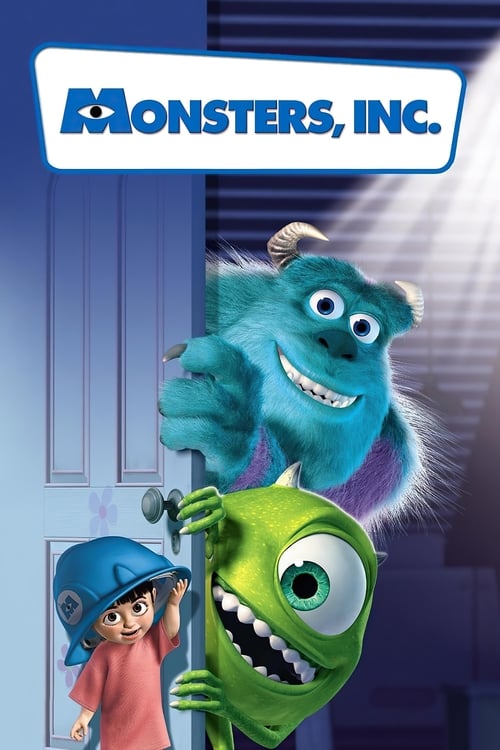
Monsters, Inc.
2001 · Pete Docter
For a family night, a comfort rewatch, or any evening you want to laugh for ninety minutes and get unexpectedly misty at the end. Pure comfort — zero homework, all payoff.
What it's about
In the monster city of Monstropolis, the power grid runs on children's screams, harvested by professional scarers who commute to work through closet doors. Sulley, the top scarer, and his fast-talking coach Mike Wazowski are riding high — until a fearless toddler named Boo wanders through a door into their world, where children are believed to be toxic. Hiding her, and getting her home, turns their whole society upside down.
The experience
Fast, funny, and endlessly inventive, with a screwball energy that never lets up — then it sneaks up on you with a gut-punch of tenderness. The kind of comedy that has adults laughing at different jokes than the kids.
Performances
John Goodman's warm rumble and Billy Crystal's motor-mouthed panic are one of the great voice-acting double acts — you forget within minutes that they're animated.
The craft
Sulley's fur — millions of individually simulated hairs — was a genuine technical breakthrough, the moment computer animation learned texture. The climactic chase through an infinite vault of flying doors is still one of animation's great setpieces, a rollercoaster with emotional logic, and Randy Newman's jazzy score (his Oscar-winning song included) gives the whole thing a big-band bounce.
Why it matters
It launched Pete Docter as Pixar's most emotionally probing director and set the template for the studio's signature move: a high-concept world built to smuggle in a simple, devastating feeling.
Pete Docter's debut as a director is built on a premise of beautiful economy: a parallel world whose entire power grid runs on children's screams, harvested by professional monsters commuting through closet doors. When a toddler slips back through, the machinery of the whole society is suddenly at stake — and so, more quietly, is the question of what fear is for. The film marked a technical watershed; Sulley's fur, millions of individually simulated hairs rippling in every shot, announced that computer animation could do texture, not just surface. The climactic chase through an infinite vault of doors remains one of the medium's great setpieces, a rollercoaster with emotional logic. Randy Newman finally won his Oscar for 'If I Didn't Have You.' In hindsight the film reads as Docter's origin story: the Pixar director who kept returning to the machinery of inner life — memory in Inside Out, purpose in Soul — starts here, with the discovery that a child's laugh outpowers her scream ten times over.
A Deleuzian reading
A closet door, open a few inches.
The full Deleuzian reading of Monsters, Inc. →
Reception
A massive hit and instant crowd-pleaser in 2001, it was long filed as 'great, but second-tier Pixar' behind Toy Story and Nemo — a ranking the internet has steadily overturned, with the door-chase finale now routinely cited among the studio's greatest sequences.
How Monsters, Inc. was received, from release to now →
Influences: the films it descends from and the films it influenced
- Toy Story (1995) — Docter helped build it; it established Pixar's high-concept 'secret life of non-humans coexisting with people' premise and the odd-couple buddy two-hander (big earnest lug + fast-talking sidekick) that Sulley and Mike directly reprise.
- Toy Story 2 (1999) — Docter's story work here refined Pixar's signature move of smuggling real emotional stakes and loss into a slapstick comedy structure — the tonal calibration Monsters uses for Boo's separation anxiety.
- Geri's Game (1997) — Its subdivision-surface characters and cloth simulation proved out the RenderMan/skin pipeline that Pixar extended into Sulley's 2.3-million-hair fur groom.
- A Bug's Life (1998) — Pushed Pixar's organic-environment rendering, layered depth-of-field and large-scale crowd handling that Monsters inherits for its factory floors and door-vault scale.
- Who Framed Roger Rabbit (1988) — Codified a cartoon dimension existing in parallel to the human world accessed through portals/doors — the exact conceit behind Monstropolis and the closet-door gateway.
- Beauty and the Beast (1991) — Made a hulking monster the sympathetic emotional lead, and its CAPS digital ballroom pioneered folding CG geometry into character animation — a rendering-integration debt Sulley inherits.
- King Kong (1933) — The template of a fearsome furred giant tenderized by his bond with a tiny human girl — Sulley/Boo is Kong/Ann restaged as comedy.
- Finding Nemo (2003) — Pixar sibling that extended the same subsurface-scattering and organic-simulation pipeline built alongside Sulley's fur, applied to translucent water and marine skin.
- Up (2009) — Docter reprises the mismatched-duo dynamic and the front-loaded emotional premise, pairing a gruff isolate with an irrepressible child stand-in (Russell echoes Boo).
- Inside Out (2015) — The film Monsters explicitly seeds: it externalizes an invisible inner system (emotions running a control room) exactly as Monsters externalized the hidden mechanics of the closet.
- Soul (2020) — Docter's inner-life metaphysics — building a rule-governed abstract 'other world' with its own bureaucracy and physics — is the mature form of Monstropolis worldbuilding.
- Monsters University (2013) — Direct origin-story prequel that rebuilt and scaled the exact fur-simulation and character-animation pipeline for a full campus of monsters.
- Ratatouille (2007) — Remy's rat-fur grooming and simulation descend directly from the hair-dynamics tools Pixar invented to animate Sulley.
- Brave (2012) — Merida's curls forced Pixar to rewrite its hair simulator — the technical heir to Sulley's fur, pushing dynamic-strand simulation from body pelt to styled hair.
- How to Train Your Dragon (2010) — Extends Monsters' central craft of a wordless, expressive giant creature bonding with a small human through pantomime animation rather than dialogue.
- Toy Story 3 (2010) — Unkrich co-directed; its door-warehouse chase honed the large-scale set-piece geography and spatial editing that structures the daycare escape.
- Inside Out 2 (2024) — Docter's method of literalizing an intangible abstraction (an emotional/energy economy) into a fully functioning industrial world with its own labor, machinery, and rules — the design logic Inside Out extends to the mind.
- Zootopia (2016) — Its Sulley breakthrough — the first blockbuster per-hair fur simulation — is the technical forebear of Zootopia's fur-grooming system that individually grooms and light-scatters millions of follicles across dozens of species.
- Toy Story 5 (2026) — Debuted Fizt, the simulation layer that ran Sulley's 2.3 million hairs and cloth as a post-animation pass; the strand solver the new film uses for hair and fiber is the same architectural idea, now resolved per-strand at interactive rates.
- Shrek (2001) — Same-year CG counterpart that also rehabilitated a monster into a lovable lead while advancing skin and expressive-face rendering, the competing pole of 2001's early-CGI-feature moment.
Similar films
- Inside Out (2015) — influence & lineage · same viewing thread
- Finding Nemo (2003) — influence & lineage · same viewing thread
- Up (2009) — influence & lineage · same viewing thread
- Shrek (2001) — influence & lineage
- Toy Story (1995) — influence & lineage
- Ratatouille (2007) — influence & lineage
- A Bug's Life (1998) — influence & lineage
- Toy Story 2 (1999) — influence & lineage
All the films related to Monsters, Inc. →
Watch it with: curated runs of related films
- Animation That Aches — A run of animated films that take loneliness, grief, and memory as seriously as any live-action drama — watch them in a row and the cartoon surface stops mattering.