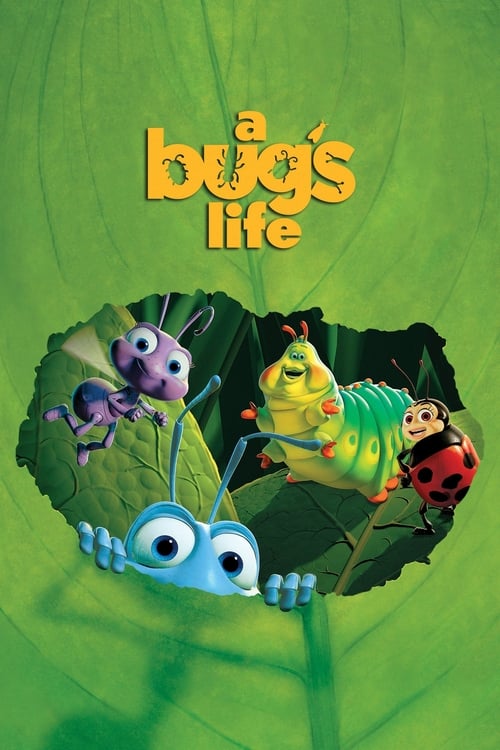
A Bug's Life
1998 · John Lasseter
Family movie night, no-fail edition: when you need something the kids will love and the adults won't just tolerate. Pure comfort, with enough wit and peril to keep everyone leaning in.
What it's about
Flik is an inventor ant whose gadgets keep backfiring on a colony that lives in fear of the grasshopper gang that shakes it down for food every season. After one botch too many, he heads to the bug 'city' to recruit warriors to fight back — and returns instead with a troupe of circus performers who have no idea they've been hired for a war.
The experience
Bright, fast, and full of gags for every age — a classic underdog adventure with a genuinely menacing villain and a warm streak about believing in your own bad ideas until one works. It's breezy fun that sneaks in real stakes.
Performances
Kevin Spacey's voice work makes Hopper one of animation's most quietly frightening villains — a bully who understands exactly how fear works — against Dave Foley's endearingly hapless Flik.
The craft
Pixar's second feature pushed early computer animation into wide-open outdoor spaces — translucent leaves, crowds of thousands of ants, a bug's-eye scale where a raindrop is a boulder. The blooper-reel gag over the credits became a beloved signature, and the color and depth still pop on a good screen.
Why it matters
It proved Pixar was a studio, not a one-hit wonder — the film where the pipeline, the house style, and the formula of misfit heroes and clockwork story construction became repeatable, setting up two decades of dominance.
Snapshot
A Bug's Life was Pixar Animation Studios' second feature film, released by Walt Disney Pictures over the American Thanksgiving weekend in November 1998, three years after Toy Story (1995) had inaugurated the computer-animated feature as a commercial form. Where Toy Story proved the medium could sustain a feature, A Bug's Life was the film in which Pixar tested whether it had a studio — a repeatable pipeline, an expandable world, and a house style robust enough to survive its own success. The premise grafts Aesop's fable of "The Ant and the Grasshopper" onto the narrative armature of the seven-warriors-for-hire tale: an inventive misfit ant named Flik, having botched the colony's tribute harvest, journeys to the city and recruits a troupe of circus bugs whom he mistakes for warriors, hoping they will defend the colony against Hopper's marauding grasshoppers. The film is remembered today partly on its own terms and partly for its place in one of Hollywood's stranger episodes — its head-to-head collision with DreamWorks' Antz, released weeks earlier the same autumn. Critically well received and commercially robust, it is a confident, sunlit comedy of scale that consolidated the techniques, the tone, and the institutional ambitions Pixar would carry forward.
Industry & production
A Bug's Life was produced under the multi-picture distribution-and-financing partnership Pixar had struck with Disney in 1991, the arrangement that had underwritten Toy Story. Coming off that first success, Pixar was simultaneously building a feature pipeline, expanding its staff, and moving toward the Emeryville campus that would house it; the film was made during a period of rapid institutional growth in which the studio had to convert a one-off triumph into a system. John Lasseter directed, with Andrew Stanton credited as co-director. The producers were Darla K. Anderson and Kevin Reher.
The production is inseparable from the so-called "dueling bug movies" controversy. Jeffrey Katzenberg, who had departed Disney acrimoniously in 1994 to co-found DreamWorks SKG, oversaw Antz, a computer-animated film with an ant protagonist that opened on October 2, 1998 — ahead of A Bug's Life's late-November release. Lasseter and Pixar's Steve Jobs publicly suggested that knowledge of Pixar's insect project had informed the rival production and that DreamWorks had rushed Antz to market to blunt Pixar's film; Katzenberg disputed any impropriety. The episode became a case study in studio rivalry and in the perils of pitching ideas across a porous industry, and it shaped the commercial framing of both releases. The historical record on precisely who knew what, and when, remains contested and is best treated with caution rather than presented as settled.
Commercially, A Bug's Life was a clear success, earning well over $300 million worldwide — figures commonly cited place the global gross in the neighborhood of $360 million — and out-earning Antz internationally. The film was accompanied in theaters by the Pixar short Geri's Game, which won the Academy Award for Best Animated Short Film, reinforcing the studio's practice of pairing features with technically and emotionally ambitious shorts.
Technology
Technologically, A Bug's Life was a substantial advance over Toy Story and a stress test of Pixar's RenderMan-based pipeline at far greater complexity. Toy Story's world had been one of hard, smooth plastic surfaces and interior spaces; the bug film demanded an organic outdoor environment of grass, leaves, dirt, water, and sky, rendered convincingly at insect scale. Two technical problems dominated. The first was translucency: leaves and blades of grass needed to glow when backlit, the way thin organic matter does, rather than reading as opaque solids — a quality central to selling the miniaturized point of view, since so much of the world is seen with the sun coming through it from above. The second was sheer crowd and environmental density — an ant colony implies hundreds of characters and a teeming, cluttered natural set, far beyond the populations Toy Story had staged.
The film was also a milestone in presentation format: it was Pixar's first feature composed and released in a widescreen scope ratio (roughly 2.35:1), a deliberate choice to give the diminutive world an epic, expansive frame and to exploit the horizontal sweep of the colony and the grasshopper invasion. Realizing all of this required extensive proprietary tool development around lighting, rendering, and scene management — work that fed directly into the maturation of Pixar's production software and its capacity to mount progressively more complex films.
Technique
Cinematography
The film's visual language is built around scale and the worm's-eye (or ant's-eye) view. Sharon Calahan served as director of photography for lighting, and the photographic strategy consistently dramatizes smallness: low angles that make grass canyons and towering grasshoppers loom; shafts of backlit sunlight filtering through translucent foliage; depth staged across vast-seeming distances that are, in fiction, only inches. The scope aspect ratio is used to emphasize horizon and breadth, lending grandeur to spaces that are physically tiny. The "bird's-eye city" of the bug metropolis, built inside a discarded can and human refuse, is lit and framed as a teeming urban environment, a comic recontextualization of human trash as insect architecture.
Editing
Lee Unkrich edited the film. The cutting balances the demands of broad physical comedy — which favors clear, legible staging and timing — with the structural momentum of an adventure plot that moves from colony to city and back, then to the climactic confrontation. The pacing is brisk and classical, prioritizing comprehension of action and the rhythm of gags over disruptive or showy montage.
Mise-en-scène / staging
Production design is the film's most inventive register. The bug world is a fully imagined civilization scaled to insects: a colony organized around an offering of food to grasshopper overlords, a city of bars and crowds improvised from human litter, and a traveling circus of "warrior" bugs. Staging exploits the comedy of perspective relentlessly — objects mundane to humans become monumental obstacles or resources, and the relative sizes of ants, grasshoppers, and the circus troupe (including the towering walking-stick, the rotund caterpillar, the ladybug, the praying mantis) are choreographed for both threat and humor. The closing-credits "outtakes" — fake bloopers presenting the animated characters as if they were live actors flubbing takes — were a novel conceit, treating the digital cast as a working ensemble and extending the film's affectionate theatrical conceit beyond the story proper.
Sound
Randy Newman composed the score, continuing the collaboration he had begun on Toy Story. His orchestral writing supplies sweep and warmth, scaling up the emotional stakes of a story about very small creatures and underscoring both the colony's pastoral life and the menace of Hopper's gang. The sound design works hard at the level of scale and texture — the buzz and clatter of insect movement, the amplified weight of objects experienced from a bug's vantage — to make the miniature world feel physically present.
Performance
The vocal ensemble is central to characterization. Dave Foley voices Flik with earnest, motor-mouthed optimism; Kevin Spacey gives Hopper a quiet, reptilian menace that makes the villain genuinely threatening within a family comedy; Julia Louis-Dreyfus plays the anxious heir Princess Atta, and Phyllis Diller the Queen. The circus troupe is a showcase of comic voices, including Denis Leary, David Hyde Pierce, Madeline Kahn, Bonnie Hunt, Brad Garrett, Joe Ranft, John Ratzenberger, and others, with young Hayden Panettiere as the determined Dot. The animation translates these performances into broad, expressive physical comedy while retaining enough nuance — especially in Hopper's stillness and in Flik's flustered enthusiasm — to give the ensemble distinct interior life.
Narrative & dramatic mode
The dramatic mode is classical comic adventure with a strong fable spine. The plot follows a clean three-act trajectory: a misfit hero whose well-meaning ingenuity causes a crisis; a quest that produces an accidental, mismatched band of helpers; a deception that unravels; and a climactic stand in which the underdog community discovers its collective strength. The film leans on the recognizable structure of the "warriors recruited to defend a vulnerable village" tale — most famously Kurosawa's Seven Samurai and its Western remake The Magnificent Seven — refracted through the case-of-mistaken-identity device whereby the recruited "warriors" are in fact circus performers. The Aesopian source supplies the moral architecture: industrious ants versus a predatory, freeloading grasshopper class. Comedy of scale, mistaken identity, and ensemble banter carry the texture, while the emotional through-line is Flik's vindication and the colony's awakening.
Genre & cycle
The film sits within the family-animation feature and, more specifically, within the still-young cycle of computer-animated features that Toy Story had launched and that the late 1990s and 2000s would expand into an industry. Within that cycle, A Bug's Life belongs to the wave of "tiny world" and anthropomorphized-creature films, and it is permanently paired in film history with Antz as the moment the CG-feature field became competitive rather than a Pixar monopoly. It also draws on older live-action genre traditions — the samurai/Western "defend the village" picture and the showbiz-troupe comedy — repurposed for animation.
Authorship & method
John Lasseter, Pixar's creative leader and the director of Toy Story, brought to A Bug's Life the sensibility that defined early Pixar: a belief in story and character first, technology in service of emotion, and a warm, accessible comic tone descended from classical Hollywood animation. Lasseter's career path — CalArts, an early stint at Disney, then the computer-graphics group that became Pixar — made him the bridge between traditional animation craft and the new digital medium, and that synthesis is visible in the film's emphasis on appealing performance and clear staging over technological display for its own sake.
His key collaborators formed the nucleus of Pixar's emerging creative leadership. Andrew Stanton, co-director and co-writer, would go on to direct Finding Nemo and WALL·E; the story is credited to Lasseter, Stanton, and Joe Ranft, with the screenplay by Stanton, Don McEnery, and Bob Shaw. Lee Unkrich, the editor, would become a director in his own right. Sharon Calahan's lighting cinematography helped codify Pixar's photographic approach, and Randy Newman's score cemented a composer relationship that would run through much of the studio's subsequent work. The method was collaborative and iterative — story development through reels and revision — a process Pixar was actively formalizing during this period.
Movement / national cinema
A Bug's Life is a product of American commercial animation, made in the San Francisco Bay Area within the Disney distribution orbit. It belongs less to any aesthetic "movement" in the art-cinema sense than to an institutional one: the rise of West Coast computer-animation studios as a new center of gravity in Hollywood family entertainment, distinct from both the Disney hand-drawn tradition centered in Burbank and the East Coast/independent animation worlds. Its lineage is the American studio cartoon and the Disney feature, reinvented through Silicon Valley engineering culture.
Era / period
The film is firmly of the late 1990s, the foundational moment of the digital-animation feature. It arrives at a hinge point: traditional cel animation was still producing major studio releases, but the commercial and technological momentum was visibly shifting toward CG. The 1998 collision with Antz marks the instant the new form became a competitive industry rather than a single studio's experiment, and the years immediately following would see the CG feature displace hand-drawn animation as Hollywood's dominant animated mode. A Bug's Life is thus a transitional artifact — a film that helped tip the balance.
Themes
The film's governing theme is the relationship between the individual and the collective. Flik embodies the disruptive value of the innovator within a conformist society organized around routine and obedience; his ideas are initially punished and ultimately redemptive. Set against this is the politics of the colony itself: a community paying tribute to a predatory ruling class, kept docile by fear. Hopper's pivotal warning to his fellow grasshoppers — that the danger is not one ant but the precedent of one ant standing up, lest the many realize their power over the few — gives the film a surprisingly pointed allegory about oppression, complicity, and collective action. Secondary themes include the worth of the misfit and the underestimated (the "warriors" who are really clowns, the smallest ant who believes in Flik), the dignity of labor against parasitism inherited from the Aesopian source, and self-reinvention. These ideas are delivered lightly, within the conventions of family comedy, but they give the film a moral seriousness beneath its bright surface.
Reception, canon & influence
Critically, A Bug's Life was warmly received, widely praised for its visual invention, comic energy, voice performances, and the confidence with which it expanded Pixar's world beyond Toy Story's toy box. It was frequently reviewed in tandem with Antz, with many critics judging Pixar's film the more family-friendly and visually expansive of the two and DreamWorks' the more adult and acerbic; the comparison became a fixture of the film's reception. Commercially it performed strongly worldwide.
Looking backward, the film's influences are legible and acknowledged in spirit: Aesop's fable supplies its moral skeleton; Kurosawa's Seven Samurai and the Hollywood Western tradition of The Magnificent Seven supply its plot structure of hired defenders; and the broader heritage of Disney and classical studio animation supplies its tone and its faith in character. Looking forward, its legacy is principally institutional and technical. It proved Pixar was a studio rather than a one-film phenomenon; it advanced the rendering of organic, translucent, densely populated outdoor environments and moved Pixar into widescreen scope; and it helped establish narrative and tonal templates — the misfit hero, the ensemble of comic specialists, the emotionally grounded adventure — that recur across the studio's subsequent output. Its closing fake-outtakes became an influential gimmick, imitated across animated films for years. Within Pixar's own canon it is sometimes regarded as a comparatively modest entry between the landmark Toy Story films, but it is a crucial bridge work: the film in which the studio scaled up its ambitions and demonstrated that the computer-animated feature would be an enduring form, not a novelty.
A Deleuzian reading
Start with a blade of grass.
The full Deleuzian reading of A Bug's Life →
Reception
A hit in 1998 and warmly reviewed, it has since settled into the role of Pixar's forgotten middle child — the one people rewatch decades later and declare quietly underrated.
How A Bug's Life was received, from release to now →
Influences: the films it descends from and the films it influenced
- Toy Story (1995) — Established the RenderMan production pipeline, the voice-ensemble casting model, and the iterative story-reel method that A Bug's Life directly inherited and scaled up.
- Seven Samurai (1954) — Supplies the load-bearing plot architecture: a vulnerable farming community recruits a band of warrior-specialists, each introduced as a distinct comic-heroic type, to repel seasonal raiders.
- The Magnificent Seven (1960) — Demonstrated the transposition of Kurosawa's recruit-the-defenders structure into broad, accessible Hollywood genre idiom — the exact register A Bug's Life adopts for the circus-bug troupe.
- Snow White and the Seven Dwarfs (1937) — Codified the classical-Disney faith in appealing personality animation and an ensemble of differentiated comic-specialist characters that Lasseter consciously carried into CG.
- Luxo Jr. (1986) — Pioneered conveying full personality through articulated object movement and clear staging rather than technological display — the restraint principle governing A Bug's Life's animation.
- Microcosmos (1996) — Modeled the immersive macro worm's-eye photography of an insect world as epic landscape, with backlit foliage and dew-scale detail rendered as a grand environment.
- Honey, I Shrunk the Kids (1989) — Established the found-object scale-comedy grammar — blades of grass as jungle, everyday detritus as architecture — that A Bug's Life builds its entire production design around.
- Jurassic Park (1993) — Proved photoreal CG rendering of organic, skinned creatures in naturalistic light, legitimizing the digital organic surfaces and translucency Pixar pursued outdoors.
- Toy Story 2 (1999) — Directly continued the closing fake-outtakes / blooper-reel gimmick A Bug's Life popularized, alongside the scaled-up production model it validated.
- Monsters, Inc. (2001) — Extended the crowd-density and complex-surface rendering pushed here into full simulated fur and teeming-city populations, retaining the comic-specialist ensemble.
- Finding Nemo (2003) — Co-director Stanton extends the translucency/subsurface-scattering rendering of organic life into a fully underwater world with light filtering through water and tissue.
- Ratatouille (2007) — Carries forward the small-creature-in-human-scale staging and translucent organic rendering (food, fur, liquids) within a meticulously realized oversized environment.
- WALL·E (2008) — Builds on Sharon Calahan's photographic lighting and the move into anamorphic scope that A Bug's Life initiated, under the same Stanton authorship.
- Epic (2013) — Constructs an entire worm's-eye miniature-forest fantasy from backlit foliage and scale juxtaposition, the immersive bug-scale landscape A Bug's Life made a viable feature setting.
- Antz (1998) — The dueling contemporaneous CG ant-colony feature working the identical individual-vs-collective premise, against which A Bug's Life's family-facing tone was defined in reception.
- Shrek (2001) — DreamWorks' CG fairy-tale ensemble extends the Pixar-vs-DreamWorks rivalry begun with Antz, working the same misfit-hero-and-comic-troupe template in a rival pipeline.
Similar films
- Toy Story (1995) — influence & lineage
- Toy Story 2 (1999) — influence & lineage
- Ratatouille (2007) — influence & lineage
- Finding Nemo (2003) — influence & lineage
- Monsters, Inc. (2001) — influence & lineage
- WALL·E (2008) — influence & lineage
- Shrek (2001) — influence & lineage
- Seven Samurai (1954) — influence & lineage · often watched together