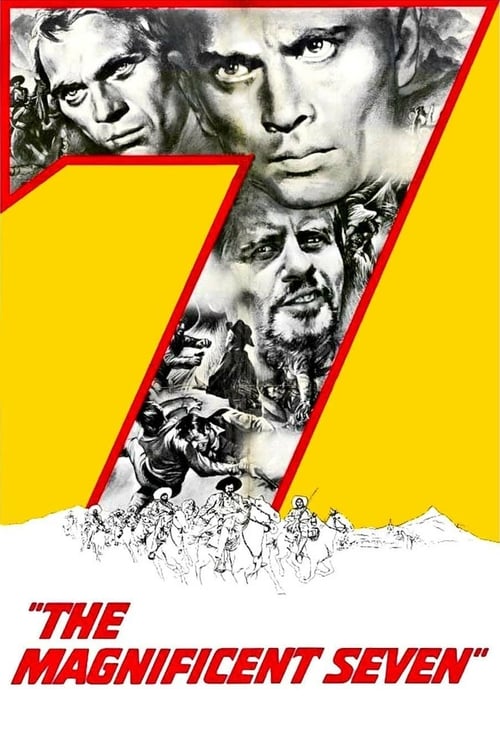
The Magnificent Seven
1960 · John Sturges
For a Saturday-afternoon crowd-pleaser mood — when you want heroes, horses, and a score that makes you sit up straighter. Comfort viewing with just enough weight to stick.
What it's about
A poor Mexican farming village, bled dry season after season by a bandit chief and his raiders, pools its last valuables and rides north to hire protection. What they can afford is seven gunfighters — drifters, hotheads, and men running low on prospects — who take the job for reasons that have little to do with money. The film follows the crew as they're recruited one by one, dig in among the farmers, and prepare for a fight they may not survive.
The experience
Big, confident, and pleasurable — the recruitment stretch is pure charisma, the buildup simmers, and the gunfights land with old-school clarity. It's rousing rather than grim, with a streak of melancholy about what men like these are actually worth to the world once the shooting stops.
Performances
Yul Brynner anchors it with cool, economical authority, while a young Steve McQueen steals scenes around him with nothing but a hat brim and a shotgun shell. Eli Wallach makes the bandit Calvera oddly charming — a villain who talks like a businessman.
The craft
Elmer Bernstein's galloping theme is one of the most famous pieces of music ever written for a Western, and it does half the film's work — the movie feels twice as alive whenever it kicks in. Sturges shoots the Mexican locations in glowing widescreen and stages the action with clean geography; it rewards the biggest screen and loudest speakers you have.
Why it matters
It turned a Japanese classic into an American genre landmark, minted the careers of McQueen, Charles Bronson, and James Coburn, and established a template — gathering a mismatched crew for a doomed mission — that action movies still follow.
Snapshot
The Magnificent Seven is John Sturges's transposition of Akira Kurosawa's Seven Samurai (1954) into the iconography of the American Western — a beleaguered Mexican farming village, repeatedly bled by a bandit chief named Calvera, hires a small band of gunfighters to mount a defense it cannot mount itself. Produced by the Mirisch Company for United Artists and shot largely on location in Mexico, the film converted a Japanese jidaigeki into a CinemaScope-era genre vehicle and, in doing so, crystallized a narrative template — the recruitment and welding-together of a disparate crew for a near-suicidal mission — that has propagated across action cinema ever since. Its commercial life was a slow burn: a modest domestic opening followed by durable international success and a long afterlife of sequels, a television series, an Elmer Bernstein theme that became one of the most recognizable cues in American music, and a 2016 studio remake. Beyond the franchise, the film is remembered as a launching pad: it assembled Yul Brynner alongside a then-largely-unproven group — Steve McQueen, Charles Bronson, James Coburn, Robert Vaughn, Brad Dexter, Horst Buchholz — several of whom became major stars on the strength of their work here.
Industry & production
The picture sits squarely in the economics of the late-studio era's transition to independent packaging. The Mirisch Company — Walter, Marvin, and Harold Mirisch — operated as an independent production outfit releasing through United Artists, the studio that had pioneered financing-and-distribution deals with independent producers and talent. Walter Mirisch produced; the remake rights to Kurosawa's film were secured from Toho, a transaction that gave the Japanese original formal acknowledgment in the American film's credits. (The well-worn anecdote that Yul Brynner and others jockeyed over who would "own" or direct the remake circulates widely, but the documentary record on its precise contours is thinner than the retellings suggest, and it is best treated cautiously.)
Production took place on location in Mexico, principally in the area around Cuernavaca and Tepoztlán in Morelos. The Mexican government exercised meaningful oversight of how its rural citizens were portrayed: a state film official monitored the shoot and pressed for the villagers to be depicted with dignity — reportedly insisting that the peasants appear in clean clothing rather than the picturesque rags a Hollywood production might default to. That intervention shaped the film's visual presentation of poverty and is a notable instance of a host nation actively negotiating its on-screen image.
The shoot is also famous for its off-camera friction, particularly the competition for attention between the established star Brynner and the ascendant McQueen, whose habit of small business — fiddling with his hat, checking his shotgun shells — repeatedly drew the eye in two-shots. Several of these accounts are anecdotal and have hardened through repetition, so they should be read as production lore as much as documented fact. McQueen took the role despite obligations to his television series Wanted: Dead or Alive, and the scheduling conflict is part of the standard account of how he leveraged the film into screen stardom.
Technology
The film was photographed in Panavision anamorphic widescreen and released in color by DeLuxe — the dominant late-1950s/early-1960s configuration for a prestige genre release competing against television's small monochrome frame. The anamorphic format mattered to the film's design: the wide canvas accommodates the ensemble, lets Sturges array multiple gunfighters and villagers within a single composition, and renders the open Mexican landscape as both refuge and exposed killing ground. The technology here is in service of scale and legibility rather than spectacle for its own sake; this is not a film of optical effects but of clean, large-format staging.
Technique
Cinematography
Charles Lang (a much-honored Hollywood cinematographer with a long studio career) shot the film, and the photography is notable for its clarity and its handling of the widescreen frame. Lang favors deep, well-organized compositions that keep the geography of the village comprehensible — entrances, rooftops, the central square, the surrounding hills — which is essential to a story built on the tactics of defense. Exteriors exploit hard sunlight and dust; the staging of approach and ambush depends on the audience always knowing where the threat is coming from. The look is robust and unfussy, prioritizing readability of action over atmospheric stylization.
Editing
Ferris Webster cut the film. The editing's principal achievement is managing a large ensemble across set-piece confrontations without losing the individual gunfighters' distinct presences. Sturges and Webster favor a cutting rhythm that lets character business register before action erupts, and the major gunfights are constructed for spatial coherence — the viewer tracks who is positioned where — rather than the fragmented, percussive montage that later action cinema would adopt. Webster would go on to a long collaboration with Sturges and McQueen.
Mise-en-scène / staging
The film's most characteristic technique is its staging of the seven as types made individual through gesture and silhouette: Brynner's controlled stillness in black; McQueen's restless physical business; Coburn's economical knife-versus-gun duel, a set piece built entirely on poise and timing; Bronson's gentleness with the village children; Vaughn's tremor of fear beneath a dandy's surface. Sturges blocks the village as a functioning space — walls, rooftops, approaches — so that the defense reads as planned and tactical. The recruitment sequences, in which each man is introduced through a single defining vignette, are models of efficient character economy.
Sound
Elmer Bernstein's score is, by common consent, the film's most enduring single element. The main theme — a galloping, brass-and-strings figure in a propulsive triple meter — became a cultural shorthand for rugged American adventure, later widely licensed (most famously for cigarette advertising) and endlessly imitated. Bernstein's music does heavy narrative lifting, lending heroic dimension to what is, in plot terms, a doomed and ambivalent enterprise; the score's confidence partly accounts for the film's lasting popular affection. The theme earned the picture its sole Academy Award nomination, for scoring.
Performance
The casting is the film's quiet masterstroke. Brynner anchors the group with magnetic restraint. McQueen's performance is the textbook case of a supporting player commandeering a film through minimalist craft. Wallach's Calvera is a crucial counterweight — voluble, self-justifying, almost genial — refusing the flat villainy the structure might have invited and giving the moral argument a real antagonist. Bronson and Coburn each turn limited screen time into career-defining presences. Buchholz's hot-headed young Chico carries the film's generational and romantic thread; his casting (a German actor as a Mexican youth) reflects period casting conventions that read differently now.
Narrative & dramatic mode
Structurally the film is a recruitment-and-siege narrative: a precipitating injustice, the gathering of a team (each member introduced through a defining test), preparation and training of the villagers, escalating skirmishes, betrayal and reversal, and a final pitched battle from which only a remnant survives. The dramatic mode is elegiac beneath its adventure surface. The gunfighters are professionals without a country — men whose skills have outlived the frontier that needed them — and the film repeatedly underlines that they have less than they appear to: no homes, no families, no future. Its closing recognition that the farmers, not the gunmen, are the ones who "won," and that men like the seven always lose, gives the film a melancholy that distinguishes it from straightforward heroic adventure and faithfully preserves the fatalism of Kurosawa's original.
Genre & cycle
The film belongs to the mature Hollywood Western at the moment the genre was beginning its long self-interrogation. It carries forward the classical Western's concern with the gun's relationship to civilization — the men of violence who make settlement possible but cannot themselves be settled — while pushing toward the more disenchanted register that would dominate the 1960s. It is also an early, influential entry in what became the "men-on-a-mission" cycle, the assemble-a-team action structure that would flourish through the decade. Its production in Mexico and its cross-cultural source mark it as part of the increasingly international Western of the period, presaging the European Westerns that would soon follow.
Authorship & method
John Sturges was a director of large-scale, masculine action cinema with a gift for ensemble logistics — a skill he had honed on Bad Day at Black Rock (1955) and Gunfight at the O.K. Corral (1957) and would carry forward to The Great Escape (1963), which reunited him with several of these actors. His method favored clarity, momentum, and strong location work over authorial flourish; he is best understood as a superb classical craftsman of action and ensemble rather than a stylist of the auteur mold.
The screenplay credit is a documented tangle. William Roberts received sole screen credit following Writers Guild arbitration, but the script drew on earlier work by Walter Newman (who reportedly withdrew his name rather than share credit) and uncredited contributions associated with Walter Bernstein, then working under the constraints of the Hollywood blacklist. The exact division of authorship is genuinely murky, and accounts differ; what is clear is that the finished screenplay is a collaborative artifact whose credited byline does not capture its full provenance.
The key collaborators are otherwise as noted above: cinematographer Charles Lang, editor Ferris Webster, and composer Elmer Bernstein, whose contribution is arguably the most decisive of the three to the film's reputation.
Movement / national cinema
The film is a product of mainstream Hollywood, not of any avant-garde or art-cinema movement, but its significance is precisely transnational. It is a documented case of cross-cultural adaptation flowing from East to West — a Japanese film, itself partly inspired by American Westerns and by John Ford in particular, remade as an American Western. That circuit (Ford → Kurosawa → Hollywood, and shortly afterward Kurosawa → Sergio Leone via Yojimbo and A Fistful of Dollars) makes The Magnificent Seven a hinge point in the international traffic of genre material between American, Japanese, and soon Italian cinema.
Era / period
Released in 1960, the film stands at the threshold between the classical studio Western and the genre's revisionist turn. It retains the production values, star packaging, and broadly heroic framing of the studio era while its fatalism and its ambivalence about the gunfighter anticipate the darker Westerns of the coming decade. It also captures a transitional moment in stardom: the eclipse of an older model of star (Brynner's commanding theatricality) by a newer, cooler, more naturalistic one (McQueen), visible within a single frame.
Themes
Its central themes are the obsolescence of the man of violence, the gulf between the warrior and the community he protects, and the unglamorous truth beneath the adventure — that professional gunmen are rootless and ultimately expendable. The film weighs courage against futility, and skill against meaning: the seven are superb at what they do, but what they do has no place to belong. A secondary thread, carried by Chico, concerns the seduction and disillusionment of the young man who idolizes the gunfighter and gradually grasps the cost. Running underneath is a clear-eyed, faintly mournful reckoning with what survives violence — the land and the people who work it — and what does not.
Reception, canon & influence
Critical reception in 1960 was mixed-to-favorable and notably less reverent than the film's later reputation would suggest; contemporary reviewers tended to measure it against Kurosawa's original and find it the lesser, more conventional work. Its commercial trajectory was the inverse of a blockbuster's: a soft domestic launch followed by strong and sustained success abroad, particularly in Europe, which is part of why it generated a franchise. The Bernstein score's Academy Award nomination was its principal awards recognition.
The influences on the film are unambiguous: above all Seven Samurai, whose plot, structure, and fatalistic ethos it preserves, and behind that the classical Hollywood Western tradition — Ford especially — that had shaped Kurosawa in turn. Sturges's own prior Westerns supplied the craft template.
Its influence forward is large. It standardized the team-assembly mission narrative for popular cinema, a structure echoed across decades of action and adventure films and animated features (the "village hires defenders" plot recurs explicitly, as in A Bug's Life). It accelerated or established the careers of McQueen, Bronson, Coburn, and Vaughn and fed directly into Sturges's The Great Escape. Bernstein's theme became free-floating cultural property. The film spawned three theatrical sequels in the 1960s and early 1970s (Return of the Seven, Guns of the Magnificent Seven, The Magnificent Seven Ride!), a 1990s television series, and a 2016 remake. And as a node in the Ford–Kurosawa–Leone exchange, it helped set the conditions for the international Western boom that reshaped the genre in the decade that followed. Its standing today rests less on contemporary critical acclaim than on this remarkable propagative reach — a competent, handsome studio Western that became one of the most widely imitated narrative engines in popular film.
A Deleuzian reading
Watch Britt first.
The full Deleuzian reading of The Magnificent Seven →
Reception
It actually underwhelmed at the US box office and got lukewarm reviews in 1960, but was a smash in Europe — and decades of TV airings turned it into one of the most beloved westerns ever made.
How The Magnificent Seven was received, from release to now →
Influences: the films it descends from and the films it influenced
- Seven Samurai (1954) — Direct source: Magnificent Seven transposes its recruitment-then-siege architecture and its method of individuating each warrior through a distinct introductory 'audition' beat before the village-defense climax.
- Stagecoach (1939) — Ford's clean spatial geography and his technique of building an ensemble from sharply differentiated social types is the Western grammar Kurosawa absorbed and Sturges inherited second-hand.
- Shane (1953) — Establishes the gunman-as-obsolete-protector who defends settled homesteaders he can never join, the elegiac obsolescence-of-violence stance the Seven adopt wholesale.
- High Noon (1952) — Community-abandons-its-hired-defender drama written by a blacklisted screenwriter (Carl Foreman), prefiguring both the Seven's thankless-mercenary theme and its blacklist-shadowed authorship (Walter Bernstein).
- Bad Day at Black Rock (1955) — Sturges's own template: anamorphic CinemaScope staging that uses wide compositions and location desert space to choreograph a tense outsider-versus-town standoff with editorial spatial coherence.
- Gunfight at the O.K. Corral (1957) — Sturges's prior exercise in massing differentiated gunfighters toward a single climactic shootout, refining the ensemble-action logistics he carries into the Seven.
- Vera Cruz (1954) — Codifies the American-mercenaries-ride-into-Mexico setup and the cynical professional-gunman partnership that the Seven's south-of-the-border framing draws on.
- The Big Country (1958) — Elmer Bernstein's galloping, ostinato-driven Americana main theme descends directly from Moross's template of a wide, propulsive melody over a driving rhythmic bed.
- The Great Escape (1963) — Sturges's immediate follow-through: reuses the men-on-a-mission ensemble-individuation method and reunites McQueen, Bronson, and Coburn, with another propulsive Elmer Bernstein march anchoring morale.
- The Dirty Dozen (1967) — Extends the recruitment engine by foregrounding the team-assembly sequence itself — convict misfits chosen one by one for a suicide mission — as the film's structural spine.
- The Professionals (1966) — Hires a band of specialized experts, each defined by a single skill, for a Mexican rescue mission — the men-on-a-mission template rendered as a competence showcase.
- The Wild Bunch (1969) — Pushes the Seven's elegiac obsolescence-of-violence into revisionist extremity: aging outlaws in Mexico choosing one last doomed stand, the dignity-in-death ethos turned bloody and explicit.
- Once Upon a Time in the West (1968) — Casts Bronson out of the Seven's gallery and extends Bernstein's character-as-leitmotif scoring into Morricone's instrument-per-character design within the same elegiac register.
- Battle Beyond the Stars (1980) — Explicit sci-fi transposition of the village-hires-seven-defenders plot, demonstrating the narrative engine's portability across genres (scripted by John Sayles).
- A Bug's Life (1998) — Reuses the recruitment-and-siege plot literally — a colony hires a band of warriors to repel raiders — proving the structure had become a free-floating popular-cinema template.
- The Magnificent Seven (2016) — Direct remake that preserves the recruitment-then-siege architecture and individuated-gunman ensemble while updating the staging to modern action coverage.
- Aliens (1986) — Sturges assigns each squad member a single dominant behavioral marker before the mission — the mercenary, the worrier, the kid — so deaths register individually during chaotic action; Cameron applies this exact character-typing system wholesale to the Colonial Marines, ensuring Hudson, Vasquez, Hicks, and Apone are legible during the processing plant decimation.
- Sholay (1975) — Transposes Kurosawa's village-defense plot into gun-and-horse Western idiom, modeling the ensemble-of-hired-protectors framing and the professional-mercenaries-with-a-code tone that Sholay's Jai and Veeru inherit.
- Silverado (1985) — The recruit-the-specialists-then-defend-the-town architecture is Silverado's structural blueprint, and Elmer Bernstein's galloping brass main title is the direct compositional ancestor of Broughton's.
- A Fistful of Dollars (1964) — Parallel transnational adaptation of Kurosawa (Yojimbo) into the Western, completing the Ford–Kurosawa–Leone exchange the Seven also occupies as a node.
- Rio Bravo (1959) — Sturges transposes Hawks's type-cast professional ensemble from a single jail to a village-defense, using the same dramatic logic: each specialist introduced through a distinct skill display, ensemble cohesion tested under sustained siege, with the professional fellowship's integrity under pressure as the film's moral center.
Similar films
- The Wild Bunch (1969) — influence & lineage · same viewing thread
- High Noon (1952) — influence & lineage · same viewing thread
- Seven Samurai (1954) — influence & lineage
- The Great Escape (1963) — influence & lineage
- Once Upon a Time in the West (1968) — influence & lineage
- A Fistful of Dollars (1964) — influence & lineage
- The Dirty Dozen (1967) — influence & lineage
- Stagecoach (1939) — influence & lineage
All the films related to The Magnificent Seven →
Watch it with: curated runs of related films
- Print the Legend — A run of frontier myths and their unmaking — town-taming marshals, aging gunfighters, and the stories the newspapers chose to print instead of the truth.