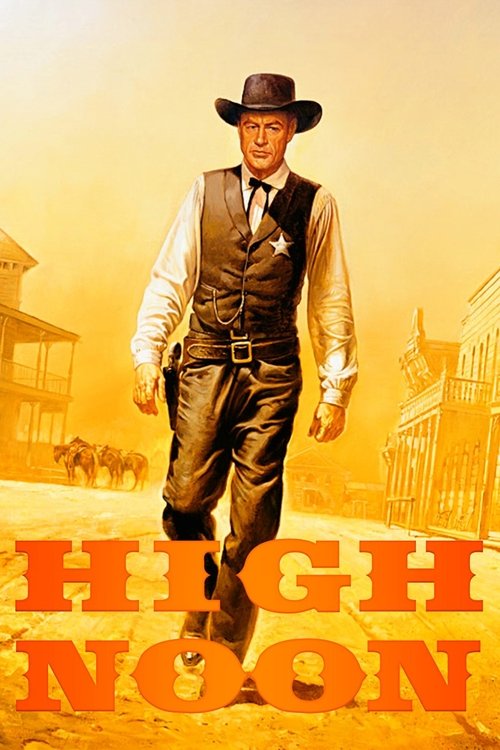
High Noon
1952 · Fred Zinnemann
For when you want a lean, no-fat classic that grips you for under ninety minutes and gives you something to argue about at dinner. It's a challenge dressed as comfort food — an old Western that still stings.
What it's about
On the morning of his wedding and retirement, small-town marshal Will Kane learns that an outlaw he sent to prison has been pardoned and is arriving on the noon train, with his gang waiting at the station to help him settle the score. Kane could ride away — everyone tells him to — but he stays and goes door to door asking the townspeople he's protected for years to stand with him. One by one, they find their reasons not to.
The experience
Taut and relentless — the film unfolds in something close to real time, with clocks on every wall counting down to noon, and the dread builds like a held breath. It's less a shoot-em-up than a moral pressure cooker, and it leaves you quietly angry at how easily people talk themselves out of doing the right thing.
Performances
Gary Cooper won the Oscar for a performance built on exhaustion: sweat, fear, and stubbornness written into a weathered face. He plays courage not as swagger but as a man who's terrified and stays anyway.
The craft
The screen time and story time run almost minute-for-minute, a real-time structure that turns every glance at a clock into a tightening screw. Stark black-and-white photography empties the streets into something skeletal, and the mournful ballad threading through the score does the worrying for the whole town.
Why it matters
Written under the shadow of the Hollywood blacklist, it became the Western that dared to criticize the town instead of the outlaw — a lightning rod politicians and filmmakers have argued over ever since, and a template for the countdown thriller.
Snapshot
A marshal stands alone in an empty street at noon. In eighty-five minutes of screen time spanning roughly eighty-five minutes of story, Fred Zinnemann's High Noon strips the Western to a single ethical proposition: what does a man owe a community that will not stand beside him? Shot in documentary-inflected black and white, propelled by a ballad that functions as a Greek chorus, and haunted by the shadow of the Hollywood blacklist, the film is simultaneously a genre landmark, a political allegory, and one of the most formally disciplined exercises in real-time suspense in classical Hollywood cinema. Its final image — a marshal dropping his star in the dust and riding away without looking back — was, in 1952, close to scandalous. Seventy-plus years on, it reads as the Western's first genuine act of self-criticism.
Industry & production
High Noon was produced by Stanley Kramer, at that point independent Hollywood's most prominent purveyor of socially engaged films (Home of the Brave, Champion, The Men), and distributed by United Artists — a combination that gave the project a degree of commercial latitude unusual for a prestige picture. Gary Cooper, fifty-one and recently Oscar-less for a decade, was cast against prevailing instinct as Will Kane; the role would win him his second Academy Award and significantly revive a flagging late career.
The film was shot in 1951 and released in July 1952. Its nominal source is "The Tin Star," a short story by John W. Cunningham published in Collier's magazine in 1947, but the screenplay by Carl Foreman departs substantially from that original, compressing, psychologizing, and politicizing the material. Foreman's situation during production became inseparable from the film's meaning: he was subpoenaed by the House Un-American Activities Committee while writing and shooting, eventually declined to name names, was effectively blacklisted, and left the country for Britain before High Noon was released. Foreman later stated plainly that Will Kane's isolation — abandoned by neighbors who once owed him everything — was his own experience transposed into the Western idiom. Whether or not this reading was intended from the outset, it was legible enough that the film accrued immediate political charge.
The production budget was modest. Zinnemann and Crosby worked efficiently, shooting on location at Columbia Ranch in Burbank and at Sonora, California, keeping the cast and settings spare. Kramer's independent production model valued economy of means, which here aligned perfectly with the film's austere, stripped-down aesthetic.
Technology
High Noon is a black-and-white film in an era when Technicolor was increasingly the prestige format for Westerns — the choice was deliberate and meaningful. Floyd Crosby's photography draws on documentary conventions (sharp, high-contrast images; a preference for available or quasi-available light) rather than the painterly romanticism of John Ford's Monument Valley compositions. The film was shot in the Academy ratio (1.37:1), standard for the period. Sound is monaural. No technological novelty defines the production; what is remarkable is the discipline with which existing tools are subordinated to a single dramatic end.
Technique
Cinematography
Floyd Crosby — whose earlier credits included Robert Flaherty's Tabu (1931), for which he won an Academy Award — brought a semi-documentary harshness to the film's visual texture. His lighting avoids glamour: faces are weathered, interiors are shadowed, the main street has no mythic grandeur. The sun-bleached quality of the exterior shots is notably unglamorous for a Western of the period. Crosby's deployment of close-ups is strategic rather than expressive — he reserves tight framing for moments of moral reckoning, pushing in on faces at the instant a character chooses silence over solidarity. The result is a visual grammar of cowardice: we watch, in close-up, human beings fail a test.
The most discussed compositional choice is the film's final overhead crane shot, which pulls back and up from Kane alone in the street to reveal the geometrically empty town — a God's-eye view that renders his isolation absolute and the community's abandonment total. It is one of classical Hollywood's great punctuation marks.
Editing
Elmo Williams, who won the Academy Award for editing this film, built the picture's entire second half on a principle of systematic contraction. As noon approaches, Williams intercuts among four streams — Kane's increasingly desperate preparations, the townsfolk arguing in the church, Helen Ramirez and Amy Kane at the train station, and the outlaws waiting on the platform — with escalating speed and shortening shot lengths. Clock inserts punctuate the montage: hands moving, faces tightening, time narrowing. Williams understood that the film's tension was mathematical before it was dramatic, and he choreographed the cutting accordingly. The technique owes something to Soviet montage (and to its Hollywood assimilation in the 1930s), but here the acceleration is not ideologically ecstatic — it is claustrophobic, the formal enactment of a trap closing.
Mise-en-scène / staging
Zinnemann's staging is austere to the point of severity. The town of Hadleyville is not Ford's mythic community; it is a collection of small rooms, back corridors, and a street that keeps appearing empty when it should be full. The blocking consistently isolates Kane: he enters rooms and people exit them; he stands at the center of frames that other characters evacuate. This is staging as argument — the spatial organization of the film demonstrates abandonment before dialogue confirms it.
The church scene is the film's major ensemble set piece, and Zinnemann treats it with the controlled chaos of a document rather than a dramatic tableau: voices overlap, the frame cannot contain everyone, the moral debate resists resolution. It is the most realistic sequence in the film and, not coincidentally, the most damning.
Sound
Dimitri Tiomkin's score operates on two registers. The ballad — "Do Not Forsake Me, Oh My Darlin'," lyric by Ned Washington, sung by Tex Ritter — plays over the opening credits and recurs, instrumentally and vocally, throughout the film, functioning as something between a Greek chorus and a leitmotif. Its effect is unusual for 1952: rather than swelling romantically beneath the action, it comments on it, giving the film an almost Brechtian distance at intervals. Tiomkin won Academy Awards for both the score and the song. The ballad's success also helped establish the narrative title song as a commercial and structural possibility in subsequent Westerns and was imitated widely through the 1950s and 1960s.
In the film's final minutes, Tiomkin largely withdraws, allowing the ticking clock and ambient silence to carry the tension. The sound design of the climax — footsteps, wind, a distant train whistle — is deliberately spare.
Performance
Gary Cooper's performance is the film's moral center and its most discussed element. Kane is not heroic in any conventional register; Cooper plays him as frightened, desperate, occasionally diminished — a man who keeps looking for help and keeps not finding it. The physicality is striking: Cooper was genuinely unwell during production, and what reads onscreen as existential exhaustion was partly actual fatigue. Whether this overlap of biography and text was exploited or merely available, the result is a Western hero who visibly suffers.
Grace Kelly, in one of her earliest major roles, plays Amy Kane with a principled severity that complicates simple sympathy — her Quaker pacifism is genuinely held, not merely conventional, and the film gives her a real argument before it requires her to abandon it. Katy Jurado, as Helen Ramirez, delivers the film's sharpest intelligence: a woman who has no illusions about the town or the men in it and acts accordingly. The counterpoint between Jurado's worldliness and Kelly's idealism is one of the film's subtler structural achievements.
Narrative & dramatic mode
High Noon is, with a margin of error of perhaps five minutes, a film in real time — the narrative clock and the running time correspond closely enough that the spectator's experience of duration and Kane's become nearly identical. This is not a gimmick but a formal strategy: it implicates the viewer. We wait with Kane. We watch the clock. The question the film poses — will anyone come? — is also posed to us, and the answer is given in a register where we cannot look away.
The dramatic mode is essentially tragic. Kane will not be rescued by community solidarity; he will survive, but the community will be indicted. The film's structure is a sustained preparation for a catastrophe that has already occurred morally before it is resolved physically.
Genre & cycle
High Noon is frequently cited as the founding text of the "adult Western" or "psychological Western" — a cycle of films in the early-to-mid 1950s that applied the conventions of film noir (moral ambiguity, psychological interiority, social critique) to the frontier genre. Shane (1953), Johnny Guitar (1954), The Searchers (1956), and Man of the West (1958) all belong to this current, each in different ways problematizing the heroic certainties of the classical Western.
The film's most instructive genre counterpoint is Howard Hawks's Rio Bravo (1959), which Hawks and John Wayne made explicitly as a rebuttal. Where Kane recruits reluctantly and fails, Hawks's John T. Chance refuses outside help on principle — the proper Western hero, in Hawks's view, does not ask citizens to fight his battles. Wayne was reportedly vociferous in his dislike of High Noon's politics, calling Kane's dependence on community un-American. The debate between the two films — civic obligation versus professional self-sufficiency — runs through subsequent Westerns as a structuring argument.
Authorship & method
Fred Zinnemann was born in Vienna in 1907 and trained in Berlin before emigrating to the United States, where he worked, among other apprenticeships, with Robert Flaherty. His sensibility is that of a European social realist transposed into Hollywood genres: his best work (The Search, From Here to Eternity, A Man for All Seasons) is characterized by formal rigor, moral seriousness, and a preference for character under institutional or communal pressure. High Noon fits this pattern precisely. Zinnemann was not a genre director in any comfortable sense; the Western interested him as a moral laboratory, not as a canvas for landscape or action.
Carl Foreman's contribution, though he was eventually removed from official credit in some contexts due to blacklisting pressures, is impossible to underestimate. The allegorical architecture of the screenplay — the countdown, the abandoned hero, the complicit community — is Foreman's construction. Floyd Crosby's documentary-inflected photography, Elmo Williams's mathematically precise editing, and Dimitri Tiomkin's genre-redefining score each constitute significant creative authorship; the film's coherence under multiple pressures (political, commercial, generic) is evidence of an unusually integrated production.
Movement / national cinema
High Noon belongs to American cinema, but its sensibility is inflected by European immigrant traditions — Zinnemann's Viennese formation, Crosby's documentary work, the general influence of German expressionism and Italian neorealism on postwar Hollywood. Stanley Kramer's production banner in this period was one of the few Hollywood spaces where social allegory was explicitly cultivated rather than tolerated, and High Noon is the most formally accomplished of his productions.
The film is also a product of a specific American historical moment: the early 1950s, the height of HUAC investigations, the culture of naming names and institutional abandonment. That context shaped both its production (Foreman's blacklisting) and its reception (the allegory was immediately legible to those in the industry). High Noon is, in this sense, a document of Hollywood's own crisis of conscience, displaced into the frontier.
Era / period
The early 1950s in Hollywood were marked by the twin pressures of television competition and political investigation, both of which pushed commercial cinema toward self-examination. The social problem film, the biopic, and the revisionist genre picture all flourished in this environment. High Noon arrives at the intersection of these trends: it is a genre picture that deconstructs its genre, a commercial entertainment that encodes dissent, a star vehicle that uses its star to dramatize vulnerability.
Themes
The film's central theme is civic cowardice — the failure of a democratic community to defend its own principles when the cost becomes personal. Hadleyville will benefit from Kane's protection without sharing its risk; the town's self-interest is dressed up variously as pragmatism, pacifism, business sense, and deference to inevitability. Zinnemann gives each form of evasion its spokesman and refuses cheap condemnation: these are recognizable human failures, not cartoon villainy.
Adjacent to this is a meditation on duty decoupled from reward. Kane could leave — he is urged to leave, he has legal cover to leave, his new wife demands that he leave. His refusal is not triumphalist; the film makes clear that it may be a form of pride as much as principle. This ambiguity is one of its deepest achievements.
The McCarthy allegory adds a specific historical layer: the community that will not stand beside the man who once protected it is the Hollywood community that named names and abandoned colleagues. Whether or not every viewer in 1952 decoded this, the structure supports it, and subsequent history has made it inseparable from the film's meaning.
The theme of gendered courage is present but contested: Amy Kane's pacifism is honored before it is overridden; Helen Ramirez's clear-eyed pragmatism is treated with more respect than any of the men's rationalizations. The film does not resolve the question of what courage costs women as cleanly as it resolves it for Kane.
Reception, canon & influence
High Noon won four Academy Awards at the 1953 ceremony: Best Actor (Gary Cooper), Best Film Editing (Elmo Williams), Best Original Score (Dimitri Tiomkin), and Best Original Song. It was nominated for Best Picture and Best Director. Critical reception was largely strong, though the film's political allegory generated some resistance, particularly from those in the industry sympathetic to HUAC's aims.
Backward influences. The film draws on the tradition of the "procedural" Western — the emphasis on professional craft and civic process — as well as on film noir's psychological interiority and moral ambiguity. The real-time formal strategy has precedents in stage drama and in certain thriller films of the 1940s. The anxious Western hero has a partial precedent in The Ox-Bow Incident (1943). The ballad-as-commentary anticipates the more thoroughgoing Brechtian experiments of the European New Waves.
Forward influence. The film's legacy is extensive and still live. Its immediate genre influence is the adult Western cycle of the 1950s; its political resonance has made it one of the most frequently cited American films in discussions of civic courage and institutional failure. It has reportedly been screened at the White House across multiple administrations, invoked as a parable for decisions made against institutional opposition. Leone's Spaghetti Westerns — which stripped classical heroism even further and added irony — are partly a radicalization of the disenchantment High Noon introduced. The lone-hero-abandoned-by-community structure has been adapted across genres, from political drama to science fiction.
Rio Bravo remains the most articulate formal response — not a sequel or imitation but a counter-argument, and its existence testifies to how seriously Hawks and Wayne took High Noon's provocation. The two films together define a dialectic about heroism, community, and American mythology that subsequent Westerns have continued to negotiate.
Within the Western canon, High Noon sits alongside Stagecoach (1939) and The Searchers (1956) as one of the genre's defining texts — not because it is the most typical Western, but because it is the most pressurized: the form at the point of breaking, still holding together under the weight of everything the genre had come to mean.
A Deleuzian reading
The clocks.
The full Deleuzian reading of High Noon →
Reception
A hit and four-time Oscar winner in 1952, but it was instantly politicized: written as a blacklist-era allegory, it was denounced by John Wayne as 'un-American,' and Howard Hawks made Rio Bravo partly as a rebuttal — a feud that still frames how the film is discussed.
How High Noon was received, from release to now →
Influences: the films it descends from and the films it influenced
- Tabu: A Story of the South Seas (1931) — Floyd Crosby won the Academy Award for Cinematography on this film, establishing the semi-documentary visual grammar — location-based, high-contrast, unglamourized — that he carried directly into High Noon's anti-mythic black-and-white texture twenty years later.
- M (1931) — Lang's cross-cutting between Beckert's pursuit and simultaneous underworld and police manhunts — multiple streams intercutting at escalating speed under mounting time pressure — establishes the parallel montage grammar that Elmo Williams would adapt for High Noon's clock-driven second half.
- The Ox-Bow Incident (1943) — Wellman established the adult western template — the genre deployed not to celebrate frontier mythology but to interrogate American civic failure — and his deliberately un-romantic, studio-bound black-and-white photography repudiates Monument Valley grandeur in exactly the way Zinnemann's location shooting would.
- The Set-Up (1949) — Wise's film is the primary Hollywood precedent for real-time narrative — its 72-minute story occupies 72 minutes of screen time — and its gritty boxing-milieu documentary photography establishes the model of clock-driven, single-session suspense with escalating intercutting that High Noon inherits structurally.
- The Gunfighter (1950) — King's film, with Gregory Peck as an aging lawman trapped by reputation in a town that wants him gone, established the adult western's core iconography of the hero as communal burden — unglamorous black-and-white in a genre going Technicolor, physical diminishment as moral statement — within two years of High Noon.
- The Stranger (1946) — Inherits the diegetic-clockwork device — ticking timepieces cut into the action as a relentless suspense metronome — that The Stranger pioneered with its clock-tower sound design.
- Destry Rides Again (1939) — Poses Destry's civic question — can a town be made to defend itself, and by what instrument — in its severest form, and retains the diegetic-song device as narrative motor, Tiomkin's ballad doing structurally what the saloon numbers do in Destry: measuring the community against the man asking it for help.
- Johnny Guitar (1954) — Ray, working in the same blacklist-allegorical register as Foreman, uses Western genre conventions to stage a community's persecution of outsiders it fears — but where Zinnemann strips myth with stark documentary black-and-white, Ray deploys garish Trucolor expressionism to heighten the allegory to near-opera, making the two films opposite formal poles of the same political project.
- Bad Day at Black Rock (1955) — Sturges directly inherits Zinnemann's spatial abandonment staging: Spencer Tracy's stranger enters a town that geometrically empties around him, rooms vacating as he approaches, the blocked geography of complicit silence rendering civic failure as visible mise-en-scène in exactly the way High Noon's blocking demonstrated Kane's abandonment.
- 3:10 to Yuma (1957) — Daves directly inherits High Noon's clock-countdown editing grammar — a train deadline substituting for noon — constructing parallel montage streams (marshal, prisoner, outlaws, hotel room) that intercut at an escalating rhythm toward an identical zero hour.
- Twelve Angry Men (1957) — Lumet's debut transposes High Noon's real-time moral pressure structure — one afternoon, one building, one ethical test — into the jury room, using the same contracting shot lengths and escalating intercutting as the moment of civic judgment closes in.
- Man of the West (1958) — Mann extends High Noon's adult western staging grammar — the reformed gunfighter permanently outside the community his violence protects — while pushing the spatial isolation into psychological extremity, stripping the genre's ethical proposition to its most brutally compressed formal expression.
- Rio Bravo (1959) — Hawks constructed this film as a point-by-point formal rebuttal to High Noon's staging of civic dependency — a marshal who refuses to beg, a community that volunteers competence — making Rio Bravo's entire craft argument legible only against Zinnemann's template of abandonment.
- Hud (1963) — James Wong Howe's starkly unglamorous CinemaScope black-and-white photography — a deliberate choice against the color dominating the Western by 1963 — directly inherits Floyd Crosby's anti-romantic aesthetic from High Noon, deploying the same semi-documentary harshness to strip the Western landscape of mythic grandeur.
- The Wild Bunch (1969) — Peckinpah radicalizes Elmo Williams's multi-stream parallel montage from High Noon's climax — simultaneous streams intercutting at escalating speed toward a single catastrophic moment — replacing Williams's clock insert with slow-motion body fragmentation as the formal marker of time's collapse.
- McCabe & Mrs. Miller (1971) — Altman directly inherits High Noon's ballad-as-Greek-chorus device — using Leonard Cohen's pre-existing songs as diegetically adjacent commentary framing the hero's fate — while inverting the emotional register from universal moral proposition to elegy for a genre that has consumed its own mythology.
- 12 Angry Men (1957) — Zinnemann aligned screen time with story time and embedded a McCarthyism allegory in a civic-courage scenario, establishing both the real-time unity and the social-problem subtext that Lumet inherits wholesale.
- A Fistful of Dollars (1964) — Zinnemann's construction of pre-duel tension through interlocking crosscut reaction shots, environmental inserts, and real-time clock ticking—treating the anticipation phase as extended filmic duration rather than narrative compression—gave Leone the structural template he then expanded to operatic extremity.
- The Good, the Bad and the Ugly (1966) — Tiomkin's 'Do Not Forsake Me' ballad structures the film's entire temporal architecture as a score-first experience—the direct precedent for Morricone's practice of composing before photography so Leone could cut to pre-existing music rather than scoring to picture.
- Ace in the Hole (1951) — Wilder's journalism thriller shares High Noon's formal strategy of using genre suspense mechanics to place the audience in the position of watching a community actively choose civic failure, making both films structural twins operating the same indictment from different genre addresses.
- Shane (1953) — Released the same year and sharing the adult western project — the hero's violence simultaneously necessary and morally contaminating — Shane is the lyrical counterpoint to High Noon's ethical severity, deploying saturated Technicolor and mythic wide framing where Zinnemann uses documentary austerity and moral close-up.
- Seven Samurai (1954) — A parallel and independent development of the siege-defense genre grammar: the recruitment-failure arc, community cowardice forcing the professional defender into isolation, and the moral gap between protectors and protected — though Zinnemann's real-time clock and Kurosawa's ceremonial accumulation of character represent formally opposite solutions to the same structural premise.
- Stagecoach (1939) — Zinnemann constructs a structural argument against Stagecoach's social myth: where Ford's community ultimately validates the outcast's virtue, Zinnemann's refuses to mobilize, inverting the Fordian model of frontier solidarity through real-time editing and oppressively compressed spatial grammar that forecloses the open-landscape escape.
- My Darling Clementine (1946) — Floyd Crosby's high-contrast B&W extends Clementine's monochromatic gravitas into the Cold War Western; Dimitri Tiomkin's 'Do Not Forsake Me' functions as a structural folk-song leitmotif moving between diegetic and nondiegetic registers, extending and formalizing Clementine's use of 'Oh My Darling Clementine' as scored material.
- Straw Dogs (1971) — Ancestor of the moral-cowardice siege: a 'civilized' man abandoned by his community must stand and fight, the real-time tightening dread Peckinpah transplanted from frontier town to English farmhouse.
- The Man Who Shot Liberty Valance (1962) — Pioneered the stripped, near-stage-bound anti-spectacle Western built on a reluctant lawman's moral test, validating Ford's deliberately soundstage, monochrome austerity over open-range grandeur.
- Tatami (2024) — Pioneered synchronizing screen time to story time as a ticking-clock structure where political cowardice closes in — the real-time moral-siege architecture Tatami stages across successive matches.
Similar films
- The Gunfighter (1950) — influence & lineage · same viewing thread
- Shane (1953) — influence & lineage · same viewing thread
- The Wild Bunch (1969) — influence & lineage · same viewing thread
- 3:10 to Yuma (1957) — influence & lineage
- Rio Bravo (1959) — influence & lineage
- The Ox-Bow Incident (1943) — influence & lineage
- Bad Day at Black Rock (1955) — influence & lineage
- The Man Who Shot Liberty Valance (1962) — same viewing thread · often watched together
All the films related to High Noon →
Watch it with: curated runs of related films
- Print the Legend — A run of frontier myths and their unmaking — town-taming marshals, aging gunfighters, and the stories the newspapers chose to print instead of the truth.