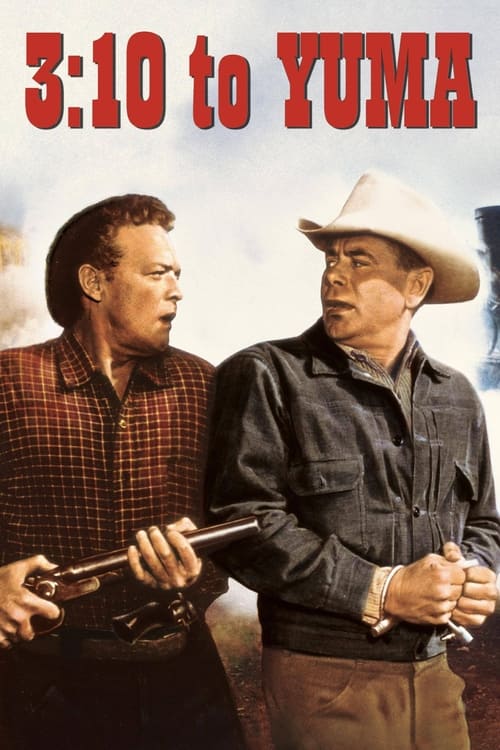
3:10 to Yuma
1957 · Delmer Daves
When you want an old movie that plays modern — lean, black-and-white, ninety-odd minutes, no fat. For a night when you'd rather be held by suspense and character than by spectacle.
What it's about
A drought-ruined Arizona rancher takes two hundred dollars to do one dangerous job: hold a captured outlaw in a small-town hotel room until the 3:10 train arrives to carry him to prison. The outlaw's gang is gathering in the street below, and the outlaw himself — charming, patient, unhurried — starts working on his guard with words instead of guns. It's a Western built almost entirely from waiting, and the waiting is the weapon.
The experience
Taut, intimate, and quietly nerve-shredding — most of it is two men and a conversation, yet it grips like a hostage thriller. The tension is moral as much as physical: you spend the film asking what you'd do for two hundred dollars and your self-respect.
Performances
Glenn Ford, cast brilliantly against his good-guy image, makes the outlaw Ben Wade seductive without ever raising his voice, while Van Heflin gives the worn-down rancher a stubborn, unglamorous decency — the film is essentially a duet, and both men are superb.
The craft
Delmer Daves directs with a chamber-drama discipline rare in Westerns: parched landscapes give way to one shadowed hotel room, shot in crisp black and white where the heat and drought are almost tactile. The compressed clock — everything builds toward one train — gives the structure a ticking pressure, framed by a mournful title ballad.
Why it matters
One of the defining psychological Westerns of the 1950s, it helped shift the genre from shootouts toward moral pressure-cookers, and it was strong enough to earn a major remake half a century later.
Snapshot
3:10 to Yuma is a chamber Western built almost entirely from waiting. A drought-ruined Arizona rancher, Dan Evans (Van Heflin), agrees for two hundred dollars to hold the captured outlaw Ben Wade (Glenn Ford) in a hotel room until the title train arrives, while Wade's gang gathers in the street below and Wade himself works patiently to talk, bribe, or unnerve his guard into letting him go. Adapted by Halsted Welles from a 1953 Elmore Leonard short story and directed by Delmer Daves for Columbia, the film is one of the defining "psychological Westerns" of the 1950s — frequently paired with Fred Zinnemann's High Noon (1952) for its compressed timeline, its ballad framing, and its preoccupation with private courage under public pressure. Its lasting reputation rests on the inversion at its center: the matinee idol Ford as a seductive killer, the second-lead Heflin as a frightened, dignified ordinary man, and a closing reversal that turns a shootout into something closer to grace.
Industry & production
The film was produced at Columbia Pictures, then under Harry Cohn, as a relatively modest black-and-white production at a moment when the major studios were pushing Westerns toward color, CinemaScope, and roadshow scale to compete with television. That choice of austerity — monochrome and an intimate scale rather than landscape spectacle — is the production's most consequential decision, aligning the picture with the cheaper, tighter "adult Western" tradition rather than the epic. Glenn Ford, a major Columbia star, took top billing in the villain's role, with Van Heflin (an Oscar winner for Johnny Eager and recently the homesteader-surrogate of Shane) cast as the beleaguered hero. Supporting roles went to Felicia Farr as the barmaid drawn to Wade, Leora Dana as Evans's wife, Henry Jones, and Richard Jaeckel as a gang member. Exteriors were shot in Arizona — the production is associated with locations around Old Tucson and the grasslands near Elgin — which lends the drought premise a parched physical reality. Precise budget and box-office figures are not something I can cite reliably here, and I won't invent them; the picture's standing rests on critical and historical reputation rather than on a documented blockbuster performance.
Technology
3:10 to Yuma was made with conventional late-1950s 35mm studio technology, and its interest lies in what it declined to use. Where contemporaries reached for Technicolor and anamorphic widescreen, Daves and his collaborators worked in black-and-white, a palette by then increasingly reserved for "serious" or low-budget pictures. The result reads as a deliberate aesthetic, not merely an economy: high-contrast monochrome renders the glare of the desert sun, the shadowed interior of the Contention hotel room, and the sweat on the actors' faces with a starkness color would have softened. I want to be careful about the exact projection ratio, which I cannot confirm from memory; what is secure and significant is the monochrome choice itself and the standard optical, recorded-sound apparatus of the period. There is no technological novelty being showcased here — the film's "technology" is essentially the refusal of the era's marquee innovations in favor of an older, more concentrated cinematic language.
Technique
Cinematography
Charles Lawton Jr. photographed the film, and his work is central to its effect. The visual scheme is one of pronounced contrasts: the open, sun-flattened exteriors of the opening stagecoach robbery and the cattle country give way to the boxed, shadow-cut interior of the hotel room where most of the second half unfolds. Lawton exploits black-and-white's capacity for deep blacks and blown-out whites to dramatize heat, exposure, and confinement. Compositions repeatedly place Evans and Wade in tense spatial relation — framed together through doorways and windows, the street and its waiting gunmen visible beyond — so that the threat outside is kept continuously present within the room. Daves was known for expressive, sometimes mobile camerawork, and the photography here balances that with a willingness to hold and let the architecture of a space carry the suspense.
Editing
Cut by Al Clark, the film's editing is organized around duration and anticipation rather than action. Long stretches are given over to two men talking in a single room, and the cutting honors that stillness; tension accumulates through the patient alternation of the besieged interior and the gathering forces outside, and through the ever-present consciousness of the clock and the train timetable. The structure is essentially a countdown, and the editing's restraint — withholding violence, extending the wait — is what makes the eventual movement to the depot and the dash for the train feel earned. This is suspense built by subtraction.
Mise-en-scène / staging
The staging is the film's signature. Once Wade is captured, the action narrows to the hotel room in Contention, and Daves treats it almost as a theatrical set: a confined box in which a psychological duel plays out while the danger masses in the street below. The drought motif governs the wider mise-en-scène — cracked earth, thirsty cattle, the economic desperation that drives Evans's bargain — so that landscape and weather are dramatized as moral and material pressure rather than scenery. The blocking keeps Wade physically relaxed and Evans physically tense, the outlaw lounging and at ease, the farmer rigid with vigilance, so that posture itself carries the contest of wills.
Sound
Sound is dominated by George Duning's score and, above all, by the title ballad "The 3:10 to Yuma," sung by Frankie Laine over lyrics by Ned Washington. The song frames and punctuates the film much as Tex Ritter's ballad does in High Noon, recurring as a kind of fatalistic chorus that keeps the approaching train — and the approaching reckoning — audible even when off-screen. Beyond the music, the soundscape leans on the textures of waiting: footsteps, the murmur of the gang, the eventual whistle and rumble of the train itself, which functions as both literal deadline and aural climax.
Performance
The performances are the engine of the film, and their casting-against-type is deliberate. Glenn Ford plays Ben Wade as charming, intelligent, and unhurried — a killer who courts his captor and the barmaid alike with easy warmth, making villainy seductive rather than snarling. Van Heflin's Dan Evans is his opposite: a tired, frightened, fundamentally decent man whose heroism is entirely a matter of refusing to quit, his courage visibly costing him. The two-hander dynamic — predator at ease, ordinary man under strain — is what critics most often single out, and it anticipates a long line of Westerns built on the moral intimacy between lawman and outlaw. Felicia Farr's brief turn as the barmaid gives Wade's charisma a romantic register that complicates his menace.
Narrative & dramatic mode
The film operates in a tight, near-classical-unity mode: a compressed timeline, a single dominant location, and a steadily tightening vise. Its dramatic interest is internal rather than external — the question is not primarily whether the gang will attack but whether Evans will hold his nerve and whether Wade, who could likely escape, will choose to. The structure withholds conventional Western action for long stretches, substituting dialogue, temptation, and endurance. This is a moral suspense story: the stakes are economic (two hundred dollars against a failing ranch) and ethical (a man's self-respect before his wife and sons), and the train becomes the concrete emblem of an abstract test. The mode is intimate, talky, and pressurized — closer to a stage thriller than to the open-air adventure Western.
Genre & cycle
3:10 to Yuma belongs to the 1950s cycle of "adult" or "psychological" Westerns that turned the genre inward, trading spectacle for moral and emotional complexity. It is routinely grouped with High Noon for its deadline structure and its examination of a man isolated by duty, and with the lean, philosophically charged Westerns of the same years — notably Budd Boetticher's The Tall T (also 1957), which likewise derives from an Elmore Leonard story and likewise stages a tense rapport between a decent man and a personable outlaw. Within Daves's own run of Westerns — Broken Arrow (1950), Jubal (1956), The Last Wagon (1956), Cowboy (1958), The Hanging Tree (1959) — 3:10 to Yuma is the most concentrated and chamber-like. It sits at the genre's mid-decade pivot toward ambiguity, where the hero is flawed and exhausted and the villain is the more magnetic figure.
Authorship & method
The film is a convergence of several distinctive sensibilities. Delmer Daves, its director, was a craftsman of unusual range — a former writer fluent in melodrama (A Summer Place) as well as the Western — known for sympathetic treatment of his characters, expressive camerawork, and an interest in moral nuance over moral certainty; his Broken Arrow had already marked him as a director willing to humanize the genre's usual antagonists. Halsted Welles wrote the screenplay, expanding Elmore Leonard's spare short story into a feature by deepening Evans's domestic and economic stakes and extending the hotel-room confrontation. Charles Lawton Jr. supplied the high-contrast monochrome cinematography that gives the film its physical and psychological texture. George Duning composed the score and Ned Washington wrote the lyric for the Frankie Laine title ballad, an integral structural device. Al Clark edited. The authorship is genuinely collaborative, but the controlling vision is Daves's preference for compression and sympathy — the decision to make the film about two men in a room rather than a gang and a posse on the range.
Movement / national cinema
This is mainstream American studio filmmaking — a Columbia Pictures product within the Hollywood Western, the most characteristically American of genres. It does not belong to a formal avant-garde or national-cinema movement, but it participates in the postwar maturation of the Western, a development that European critics, particularly at Cahiers du cinéma, were beginning to take seriously as a vehicle for serious authorship. Daves was among the American directors whose Westerns drew admiring attention from French critics of the period for their formal intelligence and humanism. The film is thus best understood not as part of a movement but as a refined instance of a classical national form at a moment of self-examination.
Era / period
3:10 to Yuma is squarely a film of the late 1950s, and its tensions are legible as the genre's response to its moment. The Western was simultaneously at its commercial peak and under pressure from television, which had absorbed the form's standard adventure plots; cinema Westerns increasingly distinguished themselves through scale (color, widescreen epics) or through psychological seriousness (the "adult Western"). This film chooses the latter path emphatically, and its black-and-white austerity reads partly as a deliberate counter-statement to the era's chromatic spectacle. Its concerns — individual moral integrity, the pressure of conscience, the ordinary man's quiet heroism — also resonate with the broader 1950s American preoccupation with the integrity of the self against social and economic pressure, a thematic current it shares with much of the decade's most lasting popular drama.
Themes
The film's governing theme is courage as endurance — heroism redefined not as gunfighting prowess but as the refusal to abandon a commitment, even a foolish or terrifying one. Bound to this is the theme of economic desperation: the drought that drives Evans to take the job grounds his moral test in material need, making his integrity costly rather than abstract. A third axis is the seduction of the charismatic outlaw: Wade's charm is a genuine temptation, dramatizing how evil can be more appealing than virtue and how the decent man must resist not only fear but allure. Underlying all of this is a current of grace and redemption, made explicit in the film's much-discussed ending, where Wade's apparent choice to allow his own capture — and the rain that breaks the drought as the train departs — suggests an unexpected reciprocity and the possibility of moral change. The ambiguity of Wade's motive is deliberately preserved, and the film resists reducing it to a single explanation.
Reception, canon & influence
3:10 to Yuma was well received in its time and has steadily gained stature, and it is now widely regarded as one of the finest American Westerns of the 1950s and a high point of Daves's career. Its critical reputation rests on the Ford–Heflin two-hander, the disciplined suspense, and the moral seriousness of its premise; the title ballad has its own durable place in the lineage of Western theme songs descended from High Noon. I should note that I cannot responsibly quote specific contemporary reviews or attach precise figures to its commercial performance, and I won't fabricate them — its canonization has been more a matter of accumulating critical esteem than of documented box-office triumph.
Influences on the film (backward): The most direct source is Elmore Leonard's 1953 short story "Three-Ten to Yuma," whose lean situation Welles expanded. Structurally and thematically, the film is in dialogue with High Noon (1952), sharing its compressed timeline, its ballad framing, and its vision of solitary moral duty. It also draws on the broader mid-1950s turn toward the psychological Western, and on Daves's own prior humanist work in the genre.
Legacy (forward): The film helped consolidate the template of the Western built on intimate moral conflict between captor and captive, a structure echoed across later genre entries. Its most conspicuous legacy is James Mangold's 2007 remake, also titled 3:10 to Yuma, with Russell Crowe as Wade and Christian Bale as Evans — a larger, more violent reworking that notably alters the original's ending, and whose existence testifies to the durability of Welles and Leonard's central situation. More broadly, the 1957 film endures as a touchstone for the idea that a Western's greatest tension can be generated by two men in a room and a clock on the wall, rather than by a gunfight on the street.
A Deleuzian reading
The picture you keep is a room.
The full Deleuzian reading of 3:10 to Yuma →
Reception
Solidly reviewed in 1957 but long overshadowed by the decade's marquee westerns, it climbed the canon as critics — the French especially, with Bertrand Tavernier championing Delmer Daves — reappraised Daves as a master, and the 2007 remake sent a new generation back to discover the original.
How 3:10 to Yuma was received, from release to now →
Influences: the films it descends from and the films it influenced
- High Noon (1952) — Establishes the real-time ticking-clock structure and the Tiomkin/Tex Ritter title ballad as narrating frame that Yuma compresses from a town's streets into a single hotel room and the 3:10 train deadline.
- The Gunfighter (1950) — Builds suspense from a marked man waiting out a deadline inside a confined saloon interior, substituting dread and conversation for gunplay — the room-bound psychological-western template Yuma inherits.
- Broken Arrow (1950) — Daves's own prior method of granting the genre's nominal antagonist interiority and dignity, carried directly into Ben Wade's articulate, seductive menace rather than flat villainy.
- Key Largo (1948) — A reluctant ordinary man is morally tested against a charismatic captor inside a single weather-besieged interior — the hostage-chamber standoff Yuma restages as the hotel-room vigil.
- The Petrified Forest (1936) — The proscenium single-room hostage drama in which captives orbit a magnetic outlaw, supplying the staging/single-room-chamber two-hander architecture.
- The Lady from Shanghai (1947) — Cinematographer Charles Lawton Jr. develops the deep-focus, high-contrast monochrome chiaroscuro he later brings to Yuma's expressive light-and-shadow textures.
- The Ox-Bow Incident (1943) — Imports classical dramatic unity and sustained moral suspense into the Western, prioritizing ethical interrogation over action — the seriousness Welles's screenplay deepens in Evans.
- Last Train from Gun Hill (1959) — Fuses Yuma's train-departure countdown with the besieged-hotel-room standoff: a lawman pinned in an upstairs room must walk his prisoner to a train leaving at a fixed hour.
- 3:10 to Yuma (2007) — Direct remake preserving the Welles/Leonard captor-captive situation and the train-clock countdown while amplifying the violence and revising the ending's moral arithmetic.
- Blazing Saddles (1974) — Brooks hires Frankie Laine to sing a straight-faced title ballad expressly to invoke — and gently parody — the Laine/High Noon/Yuma Western theme-song tradition.
- The Tall T (1957) — Adapted the same year from an Elmore Leonard short story, built on the identical captor/captive moral two-hander between an everyman and a philosophizing, oddly likable outlaw.
- The Naked Spur (1953) — Psychological captor/captive western whose bound prisoner manipulates and corrodes his keepers through proximity — the moral-erosion duel Yuma chambers indoors.
- Gunfight at the O.K. Corral (1957) — Same-year Frankie Laine title ballad with a Ned Washington lyric deployed as structural framing — the exact balladeer-and-lyricist craft package as Yuma's theme song.
- Cowboy (1958) — Daves immediately reteams with cinematographer Charles Lawton Jr. and star Glenn Ford, continuing the expressive monochrome and the morally ambiguous mentor/captor figure.
- Rio Bravo (1959) — Confinement western that locks lawman and prisoner inside a besieged jailhouse, generating tension from enclosure and proximity rather than open-range gunfights.
- Hombre (1967) — Another Elmore Leonard adaptation that confines a morally divided group under siege and pivots on a reluctant protector's ethical reckoning, extending the Leonard captor/captive moral situation.
Similar films
- Rio Bravo (1959) — influence & lineage · same viewing thread
- 3:10 to Yuma (2007) — influence & lineage
- High Noon (1952) — influence & lineage
- The Ox-Bow Incident (1943) — influence & lineage
- The Naked Spur (1953) — influence & lineage
- The Gunfighter (1950) — influence & lineage
- El Dorado (1966) — same viewing thread · often watched together
- Wagon Master (1950) — same viewing thread
All the films related to 3:10 to Yuma →
Watch it with: curated runs of related films
- The Classical Hollywood Frontier — Watch these to see the American Western at its studio-era height — from Ford's frontier poetry to the tight one-room standoff — the bedrock that Leone and everyone after would later inherit and invert.