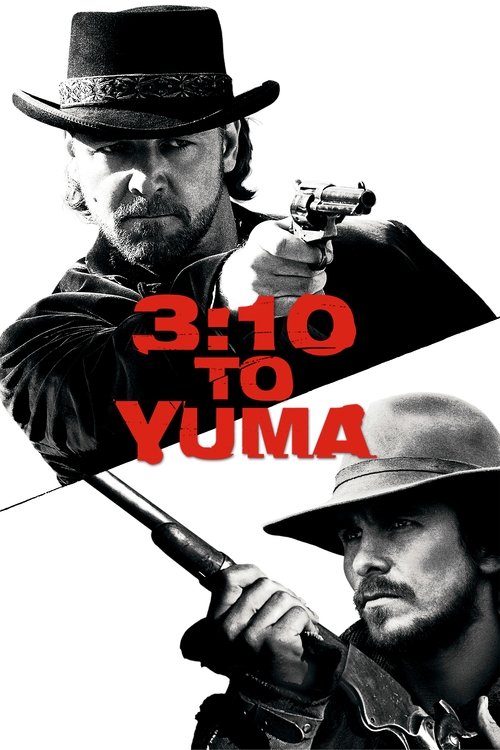
3:10 to Yuma
2007 · James Mangold
For when you want a proper, red-blooded Western — action, horses, standoffs — that also gives you something to argue about afterward. A satisfying, crowd-pleasing watch with real moral weight.
What it's about
In drought-ruined Arizona, a broke rancher and Civil War veteran volunteers for a job nobody wants: escorting the charming, dangerous outlaw Ben Wade across open country to the 3:10 train that will carry him to trial. Wade's gang is riding hard to free him, and the journey becomes a long, armed conversation between a desperate honest man and a killer who sees right through him.
The experience
Tense and propulsive, with the clock always ticking, but the real charge is in the talk — two men circling each other's weaknesses between gunfights. It builds to a finish that leaves your pulse up and a lump in your throat.
Performances
Russell Crowe makes Wade magnetic — a killer who quotes scripture and sketches birds — while Christian Bale plays Evans's battered dignity so quietly it aches. Ben Foster nearly steals the film as Wade's devoted, frightening lieutenant Charlie Prince.
The craft
Mangold stages the canyon-country ride with classical clarity: clean widescreen landscapes, thundering set pieces, and a score that honors the genre without pastiche. The shootouts are muscular and legible, and the whole thing sings on a big screen with the volume up.
Why it matters
Its success helped prove the Western could still work for modern audiences, and it stands with the best of the 2000s revival of the genre.
Snapshot
A two-hander moral thriller in Western dress, 3:10 to Yuma follows broke Civil War veteran Dan Evans (Christian Bale) as he volunteers to escort captured outlaw Ben Wade (Russell Crowe) to the 3:10 train at Contention and into federal custody. The film is a remake of Delmer Daves's 1957 picture of the same name, itself adapted from Elmore Leonard's lean, tension-coiled short story first published in Dime Western magazine in 1953. Mangold's version expands the source into a full odyssey—a cross-country ride through canyon country with Wade's murderous lieutenant Charlie Prince (Ben Foster) closing in from behind—while keeping faith with Leonard's central conceit: that what is tested across one long night is not merely the courage of one desperate man, but the very architecture of masculine honor in a world that rewards neither virtue nor sacrifice.
Industry & production
The project was developed by Lionsgate, with Tree Line Film producing. Mangold had established himself as a commercially viable prestige director through Walk the Line (2005), and the studio agreed to a modestly scaled production by the standards of the era—a budget reported in the range of fifty to sixty million dollars—which was appropriate for a genre considered commercially risky at the time. The original Daves film had been a modest Technicolor oater from Columbia, admired by critics and largely forgotten by the 1980s. Interest in remaking it was partly driven by a broader industry re-evaluation of the Western following the success of Open Range (2003) and the prestige of Brokeback Mountain (2005). Mangold had reportedly been developing the project for some years before Walk the Line secured his commercial standing.
The screenplay was written by Derek Haas and Michael Brandt, working from Halsted Welles's 1957 adaptation, which remained a credited source. The writers substantially expanded the journey—adding the ambush at the beginning, the Evans backstory (the one-legged veteran, the drought-stricken ranch, the mortgage), and the climactic shootout that transforms the film's final movement from a contained standoff into something closer to a siege. The casting of Crowe and Bale, two actors with Academy Award credibility and international box-office weight, was integral to Lionsgate's risk calculus. Ben Foster, then best known for television work and smaller supporting roles, was cast as Charlie Prince; his performance would prove a landmark of the film's reception. Peter Fonda took the role of Pinkerton agent Byron McElroy, and Logan Lerman played Evans's eldest son William, a character amplified from the source to serve the film's thematic interest in fathers and sons.
Principal photography took place primarily in New Mexico—the landscape around Santa Fe and the high-desert terrain of the state's southern ranges—with some material shot in Arizona. New Mexico's tax incentive structure and visual versatility had by the mid-2000s made it a standard production base for Westerns and period pictures.
Technology
3:10 to Yuma was shot on 35mm film in anamorphic widescreen (2.39:1), a ratio that Papamichael and Mangold used throughout to emphasize the expansiveness and indifference of the landscape. The era's digital intermediate pipeline was fully employed for color grading, allowing the warm ochre and slate palette of the desert sequences to be precisely tuned in post against the cooler, shadow-heavy interiors. The film predates the widespread move to digital acquisition; the grain of 35mm is perceptible in the nighttime canyon sequences, contributing texture and a tactile quality that Papamichael has consistently favoured over clinical sharpness.
Technique
Cinematography
Phedon Papamichael, Mangold's regular collaborator (they had worked together on Walk the Line and would reunite for Logan), brings a classical compositional discipline to the film's visual grammar. The wide format is used not for spectacle but for geometry: the frequent shot of a small human figure dwarfed by an enormous sky or a canyon wall establishes the moral register before a word is spoken. The film is notably lit for naturalism—hard sun in the open country, lamplight and shadow in the interior scenes at the hotel in Contention—though the naturalism is itself carefully designed. The late-afternoon sequence in the canyon, as the posse moves through narrow rock corridors, uses slanted backlighting that seems to anticipate danger as much as describe geography. Papamichael avoids the stylized, golden-filter nostalgia of many period Westerns and shoots instead in a slightly cooler, more documentary register that keeps the violence credible.
Editing
Michael McCusker, who would continue as Mangold's editor through The Wolverine, Logan, and Ford v Ferrari, structures the film around a slow compression of time and space. The first half has the loose, episodic rhythm of a journey, accumulating incident and character without urgency. As the party closes in on Contention, McCusker begins intercutting between Evans and Wade's developing dynamic—the hotel room sequences—and Charlie Prince's increasingly violent progress toward the same destination. The film's climactic shootout is edited with precision but without the hyperkinetic fragmentation that had become a stylistic default in American action cinema post-The Matrix; Mangold and McCusker keep the geography of the action legible throughout, which heightens rather than diffuses the tension.
Mise-en-scène / staging
The film's most sustained set piece is the hotel room: Evans and Wade, locked together for hours, fencing with language and history. Mangold stages these scenes with a commitment to proximity and physical specificity—the way Wade sketches (he draws portraits of people he encounters throughout the film, a habit that signals his intelligence and detachment), the spatial arrangement that gives each man a corner of the frame and its attendant symbolic weight. The staging asks the audience to read the room as a chess problem: who controls the space, who concedes it, how those adjustments in physical positioning correspond to shifts in the power dynamic. This is the Leonardian inheritance directly encoded into mise-en-scène. The climactic chase through Contention's streets is staged with unusual attention to the physical layout of a frontier town—the angles of fire, the distances between cover, the geometry of a shootout as a spatial event rather than an abstract spectacle of carnage.
Sound
Marco Beltrami's score occupies a careful middle ground between homage and distinctiveness. Beltrami—whose career had been built largely in horror (the Scream franchise) before broadening—draws on the instrumentation of the classic Hollywood Western while avoiding direct pastiche. Guitars, harmonica, spare brass: the vocabulary is familiar, but the harmonic language has more ambiguity and minor-key irresolution than the triumphalist scores of the genre's Golden Age. The film's sonic geography distinguishes sharply between the silence of open country (wind, hooffall, the creak of leather) and the compressed, echo-laden sound world of the canyon sequences and the town. The train—heard before it is seen, its whistle arriving as an almost abstract signifier of fate and deadline—is given considerable sonic weight throughout the film's final act.
Performance
The film's two lead performances are calibrated in deliberate counterpoint. Crowe plays Wade with a kind of relaxed, amused omniscience—he is the most dangerous man in any scene he occupies, and he knows it, and that knowledge has made him generous in the way that only those with nothing to fear can afford to be. Bale's Evans is tighter, more interior, a man who has learned to ration dignity because he has so little left. The performances find each other: Crowe's expansiveness creates space for Bale's compression to register as intensity rather than blankness. Ben Foster's Charlie Prince is something else entirely—a performance pitched at a different temperature, feral and devoted, operating on a logic of pure loyalty that the film presents as both admirable and terrifying. Foster brings a physical volatility and almost camp elegance to Prince that distinguishes the performance from the conventions of Western villainy. Peter Fonda's McElroy is knowingly cast against the iconography of his countercultural past; his Pinkerton carries the weight of that history without the film quite being able to metabolize it.
Narrative & dramatic mode
The film operates as a pressure-chamber two-hander with an odyssey structure: the road narrative provides variety and incident, but the core drama is psychological, staged between two men who recognize in each other something they cannot find elsewhere. Leonard's original story—rooted in the tradition of the character study as moral experiment—supplies the film's central mechanism: what will Evans do when Wade offers him money to let him go? What will Wade do when he has the chance to escape but Evans is still standing? The screenplay adds the father-son dimension with Evans and William, which serves to externalize Evans's moral stakes but also slightly dilutes the Leonardian purity of the closed system. The film's ending—Wade voluntarily boards the train after Evans is shot dead by Prince, then apparently whistles for his horse Rainmaker as the train pulls away—is its most debated narrative choice. It preserves Wade's enigma while giving Evans a posthumous victory of a sort, but the ambiguity has divided critics who read it as earned complexity and those who find it a compromise that avoids committing to either the Western's classical morality or its revisionist critique.
Genre & cycle
3:10 to Yuma belongs to the post-classical, post-revisionist Western—a mode that had emerged with sufficient confidence by the 2000s to revisit the classical forms without either the period's original ideological confidence or the revisionism's corrective fury. The film is not hostile to the Western's mythology, as Peckinpah was in The Wild Bunch (1969) or Eastwood was in Unforgiven (1992); nor does it simply reproduce the mythology uncritically. It occupies a middle position: it takes the genre's iconography seriously, treats its moral questions as genuinely open, and allows its figures to be complicated without resolving that complexity into a lesson. The film sits in a loose constellation with Open Range (2003), The Assassination of Jesse James by the Coward Robert Ford (2007), and No Country for Old Men (2007)—a run of mid-2000s films that collectively demonstrated the Western's vitality as a vehicle for adult dramatic storytelling when working outside the blockbuster economy. The two-hander thriller structure owes something to High Noon (1952), and the film's interest in masculine honor under pressure to the 1950s psychological Western more broadly—films like the original 3:10 to Yuma, Shane (1953), and Man of the West (1958).
Authorship & method
James Mangold's cinema is consistently organized around questions of masculine identity under pressure—men at the limit of what they thought they were, discovering who they actually become. This theme runs from Cop Land (1997) through Walk the Line (2005), 3:10 to Yuma, and into Logan (2017), which can be read as a kind of final recapitulation of the same concerns in explicitly elegiac terms. Mangold is not typically described as an auteur in the full European sense; he is a classicist working inside Hollywood genres rather than against them, and his strongest films are marked by an absence of conspicuous stylistic signature rather than its presence. The signature, if one exists, is in his commitment to performance and his willingness to let a scene run at the length required by its dramatic weight rather than cutting to keep pace with convention. Phedon Papamichael's collaboration brings a particular approach to natural light and landscape that Mangold has returned to repeatedly. Haas and Brandt's screenplay is a competent expansion of the source material; their contribution is professional rather than distinctive, and the film's literary qualities derive largely from Leonard's original. Marco Beltrami contributes a score that serves the images without asserting its own identity too strongly, which may be the appropriate choice here—the film's atmosphere is built from landscape and performance, not musical signposting.
Movement / national cinema
The film is unambiguously a product of American commercial cinema, working squarely within the Hollywood Western tradition. It has no meaningful relationship to non-American filmmaking movements, though the debt to the Italian Western—to Leone's moral ambiguity, his attention to the charisma and psychology of outlaws, his willingness to make the antagonist more compelling than the protagonist—is visible in the treatment of Wade. The Western as a genre is irreducibly American in its mythological address, even when appropriated by European filmmakers, and 3:10 to Yuma treats it as such: the landscape, the history of the Civil War veteran's dispossession, the railroad as instrument of capitalist expansion and federal authority—these are specifically American griefs and specifically American power structures.
Era / period
The film was released in September 2007, a moment of notable Western activity: The Assassination of Jesse James appeared in the same month, and the Coen Brothers' No Country for Old Men arrived that November. The mid-2000s had seen a quiet but sustained re-emergence of the Western as a prestige form following years of dormancy, driven partly by the critical rehabilitation of the genre's history, partly by the commercial model established by Open Range, and partly by a cultural appetite for moral clarity and its complication at a moment of American foreign policy debate. Whether the Western revival of the 2000s was directly inflected by the Iraq War context is a question that criticism raised at the time without fully resolving; the films themselves are not straightforwardly allegorical, but the genre's historical preoccupation with law, violence, and the legitimacy of force was not lost on reviewers.
Themes
Honor and its cost; the relationship between reputation and identity; fatherhood as a site of failed transmission and unexpected rescue; the structural impossibility of virtue in an economic system that punishes it. Evans's central problem is not moral but financial—he cannot afford to be honorable—and the film refuses to pretend that virtue is costless or that the good man is rewarded. Wade's arc is harder to summarize: his apparent respect for Evans, his voluntary boarding of the train, suggest that something in Evans's refusal to compromise has touched a faculty in Wade that had atrophied from disuse. The film is interested in honor as a kind of contact contagion—Evans's stubbornness changing the conditions of the game for Wade. The father-son dimension adds a generational dimension: William's growing admiration for his father's moral courage functions as the only register in which Evans's sacrifice can be understood as something other than futile.
Reception, canon & influence
Critical reception. The film received a strong critical response on release, with reviewers finding it a mature and pleasurable revival of classical Western storytelling. Ben Foster's performance was almost universally singled out as the film's most startling element, distinguishing itself from even the two prominent leads. The ending generated debate, with some critics finding its ambiguity thematically coherent and others reading it as a failure of nerve—an unwillingness to commit to either classical moral consequence or genuine revisionism. The film was commercially respectable though not a breakout success; exact figures are available in trade records.
Influences on the film (backward). The primary source is Leonard's 1953 story, filtered through Daves's 1957 adaptation—Glenn Ford and Van Heflin establishing the charismatic-villain / principled-everyman template that Crowe and Bale inherit. The 1950s psychological Western more broadly—particularly High Noon, Shane, and Man of the West—supplies the film's interest in testing masculinity against social pressure. Leone's Dollars Trilogy inflects the treatment of Wade as a figure of superior competence and detachment. Peckinpah's revisionism, particularly The Wild Bunch, shadows the film's willingness to contemplate failure and the futility of sacrifice without resolving that contemplation into nihilism.
Legacy and forward influence. The film contributed to the credibility of the Western as a prestige vehicle in the late 2000s, demonstrating alongside No Country for Old Men and Jesse James that the genre could sustain adult, morally complex filmmaking within the studio system. Its most direct lineage runs through Mangold's own subsequent work: Logan (2017) is comprehensible partly as a meditation on the same themes—the aging body, the exhausted masculine ideal, the question of whether one last honorable act means anything—refracted through the superhero genre. The two-hander moral thriller structure, the use of Western landscape as ethical commentary, the outlaw whose code turns out to be more coherent than the world's: these are concerns that Mangold has not finished with. The film has not reshaped the genre or generated a school of followers in the way that Unforgiven did, but it holds its place in the 2000s Western canon as a patient, well-crafted example of what the genre can do when it trusts its material.
A Deleuzian reading
A man on a horse, very small, under a sky that does not care.
The full Deleuzian reading of 3:10 to Yuma →
Reception
A warmly reviewed hit in 2007 that got slightly buried under that year's insanely stacked slate (No Country, There Will Be Blood, Jesse James) — it's since climbed into near-automatic inclusion on 'best 21st-century Westerns' lists.
How 3:10 to Yuma was received, from release to now →
Influences: the films it descends from and the films it influenced
- 3:10 to Yuma (1957) — Mangold directly adapts Halsted Welles's screenplay, inheriting the hotel-room pressure-chamber staging in which the criminal's charismatic certainty systematically erodes the lawman's moral resolve across a single night of enforced proximity.
- The Naked Spur (1953) — Mann's two-hander establishes the prototype Mangold inherits: a bounty hunter transporting a captured criminal across hostile terrain while the prisoner psychologically manipulates his captor's self-image, using the journey's spatial confinement as the primary pressure mechanism.
- High Noon (1952) — Zinnemann's parallel-cut countdown structure—intercutting the protagonist's moral isolation with the approaching threat's inexorable progress—directly informs Mangold's interweaving of the Evans/Wade hotel scenes with Charlie Prince's violent pursuit closing on Contention.
- The Searchers (1956) — Ford's VistaVision grammar of dwarfing the human figure against an indifferent landscape to establish moral register—codified in the doorway composition—grounds Papamichael's strategy of using the anamorphic frame's width to subordinate characters to geography before each confrontation.
- Ride the High Country (1962) — Peckinpah's calibrated counterpoint between two aging gunfighters with divergent moral codes sharing a journey establishes the two-hander dynamic of mutual recognition between principled man and compromised man that Bale and Crowe directly inherit.
- Once Upon a Time in the West (1968) — Leone's use of extreme anamorphic widescreen to alternate between vast establishing shots and claustrophobic close-ups in staging spatial power dynamics—alongside his elevation of diegetic sonic geography (train sounds, spurs, wind) as primary narrative punctuation—directly informs Mangold and Papamichael's confrontation grammar.
- Pat Garrett and Billy the Kid (1973) — Peckinpah's elegiac two-hander of mutual fatal understanding between a lawman and outlaw who share a code neither can abandon uses slow temporal compression and near-ambient sound design to build dread—the tonal and structural template for Evans and Wade's final night together.
- Unforgiven (1992) — Eastwood established the post-classical Western blueprint Mangold updates: naturalistic lighting, a desaturated period palette, and systematic interrogation of masculine honor mythology within the genre's own codes, demonstrating the form could bear psychological weight without sacrificing commercial scale.
- Identity (2003) — Inherits the disciplined contained-genre tension and inaugurates fully the Mangold–Papamichael visual partnership that consolidated on Identity, applying its single-pressure-cooker staging to the Western.
- Tombstone (1993) — A star-driven, quotable, character-forward genre revival that similarly builds its appeal around a charismatic gunfighter's verbal wit.
- True Grit (2010) — Roger Deakins's 2.39:1 anamorphic widescreen uses period-naturalistic lamplight and overcast exteriors in the same compositional mode as Papamichael, while Carter Burwell's minor-key score sustains irresolution; the journey structure accumulates calibrated counterpoint performance in explicit continuation of the post-classical Western grammar Mangold advanced.
- Hell or High Water (2016) — Mackenzie's parallel-cut structure intercutting pursuer and pursued builds the same pressure-chamber compression, the two-hander ending resolves in the same ambiguous moral standoff, and near-total reliance on diegetic sonic geography with minimal score directly extends Mangold's approach to post-classical Western sound design.
- Logan (2017) — Mangold, Papamichael, and McCusker deploy the identical anamorphic widescreen naturalistic-lighting grammar and slow temporal compression developed on this film to construct a superhero Western, with the masculine-honor-unto-death arc and calibrated counterpoint between aging protector and young charge functioning as a direct transposition of the Evans/Wade dynamic.
- Hostiles (2017) — Cooper's forced-proximity journey narrative places moral antagonists in escalating psychological confinement across an anamorphic widescreen frame lit with the same naturalistic discipline as Papamichael, with slow temporal compression and an ambiguous ending refusing resolution of the masculine honor theme—extending Mangold's post-classical Western grammar into the following decade.
- Open Range (2003) — Costner's mid-2000s Western uses anamorphic widescreen with naturalistic overcast-sky lighting and deliberate editorial compression across the first two acts, demonstrating genre commercial viability in the same revival moment Mangold entered and sharing the slow build toward a geometrically legible climactic gunfight.
- Brokeback Mountain (2005) — Rodrigo Prieto's anamorphic widescreen uses the Western landscape's spatial geometry to externalize psychological interior states, establishing in the industrial moment immediately preceding Mangold's production that the genre could support prestige psychological drama with naturalistic lighting and Academy-grade performance.
- The Assassination of Jesse James by the Coward Robert Ford (2007) — Roger Deakins's anamorphic widescreen uses period-naturalistic light sources, lens-edge vignetting, and slow temporal compression to construct a pressure-chamber psychological study of two men locked in a fatal dynamic of recognition and destruction—a parallel-development sibling released in the same year as Mangold's film.
- No Country for Old Men (2007) — The Coens' near-total reliance on diegetic sonic geography with no score across large sections, their parallel-cut pursuit structure, and an ambiguous ending refusing conventional moral resolution make this a direct sibling in the same 2007 Western revival wave sharing Mangold's slow temporal compression as primary tension mechanism.
- Ford v Ferrari (2019) — Papamichael's naturalistic horizontal wide-frame cinematography — the anamorphic landscape framing that positions characters against open space without compositional flourish — is directly continuous with his Ford v Ferrari visual approach, and the working-class protagonist defending competence against institutional pressure is the same dramatic engine in Western register.
- Walk the Line (2005) — Mangold's immediate reunion with DP Phedon Papamichael, extending the same naturalist, character-first genre craftsmanship and warm period palette.
Similar films
- True Grit (2010) — influence & lineage · same viewing thread · often watched together
- The Assassination of Jesse James by the Coward Robert Ford (2007) — influence & lineage · same viewing thread
- Hell or High Water (2016) — influence & lineage · same viewing thread
- Unforgiven (1992) — influence & lineage · often watched together
- 3:10 to Yuma (1957) — influence & lineage
- Hostiles (2017) — influence & lineage
- No Country for Old Men (2007) — influence & lineage
- Logan (2017) — influence & lineage
All the films related to 3:10 to Yuma →
Watch it with: curated runs of related films
- The Frontier's Long Shadow — A run of American myths going to seed — outlaws, oilmen, and foreclosed ranchers set against big country that outlasts them all; watch them close together and the classic Western slowly dissolves into its elegiac modern kin.