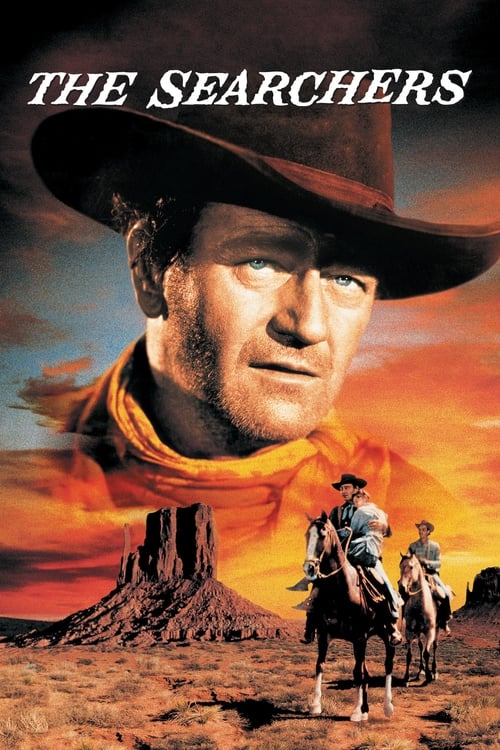
The Searchers
1956 · John Ford
For when you want a monumental piece of American cinema to chew on — a film that's both a gorgeous old-fashioned Western and a dark interrogation of one. Rewards patience and a willingness to argue with it afterward.
What it's about
A Confederate veteran, Ethan Edwards, returns to his brother's Texas homestead just before a Comanche raid destroys it and carries off his young niece. Ethan spends years crossing the frontier to find her — but the longer the search runs, the clearer it becomes that his hatred may be aimed at the girl herself, for having lived among the people who took her. It's a Western about rescue that keeps asking whether the rescuer is the most dangerous man in it.
The experience
Sweeping and mythic on the surface — vast desert vistas, campfires, cavalry — with something genuinely disturbing coiled underneath. It moves like a classic adventure but sits with you like a tragedy, and the ambiguity at its center never lets you get comfortable.
Performances
John Wayne gives the performance of his career as Ethan Edwards — his familiar heroic presence turned inside out into obsession and menace, a portrait of racism wearing the face of a rescuer.
The craft
John Ford at the height of his powers: Monument Valley shot in blazing Technicolor and widescreen, with doorway compositions and horizon lines that filmmakers have been quoting ever since. It's one of the most visually influential films ever made, and it deserves the biggest screen you can find.
Why it matters
Widely regarded as one of the central works of American cinema, it shaped generations of directors and became the template for the story of the obsessive searcher whose quest consumes him.
Snapshot
A Confederate veteran, Ethan Edwards, spends years pursuing the Comanche war chief Scar, who massacred his brother's family and abducted his niece Debbie. As the search stretches across the Texas frontier, Ethan's drive to "rescue" Debbie curdles into something closer to an intent to kill her for having lived among the Comanche — and the film never fully resolves the horror of that ambiguity. The Searchers is at once John Ford's most technically accomplished Western and his most psychologically disturbed one: a film that turns the genre's foundational myth of civilizing rescue into a study of racist obsession, displacement, and the violence upon which the American frontier was actually built. It is now regarded by a broad consensus of critics and filmmakers as one of the central works in American cinema.
Industry & production
The film was produced under C.V. Whitney Pictures, a production company bankrolled by the socialite and sportsman Cornelius Vanderbilt Whitney, who wanted to enter the prestige Western market. Whitney partnered with Merian C. Cooper, the adventurer-producer behind King Kong (1933) and an old Ford collaborator, who helped assemble the deal. John Wayne's own Batjac Productions had a subsidiary interest. Distribution was handled by Warner Bros. The arrangement gave Ford unusual autonomy: a generous budget, Monument Valley locations, and a cast drawn from his established "stock company." Frank S. Nugent, Ford's preferred screenwriter from the late 1940s onward, adapted Alan Le May's 1954 novel, which Le May had built from frontier captivity narratives, most notably the historical case of Cynthia Ann Parker — a white settler woman captured by Comanche in 1836, who lived among them for roughly twenty-four years and bore children including the future Comanche leader Quanah Parker. Le May heavily fictionalized these materials; Nugent's script then reworked Le May's novel further, darkening Ethan's psychology and sharpening the film's racial ironies.
Technology
The Searchers was photographed in VistaVision, Paramount's horizontally-run widescreen negative format, and printed in three-strip Technicolor. VistaVision ran 35mm film through the camera sideways, producing a negative roughly twice the standard frame area; this allowed for exceptional sharpness and color fidelity when the large negative was optically reduced to standard-aperture prints. Ford and cinematographer Winton C. Hoch exploited the format's width to frame the vast Monument Valley topography against human figures rendered tiny at the base of the image — a compositional strategy that would have been visually incoherent on the narrower Academy-ratio frame. The format was new enough in 1956 that its use on a Western (rather than a prestige roadshow picture) was itself a statement of ambition. The projected aspect ratio in most engagements was approximately 1.85:1, though the VistaVision negative retained additional image area above and below.
Technique
Cinematography
Winton C. Hoch had already photographed Ford's She Wore a Yellow Ribbon (1949) and The Quiet Man (1952), winning Academy Awards for both. On The Searchers he worked within a palette of high desert extremity: the red and orange sandstone buttes of Monument Valley rendered in saturated Technicolor, the whites of snowfields, the deep blacks of interior spaces. Ford's compositional habits — figures silhouetted against open sky, doorways and window frames used as inner frames that define threshold and exclusion — achieve their fullest expression here. The film's most analyzed image, the prologue and epilogue, frames the whole story within a dark domestic doorway: we look outward from inside a settler homestead as Ethan walks toward and then away from it, civilized space enclosing the wilderness, or the wilderness expelling the figure who cannot belong within. Hoch consistently placed Ethan at a remove from other figures, using depth of field and compositional separation to render his physical isolation visible. The interior scenes, often lit by firelight or oil lamp, contract the wide-frame expansiveness into shadow and enclosure. Ford characteristically demanded that Hoch shoot in available and near-available golden-hour light during location photography; some of the Monument Valley sequences were reportedly filmed at dawn to catch the low-angle light the director wanted.
Editing
Jack Murray edited the film with Ford's characteristically elliptical rhythm. The Searchers covers approximately five years of narrative time in under two hours, and Murray's editing strategy — matching on action, cutting away before violence completes itself, eliding seasons and journeys with a single cut — enforces the sense of time as something obsession consumes rather than inhabits. The Comanche raid on the Edwards homestead is edited in a manner of deliberate withholding: we see the family's premonition, the attack's approach, and then the aftermath without witnessing the massacre directly. This refusal to show is itself an argument; the horror is legible in what the camera chooses not to present. Ford's editing sensibility was never flashy — he was known for shooting with economy, often giving the editor relatively few alternative takes — and the film's pacing reflects a classical directness that trusts the weight of its imagery rather than accreting coverage.
Mise-en-scène / staging
Ford's staging in The Searchers is unusually severe by his own standards. The Fordian community — the festive, singing, communal settler world that organizes My Darling Clementine (1946) or Fort Apache (1948) — is present at the margins here but rendered fragile and finally inadequate. The film's domestic opening, with its half-comic courtship subplot and the welcome of a returning soldier, is interrupted with such violence that the community never fully reconstitutes itself as a site of meaning. Ethan's relationship to space is the film's organizing spatial logic: he is always arriving at thresholds he cannot cross, excluded from the Jorgensen household interior in a series of shots that rhyme the final doorway image. Scar's camp is staged with an ambiguity that mirrors Ethan's own unresolved psychology — it is recognizably a home, even a community, and the film does not permit the visual vocabulary of savagery that conventional Westerns provided. Ford's sense of irony in spatial arrangement extends to the casting of Native American characters: Navajo extras, working in a landscape that was their own territory, play Comanche, and Ford incorporated elements of actual Navajo life into several scenes, including a wedding sequence conducted (reportedly to the amusement of the Navajo performers) partly in actual Navajo language.
Sound
Max Steiner's score leans on operatic gesture and the established conventions of Western film music — brass, strings, period-inflected folk melody. The title theme, "What Makes a Man to Wander," is sung over the opening credits and recurs instrumentally, serving as both a character motif for Ethan and an ironic frame: the ballad renders the search in terms of romantic wandering that the film's actual content systematically refuses. Steiner's score is not considered among his finest work by most commentators — its idiom is somewhat generic by comparison to the film's visual intelligence — but it functions to locate the film within the affective register of the prestige Western, which may itself be part of Ford's strategy of using genre convention as a container for what refuses containment.
Performance
John Wayne gives what is frequently described as the finest performance of his career. The Ethan Edwards he constructs is built on habitual Wayne physicality — the gait, the stance, the contained economy of gesture — but systematically deprived of the character's customary warmth. Ethan's affection for Debbie as a child, his tenderness toward the Jorgensen family, his dry wit in early scenes are all present as evidence of what the obsession has displaced; Wayne's craft is to make those residual qualities legible precisely because they no longer govern the character. The film's most disturbing moment — when Ethan lifts the adult Debbie in a gesture that we expect will be murderous and instead resolves into the sheltering embrace of "Let's go home, Debbie" — works entirely because Wayne has built a performance that makes both outcomes believable. Jeffrey Hunter as Martin Pawley (of one-eighth Cherokee descent, repeatedly reminded of this by Ethan's contempt) provides a counterweight: young, earnest, fundamentally decent, representing the provisional future the post-war Western was beginning to imagine. Vera Miles, Ward Bond, and the rest of Ford's stock company operate at a level of practiced naturalism that anchors the film's community in something recognizable before Ford dismantles it.
Narrative & dramatic mode
The Searchers is structured as a quest narrative — Ethan and Martin's obsessive hunt across seasons and years — but it systematically frustrates the satisfactions the quest structure conventionally provides. The object of the rescue, Debbie, is not recovered through heroic action but through a negotiated bribe and a scene whose dramatic logic borders on the incidental. The hero does not return transformed and integrated; Ethan, in the final image, turns away from the homestead and walks back toward the wilderness, barred by some internal condition from entry. The film's narrative mode is thus closer to tragedy — or to what critics have called a "dark pastoral" — than to the triumphant settler mythology of the classical Western. The comedy subplot, present throughout (Martin's accidental purchase of a Comanche wife is played for broad farce), does not relieve the film's darkness so much as make it stranger; the tonal disjunctions feel less like miscalculation than like Ford's acknowledgment that the frontier narrative was always held together by genre's willingness to look away.
Genre & cycle
The Searchers belongs to the post-war revision of the Western, a cycle that includes High Noon (1952), Shane (1953), and Johnny Guitar (1954), and that gradually displaced the genre's Manichean moral clarity with psychological ambiguity, institutional critique, and a darkened view of settler violence. Ford himself had already complicated his own mythological investments in Fort Apache (1948), which examined the cavalry's suppression of Native resistance without endorsing it. The Searchers goes further: Ethan is recognizably the Western hero in body and skill, but his inner life is structured by a racism that the film does not redeem. The captivity narrative — one of the oldest American popular genres, running from seventeenth-century Puritan accounts through the dime novel — is here turned to expose the psychosexual anxieties the genre was designed to manage. The film is a fulcrum: it is the last great classical Western even as it inaugurates the revisionist one.
Authorship & method
John Ford had been directing Westerns since the silent era; by 1956 his authority over the form was total and historically earned. His working method was famously economical and domineering — he typically shot sparingly, rehearsed little, protected his setups from studio intrusion, and intimidated collaborators into efficiency. His relationship with Wayne was by this point nearly three decades old (Stagecoach, 1939, had launched Wayne's star career); Ford's direction of Wayne on The Searchers reportedly included calculated humiliations designed to strip away the star persona and force a different kind of interiority, though accounts of Ford's methods must be treated with some skepticism given the mythologizing that surrounded him.
Frank S. Nugent, who had been a New York Times film critic before Ford hired him to write Fort Apache, brought a literary intelligence to the adaptation; his handling of Le May's more schematic racial materials added the ironic counterpoint between Ethan's racism and Scar's mirror-like status as a figure also defined by the violence done to his family. Winton C. Hoch's contributions have been discussed above. Max Steiner and editor Jack Murray completed the principal creative team. The film is unambiguously Fordian in every meaningful sense of auteurist attribution, but the collaboration — particularly between Ford and Nugent, and Ford and Hoch — was generative rather than merely executive.
Movement / national cinema
The Searchers is a product of classical Hollywood cinema at its late apogee, and of the Western as the genre that Hollywood used most explicitly to narrate American national mythology. Ford's place within that cinema is anomalous: he was simultaneously its most canonical practitioner and, in films like this one, its most searching internal critic. The influence of European émigré directors on Ford is worth noting — expressionist shadow play, landscape as psychological projection — though Ford's own Irish-American identity and his interest in questions of belonging and exclusion gave these techniques a distinctly American inflection. The film was made at a moment when the Western was Hollywood's dominant prestige genre; the cycle's gradual collapse across the 1960s would be partly a response to the psychic territory The Searchers had mapped.
Era / period
The film's production falls within the mid-1950s, a period of considerable anxiety in American cultural life: the Korean War's unresolved aftermath, McCarthyism's recent passage, the early pressure of the civil rights movement, and a general unease about masculine identity and national purpose that would generate the period's characteristic ambivalence about heroes. The Western's postwar darkening — its interest in traumatized veterans, racial violence, and institutional betrayal — was not coincidental to this cultural moment. The Searchers addresses American racism at a historical juncture when that subject was becoming difficult to avoid, though Ford's engagement with it is oblique rather than programmatic, which is both the film's limitation and the source of its enduring interpretive richness.
Themes
The film's central thematic concerns are race, belonging, and the violence that founds national mythologies. Ethan's racism is inseparable from the film's examination of how settler culture constructed itself against an Indigenous other it simultaneously exterminated and desired — the captivity narrative's sexual panic is here located not in the Comanche but in Ethan himself, whose obsession with Debbie's "contamination" exposes the anxiety the genre was designed to manage. The door as threshold recurs as the film's governing symbol: who may enter the domestic space, who is expelled from it, what kind of violence the threshold requires. The film also interrogates the Western hero's irreducible isolation: Ethan's skills — tracking, riding, killing — are exactly what the settler community needs and exactly what prevents him from belonging to it. The search is ultimately not for Debbie but for a place Ethan cannot find because it does not exist for someone constituted as he is.
Reception, canon & influence
Backward influences. The immediate sources are Le May's novel and the Cynthia Ann Parker captivity tradition. Behind those lie the broader captivity narrative genre, the dime Western, and — formally — the John Ford filmography itself, including My Darling Clementine and the Cavalry trilogy. D.W. Griffith's silent epic The Birth of a Nation (1915) haunts the film as a negative model: its foundational linking of racial panic to rescue narrative is precisely what Ford dismantles.
Initial reception. Reviews at the time of release were respectful but did not identify the film as a landmark. Critics noted Ford's technical command and Wayne's performance, while several expressed unease about the film's tonal complexity without fully articulating why. Box-office performance was solid but not exceptional. The film did not receive major Academy Award nominations, a fact that subsequent scholarship has found remarkable given its accomplishments.
Critical rehabilitation and canon. The film's elevation to canonical status began in the early 1960s, largely through auteurist criticism imported from the French Cahiers du cinéma critics — particularly Jean-Luc Godard and Jacques Rivette, who had championed Ford in their critical writing — and domesticated by Andrew Sarris in The American Cinema (1968), where Ford occupies the first position among American directors. By the 1970s The Searchers had become a touchstone for a generation of American filmmakers, and its reputation has only grown. It ranked seventh in the Sight & Sound directors' poll of 2012 — the highest position for an American sound film in that ballot. The American Film Institute placed it among the top ten American films in its canonical lists.
Forward influence. The film's afterlife is extraordinarily extensive. Martin Scorsese has cited it as a foundational text; Taxi Driver (1976) rewrites the narrative directly, transposing the obsessive pursuit and ambiguous rescue to contemporary New York, with Travis Bickle as a degraded, urban Ethan Edwards. George Lucas's Star Wars (1977) echoes the burning homestead massacre as the inciting violence that launches Luke Skywalker's quest. Paul Schrader, who wrote Taxi Driver, has discussed the film's influence explicitly in his own critical and screenwriting work. Francis Ford Coppola's Apocalypse Now (1979) and its structure of obsessive pursuit into darkness carry Fordian traces. Don Siegel, Clint Eastwood, Sam Peckinpah, Walter Hill, and the makers of the revisionist Western cycle of the late 1960s and 1970s all drew on the film's dismantling of heroic mythology. More recently, the Coen Brothers' True Grit (2010), Quentin Tarantino's The Hateful Eight (2015), and Kelly Reichardt's Western work show its long shadow. In global cinema, Akira Kurosawa and Sergio Leone had already absorbed Ford's spatial grammar before The Searchers crystallized it; the film's influence runs through the Spaghetti Western and into the global action cinema that descended from it.
The Searchers occupies an unusual position in the canon: it is both a genre film that fulfills every formal expectation of the prestige Western and a film that uses those expectations as a structure of entrapment — for its characters, and for an audience expecting the mythology to hold.
A Deleuzian reading
The film opens on black.
The full Deleuzian reading of The Searchers →
Reception
In 1956 it was just another well-reviewed John Wayne Western — it earned zero Oscar nominations. The 1970s film-school generation (Scorsese, Schrader, Spielberg, Lucas) championed it into the pantheon, and it's now a Sight & Sound top-tier fixture and AFI's pick for greatest Western ever.
How The Searchers was received, from release to now →
Influences: the films it descends from and the films it influenced
- Stagecoach (1939) — Ford and DP Bert Glennon established Monument Valley's sandstone buttes as compositional verticals — tiny figures anchored at the base of towering red rock — a landscape grammar The Searchers scales to VistaVision's doubled negative area and carries to its formal apex.
- Fort Apache (1948) — Fort Apache is Frank S. Nugent's first Ford screenplay, the collaboration that taught Nugent to translate frontier military records and Le May-style captivity source material into Ford's tonal register — the direct training ground for the Nugent-Ford Searchers script.
- She Wore a Yellow Ribbon (1949) — Winton C. Hoch's first Oscar-winning Technicolor collaboration with Ford; the saturated sunset silhouettes, figures against deep-orange sky, and golden-hour location shooting that Hoch and Ford refined here become the dominant visual system of The Searchers' Monument Valley sequences.
- Red River (1948) — John Wayne's Thomas Dunson — the obsessive, paternalistic patriarch whose reclamation mission curdles into destructive violence against his own family — is the interpretive model Wayne and Ford explicitly reworked when building Ethan Edwards; the suppressed warmth under mounting menace is the same performance architecture.
- Pursued (1947) — James Wong Howe's high-contrast landscape cinematography and Niven Busch's screenplay of racial trauma, family massacre, and the obsessive pursuit of a figure who belongs to no community established the dark-pastoral noir-Western mode that The Searchers inherits and scales up to Technicolor and VistaVision.
- The Quiet Man (1952) — Hoch's second Oscar-winning Ford collaboration introduces the doorway-and-window compositional motif as a structural figure — the cottage threshold that frames arrivals and departures — which Ford formalizes into the symbolic prologue-and-epilogue doorway of The Searchers.
- Shane (1953) — Ford adopted Stevens's doorway-threshold framing as a structural device: the cabin doorframe as mediating boundary between domesticity and wilderness governs the film's famous opening and closing shots, directly echoing Shane's homestead-window compositions that organized the civilization-versus-wilderness dialectic spatially.
- My Darling Clementine (1946) — Ford's most systematic development of the threshold-framing motif deployed throughout Clementine — doorway and arch compositions that structure the relationship between civilized interior and open wilderness — here theorized as the film's organizing visual argument; Winton Hoch's VistaVision Monument Valley deep-space is Clementine's visual vocabulary at its fullest extension.
- The Ox-Bow Incident (1943) — Exemplifies the 'adult'/revisionist Western Ox-Bow licensed, turning the genre's frontier mythology into sustained self-criticism.
- Wagon Master (1950) — Carries the Stan Jones title ballad performed by the Sons of the Pioneers into full narration function — the song opening the door, framing the years, and commenting on the rider — the device Wagon Master had run for an entire feature.
- The Wild Bunch (1969) — Peckinpah's slow-motion multi-angle editing of the film's opening and closing massacres is a direct formal argument against Ford's strategy of withheld violence in The Searchers; where Ford cuts away before the Edwards homestead attack completes, Peckinpah cuts into violence from multiple angles simultaneously, making legible what Ford chose to withhold.
- Once Upon a Time in the West (1968) — Leone's threshold compositions — the film opens with three men framed inside a doorway arch, waiting; it ends at a doorway — transpose Ford's exclusion-staging directly; additionally, Leone's casting of Henry Fonda against his entire Fordian persona constitutes a systematic dismantling of the moral authority Ford's framing had granted that face.
- Taxi Driver (1976) — Scorsese and Paul Schrader built Travis Bickle's structure explicitly on Ethan Edwards: the urban vigilante whose 'rescue' mission barely conceals genocidal contempt for the community he claims to protect, culminating in a threshold staging where the rescuer stands in a doorway, expelled from the domestic space he has violently cleared.
- Apocalypse Now (1979) — John Milius structured his original Apocalypse Now screenplay explicitly on The Searchers — the frustrated quest upriver, the protagonist's growing identification with the enemy he was sent to destroy, and the final confrontation that refuses clean moral resolution — transposing Ford's frontier-captivity dark pastoral into the Vietnam theater.
- Heaven's Gate (1980) — Vilmos Zsigmond's golden-hour landscape cinematography — figures dwarfed in a horizontal frame by open sky, dust, and vast grassland — is a direct inheritance of Hoch's Searchers compositions transposed to Wyoming; Cimino cited Ford explicitly as the compositional model for the film's landscape grammar.
- There Will Be Blood (2007) — Robert Elswit's landscape cinematography — oil derricks and tiny figures in the middle-ground of vast Southwest desert, golden-hour light — and Daniel Day-Lewis's performance of suppressed warmth curdling into obsessive, property-driven hatred both descend directly from Hoch's and Wayne's Searchers work; Anderson has named the film a primary reference.
- Meek's Cutoff (2010) — Christopher Blauvelt's deliberately narrow Academy-ratio frame in desert landscape is a structural inversion of Ford's VistaVision horizontal command of space; Reichardt's women-centered captivity narrative restages the Searchers' desert trek from the interior perspective of those Ford's camera excluded, reversing the gendered point-of-view architecture at the film's formal foundation.
- Star Wars (1977) — Luke's binocular shot scanning the twin-sun Tatooine horizon is a direct visual quotation of Ford's doorframe compositions; the desert frontier as morally charged wilderness where the hero is constitutively displaced derives from Ford's mythic staging of landscape as inner state.
- A Fistful of Dollars (1964) — Ford's deployment of VistaVision's extreme horizontal field to position solitary figures as specks within inhuman rock formations established the visual grammar of widescreen-as-mythic-geography that Leone literalized in Almería's terrain, making landscape itself an active dramatic agent rather than backdrop.
- The Good, the Bad and the Ugly (1966) — Ford's systematic cutting between extreme widescreen landscape shots (Monument Valley reducing figures to specks) and tight close-ups on faces established the close-up/wide oscillation grammar that Leone and Delli Colli radicalized by eliminating all middle-ground focal distance entirely.
- For a Few Dollars More (1965) — Mortimer's arc—years-long obsessive revenge driven by a family trauma withheld until the climactic reveal—descends from Ethan Edwards' structure; Leone adopts Ford's device of withholding the backstory wound to retroactively reframe all prior mercenary action as grief at the moment of revelation.
- Lawrence of Arabia (1962) — Ford and Winton Hoch's compositions placing lone figures against Monument Valley's sandstone formations established the visual grammar — human form as punctuation against geological vastness — that Freddie Young systematically extended to Wadi Rum in 65mm, including the technique of cutting between extreme-close and extreme-wide to make scale a psychological rather than merely spatial fact.
- Ulzana's Raid (1972) — Alan Sharp's screenplay and Aldrich's editing reconstruct Ford's cavalry-vs.-Apache captivity-raid structure using the same elliptical grammar — raid aftermath shown, not the raid itself — to arrive at the opposite political conclusion: that the soldier-rescuer's violence is indistinguishable from the violence he pursues.
- McCabe & Mrs. Miller (1971) — Vilmos Zsigmond's deliberately fogged, lens-diffused, desaturated Technicolor palette is a systematic inversion of Hoch's saturated Searchers color; Altman uses the same Technicolor printing technology as a counter-argument, draining the mythic Fordian frontier of its chromatic authority.
- The Proposition (2005) — Benoît Delhomme's wide-frame Australian outback compositions use the same golden-hour figure-against-sky silhouette grammar as Hoch's Searchers images, and Nick Cave's screenplay mirrors Ford's captivity plot — an obsessive brother pursuing family across a racially-charged frontier — with the colonial valence of the violence made fully explicit rather than structurally ambiguous.
- No Country for Old Men (2007) — Roger Deakins' use of Texas Southwest desert to dwarf figures in a wide horizontal frame, and the Coens' elliptical editing that withholds violence by cutting to aftermath rather than act — the hotel corridor killing heard but not seen — constitute a systematic formal echo of Ford's landscape-figure grammar and the Searchers' elliptical massacre editing.
- Star Wars: The Last Jedi (2017) — Model for hollowing a mythic Western hero into an embittered, failed figure framed in doorways and vast negative-space vistas — the demythologized-legend mode applied to Luke.
- Man on Fire (2004) — Donates the abduction-and-obsessive-rescue quest architecture — the protector's monomaniacal search organizing the whole back half — that underwrites the film's second-movement vengeance structure.
- Rabbit-Proof Fence (2002) — Supplies the abduction-and-pursuit architecture staged across monumental landscape, which Rabbit-Proof Fence inverts — the abducted children become the searchers, walking home along the fence rather than being hunted by a white avenger.
- The Man from Laramie (1955) — Ford's VistaVision epic centers an obsessive, racially poisoned avenger whose fury dwarfs his cause, staging Monument Valley as the mirror of a psyche — the landscape-as-psychology and revenge-driven hero running parallel to Mann.
- The Nightingale (2018) — ancestor — the obsessive cross-country pursuit western organized around racial hatred and a captivity logic, whose vengeance narrative Kent inverts by handing the quest to the colonized.
- Winchester '73 (1950) — Ford answers Mann's proposition that the Western hero can be pathological, giving Wayne an obsession the film declines to explain and disclosing his interior state through doorway framings and refused entrances instead of exposition.
- The Naked Spur (1953) — Parallel solution to the same problem — a star's likability weaponized as racial-sexual obsession, and a journey structured as a series of camp scenes where landscape scale mocks the party's moral smallness.
Similar films
- Stagecoach (1939) — influence & lineage · same viewing thread · often watched together
- Red River (1948) — influence & lineage
- Fort Apache (1948) — influence & lineage
- Pursued (1947) — influence & lineage
- The Wild Bunch (1969) — influence & lineage
- No Country for Old Men (2007) — influence & lineage
- Wagon Master (1950) — same viewing thread
- Rio Bravo (1959) — same viewing thread
All the films related to The Searchers →
Watch it with: curated runs of related films
- The Classical Hollywood Frontier — Watch these to see the American Western at its studio-era height — from Ford's frontier poetry to the tight one-room standoff — the bedrock that Leone and everyone after would later inherit and invert.
Film essays and courses that include it
- Blood, Dust & Opera: How Leone Reinvented the Western
- The Magnificent Loop: Ford, Kurosawa, Leone, and the Western That Ate Itself
- Print the Legend: The Western from Myth to Memory
- Blood Will Have Blood: Cinema's Long Reckoning with Revenge
- No One Gets Away Clean: The Arc of Revenge Cinema
- The Immense Frame: Cinema's 70mm Obsession from VistaVision to IMAX
- The Genre That Aged With America