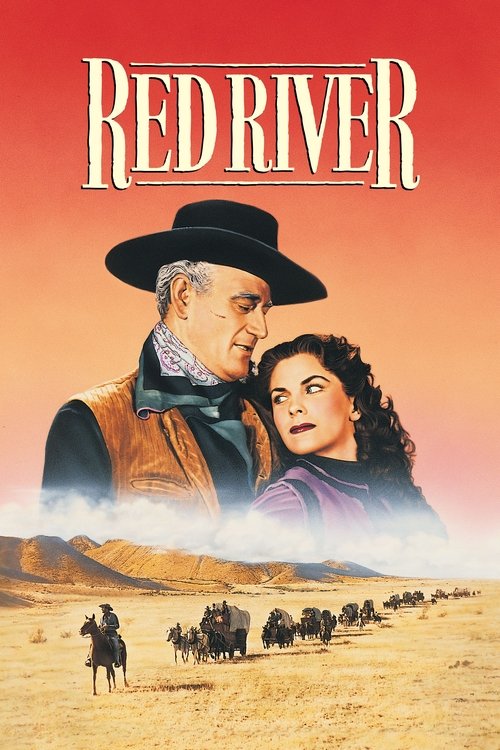
Red River
1948 · Howard Hawks
For a sprawling, satisfying evening when you want an old-fashioned adventure with real dramatic weight — comfort viewing with teeth. A perfect entry point if you think Westerns aren't for you.
What it's about
After the Civil War, iron-willed Texas rancher Thomas Dunson stakes everything on driving his enormous cattle herd hundreds of miles north to market — through storms, stampedes, and hostile country. As the drive grinds on, his discipline hardens into tyranny, and his adopted son Matthew, the best man on the crew, is pushed toward an unthinkable choice. A frontier epic that's really a father-son collision waiting to happen.
The experience
Big and propulsive — river crossings, night stampedes, campfire tension — but what grips you is the slow-building dread of watching a man you admire turn into someone to fear. It earns the word epic and still moves like a thriller.
Performances
John Wayne, cast against his heroic image, is genuinely frightening as Dunson — a performance that revealed he could really act. Montgomery Clift, in one of his first films, brings a coiled, modern sensitivity that makes every scene between them feel like two eras of screen acting squaring off.
The craft
Hawks stages the drive at true scale — thousands of real cattle, weather you can feel — and shoots the black-and-white landscapes with an epic sweep, while keeping the human drama tight and unsentimental. The stampede sequence and the dawn launch of the drive are showpieces of classical Hollywood filmmaking at full power.
Why it matters
A defining American Western that expanded what the genre could carry emotionally, and the film that permanently changed John Wayne's stardom by proving he could play a man gone wrong.
Snapshot
Red River is a landmark epic Western produced by Howard Hawks and released by United Artists in September 1948. Based on Borden Chase's Saturday Evening Post serial "Blazing Guns on the Chisholm Trail," the film follows a punishing cattle drive from Texas northward, orchestrated by Thomas Dunson (John Wayne), an iron-willed rancher whose authority curdles into tyranny, and ultimately contested by Matthew Garth (Montgomery Clift), the adopted son who mutinies against him. Routinely placed among the greatest American Westerns and among the defining works of Hawks' career, Red River is a confluence of epic landscape, psychological depth, and charged male performance that permanently redirected both the genre and the scope of John Wayne's stardom.
Industry & production
Hawks produced the film through his own independent company, Monterey Productions, financing it outside the studio system before selling distribution rights to United Artists — an arrangement that gave him unusual creative autonomy. Principal photography began in June 1946, shooting primarily on location near Elgin in Arizona's Rain Valley, with the production mustering a herd variously estimated in the thousands of head across difficult desert terrain. The logistics of the drive sequences — organizing animals, riders, and camera crews across open landscape — pushed the limits of what location production customarily attempted in the period.
The casting of Montgomery Clift was a significant gamble. A stage actor with no major screen credits, Clift was paired opposite one of Hollywood's established male stars at a moment when the combination seemed commercially uncertain. A wrinkle in the film's historical record deserves noting: although Red River was shot in 1946, its release was delayed until September 1948. In the interim, Fred Zinnemann's The Search opened in March 1948, making Clift's screen debut in a literal sense before Red River reached theaters. Hawks' film was Clift's first work made but not his first seen, which complicated the critical narrative of his "discovery" on its release.
The extended gap between production wrap and release — unusual even by the standards of the period — is not fully explained in the available historical record, though distribution negotiations and post-production refinement both likely contributed. The film exists in two distinct cuts. One uses a framing device built around a fictional journal, with turning pages marking narrative chapters; the other dispenses with this conceit. The relationship between these versions — production sequence, primary theatrical release, subsequent revision — has been the subject of scholarly discussion, and both circulate in archival and revival contexts.
Hawks materially altered Borden Chase's source ending. In Chase's serial, Dunson dies; Hawks insisted on reconciliation between the two men. The choice was deliberate and defended by Hawks in interviews, though it generated immediate critical controversy and continues to divide readers of the film.
Technology
Red River was photographed in black-and-white on standard 35mm, using spherical lenses within the Academy ratio. It predates the widescreen revolution of the early 1950s, which means the film's epic spatial ambitions — the lateral spread of a moving herd, the depth of an Arizona plain — had to be achieved within the constraints of a format that rewarded vertical rather than horizontal composition. This placed considerable demand on cinematographer Russell Harlan and on Hawks' own instinct for staging.
The cattle sequences required synchronization of camera movement with the rhythm of the herd, a technical and logistical challenge addressed through a combination of mounted camera work and fixed positions that allowed the animals to move through rather than past the frame. Sound work on a production of this outdoor scale involved the difficulties typical of location recording in the period; the integration of ambient herd noise into the film's overall sonic design was addressed substantially in post-production.
Technique
Cinematography
Russell Harlan had worked as a stuntman before establishing himself as a location cinematographer, and Red River significantly elevated his professional standing. His compositions in the drive sequences favor low angles that press the cattle mass against an open sky, and wide shots scaled to dwarf individual figures within the moving herd — strategies that communicate both the grandeur and the inhuman pressure of the enterprise. The horizontal limitation of the Academy frame is turned to advantage: Harlan uses the full width of the image and controls depth through clear planar separation, keeping the near landscape, the riders, and the extending plain simultaneously legible.
The nighttime stampede sequence demonstrates his command of contrast: deep shadow is used not to obscure but to suggest chaos, with firelight and available illumination providing enough visual purchase to sustain dramatic coherence. Deep-focus photography — widely discussed in Hollywood following Gregg Toland's work on Citizen Kane (1941) — allows Harlan to hold foreground performers and receding landscape in simultaneous clarity, an approach he applies to both the epic and intimate registers of the film. His subsequent career, which encompassed The Blackboard Jungle (1955) and To Kill a Mockingbird (1962), confirmed the trajectory Red River helped establish.
Editing
Christian Nyby, who had cut several Hawks productions, managed the film's particular editorial challenge: sustaining rhythm across an episodic, durational narrative structured around accumulation rather than classical crisis-and-resolution plotting. His editing of the drive sequences builds tension through increasingly compressed cuts during moments of crisis — the stampede, the threat of rebellion — before releasing that tension through wider, more deliberate shots that restore spatial orientation. In the conflict scenes between Wayne and Clift, Nyby and Hawks are notably restrained: sustained takes register the psychological weight of the encounters rather than fragmenting performance through rapid intercutting, a choice that gives both actors room to work in their very different registers.
Nyby's editorial relationship with Hawks was close enough that when he directed The Thing from Another World in 1951, debate persisted over Hawks' actual creative involvement in that production. Whatever the exact division of labor, Nyby's work on Red River reflects the economical, action-oriented sensibility Hawks consistently valued.
Mise-en-scène / staging
Hawks stages conflict through spatial proximity to the group. Dunson and Garth are rarely isolated from the community of the drive; their conflict unfolds before witnesses, and the men around them function as a moral chorus even when they lack the authority to intervene. This collective framing is a characteristic Hawks strategy: the male group registers the significance of what its members cannot bring themselves to say directly.
The early scene in which Garth and Cherry Valance (John Ireland) compare and exchange revolvers — handling each other's guns with deliberate care, exchanging quietly admiring assessments — is staged with an intimacy that has attracted sustained attention from queer film scholars. Its placement in the film establishes a homosocial tension that runs counter to and alongside the father-son narrative, offering Garth an alternative bond to the one Dunson has formed him in.
Hawks uses Wayne's physical mass as an architectural element, positioning him to dominate the frame when his authority is intact and progressively crowding and isolating him as it erodes. The gradual introduction of a limp, of increasing rigidity in posture and expression, is carefully built across the film's middle section — a physical performance strategy that gives the character's decline its cumulative weight.
Sound
The sustained roar of the herd — hooves, lowing, the creak of moving bodies — is the film's most consistent sonic presence, and Dimitri Tiomkin's score works around and through this environmental texture rather than simply displacing it. A recurring ballad figure, voiced at intervals across the drive, functions as a temporal marker, measuring the journey's duration and registering its human cost. Tiomkin, who had scored several Hawks pictures before Red River and would go on to win Academy Awards for High Noon (1952) and The High and the Mighty (1954), employs a broadly heroic idiom here that registers the grandeur of the undertaking without resolving its moral contradictions. The brass writing in the opening sequences and the quieter, more elegy-tinged passages during the drive's low points suggest a composer alert to tonal differentiation within a conventionally grand framework.
Performance
The film's central dramatic tension is a collision of two incompatible performance modes. Wayne brings a physical authority built over two decades of B-Westerns and consolidated by John Ford's Stagecoach (1939): he projects will and mass, a sense that the body itself is an argument. Dunson's force does not require explanation; it precedes language. Clift brings the nascent traces of what would become identified as Method performance — interiority held under pressure, emotion surfacing obliquely through small physical adjustments rather than declarative statement. The two actors are not simply playing a story; they are demonstrating, in their competing techniques, the generational shift in American screen acting that the late 1940s was beginning to register.
John Ford, upon seeing the film, reportedly remarked — in a formulation whose exact wording is uncertain and which may be apocryphal — that he had not known Wayne could act. However the comment was actually phrased, it captured the widespread critical surprise at the depth Wayne found in Dunson, a role that required him to inhabit a genuine moral failure rather than a heroic front. Walter Brennan, as the loyal retainer Groot, provides the film's affective register, moving between comedy and pathos without disrupting either. Joanne Dru's Tess Millay — arriving in the film's final third — is the Hawksian woman in a specific key: direct, unintimidated by masculine posturing, and capable of puncturing the film's most charged confrontation with a theatricality that some viewers have found tonally dissonant and others have found necessary precisely because of that dissonance.
Narrative & dramatic mode
The film's narrative closely parallels a sea-voyage mutiny story — a resemblance critics noted immediately upon release, invoking both the Nordhoff and Hall novel and the 1935 MGM adaptation of Mutiny on the Bounty. The cattle drive is a closed social world subject to a captain's law, and Hawks traces the precise point at which legitimate authority becomes unendurable tyranny. This structural parallel is less a weakness than the film's organizing principle: Hawks is not concealing the resemblance but transposing its moral logic into a specifically American, specifically territorial register.
The Oedipal logic of the father-son conflict gives the film its psychological density. Garth owes Dunson everything: survival, education, professional formation, the very cattle that constitute their shared wealth. His act of usurpation is inseparable from this debt, which is why the film resists simplifying either man into a position the viewer can hold without discomfort. The narrative's drive toward Missouri — redirected mid-film to Abilene, Kansas, as the more viable cattle market — mirrors this moral redirection: the destination itself is revised under pressure, as is the film's understanding of who its protagonist is.
The ending remains the film's most contested element. Dunson's homicidal rage collapsing into laughter and reconciliation under Tess's blunt intervention reads either as Hawks' instinct for comic resolution overriding the tragic logic the film has been building, or as a deliberate deflation of masculine mythmaking — the final demonstration that neither man can actually carry out the violence the story has seemed to make inevitable.
Genre & cycle
Red River belongs to the generation of "adult Westerns" that emerged in the late 1940s and reshaped the genre's prestige profile. These films — John Ford's Fort Apache (1948) and She Wore a Yellow Ribbon (1949) appeared in close proximity — brought psychological complexity, moral ambiguity, and a serious engagement with American historical mythology to a genre that had been defined largely by programmers and Saturday matinee serials. Red River is the most psychologically interior of this initial cohort: where Ford frames his flawed commanders within the structures of institution and community, Hawks isolates the damaged will of a single man.
The cattle-drive Western as a distinct subgenre finds its locus classicus here. Later films working in this space — including Raoul Walsh's The Tall Men (1955) — operate in the template Red River established. The television series Rawhide (1959–65) drew directly from the drive narrative, launching Clint Eastwood's career in a format that explicitly recalled Hawks' film; Eastwood's own later engagement with Western mythology is substantially indebted to this lineage.
The film also participates in a postwar cycle preoccupied with the legitimacy of authority. Released into a culture reconsidering the moral standing of hierarchy after the experience of the Second World War, Red River's portrait of a great man turned tyrant carried resonances specific to its historical moment that contemporary critics were alert to without always articulating directly.
Authorship & method
Howard Hawks is the film's dominant creative intelligence, and Red River is central to the auteurist account of his work. Borden Chase's screenplay, developed with Charles Schnee from Chase's serial, provided the narrative architecture, but Hawks was known to reshape material extensively in production, often developing scenes in collaboration with actors and overriding source decisions when his dramatic instinct differed. The revision of Chase's ending is the most documented instance. Hawks' thematic signature is legible throughout: the professional group under pressure; the masculine code of competence and emotional reserve; the woman who enters the male world on her own terms; the deflation of heroic posture through comedy at the moment of highest tension. Robin Wood's study of Hawks — one of the foundational auteurist texts in English-language film criticism — argued that Red River exemplifies the director's ability to work simultaneously in the epic and intimate registers, finding the interpersonal dynamics of a Hawks screwball comedy transposed into a landscape of violent consequence.
Russell Harlan as cinematographer, Christian Nyby as editor, and Dimitri Tiomkin as composer each contributed substantially. Harlan's career received a decisive boost from the film's success and extended across the following two decades into very different dramatic registers. Tiomkin's Western scoring idiom, developed and refined here, became a genre template through the 1950s. Chase himself went on to write several major Westerns, including Bend of the River (1952) and The Far Country (1954) for Anthony Mann — films that explore similar territory of frontier authority and moral testing through a different directorial sensibility.
Movement / national cinema
Red River is firmly a product of Hollywood's classical period, even though Hawks produced it independently. It operates within the conventions of classical narrative — continuity editing, psychologically motivated characters, goal-directed plotting, legible spatial geography — while stretching those conventions toward the epic. It is not associated with any national cinema other than American, nor with any avant-garde or art-cinema movement.
The film contributes to Hollywood's mid-century mythologization of western expansion. Its treatment of the frontier is heroic in its primary frame — the establishment of the cattle economy, the opening of northern routes, the founding of what will become a commercial civilization — though the film's opening sequence, in which Dunson's appropriation of land from its Native American inhabitants is narrativized as the natural precondition of enterprise rather than as dispossession, has been extensively analyzed in subsequent scholarship as an instance of the Western's structural erasure of Indigenous claims. The raid that follows is rendered as obstacle, not response.
Era / period
The film was made between 1946 and 1948, in the immediate postwar years, and released into a cultural moment of American self-examination following the war. The Western was undergoing a significant generic mutation in this period — from genre entertainment toward a vehicle for exploring national mythology and its contradictions — and Red River is one of the films that crystallized that mutation rather than simply reflecting it. The independent production model Hawks employed also anticipates the gradual dissolution of the studio system that would accelerate through the 1950s, though Red River was realized and distributed in ways that differed little in practical terms from major-studio production.
Themes
The film's central preoccupation is the relationship between authority and tyranny — the question of when necessary hardness becomes unacceptable cruelty. Dunson is not a villain in any simple sense. The film's opening section establishes his vision, his capacity for sacrifice, and the genuine cost of the will required to do what he does: he abandons a woman he loves to pursue a founding project; she dies for it. The drive is an extension of that founding impulse, and what the film traces is the precise point at which the qualities that make a civilization possible become incompatible with that civilization's continuation.
The father-son dynamic carries this theme in its most intimate register. Garth's debt to Dunson is absolute, which makes his mutiny both necessary and wrenching. The film holds in tension the genuine love between the two men and the impossibility of that love surviving Dunson's trajectory — and then, controversially, refuses to honor that tragic logic in its final minutes.
Manifest Destiny, the cattle economy, and the violence required to open a continent are present not as abstract themes but as the material substance of every scene. The herd itself — thousands of animals moved by force of will and organized labor across a landscape — is the film's most honest image of what Dunson's project actually is: an imposition of order onto both nature and other men, at a cost that the film makes felt even when it refuses to fully account for it.
Masculinity as code and as performance runs throughout. The men of the drive live by rules of competence, loyalty, and stoic endurance; the film examines what happens when those rules collide. The gun-comparison scene has been read — within queer film scholarship, most thoroughly — as an image of desire operating within and against the masculine code, suggesting that the code organizes feeling it can never explicitly acknowledge.
Reception, canon & influence
Influences on the film: Borden Chase's serial is the direct source, itself shaped by the conventions of Western literary fiction and the cattle-drive tradition reaching back through Andy Adams' The Log of a Cowboy (1903). The structural parallel to Mutiny on the Bounty — novel and film — was conscious enough that critics noticed it on release; whether it constitutes influence or analogy is a matter of framing. Hawks' own prior work on professional male groups under pressure — Only Angels Have Wings (1939), To Have and Have Not (1944) — provided the interpersonal template. Ford's Stagecoach had demonstrated the Western's capacity for serious dramatic ambition; Red River extends that ambition into longer form and more explicitly psychological territory.
Critical reception at release: The film was well received as a serious, large-scale Western. Critics noted the novelty of Wayne's performance and the unusual generational and stylistic pairing with Clift. Reservations centered on the ending, which some found abrupt and tonally inconsistent with the film's preceding logic. Commercially, the film performed strongly, confirming Hawks as a viable independent producer and Wayne as an actor capable of carrying prestige material.
Canonical status: Red River was recognized relatively quickly as a major work. It appears consistently on critical lists of the greatest Westerns and the greatest American films, and it is central to the auteurist rehabilitation of Hawks that André Bazin initiated and that English-language critics including Robin Wood developed through the 1960s and 1970s. The film's canonical position solidified as the Western itself became an object of serious academic attention.
Forward influence: The film's most immediate and well-documented legacy is its transformation of John Wayne's screen persona. Before Red River, Wayne was a major star; after it, he was capable of playing men of genuine moral complexity. This capacity informed his work across John Ford's cavalry trilogy and reaches its fullest and darkest expression in The Searchers (1956), where the Dunson template — the driven, morally compromised patriarch of American expansion whose founding violence has become his defining pathology — achieves its most complete articulation. The Searchers is substantially unintelligible without Red River as its antecedent.
The cattle-drive narrative template Red River established influenced the Western genre for decades, most directly through Rawhide and the early formation of Clint Eastwood's Western sensibility. Hawks' model of intimate conflict within a professional collective under pressure became a template studied and internalized across Hollywood action cinema well beyond the Western's period of genre dominance. Red River demonstrates, with an authority that subsequent filmmakers did not fail to register, that the Western could hold the full weight of American self-myth.
A Deleuzian reading
The drive begins with a sound before it begins with a movement.
The full Deleuzian reading of Red River →
Reception
A big hit in 1948 and respected from day one, it has since climbed to consensus status as one of the greatest westerns ever made — the film people point to when arguing Hawks belongs beside Ford.
How Red River was received, from release to now →
Influences: the films it descends from and the films it influenced
- The Covered Wagon (1923) — Cruze's production established the overland drive as epic cinematic form, with actual large-scale livestock and wagon staging across open landscape — the logistical and compositional grammar Hawks inherits for organizing cattle, riders, and camera across difficult location terrain.
- Tumbleweeds (1925) — Hart's Oklahoma Land Rush finale — horses and riders filmed at ground level from both moving and fixed positions — is the direct precursor to Harlan's low-angle herd compositions that press cattle mass against open sky in Red River's drive sequences.
- Stagecoach (1939) — Ford's crisis cross-cutting between the coach and pursuing Apaches gave Nyby his rhythmic template for stampede-sequence compression; the film also established Wayne's heroic star persona as the fixed cultural point Hawks then systematically destabilized through Clift's countervailing presence.
- Citizen Kane (1941) — Gregg Toland's deep-focus photography — simultaneously holding foreground performers and receding background in sharpness — is the specific technical antecedent Harlan engages and adapts to outdoor conditions, applying it to hold riders and extending plains in the same focal plane.
- The Ox-Bow Incident (1943) — Wellman established the collective-witness structure in the adult Western — a group watching institutional authority commit a moral wrong — which Hawks directly transposes into the mutiny sequence where Garth's challenge is ratified by the assembled drovers' gaze.
- Shane (1953) — Stevens' low-angle heroic compositions of Alan Ladd — shooting from below to monumentalize the solitary figure against open sky — directly extend Harlan's Red River strategy, and the film consolidates the adult Western's insistence on violence as consequence rather than spectacle that Hawks first proposed.
- Giant (1956) — James Dean's method naturalism against Rock Hudson's classical bearing restages the Clift/Wayne performance dynamic; Stevens' Texas ranch epic at comparable scale uses Dimitri Tiomkin's recurring leitmotif architecture — the same composer, the same ballad-as-structural-device — inherited directly from Red River.
- The Searchers (1956) — Wayne's Ethan Edwards is Dunson extended into pure obsession — the patriarch whose uncompromising authority permanently excludes him from the domestic community he protects — and Ford's use of Monument Valley as moral geography scales up what Hawks established in Arizona's Rain Valley.
- Hud (1963) — James Wong Howe's black-and-white location photography of Texas cattle country directly continues Harlan's approach to ranch landscape; the film's oedipal structure — Melvyn Douglas' patriarch against Paul Newman's rebellious heir — explicitly restages Red River's generational authority conflict on the same terrain.
- The Wild Bunch (1969) — Peckinpah's editing of the opening and closing massacres — multiple cameras intercutting slow-motion and real-speed footage from simultaneous angles — is a systematic kinetic extension of Nyby's crisis-compression editing in Red River's stampede sequence, pushed to its logical formal extreme.
- Lonesome Dove (1989) — McMurtry's source novel explicitly re-engages Red River's cattle drive as literary template; the miniseries' episodic accumulation structure and Basil Poledouris' recurring ballad motif — a theme that returns to mark the drive's emotional waypoints — map directly onto Red River's editorial rhythm and Tiomkin's musical strategy.
- Unforgiven (1992) — Eastwood, whose career launched on Rawhide — the TV series directly modeled on Red River's cattle drive structure — deconstructs the Dunson-type authority figure by insisting on the full bodily cost of the patriarch's violence-and-command code, completing a generational arc that Red River set in motion.
- Rio Bravo (1959) — Russell Harlan photographed both films, establishing the clean functional lighting and sustained actor-led long takes that support Hawks's blocking without expressive intrusion — the same technical baseline Rio Bravo applies to its jail-set ensemble scenes.
- Ride the High Country (1962) — The two-man generational pairing in tension, and professionalism as the western's true subject, model the Judd/Westrum partnership and the older-mentor/younger-rider dynamic.
- The Last Picture Show (1971) — Literally screened inside the film as the last picture show, and Hawks's unhurried, behavior-driven scene pacing is the rhythm Bogdanovich consciously imitates.
- Tombstone (1993) — Its Hawksian code of male professionalism and tested loyalty between men under pressure underwrites the Earp–Holliday bond at the film's emotional core.
- El Dorado (1966) — Pioneers Hawks's use of John Wayne as a physically weathered authority figure and the two-shot staging of paired men bickering through danger, the performance register El Dorado pushes toward self-aware aging.
- The Treasure of the Sierra Madre (1948) — Bogart's Dobbs and Wayne's Dunson are structural twins produced in the same moment: authority figures whose obsession curdles into paranoid tyranny within a male working group under sustained material pressure, each film grounding psychological disintegration in location naturalism.
- Fort Apache (1948) — Fonda's Colonel Thursday stages Hawks' same dramatic problem in cavalry dress — a rigidly commanding officer whose refusal to adapt leads to catastrophe, with the regiment as collective moral witness — making both films simultaneous explorations of institutional authority's self-destruction.
- Yellow Sky (1948) — Wellman uses Death Valley's extreme environment to generate material pressure on a male outlaw group whose internal hierarchy fractures, with Gregory Peck's authority contested in a mutiny-adjacent structure — a direct contemporary working the same dramatic architecture as Red River.
- My Darling Clementine (1946) — Russell Harlan's B&W deep-space landscape compositions share Clementine's visual grammar of human figures against consequence-laden open terrain; Hawks centers the film on male friendship as the Western's structural core and gives the younger man a dissolution-and-redemption arc that parallels Doc Holliday's tragic curve.
- Only Angels Have Wings (1939) — Reapplies the professional-group-under-strain structure to a cattle drive, with the same privileging of shared competent work and coded loyalty over plot mechanics.
Similar films
- The Searchers (1956) — influence & lineage
- Stagecoach (1939) — influence & lineage
- Fort Apache (1948) — influence & lineage
- Unforgiven (1992) — influence & lineage
- Shane (1953) — influence & lineage
- The Treasure of the Sierra Madre (1948) — influence & lineage
- The Wild Bunch (1969) — influence & lineage
- Rio Bravo (1959) — shared sensibility
All the films related to Red River →