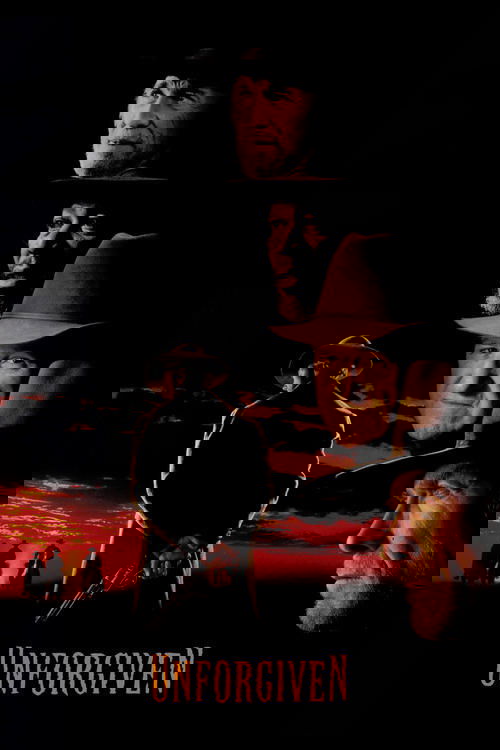
Unforgiven
1992 · Clint Eastwood
For when you want a serious, grown-up film that questions the myths it rides in on — a whiskey-and-firelight watch that leaves you thinking about violence and reputation long after. This is the challenging end of the Western, not the comfort end.
What it's about
William Munny was once a killer of legendary cruelty; now he's a broke widower failing at hog farming in 1880s Kansas, raising two kids alone. When word arrives of a bounty on two men who mutilated a prostitute in a Wyoming town, he saddles up for one last job with his old partner and a bragging young gunman — and rides into the territory of a sheriff who deals out his own brutal brand of order.
The experience
Somber, weathered, and slow-burning, with violence that lands as ugly and costly rather than thrilling. It builds a dread that pays off in a finale of genuine, hard-earned power.
Performances
Clint Eastwood turns his own screen legend inside out as Munny, and Gene Hackman won an Oscar as Little Bill, a sheriff whose folksy charm and casual sadism live in the same breath; Morgan Freeman and Richard Harris round out a flawless quartet.
The craft
Eastwood directs with patient, unglamorous authority — wide plains, rain-soaked streets, and interiors lit like oil paintings — while David Webb Peoples' screenplay strips the gunfighter myth down to regret and consequence. Every death in it is made to weigh something.
Why it matters
Winner of four Academy Awards including Best Picture, it revived the Western as serious adult drama and stands as both the genre's culmination and its reckoning — the capstone of Eastwood's career-long conversation with the gunfighter figure.
Snapshot
A retired assassin — broke, grief-stricken, hog-farming on the Kansas plains — accepts one last killing job alongside his old partner and a young pretender. In the process he dismantles every consoling myth the Western had ever told about its gunfighters: that violence is heroic, that reputation corresponds to character, that a reformed man stays reformed. Unforgiven is simultaneously the fullest expression of the American Western and its most devastating autopsy. It won four Academy Awards including Best Picture and Best Director, was among the first films to re-establish the Western as a genre capable of serious adult drama, and remains the most critically durable work in a fifty-year career.
Industry & production
David Webb Peoples completed the screenplay — then titled The Cut-Whore Killings — in the early 1970s, before he became widely known for co-writing Blade Runner (1982). The script circulated through Hollywood for years; Clint Eastwood acquired it and held it deliberately, reportedly stating he wanted to wait until he was physically old enough to make the part credible. He produced the film through his Malpaso Productions company, which had operated as his creative home since the late 1960s, giving him a degree of control over casting, scheduling, and final cut that was unusual even by the standards of a director with his commercial track record. The production received studio backing from Warner Bros., Eastwood's long-standing distribution partner. Principal photography took place primarily in Alberta, Canada — around the Longview area — with additional shooting in California, the Alberta landscape standing in for Wyoming and allowing the production to use wide, genuinely austere terrain. The budget was modest by the standards of a major studio Western, and Eastwood ran the set with his characteristic efficiency: he preferred single takes and discouraged rehearsal, a method that will be addressed under Performance.
Technology
The film was photographed on 35mm in the anamorphic 2.39:1 aspect ratio using Panavision equipment, consistent with the genre tradition that associates the widescreen frame with the epic horizontal sweep of the West. What distinguishes Unforgiven technically is Jack N. Green's rejection of the clean, sunlit palette associated with classical Hollywood Westerns. Interiors — particularly the scenes inside Greeley's Saloon — are lit with conspicuously low-key, near-candlelit sources, creating pools of darkness that pull faces and bodies into and out of legibility. This was an aesthetic choice that aligned the Western's visual grammar with the moral indeterminacy at the film's center. The exterior cinematography emphasizes overcast skies, mud, and rain; the Alberta landscape is magnificent but unwelcoming. No detailed technical documentation about specific film stock or lens choices has entered the public record, but the available-light texture is visually consistent and clearly intentional.
Technique
Cinematography
Green's visual scheme is organized around an opposition between open sky and enclosure. The film opens on one of the most iconic images in late-twentieth-century American cinema: a lone figure digging a grave at dusk, silhouetted against a luminous orange sky with a dead tree in the foreground — an image that rhymes with the film's closing shot and brackets the narrative in elegy. Wide-angle establishing shots of the Canadian prairie emphasize the smallness of human figures within the landscape, reversing the heroic scale relationship of classical Westerns. When violence erupts, Green refuses to glamorize it: the killing sequences are often dark, confused, and unbeautifully composed, their visual messiness inseparable from their moral weight. The film does not aestheticize death.
Editing
Joel Cox, who had edited Eastwood's films going back to The Outlaw Josey Wales (1976), brought a patience to Unforgiven that is rare in contemporary Hollywood. Scenes are allowed to breathe; silence is not filled. The editing won the Academy Award for Best Film Editing, a notable result given the film's apparent lack of pyrotechnics — the award implicitly recognized the craft of restraint. Cox uses the rhythm of scenes to accumulate dread: the repeated anticipations of violence that do not arrive on schedule train the audience to understand that this world does not work on genre conventions. When violence does come, its abruptness is partly an editing effect.
Mise-en-scène / staging
The staging throughout Unforgiven is organized around power, authority, and vulnerability in space. Little Bill Daggett's unfinished house — which he is building himself, badly — is one of the film's richest images: a figure who imposes his will on an entire town cannot construct a simple domestic shelter. The house is a literal and metaphorical ruin, and the scenes staged inside it, with rain leaking through the roof, make Little Bill's pretensions to civilization visually absurd. The saloon interiors are conceived as constricting spaces; the scene in which Little Bill publicly and systematically beats English Bob — while the mythographer W.W. Beauchamp watches with his notebook — is staged as a demonstration of sovereign power that is also an exposure of how power writes itself into narrative. Eastwood's characteristic staging preference for wide shots over coverage, for observing action rather than cutting into it, maintains a quality of distance that refuses audience identification with violence.
Sound
Lennie Niehaus's score is deliberately sparse, with large portions of the film left unscored — an unusual choice for a Hollywood prestige production of the period. The silence between gunshots, the ambient sounds of rain and wind, and the long pauses in dialogue carry as much weight as the music. The score, when it appears, leans toward the elegiac: sparse piano and strings that refuse the triumphant brass idiom of the classical Western. The sonic world of Unforgiven refuses the amplified, operatic quality that Ennio Morricone brought to the Leone films Eastwood had appeared in; instead, sound design and score collaborate to produce unease and depletion.
Performance
Eastwood's method — minimal rehearsal, preference for first takes, an atmosphere on set that rewards spontaneity — is well-documented across his career. In Unforgiven it produces two distinct registers. His own performance as William Munny is built around stillness, silence, and the economy of the very old Western star: an actor who knows that presence does not require gesture. Gene Hackman's Little Bill is a performance of enormous controlled energy — gregarious, cruel, self-deceiving, and finally terrified — and won Hackman the Academy Award for Best Supporting Actor. Hackman makes Little Bill a man who genuinely believes his own rationalizations, which is what makes him horrifying rather than merely evil. Morgan Freeman brings a quality of quiet moral clarity to Ned Logan that the film gradually and harrowingly betrays. Richard Harris as English Bob is deliberately theatrical — a performance about performance, a self-mythologized gunfighter undone by the reality of Little Bill's violence. Jaimz Woolvett as the Schofield Kid traces the film's central arc in miniature: from bravado and posturing through the act of killing to the admission — "I guess he had it coming" / "We all have it coming, kid" — that no Western film had ever granted its young would-be hero.
Narrative & dramatic mode
Unforgiven is structured around three parallel processes of myth-deflation. The first concerns the Schofield Kid, who wants to be a gunfighter and discovers that killing is shattering rather than glorious. The second concerns W.W. Beauchamp, the dime-novelist who travels first with English Bob and then with Little Bill, attaching his hagiographic pen to whoever holds power — a meta-commentary on how the Western genre has always served power by sanctifying violence. The third and most complex concerns William Munny himself, whose arc involves the horror of self-knowledge: the film finally confirms that Munny was as monstrous as the legends say, that his wife's reformation was real but not permanent, and that the climactic killing spree in Greeley's Saloon — morally unjustifiable by any standard — is nonetheless what the genre has always promised its audience. Eastwood refuses to let the audience enjoy it cleanly. The film's epilogue text, which describes Munny's eventual disappearance into San Francisco commerce, strips even the tragic grandeur from the Western's ending.
Genre & cycle
Unforgiven arrives in the specific context of what might be called the Western's second revisionist wave. The first wave — Sam Peckinpah's The Wild Bunch (1969) and Pat Garrett and Billy the Kid (1973), Robert Altman's McCabe & Mrs. Miller (1971), Arthur Penn's Little Big Man (1970) — had anatomized the classical Western's violence and ideology during the New Hollywood period. By the late 1970s and 1980s the Western had largely collapsed as a commercial genre. Kevin Costner's Dances with Wolves (1990) had demonstrated there was still an audience for the form, though its revisionism was sentimental. Unforgiven belongs to neither the classical tradition nor the sentimentalized revival: it is the most rigorous deconstruction of the gunfighter myth the Hollywood Western had yet produced, and it did so while also being, structurally, a revenge Western — a fact the film refuses to let its audience forget.
Authorship & method
Eastwood's authorship of Unforgiven is best understood in terms of his curatorial and embodied intelligence rather than originary creation: Peoples wrote the screenplay; Jack N. Green provided the visual texture; Joel Cox shaped the rhythm; Lennie Niehaus supplied the sonic restraint. What Eastwood contributes as director-producer-star is the confluence of biography and genre history that makes the film legible as a summation. He had spent the late 1950s and early 1960s in television Westerns (Rawhide), then been transformed by Sergio Leone into an international icon of a specifically amoral screen violence, then worked under Don Siegel to bring that iconography into the American mainstream. Unforgiven is dedicated, in its closing titles, "For Sergio and Don" — Leone had died in 1989, Siegel in 1991, both before the film's release. The dedication is an act of mourning and of reckoning: Eastwood positions the film as both inheritance and critique. David Webb Peoples, whose screenplay is the film's moral architecture, has spoken in interviews about writing the Schofield Kid's disillusionment as the center of the script's argument; the degree to which his original intentions survived Eastwood's production is difficult to establish from the public record.
Movement / national cinema
Unforgiven is an American film in the deepest generic sense: the Western has always been Hollywood's foundational mythology, its self-articulation of the violence underlying national expansion. The film belongs to no formal movement but occupies a specific position within the long argument that American cinema has conducted with its own foundational myth. It is also, obliquely, a product of the transnational formation of Eastwood's own star image: the Italian production context that shaped his screen persona as the Man with No Name made the American Western strange and exportable in ways that informed how Eastwood later understood the genre's operations. The film was shot in Canada — a practical choice that nonetheless places its landscape outside the strictly national symbolic territory.
Era / period
The film was released in August 1992, arriving in a Hollywood moment characterized by the maturation of the post-New Hollywood generation. The early 1990s saw a cluster of prestige American films reckoning with national mythology — the same year saw Malcolm X, A Few Good Men, and The Last of the Mohicans — but Unforgiven was distinctive in performing its reckoning through genre from within, using the Western's own vocabulary to expose its ideological work. Eastwood was sixty-two at the time of the film's release; the film can be read as a late-career statement, a form of self-examination conducted through the genre that made him.
Themes
Violence and its cost is the film's primary subject, examined from multiple angles: the psychological cost to the person who commits it (the Schofield Kid's devastation, Ned Logan's refusal, Munny's dissociation), the physical reality of dying (which the film refuses to make clean), and the narrative cost of telling stories about it that make it seem heroic. Reputation versus reality runs through every major character: English Bob's legend collapses under Little Bill's methodical exposure; Little Bill's authority rests on a violence he frames as law; Munny's infamy turns out to be accurate, though the film withholds this confirmation until the end. The prostitutes who initiate the plot — particularly Strawberry Alice, played by Frances Fisher — constitute an economic and moral counter-argument to the masculine mythology: they are the people the West's violence actually lands on, and they have organized their own form of collective justice, however imperfect. Age and mortality pervade the film's texture; Munny's failed attempts to mount his horse, his fever and hallucinations, his general physical decrepitude, make the body a constant ironic commentary on the legend.
Reception, canon & influence
Critical reception was overwhelmingly positive on release. The film won the Academy Award for Best Picture, Best Director, Best Supporting Actor, and Best Film Editing — only the third Western in Oscar history to win Best Picture, after Cimarron (1931) and Dances with Wolves (1990). It consistently appears in critical polls of the greatest American films, and in virtually every list of the greatest Westerns.
Influences on the film (backward) are embedded in its dedication and its form. The Leone spaghetti Westerns — particularly The Good, the Bad and the Ugly (1966) and Once Upon a Time in the West (1968) — established the ironic, amoral register within which the film operates, and taught Eastwood the iconographic value of restraint and silence. Don Siegel's Two Mules for Sister Sara (1970) and The Beguiled (1971) introduced a darker, more psychologically ambiguous use of the Eastwood persona. Peckinpah's The Wild Bunch established the visual and thematic vocabulary of violence-as-tragedy that Unforgiven inherits and extends. The classical Anthony Mann–James Stewart Westerns of the 1950s — Winchester '73, Bend of the River, The Naked Spur — established the psychologically troubled gunfighter as a legitimate dramatic subject. People's screenplay also works in dialogue with the dime-novel tradition it directly represents through Beauchamp: the film knows its genre's literary prehistory.
Legacy and forward influence is substantial. Unforgiven is generally credited with re-legitimizing the Western as a vehicle for serious filmmaking in the post-New Hollywood period, opening space for the neo-Western cycle that followed. The Coen Brothers' No Country for Old Men (2007) shares its interest in violence as unglamorous fact and in aging, weary men confronting a world that has outrun their understanding. Andrew Dominik's The Assassination of Jesse James by the Coward Robert Ford (2007) extends Unforgiven's interrogation of myth-making and celebrity around violence. The Coen Brothers' True Grit (2010) works in the shadow of Unforgiven's revisionism even while engaging a different aspect of the Western tradition. More broadly, the film's influence on the representation of violence — its insistence that killing be shown as costly and ugly — can be traced across a generation of American filmmakers working in genre. Tommy Lee Jones's The Three Burials of Melquiades Estrada (2005) and his directorial work more generally cite Eastwood as a significant influence, and Unforgiven specifically. The film also stands as the key text in thinking about star-self-reflection in Hollywood cinema: Eastwood using his own legend — his decades of screen killing — as the raw material of the film's moral argument. That move has influenced how later star-directors, and critics writing about them, understand the possibility of meta-textual autobiography within genre filmmaking.
A Deleuzian reading
A man digs a grave at dusk.
The full Deleuzian reading of Unforgiven →
Reception
No reappraisal needed — it landed as an instant classic in 1992, sweeping to Best Picture and Eastwood's first directing Oscar, and three decades on it's only hardened into the definitive 'last word' on the western.
How Unforgiven was received, from release to now →
Influences: the films it descends from and the films it influenced
- A Fistful of Dollars (1964) — Leone and Eastwood together codified the 'stillness-as-presence' performance grammar — the professional killer whose silence is more threatening than speech — that becomes William Munny's defining physical vocabulary in Unforgiven.
- Once Upon a Time in the West (1968) — Leone's formal template — anamorphic wide shots dwarfing figures against landscape, silhouette framing at dusk, violence preceded by extended non-dialogue, and a sparse score built structurally on absence — is the direct technical model for Jack N. Green and Eastwood's visual scheme.
- Ride the High Country (1962) — Peckinpah established the elegiac narrative architecture — aging gunfighters taking a final job as their era closes — and the use of wide landscape to signal the historical passing of the West, which Unforgiven inhabits and systematically darkens.
- The Wild Bunch (1969) — Peckinpah's explicit revision of the genre's moral economy established violence as traumatic and unglamorous; Eastwood then refuses Peckinpah's own slow-motion aestheticization entirely, making Unforgiven's violence starker and more morally unforgiving by conspicuous formal contrast.
- The Man Who Shot Liberty Valance (1962) — Ford's structural device of embedding a myth-critic within the Western — the journalist who 'prints the legend' — is the direct formal ancestor of W.W. Beauchamp, who rewrites his mythological accounts in real time as the film systematically destroys each legend he has assembled.
- McCabe & Mrs. Miller (1971) — Altman replaced the Western's sunlit visual iconography with mud, overcast skies, and rain, and used ambient sound texture in place of dramatic underscore — both formal decisions directly anticipate Unforgiven's Alberta palette and Niehaus's decision to leave large portions of the film unscored.
- The Outlaw Josey Wales (1976) — Eastwood's first sole Western direction established the Joel Cox editing partnership (Cox won the Oscar for Unforgiven) and the observational wide-shot staging that resists cutting into action, while introducing the reformed-violent-man-forced-back structure that Unforgiven will systematically dismantle.
- The Shootist (1976) — Siegel — Eastwood's primary directorial mentor across six collaborations — directed this final Western: an aging gunfighter whose reputation costs him peace; Siegel's economical staging, unbeautified interiors, and focus on violence's cost to practitioners rather than victims passed directly into Eastwood's directorial vocabulary.
- Pale Rider (1985) — Eastwood's direct rehearsal for Unforgiven's visual grammar: the stranger-as-silhouette framing, low-key interior lighting in the mining camp, and Joel Cox's patient editing restraint are all fully present — where Pale Rider still traffics in myth (a supernatural avenger), Unforgiven deploys the identical formal apparatus to destroy it.
- The Good, the Bad and the Ugly (1966) — Eastwood conducts a systematic demythologization of the Western hero persona he embodied under Leone, deploying the same minimalist-stillness performance code—withheld affect, economical movement—now against itself to expose the psychology of damage and self-deception beneath the iconic silence.
- For a Few Dollars More (1965) — Eastwood constructs William Munny as a direct deconstruction of the minimalist archetype he embodied for Leone: where FAFDM aestheticizes the laconic hired killer through formal elevation, Unforgiven subjects the same performance grammar to moral examination—the performance of masculine violence that Leone mythologized becomes the film's explicit and corrosive subject.
- Red River (1948) — Eastwood, whose career launched on Rawhide — the TV series directly modeled on Red River's cattle drive structure — deconstructs the Dunson-type authority figure by insisting on the full bodily cost of the patriarch's violence-and-command code, completing a generational arc that Red River set in motion.
- The Assassination of Jesse James by the Coward Robert Ford (2007) — Roger Deakins' cinematography — silhouette framing against candlelit interiors, low-key chiaroscuro faces, anamorphic widescreen used as elegiac register — is the most technically rigorous extension of Unforgiven's visual grammar; Dominik also embeds a mythographer figure (Robert Ford, then the epilogue narrator) who mirrors Beauchamp's function as simultaneous recorder and destroyer of outlaw legend.
- No Country for Old Men (2007) — The Coens extend Unforgiven's sound-design strategy: Carter Burwell's score is almost entirely absent from the film's first half, replaced by ambient wind and footsteps, and the editing withholds violence at genre-predicted moments to generate dread through rhythm and restraint rather than action.
- 3:10 to Yuma (2007) — Mangold extends Unforgiven's staging vocabulary of power-dynamics-in-space: the hotel-room confrontation is organized entirely around who controls physical territory and who is forced into subordinate positions; the production explicitly cited Unforgiven as the permission structure enabling serious Western filmmaking after years of genre dormancy.
- True Grit (2010) — The Coens deploy Unforgiven's myth-deflation strategy — a legendary frontier lawman revealed as alcoholic, unreliable, and morally diminished — through Deakins' anamorphic landscape photography with overcast, desaturated daylight that formally echoes Green's Alberta palette.
- Hell or High Water (2016) — Mackenzie transposes Unforgiven's formal grammar into the neo-Western: Cave and Ellis's minimal score treats silence as compositional material, Giles Nuttgens' widescreen photography consistently diminishes human figures against the Texas panhandle, and the observational staging refuses the dramatic close-coverage that would sentimentalize violence.
- Gran Torino (2008) — Eastwood completes the arc begun in Unforgiven — a man of violent capacity who finds the only meaningful act is to withhold violence — using the same first-take performance method, Joel Cox's rhythm-of-dread editing, and stillness-as-presence as the dominant performance register in a contemporary suburban setting.
- Absolute Power (1997) — Joel Cox's editing rhythm of deliberate patience—cuts deferred until the scene's internal logic demands them, reaction shots held rather than rushed—and the structural device of Jacobean moral accounting as resolution rather than climax are both carried directly into this film by the same editor and director.
- American Sniper (2014) — Eastwood's own established template for the gap between a man's mythologized reputation and the actual texture of his violence, using sparse score and classical wide-frame staging as formal correlates of moral ambiguity; American Sniper's formal grammar is continuous with this film's approach while refusing its explicit reckoning.
- In the Line of Fire (1993) — Immediately precedes and licenses Eastwood's self-reflexive performance about aging, guilt, and obsolescence — the persona ITLOF's Frank Horrigan is built to interrogate.
- The Equalizer (2014) — The aging killer drawn back into violence, interrogating whether righteous violence restores or damns — the moral weight Fuqua grants each killing.
- Mystic River (2003) — Eastwood's own template of revisionist violence-as-cost, shot in low-key tenebrism with minimal coverage and a spare self-composed piano theme — the direct authorial precursor to Mystic River's moral gravity and restraint.
- Logan (2017) — Supplies the revisionist-Western template of the depleted, conscience-haunted killer whose body has failed him, where each killing is costly and demythologized rather than triumphant.
- The Proposition (2005) — Nick Cave and Warren Ellis's score — sustained tonal drones, minimal melodic statement, silence treated as compositional element — employs structurally the same sparse-underscore strategy as Niehaus; Hillcoat also deploys anamorphic widescreen to consistently diminish human figures against an inhospitable landscape, with identical moral architecture: violence corrupts all who use it.
- Dances with Wolves (1990) — The other prestige revisionist Western of the immediate revival Dances enabled, deglamorizing genre violence and winning Best Picture two years later — a sibling product of the door Costner reopened for the serious adult Western.
- The Bridges of Madison County (1995) — The Malpaso house style crystallized: cinematographer Jack N. Green, editor Joel Cox and composer Lennie Niehaus working the same unhurried, minimal-take restraint carried directly into Bridges.
- Asuran (2019) — A revisionist revenge film that indicts its own genre — the retired killer forced back to the gun — performing the same anti-violence turn on the vengeance drama that Asuran enacts.
- Silverado (1985) — Uses the same purpose-built one-street town as a readable moral map and converges its scattered principals on a single saloon for the finish, with Jack Green's rain-dark lamplight answering Silverado's sunlit staging of that identical geometry.
Similar films
- True Grit (2010) — influence & lineage · often watched together
- No Country for Old Men (2007) — influence & lineage
- The Outlaw Josey Wales (1976) — influence & lineage
- The Wild Bunch (1969) — influence & lineage
- A Fistful of Dollars (1964) — influence & lineage
- The Man Who Shot Liberty Valance (1962) — influence & lineage
- Hell or High Water (2016) — influence & lineage
- Ride the High Country (1962) — influence & lineage
All the films related to Unforgiven →
Watch it with: curated runs of related films
- Judgment and Mercy — Watch these together for the way each puts a life on the scales — a jury room, a death-row block, a slave plantation, a gunfighter's conscience — and asks what mercy costs the people handing down the verdict.
Film essays and courses that include it
- Blood, Dust & Opera: How Leone Reinvented the Western
- The Magnificent Loop: Ford, Kurosawa, Leone, and the Western That Ate Itself
- Print the Legend: The Western from Myth to Memory
- Blood Will Have Blood: Cinema's Long Reckoning with Revenge
- No One Gets Away Clean: The Arc of Revenge Cinema
- Name Your Price: Cinema's Anatomy of the Dark Deal
- The Icon Against Itself
- The Genre That Aged With America