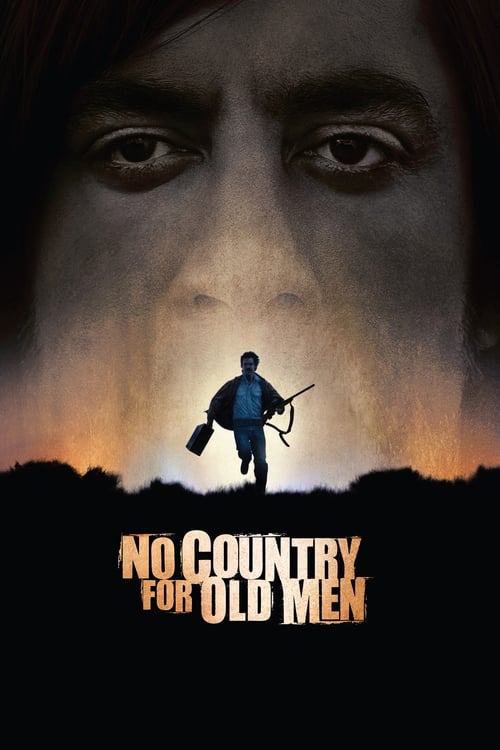
No Country for Old Men
2007 · Joel Coen
When you want to be pinned to your seat by pure suspense and still have something to chew on for days after. This is challenge, not comfort — bleak, brilliant, and unshakable.
What it's about
In the West Texas borderlands of 1980, a welder named Llewelyn Moss stumbles onto the aftermath of a drug deal gone wrong — bodies, heroin, and a satchel holding two million dollars. He takes the money, and a hitman of terrifying calm named Anton Chigurh comes to get it back, while an aging sheriff trails them both, trying to make sense of a violence he no longer recognizes. What follows is a cat-and-mouse chase across motels, border towns, and open desert.
The experience
Almost unbearably tense — long stretches with no music at all, just footsteps, wind, and the click of a lock, punctuated by violence that arrives fast and without mercy. It grips like a thriller and lingers like a eulogy.
Performances
Javier Bardem's Chigurh is one of the great screen villains — implacable, oddly polite, terrifying without ever raising his voice — and it won him the Oscar. Tommy Lee Jones and Josh Brolin match him with weathered, wordless authenticity.
The craft
The Coens' direction is surgical: Roger Deakins shoots the desert in vast, pitiless widescreen, and the near-total absence of a score turns every ambient sound into a threat. The motel sequences are masterclasses in staging suspense through geography and silence. Watch it loud and undistracted.
Why it matters
It swept four Oscars including Best Picture and reset the bar for the modern crime film, proving a thriller could refuse its audience closure and be more powerful for it.
Snapshot
A laconic, near-merciless adaptation of Cormac McCarthy's 2005 novel, No Country for Old Men strips the crime thriller of its consolations—catharsis, justice, closure—and replaces them with an elegy for a world being unmade by an evil that predates any individual act. Set in the dusty borderlands of West Texas in 1980, the film triangulates three figures: Llewelyn Moss, a Vietnam veteran who stumbles onto a drug deal's bloody aftermath and lifts two million dollars in cash; Anton Chigurh, a hitman of near-mythic impassivity sent to recover it; and Sheriff Ed Tom Bell, an aging lawman whose narrated reflections frame the action as a meditation on what it means to grow old in a world one no longer recognizes. The Coen Brothers won four Academy Awards, including Best Picture and Best Director, for a film that refuses to behave like a Best Picture winner—withheld violence, off-screen death, and a final monologue that closes on a dream rather than a resolution.
Industry & production
The project originated when producer Scott Rudin brought the Coens the McCarthy novel shortly after its publication. The brothers had long worked in the crime and noir registers, and the material aligned with their existing aesthetic commitments while also representing a departure in tone: grimmer, more stripped of irony than most of their prior work. The film was co-produced by Rudin's Scott Rudin Productions and the Coens' own Mike Zoss Productions, and distributed by Miramax Films and Paramount Vantage. Principal photography took place largely in New Mexico—particularly in and around Las Vegas, Santa Fe, and Albuquerque—with additional work in Texas, doubling for the 1980 South Texas landscape McCarthy describes. The production budget has been widely reported at approximately $25 million, modest for a film of its eventual prestige, which reflects both the Coens' discipline and the material's deliberate austerity. The adaptation process was unusually faithful: the Coens carried McCarthy's dialogue into the screenplay with minimal alteration, and the novel's structural choices—including the withholding of Moss's death—were preserved intact rather than softened for commercial convention.
Technology
Roger Deakins shot the film on 35mm using Panavision equipment with anamorphic lenses, a format that accommodates the wide, flat horizons of the West Texas landscape while preserving the sharpness and detail Deakins required for close interiors. The anamorphic 2.39:1 aspect ratio allowed the cinematography to operate in two registers simultaneously: the vast, indifferent exterior spaces where men are dwarfed by landscape, and the compressed, claustrophobic interiors—motel rooms, gas stations, cattle pens—where violence materializes at close range. The film predates the industry's full transition to digital acquisition; its grain structure and tonal range are intrinsic to its period texture. Post-production color grading was handled conventionally for a photochemical pipeline, with Deakins seeking a bleached, sun-exhausted palette rather than the saturated genre primaries of conventional crime cinema.
Technique
Cinematography
Deakins's work here is among the most admired in his filmography, notable less for showmanship than for strategic restraint. Outdoor sequences treat the landscape as participant rather than backdrop: long lenses compress figures against featureless desert, emphasizing distance and exposure. The film's most celebrated sequence, Chigurh's encounter with a gas station proprietor (Gene Jones) over a coin toss, is lit almost entirely by the store's overhead fluorescents, giving Bardem's face a sickly, institutional pallor. Deakins also employs extended darkness—the motel tracking sequences at night are lit as if by available or near-available sources, and several action beats occur at the very edge of visibility. This is a philosophical as well as practical choice: the film withholds clarity, visual and moral alike.
Editing
The Coens edit their own films under the pseudonym Roderick Jaynes—a running joke that became Oscar-acknowledged when "Jaynes" received a nomination. The editing of No Country is defined by its omissions. The deaths of most significant characters happen between cuts: Moss dies off-screen, between scenes, and the audience learns of it secondhand through a deputy's report. This refusal of conventional spectacle in violent payoffs extends to the film's largest action beats. The Eagle Pass hotel sequence, in which Chigurh hunts Moss through darkness, is cut so that cause and effect must be inferred. Rhythm in the quieter scenes is extremely slow by commercial standards—the Coens hold on faces, on objects, on empty rooms after figures have departed—creating tension through duration rather than acceleration.
Mise-en-scène / staging
The film's staging consistently privileges ambiguity of threat. Chigurh frequently enters spaces that are only partially visible to the audience, and the camera rarely follows him into a room until after a beat. Props function as narrative objects: the captive bolt pistol (a cattle stunner, rooting Chigurh explicitly in the livestock industry of the region) becomes his primary weapon and a symbol of industrial, bureaucratic death—killing without passion, as one kills cattle. The coin is staged identically in every scene where it appears, a ritual formalized into near-liturgy. The film's period texture—1980 Texas, rendered through clothing, vehicles, and production design by Jess Gonchor—is meticulous without being foregrounded; it recedes into the landscape rather than announcing itself as period drama.
Sound
Possibly the most discussed technical choice in the film is Carter Burwell's near-complete absence. Burwell, who has composed for virtually every Coen film, provides only minimal ambient tones and a spare end-credits piece; the film otherwise runs without underscore. This is a decisive departure from thriller convention, where music cues anxiety and signals danger. In No Country, that function falls entirely to Skip Lievsay's sound design: the percussion of the bolt gun, the hiss of Chigurh's silenced shotgun, wind across scrubland, the ambient hum of motel air conditioning. Silence itself becomes a threat-signal—the absence of sound in a corridor or outside a motel door is more alarming than any stinger could be.
Performance
Javier Bardem's Anton Chigurh operates entirely outside genre convention for the screen villain. Bardem, working with the Coens on his first American-language role of this scale, renders Chigurh as something closer to a natural force than a person: affectless, patient, possessed of a coherent internal logic that is communicated without explanation. The Dutch-boy haircut (Bardem's own suggestion, in consultation with the Coens) is part of the character's disorienting function—it reads as neither period-accurate nor contemporary, neither masculine nor feminine, neither threatening nor benign. Tommy Lee Jones plays Bell in a register of exhaustion and grief, using understatement to carry what the screenplay leaves explicit only in the voiceovers. Josh Brolin makes Moss pragmatic and recognizably human, which is essential: someone must occupy the position of the audience's surrogate, and Brolin plays him as capable and mortal in equal measure.
Narrative & dramatic mode
The film is a sustained examination of genre conventions simultaneously honored and evacuated. It proceeds through the mechanics of pursuit—hunter and hunted, predator and prey—but methodically denies the emotional payoffs those mechanics are designed to produce. The three-strand structure inherited from McCarthy positions Bell's narration as the film's moral consciousness, but Bell arrives everywhere too late; his function is witness and mourner, not agent. The final scene—Bell recounting two dreams to his wife over a kitchen table—constitutes the film's entire resolution. No confrontation, no accounting, no justice. This is philosophically coherent with McCarthy's source material but represents a dramatic mode at substantial remove from what the crime thriller is commercially understood to provide.
Genre & cycle
No Country arrives at the intersection of the neo-Western and prestige crime film as those cycles were peaking in the mid-2000s. The neo-Western's revisionist relationship to frontier myth—the West as site of violence and moral vacancy rather than heroism—was well established by 2007, running through Sam Peckinpah's The Wild Bunch (1969) and Pat Garrett and Billy the Kid (1973), through Blood Simple (1984), and into the 1990s and 2000s cycle of Southern Gothic crime (the films of David Gordon Green, Monster's Ball, Mud). There Will Be Blood, released in the same awards season, represents a parallel meditation on American founding violence and the corruption of landscape; the pairing was widely noted at the time. Within the Coens' own career, No Country completes a thematic triptych with Blood Simple (crime and paranoia in Texas) and Miller's Crossing (the ethics of violence within criminal organizations).
Authorship & method
Joel and Ethan Coen function as a single authorial unit—co-writing, with Joel taking the directing credit by guild convention, both present on set and in the editing room. Their method involves extensive pre-production scripting and storyboarding; they do not improvise during production and grant actors little latitude to depart from the text. This discipline is audible in how precisely Bardem's pauses and Brolin's inflections track the written dialogue. Roger Deakins has been the Coens' principal cinematographer since Barton Fink (1991), and his collaboration here reflects more than a decade of shared visual language—the flattened, sun-bleached exteriors, the forensic attention to practical lighting sources. Carter Burwell's minimal role inverts his usual function: he is credited not for what he contributes but for what he was asked to withhold.
Movement / national cinema
The film sits squarely within American cinema, specifically within the tradition of literary adaptations that cross literary prestige with genre conventions—a mode pioneered at scale by the studio system and reinvigorated in the 1990s and 2000s by independent producers willing to preserve source material's darkness. Its regional identity is pronounced: Texas and the Southwest as moral landscape, the borderlands as a space where civic order thins and other forces become visible. This geographic imagination connects No Country to a long lineage of American Southwest fiction and film, from Larry McMurtry through McCarthy himself.
Era / period
The film belongs to the mid-2000s cycle of American prestige crime cinema—Mystic River (2003), A History of Violence (2005), The Departed (2006), Zodiac (2007), There Will Be Blood (2007)—in which studios and distributors were willing to back expensive, adult, uncompromising crime dramas for the awards market. This cycle was enabled partly by the Miramax model of prestige genre filmmaking and partly by a post-9/11 cultural appetite for films that took violence and political futility seriously. The film's 1980 setting places its moral concerns—the sense that something has gone wrong with America, that old certainties are collapsing—at a historical remove that is nonetheless clearly addressed to the 2007 moment.
Themes
The central preoccupation is the nature of evil as impersonal force: Chigurh is explicitly coded not as a psychopath explicable by backstory but as something more like fate, or entropy. Bell's narrated meditations, drawn directly from McCarthy's prose, extend this into a meditation on aging, inheritance, and the impossibility of understanding the world one inhabits. The coin toss—which Chigurh deploys as a genuine metaphysical proposition rather than theater—dramatizes the film's argument about fate and agency: luck is real, consequence is arbitrary, and human will is a thinner protection against violence than we prefer to believe. The film also meditates on inheritance and generation: what is passed down, what degrades, what cannot be transmitted.
Reception, canon & influence
No Country for Old Men premiered in competition at the 2007 Cannes Film Festival, where it received strong critical response. Domestic reviews were overwhelmingly favorable, with particular attention to Bardem's performance and the film's formal austerity. At the 80th Academy Awards it won Best Picture, Best Director, Best Supporting Actor (Bardem), and Best Adapted Screenplay—a sweep that positioned it as a critical consensus film despite its refusal of conventional satisfactions. Its critical standing has solidified in the years since; it regularly appears on decade-best lists for the 2000s.
Looking backward, the film draws on Peckinpah's elegiac violence and the formal rigor of the American neo-noir tradition, on the Coens' own established crime filmography, and on the specific literary prestige of McCarthy, whose 1985 Blood Meridian had circulated for two decades as an "unadaptable" novel, lending No Country a sense of serious literary legitimacy. The adaptation's fidelity to McCarthy's structure—including its refusal to show the climactic violence—demonstrated that such fidelity could survive commercial release.
Looking forward, Bardem's Chigurh established a template for the philosophical screen villain—impassive, rhetorically coherent, interested in the meaning of his own actions—that has been visible in subsequent prestige crime and genre work. The film's sound design strategy, using ambient naturalism in place of underscore, influenced subsequent filmmakers working in the thriller and horror adjacencies. More broadly, its success at the awards level demonstrated that a film could refuse genre catharsis and still reach a mainstream audience, a proof-of-concept that subsequent prestige crime production has returned to repeatedly.
A Deleuzian reading
A man flips a coin onto a gas-station counter and asks the owner to call it.
The full Deleuzian reading of No Country for Old Men →
Reception
No reappraisal needed — it swept the 2008 Oscars (Picture, Director, Adapted Screenplay, Supporting Actor) and was hailed instantly; nearly two decades on it's only climbed, routinely topping best-of-the-2000s lists.
How No Country for Old Men was received, from release to now →
Influences: the films it descends from and the films it influenced
- Le Samourai (1967) — Melville's construction of Jef Costello—the near-silent, ritualistic hitman who operates on procedural logic rather than emotion, surrounded by diegetic ambient sound rather than score—is the direct performance and sound-design ancestor of Chigurh's operational remove and NCFOM's scoreless track.
- Badlands (1973) — Holly's peripheral voiceover frames Kit's affectless killing with aesthetic detachment that directly establishes the frame-narration grammar NCFOM inherits—a witness who poeticizes violence they cannot morally process, aestheticizing evil rather than condemning it.
- The Conversation (1974) — Walter Murch's sound editing here established the grammar for diegetic sound as primary narrative tension—the rustle, the drone, the ambient room tone as meaning-making instrument—that NCFOM's scoreless, diegetic-only track descends from directly.
- Chinatown (1974) — Polanski's structural decision to give the villain the resolution—Evelyn dies, Cross takes the girl, Gittes fails—is the prestige-crime template for NCFOM's withheld catharsis and the formal refusal of detective-genre redemption arcs.
- Two-Lane Blacktop (1971) — Hellman's scoreless, ambient-only soundtrack and structural refusal of resolution—the narrative dissolves without closure, the film literally burns—establish the neo-western anti-cathartic grammar that NCFOM inherits as its organizing formal principle.
- Days of Heaven (1978) — Nestor Almendros's available-light Panavision doctrine—minimizing artificial sources, accepting grain and darkness as information, using peripheral voiceover narration from a witness who cannot fully comprehend the violence—is the direct cinematographic and narrative ancestor of Deakins's near-darkness motel sequences and Bell's elegiac frame narration.
- Blood Simple (1984) — The Coens establish their crime grammar here: violence occurring off-screen or at the edge of the frame, diegetic sound foregrounded as anxiety-producer, and dramatic irony withheld from characters who cannot read what the audience can—the full toolkit NCFOM distills into austerity.
- Miller's Crossing (1990) — The Coens develop prop-as-symbol in the recurring hat—which accumulates narrative and ethical weight each appearance, functioning as ritual object rather than costume—the technique they extend directly to Chigurh's captive bolt pistol and the coin, both staged with identical ceremonial formality.
- Fargo (1996) — Roger Deakins's first Coen crime film in Panavision anamorphic establishes the flat, exposure-rich landscape grammar that dwarfs figures in moral exposure; Gaear Grimsrud as affectless, near-wordless violence rehearses the performance model Deakins and the Coens refine into Chigurh.
- Unforgiven (1992) — The Coens extend Unforgiven's sound-design strategy: Carter Burwell's score is almost entirely absent from the film's first half, replaced by ambient wind and footsteps, and the editing withholds violence at genre-predicted moments to generate dread through rhythm and restraint rather than action.
- The Wages of Fear (1953) — The Coens apply Wages of Fear's score-restraint and temporal-extension editing to the confrontation thriller: motel-room sequences are stretched to durations calibrated to produce physical dread rather than excitement, the nearly absent score forces attention to diegetic sound, and the ironic closure refuses catharsis as completely as Clouzot's final dance sequence.
- The Good, the Bad and the Ugly (1966) — Chigurh's minimalist-stillness performance (Bardem: no inflection, no visible threat-signal, maximum danger) is GBU's performance method pushed to pathological abstraction; the film's near-total diegetic silence—virtually no non-diegetic score—extends Leone's weaponized silence from technique to encompassing aesthetic philosophy.
- Drive (2011) — Refn inherits NCFOM's duration-tension editing model—extended holds on faces and empty spaces, violence erupting from sustained stillness—and the near-silent affectless villain-protagonist whose off-screen, aftermath-revealed violence grammar descends from the Coens' Eagle Pass hotel sequence.
- Sicario (2015) — Roger Deakins directly transposes his NCFOM visual grammar to the US-Mexico border: anamorphic long-lens compression of figures in desert landscape, a night-vision tunnel sequence staged at the literal edge of visibility, and sustained scoreless tension sections built entirely from diegetic ambient and procedural sound.
- Hell or High Water (2016) — The film's structural architecture is NCFOM's: an aging Texas Ranger whose frame-narration irony (Jeff Bridges's Marcus Hamilton as Bell surrogate) comments on a crime he cannot prevent, neo-western withheld catharsis, and West Texas landscape treated as moral field encoding entropy rather than romantic backdrop.
- True Grit (2010) — The Coens' immediately prior film established the precise template carried into True Grit: Deakins' anamorphic long-focal compression of sun-bleached American landscape, unhurried editing punctuated by abrupt violence, and literary adaptation of a morally serious genre novel as the production method.
- Prisoners (2013) — Near-silence scoring strategy: radical withholding of non-diegetic music forces sound design and ambient texture to carry emotional freight, which Jóhannsson's sub-bass drone score on Prisoners inherits and extends.
- A Hard Day (2014) — The restrained-villain template: an antagonist who controls space through procedural calm, making architecture itself adversarial, whose pursuit cannot be outrun because it follows a logic the protagonist cannot comprehend — the direct grammar of Cho Jin-woong's corrupt detective.
- Three Billboards Outside Ebbing, Missouri (2017) — Roger Deakins' wide spherical-lens cinematography of American heartland spaces — flat planes, warm ambient light, institutional interiors stripped of atmosphere — is the direct visual template Ben Davis works from, and the sheriff who cannot intercept violence and retreats in existential defeat mirrors Chief Willoughby's institutional failure.
- Wind River (2017) — Deakins' anamorphic wide frames render violence small against indifferent West Texas landscape, and the procedural ends without justice or catharsis — both the visual grammar and the catharsis-refused structure are the templates Sheridan rebuilds in Wyoming snow.
- Beasts Clawing at Straws (2020) — Chapter-based multi-perspective withholding in which cash functions as moral litmus test across separate character threads; low-key depth staging in constrained interiors under near-available-light conditions, where composed stillness amplifies off-screen threat.
- The Banshees of Inisherin (2022) — Negative-space two-shot staging in spare landscapes where one figure dominates and one recedes; the editing's theatrical patience — scenes held through long silences well past social comfort — and the formal discipline of withholding narrative explanation that McDonagh adopts for refusing to rationalize Colm's decision.
- Weapons (2025) — Silence deployed as primary dread instrument; de-dramatized framing of violence that refuses conventional thriller grammar; the catastrophe-procedural mode in which violence is an ongoing community event rather than a discrete dramatic climax — the formal model for Weapons' sound and editing strategy.
- Skyfall (2012) — Deakins's motivated, naturalistic low-key lighting and patient spatial editing — legible geography over montage — feed directly into Skyfall's classical action staging.
- The Assassination of Jesse James by the Coward Robert Ford (2007) — Roger Deakins shot both films in the same period using identical anamorphic Panavision methodology—long-lens compression of figures against open landscape, frame narration from a peripheral witness, and duration-tension editing held past commercial tolerance—making this NCFOM's closest visual and structural twin in the Western tradition.
- There Will Be Blood (2007) — Robert Elswit's Panavision anamorphic widescreen, Jonny Greenwood's near-absent conventional score, and Daniel Plainview as philosophical screen villain whose evil is systemic and entropic rather than psychological make this NCFOM's direct structural sibling in prestige American cinema's simultaneous 2007 refusal of moral resolution.
- Killing Them Softly (2012) — Dominik deploys NCFOM's scoreless diegetic-sound-design approach in a crime film where Brad Pitt's Cogan operates with Chigurh-adjacent professional remove—violence either withheld or staged as deflation rather than spectacle, catharsis structurally refused in favor of systemic bleakness.
- The Dark Knight (2008) — The Coens' editing restraint—violence occurs off-screen or without score, the killer is never framed with accelerating urgency—and the philosophical antagonist as post-institutional force align precisely with TDK's thesis that ideological evil cannot be contained by procedural law; released simultaneously, both films reframe the crime genre around this thesis.
- Insomnia (2002) — The Coens extend neo-noir moral inversion into a film in which the detective literally cannot solve the crime; Deakins's flat, overlit Texas desert refuses concealment in the same expressionistic mode as Pfister's Alaska, and Tommy Lee Jones's physical deterioration across the film maps structurally onto Dormer's insomnia-as-accumulated-guilt.
- Heat (1995) — Places Chigurh and Moss in a professional hunter/hunted mirror that never resolves in shared-frame confrontation, executing Heat's elegiac mode through Roger Deakins' West Texas landscapes — professionals defined entirely by operational code moving through space as a series of solvable problems, with Bell as the elegiac witness parallel to Heat's law-enforcement perspective.
- The Departed (2006) — Released the year after The Departed, the Coens deploy the same formal strategy of refusing genre catharsis — the villain escapes cleanly, the protagonist withdraws into impotence, violence has no redemptive arc — treating anti-resolution not as pessimism but as the crime film's most honest structural claim.
- The Searchers (1956) — Roger Deakins' use of Texas Southwest desert to dwarf figures in a wide horizontal frame, and the Coens' elliptical editing that withholds violence by cutting to aftermath rather than act — the hotel corridor killing heard but not seen — constitute a systematic formal echo of Ford's landscape-figure grammar and the Searchers' elliptical massacre editing.
- Gone Baby Gone (2007) — The Coens used near-ambient sound design—minimal score, location audio as the dominant register—and a principled withholding of cathartic resolution to deny the audience genre satisfactions that would aestheticize moral failure, working in the same formal register as Affleck's restrained score and anti-redemptive ethical openness.
- American Gangster (2007) — The Coens and Scott, working simultaneously, both stripped the crime film of its cathartic score — Carter Burwell's near-silence mirrors AG's restrained soundtrack — and committed to withholding-register performances that refuse genre resolution; both films are 2007 prestige-crime refusals of the operatic tradition Scarface had established.
- 3:10 to Yuma (2007) — The Coens' near-total reliance on diegetic sonic geography with no score across large sections, their parallel-cut pursuit structure, and an ambiguous ending refusing conventional moral resolution make this a direct sibling in the same 2007 Western revival wave sharing Mangold's slow temporal compression as primary tension mechanism.
- Shooter (2007) — Shares the procedural-restraint mode for depicting a professional killer: Chigurh's weapon rendered with the same obsessive technical specificity Shooter applies to long-range ballistics — violence as precision craft rather than spectacle, with stoic reticence as the performance register for lethal competence.
Similar films
- There Will Be Blood (2007) — influence & lineage
- Hell or High Water (2016) — influence & lineage
- The Assassination of Jesse James by the Coward Robert Ford (2007) — influence & lineage
- Miller's Crossing (1990) — influence & lineage
- Sicario (2015) — influence & lineage
- Fargo (1996) — influence & lineage
- Chinatown (1974) — influence & lineage · often watched together
- True Grit (2010) — shared sensibility
All the films related to No Country for Old Men →
Film essays and courses that include it
- What the Ear Sees: A Century of Cinematic Sound
- Guilty by Design: The Art and Architecture of Film Noir
- Print the Legend: The Western from Myth to Memory
- Cold Business: Hired Killers from Noir to the Nation-State
- On the Edge: Cinema's Grammar of Suspense
- No Comfort: Cinema's Grammar of Despair
- No Vacancy: A Century of Rooms
- The Case That Won't Close: Eight Films About Detectives Who Can't Detect Anymore
- Name Your Price: Cinema's Anatomy of the Dark Deal
- The Myth Made in Italy
- The Ventriloquists
- The Genre That Aged With America
- The Invisible Master