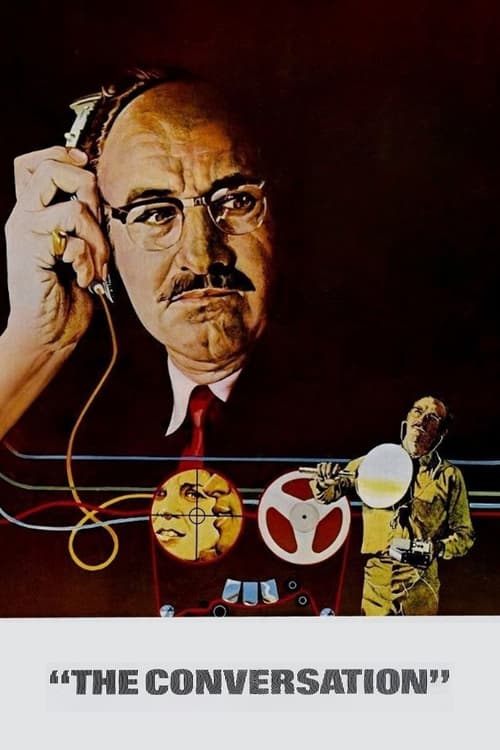
The Conversation
1974 · Francis Ford Coppola
Megalopolis is the decade's great folly narrative: self-funded with $120M of wine money, chaotic Cannes premiere, a pulled trailer with AI-fabricated critic quotes, on-set conduct allegations, and a defiant "I don't care" tour. The conversation is about the mythology of the last mogul-auteur.
For when you want a film to chew on for days — a slow-burn paranoia piece for a solitary late night, not a crowd-pleaser. Choose it when unease sounds appealing.
What it's about
Harry Caul is the best surveillance man on the West Coast — a secretive, guilt-haunted loner who bugs conversations for money and asks no questions. Then he records a young couple in a crowded San Francisco square, plays the tape back one too many times, and becomes convinced his work is about to get someone killed. What follows is a slow unraveling of a man whose profession is listening and whose terror is being heard.
The experience
Quiet, coiled, and deeply unnerving — a thriller that works through repetition and silence, tightening around you as the same scrap of audio takes on new meanings. It gets under your skin and stays there; the ending haunts.
Performances
Gene Hackman gives one of the great interior performances of the 1970s: a man in a translucent raincoat whose whole tragedy plays out in evasions, flinches, and a lonely saxophone.
The craft
The sound design is the star — Walter Murch built the film around the texture of the recording itself, so you experience the mystery through Harry's ears, distortion and all. Coppola shot it between the two Godfathers, and it won the Palme d'Or. Wear headphones or use good speakers; this one is meant to be heard.
Why it matters
The definitive film of America's wiretap-era paranoia — released as Watergate broke, though written years earlier — and a touchstone for every surveillance thriller since.
Snapshot
A masterwork of American paranoia cinema, The Conversation follows Harry Caul (Gene Hackman), a reclusive, guilt-ridden surveillance expert who becomes obsessed with a recording he has made of a couple in San Francisco's Union Square, convinced that his work will lead to their deaths. Shot between the two Godfather films and written years earlier, it is the most interior and formally audacious of Coppola's major works—a chamber drama dressed as a thriller, whose real subject is the catastrophic cost of knowledge and the impossibility of ethical neutrality for those who traffic in secrets. It won the Palme d'Or at Cannes in 1974.
Industry & production
Coppola had been developing the screenplay since the late 1960s—well before the Watergate break-in of June 1972—though its release in April 1974, as the Senate Watergate hearings were completing their work and Nixon's resignation was only months away, made it feel prophetically topical. The timing was coincidence, not calculation, but it gave the film a cultural urgency that Coppola could not have manufactured.
The project was produced through The Directors Company, a short-lived venture Coppola formed with Peter Bogdanovich and William Friedkin under a Paramount deal, which gave the three directors unusual creative autonomy in the post-Godfather moment when New Hollywood's auteurs commanded exceptional leverage. Coppola served as sole producer and writer-director, keeping the production tightly controlled. The budget was modest relative to his Godfather work, and the shoot took on an almost ascetic, experimental character—real San Francisco locations, a small crew, a central performance built around restraint rather than expressiveness.
The film opened in the United States in April 1974 and premiered at the Cannes Film Festival in May, where it won the Palme d'Or. At the 47th Academy Awards (1975), it received nominations for Best Picture, Best Original Screenplay, and Best Sound. It did not win in any category; Best Picture went to The Godfather Part II, making that ceremony the unusual spectacle of Coppola competing against himself with two of the five nominated films.
Technology
The film is inseparable from its moment in the history of audio recording. The surveillance apparatus Harry deploys—directional shotgun microphones, parabolic reflectors, radio transmitters worn by operatives moving through the crowd, multitrack reel-to-reel mixing consoles—was, by 1974, recognizable to audiences primed by Watergate to understand that recording technology had become an instrument of political power. Coppola and his collaborators consulted with actual surveillance professionals during development, and the equipment shown onscreen was functional rather than merely dressed. The logic of Harry's mixing sessions—isolating target voices from ambient noise through overdubbing and equalization—corresponds to genuine practices of the period.
Harry's exposition of his professional biography, including a claimed feat of recording a conversation through two panes of glass, establishes him as a figure of near-legendary technical mastery. That mastery is the source of both his livelihood and his moral catastrophe: the film is fascinated by the gap between technical precision and interpretive certainty.
Technique
Cinematography
The cinematography, credited to Bill Butler, opens with one of the most formally striking surveillance sequences in American cinema: elevated long-lens imagery of Union Square that compresses space, flattens the crowd, and renders Harry's targets as anonymous figures dissolving into urban noise. The effect is intrinsically voyeuristic—we occupy surveillance distance before we understand what we are watching or why.
Throughout the film, Butler maintains a visual grammar of obstruction: glass partitions, wire mesh, reflections in windows, half-opened doors. Harry is rarely in open, unmediated space; even in his own apartment, the mise-en-scène places him behind or within structures. The palette runs to institutional grays and muted earth tones. The convention center where Harry works—anonymous fluorescent light, bare concrete—and the hotel room where the film reaches its climax are photographed with a clammy, destabilized quality that makes familiar interiors feel contaminated.
Editing
Walter Murch served as both supervising sound editor and, with Richard Chew, co-editor. The editing structure is deliberately fragmentary in its treatment of time, particularly in the sequences where Harry replays the recorded conversation. The film returns to the same brief passage of audio multiple times; on each repetition, the image track varies—we see the couple as Harry imagines them, as he fears them, as they may actually be—while the words remain ostensibly the same. This is editing deployed as epistemology: a single event rendered unstable by the frame placed around it.
The overall pacing is slow by genre-thriller standards, preferring duration and repetition to acceleration. Dead air and held silences carry the same editorial weight as dialogue.
Mise-en-scène / staging
Harry Caul's physical world is a controlled study in the aesthetics of concealment. His apartment is stripped of personal identity—no photographs, minimal furniture—save for the saxophone he plays alone to jazz records. He wears a transparent plastic raincoat; his professional persona is one of invisibility. Coppola stages him at the edges of rooms, behind partitions, half-visible through frosted glass. The Union Square sequence establishes a principle that governs the entire film: Harry observes everything but participates in nothing. The crowd moves around him; he is a technical apparatus, not a social body.
When he attempts to participate—at a party in his own workspace, in his uneasy relationship with his girlfriend Amy (Teri Garr), who knows almost nothing about him—the staging places him slightly out of phase with the social rhythms around him. The most memorable staging arrives in the hotel room climax, when Harry, having rented an adjoining room expecting to prevent a murder, hears sounds of violence through the wall. The blood-soaked toilet, overflowing in a manner that has few equivalents in American cinema for quiet, sustained dread, is disclosed with extraordinary precision of timing—a revelation that, once apprehended, cannot be undone.
Sound
Walter Murch's work on The Conversation is among the most consequential contributions to film sound in the history of the medium. Murch is generally credited with coining the title "sound designer" to describe his role—an acknowledgment that sound could be a primary authorial contribution to a film's meaning rather than a technical support function. That claim was not merely professional; the film itself is its argument.
The central formal problem Murch solved was how to render recorded audio as subjective, unstable, interpretable. The conversation Harry has captured is deliberately murky on first presentation; subsequent replays appear to clarify it, though the clarification may be projection. The film's crucial ambiguity—a sentence whose meaning pivots entirely on which syllable is stressed, transforming its implications from threat to vulnerability—is achieved through genuine acoustic technique: multitrack layering and selective equalization produce genuinely different emphases in different listening contexts. The ambiguity is not a scripted illusion but a real property of the sound Murch constructed.
The ambient soundscape—urban noise, machinery, the distant jazz Harry plays against—is mixed with a sophistication that treats diegetic and non-diegetic sound as a continuous, porous field.
Performance
Gene Hackman gives one of the defining character performances of 1970s American cinema. Harry Caul is constituted almost entirely by withholding; Hackman built the role from the outside in, from the physical details—the flat Midwestern neutrality of his voice, the precise way he moves through spaces, the moments when Catholic guilt briefly surfaces through the professional mask—rather than from expressiveness. It is a performance of negative space, and its reticence is what makes Harry's eventual collapse so devastating.
John Cazale, in the second of his five career film appearances—all of which, by a remarkable circumstance, received Academy Award nominations for Best Picture—brings an earthier, more sociable energy to Stan that functions as a foil to Harry's asceticism. Harrison Ford plays a cold corporate fixer with an economy that anticipates his later stardom. Robert Duvall appears briefly as the unnamed Director who has commissioned the surveillance.
Narrative & dramatic mode
The Conversation is structured as an investigation narrative—Harry accumulates evidence, interprets it, acts on his interpretation—but systematically undermines the epistemological confidence that investigation implies. The narrative's central revelation is not what Harry learns but what he mislearned: his interpretive certainty, his professional precision, led him to the wrong conclusion about who is in danger. The film withholds backstory and contextual anchoring in ways that are almost aggressive by mainstream dramatic standards. We receive fragments of Harry's history—a prior surveillance job whose consequences haunted him—but the film never fully explains or resolves these references. His guilt is real; its object remains imprecise.
The ending—Harry sitting in the ruins of his demolished apartment, unable to locate the bug he knows is concealed there, playing saxophone amid the wreckage—is one of American cinema's most complete images of paranoia as total self-annihilation.
Genre & cycle
The Conversation belongs to what critics have identified, largely in retrospect, as the paranoia cycle of 1970s American cinema: a loose cluster of films including Klute (1971), The Parallax View (1974), Chinatown (1974), Three Days of the Condor (1975), and All the President's Men (1976). These films share a structural pessimism about American institutions—government, corporations, law enforcement—that had little precedent in classical Hollywood and was clearly energized by the political catastrophes of the late 1960s and early 1970s: assassinations, Vietnam, COINTELPRO, and ultimately Watergate.
Within this cycle, The Conversation is distinctive in its near-complete internalization of the political critique. Where The Parallax View and All the President's Men dramatize conspiracy externally—as investigation of systems—Coppola's film locates the catastrophe inside its protagonist. The surveillance state is not the antagonist; Harry Caul is.
Authorship & method
Coppola wrote the screenplay alone over several years and is the film's sole authorial voice in the classic auteur sense. Unlike the Godfather films, which were adaptations shaped by studio priorities and collaborative negotiation, The Conversation was a purely personal project, gestated before Coppola had the leverage to make it without interference.
Walter Murch's contribution transcends the conventional boundaries of his credited roles. As sound designer and co-editor, Murch shaped not only the film's texture but its epistemology: the question of what can be known from recordings is one that Murch, working at his mixing desk, was positioned to ask with unique precision. His working relationship with Coppola—which extended through Apocalypse Now and both Godfather sequels—is one of the defining director-collaborator pairings of the New Hollywood era.
David Shire's score is deliberately spare and percussive, built around an isolated piano that suggests both Harry's interiority and the mechanical, repetitive nature of surveillance work. Bill Butler's cinematography established a visual vocabulary for the surveillance aesthetic that has been widely absorbed into subsequent filmmaking.
Movement / national cinema
The Conversation is a defining film of New Hollywood—the period roughly spanning 1967 to 1980 in which a generation of American directors trained on European art cinema and domestic independent filmmaking gained access to major studio resources and used them to make formally adventurous, thematically darker work than the classical system had permitted. Coppola, alongside Altman, Ashby, Pakula, Scorsese, and others, was central to this movement.
The film also reflects sustained engagement with European art cinema, particularly the Italian modernism of Antonioni. The influence of Blowup (1966)—in which a photographer becomes obsessed with an image that may or may not document a murder, and whose professional mastery over his medium leads him not to knowledge but to epistemological disintegration—is structural and thematic rather than merely coincidental. Coppola has acknowledged this debt. Both films are about professionals who manipulate recorded media and discover that the meaning of what they have captured is irreducibly ambiguous.
Era / period
The film arrives at the precise midpoint of Nixon's America and registers, with unusual precision, the psychic atmosphere of a society that had learned it was being recorded by its own government. The Senate Watergate Committee's public hearings—in which testimony about secret White House tape recordings played a central role—concluded in the summer of 1973. Whether or not audiences knew that Coppola had written the script years earlier, they could not have experienced The Conversation in spring 1974 as anything other than a film about the present.
Themes
Privacy and its violation are the film's explicit subject, but its deeper concerns are with guilt, complicity, and the ethics of craft. Harry Caul is not a malicious man; he is a craftsman who has elevated professional detachment into a moral philosophy. His crisis is precipitated by the discovery that detachment is not moral neutrality—that the work he performs has consequences he cannot escape by declining to think about them.
Catholic guilt runs through the film as a structuring motif. Harry confesses to a priest but cannot articulate what he has done wrong; his sin is diffuse, systemic, built into his professional identity rather than reducible to a discrete act. The religious iconography in his apartment—small figures, a devotional medal—suggests a man who still believes in accountability without being able to submit to it.
The relationship between recording and reality—between a representation and the event it purports to capture—is interrogated at every level. The film proposes that recordings do not capture truth; they capture data that interpretation transforms, and interpretation is never innocent.
Reception, canon & influence
The Conversation was recognized immediately as a significant work. The Palme d'Or established its standing in international critical culture; the Oscar nominations confirmed it domestically, even as the film's commercial performance was modest relative to its director's other work of the period. Critical appreciation deepened over subsequent decades as its prescience about surveillance culture became more rather than less apparent. By the time of post-9/11 expansions of domestic surveillance infrastructure and the Snowden disclosures of 2013, the film had become a canonical reference point in cultural discussions of privacy and state power that extended well beyond film criticism.
Backward influences: Antonioni's Blowup is the most direct antecedent structurally and thematically. Hitchcock's Rear Window (1954) shadows the film's treatment of voyeurism and the ethical cost of watching. The broader European art-cinema tradition—films that prioritize ambiguity over resolution and treat the investigative protagonist as epistemologically unreliable—informs its narrative architecture.
Forward influence: Tony Scott's Enemy of the State (1998) is essentially a revisitation of The Conversation's universe, with Gene Hackman cast as a surveillance expert named Brill who is a transparent echo of Harry Caul transplanted into a more conventionally plotted thriller—an acknowledgment, embedded in the casting, of the earlier film's foundational status. Michael Haneke's Caché/Hidden (2005) revisits the epistemological instability of recorded image and the question of inescapable guilt with European severity. Florian Henckel von Donnersmarck's The Lives of Others (2006) extends the territory of the surveillance professional confronted with the human consequences of his work. More broadly, the film helped establish the formal and thematic vocabulary for a strain of intelligence-community drama—from The Wire and The Americans in television to the contemporary wave of films dealing with the mechanics of state and corporate surveillance—that has become one of the dominant narrative modes of the twenty-first century. Walter Murch's work had independent and lasting influence on sound design as a discipline and a credit, helping to establish that the acoustic dimension of a film could be as intentionally authored as its visual one.
A Deleuzian reading
Start with the thing that happens before anything is explained.
The full Deleuzian reading of The Conversation →
Reception
Somewhat lost in 1974 in the shadow of Coppola's own Godfather Part II, despite winning the Palme d'Or at Cannes — decades later it's routinely called his most personal film and one of the definitive American movies of the 70s.
How The Conversation was received, from release to now →
Influences: the films it descends from and the films it influenced
- Blow-Up (1966) — Directly cited progenitor: Antonioni's photographer enlarges photographic evidence of a possible murder and loops obsessively through it, establishing the investigation-misinterpretation template — professional tool as epistemological trap — that Coppola inherits wholesale and transposes to audio.
- Rear Window (1954) — The fixed-position voyeur surveilling through telephoto glass establishes both the obstruction grammar of windows and frames as ethical condition and the watcher-becomes-morally-captive structure; Coppola extends Hitchcock's visual principle into sound.
- Peeping Tom (1960) — Craft-complicity taken to literal extreme: the cinematographer-protagonist's camera is simultaneously artistic instrument and murder weapon, making technical mastery itself the source of pathology — the direct precursor to Harry Caul's profession as moral catastrophe.
- Klute (1971) — Gordon Willis's deep-shadow compositions that use architectural obstruction — doorways, partitions, ceilings pressing down — to isolate characters in institutional space directly anticipates Butler's visual grammar; both films deploy wiretapping as the thriller mechanism that morally entangles the professional.
- THX 1138 (1971) — Walter Murch's first major sound-design credit, where he dissolves diegetic-nondiegetic boundaries to render surveillance voices simultaneously ambient and diagnostic — the acoustic strategies he would codify with Coppola three years later are rehearsed here in a surveillance-state institutional soundscape.
- Vertigo (1958) — Coppola directly inherits Scottie's role as hired technical voyeur whose professional competence is undone by erotic projection: Harry Caul's catastrophic misreading of a recorded woman's voice reproduces the structural logic of the surveillant male's fatal over-identification with his target.
- North by Northwest (1959) — Walter Murch extends NxNW's strategic-silence formal vocabulary: the crop duster sequence's naked ambient soundscape — no score, no dialogue, only wind and propeller — becomes, in Murch's hands, the governing architecture of a film built entirely on sonic gaps and misheard audio as primary suspense mechanism.
- The Man Who Knew Too Much (1956) — Harry Caul possesses a surveillance recording he believes documents a murder plot but cannot prevent the violence without exposing both his subjects and himself; the staging of dangerous knowledge as a burden that paralyzes rather than empowers, and the spatial paranoia of a protagonist who cannot trust any enclosed space, directly extends the McKennas' structural predicament into a post-Watergate register.
- The Manchurian Candidate (1962) — Coppola extends Frankenheimer's brainwashing-sequence editing principle — assembling what happened from fragments of acoustic and visual evidence, withholding direct representation — into an entire film structured around the gap between recorded material and the event it supposedly documents.
- The French Connection (1971) — Coppola and Walter Murch built the narrative around the surveillance professional's obsessive replaying and re-editing of captured audio — a formal extension of French Connection's patient telephoto surveillance sequences, transposing Doyle's compulsive visual spectatorship into the acoustic register of the wiretapper's isolation.
- The Spy Who Came In from the Cold (1965) — Walter Murch's ambient sound design accumulates surveillance recordings into existential dread, extending Ritt's ambient-silence-as-pressure from absence into presence: both films use what sound does and does not reveal as the primary mechanism of institutional entrapment.
- Foreign Correspondent (1940) — Elevates Foreign Correspondent's diegetic ambient sound-as-misdirection into the film's total formal and narrative subject: a surveillance professional whose own recording deceives him, converting Hitchcock's technique into self-consuming structure.
- All the President's Men (1976) — The paranoia cycle's procedural culmination: wiretapping as the historical MacGuffin that drives the investigation, multitrack management of informational fragments, and Willis's underground-garage obstruction grammar completing the visual vocabulary begun in Klute and rhyming with The Conversation's institutionalized concealment aesthetics.
- Apocalypse Now (1979) — Murch's sound design for Coppola directly extends The Conversation's diegetic-nondiegetic porosity to hallucinatory scale — helicopter blades dissolving into the Doors' guitar is the logical intensification of the multitrack acoustic ambiguity the two collaborators developed in 1974.
- Blow Out (1981) — The most direct craft descendant: De Palma's sound recordist accidentally captures acoustic evidence of a political assassination and replays the tape obsessively, transposing The Conversation's epistemological-repetition structure and craft-complicity theme into explicit homage with the sound medium held constant.
- Enemy of the State (1998) — Gene Hackman's character Brill is functionally an aged Harry Caul — a surveillance specialist who evades a state apparatus using obsolete equipment — the deliberate casting echo marking this as conscious descendant in the surveillance-audio lineage, extrapolating Coppola's 1974 technology to the NSA digital context.
- Caché (2005) — Surveillance videotape returned anonymously creates an epistemological replay loop analogous to Harry's tape rewinds: the same brief recorded event re-examined yields different meanings, and the diegetic-nondiegetic porosity of the tape's origin remains permanently unresolved, inheriting the film's structural principle of evidence that refuses interpretation.
- The Lives of Others (2006) — The Stasi listener whose professional immersion in monitored domestic intimacy transforms his moral identity extends the craft-complicity theme to its logical endpoint: multitrack surveillance of private life, and the professional whose technical expertise implicates him in what he overhears until he can no longer remain neutral.
- Zodiac (2007) — Investigation-misinterpretation as formal endgame: the film's procedural exhaustion mimics The Conversation's tape-replay sessions by accumulating evidence that approaches but never arrives at interpretive certainty, structuring the failure of professional expertise as the subject rather than the obstacle of the narrative.
- Tinker Tailor Soldier Spy (2011) — Gary Oldman's performance of withholding and concealment directly inherits the negative-space acting tradition of Hackman's Harry Caul; the film's obstruction grammar — Oldman framed through institutional glass, in doorways, behind partition furniture — replicates the staging of surveillance professionals as partial presences whose interiority is structurally withheld.
- Disclosure Day (2026) — Builds paranoia from an audio signature treated as forensic evidence, the sound-design-as-revelation method behind the seed's alien-sonic-signature reading.
- The Voice of Hind Rajab (2025) — Makes a degraded audio recording the film's central document—replayed, cleaned, and re-listened to—turning the act of attending to imperfect captured sound into the dramatic engine.
- Absolute Power (1997) — Hackman as a surveillance professional destroyed by witnessing a crime through his own craft; Walter Murch's ambient sound design as the formal register of complicity and dread directly anticipates Niehaus's approach to the score's ambient tension around the mirror sequence.
- Three Colors: Red (1994) — Centers a surveillance professional defined by his capacity to listen to private communications; the judge's wiretapping as both vocation and moral condition descends from Harry Caul's profession as formal and ethical premise.
- Chinatown (1974) — The same-year chamber-noir where a detective's professional competence in reading evidence leads him into catastrophe he cannot prevent: investigation-misinterpretation as formal principle, the expert whose expertise is useless against the opacity of power.
- The Parallax View (1974) — Pakula's telephoto-compressed crowd imagery — the opening assassination atop the Space Needle dissolving individuals into anonymous mass — and its epistemological uncertainty about witnessed events place it in direct formal dialogue with The Conversation's Union Square surveillance sequence.
- Night Moves (1975) — Gene Hackman's immediately subsequent role as a private investigator who fatally misreads assembled evidence transports The Conversation's investigation-misinterpretation structure and negative-space acting register into neo-noir; the same star performing the same bleak irony of expertise enabling catastrophe.
- The Long Goodbye (1973) — Multi-track sound design as both formal technique and narrative theme; the investigator who cannot finally hear what he has captured mirrors Altman's detective who cannot finally know what he has witnessed, and Coppola uses architectural space (warehouse, hotel room) as moral environment in the same way Altman uses the Malibu beach house.
- Three Days of the Condor (1975) — Both films use the epistemological quest structure where the protagonist's professional expertise generates knowledge he cannot act on without consequences; Coppola's specific innovation — foregrounding ambient location sound as a form of paranoid attention rather than subordinating it to score — is audible in Condor's sound design, which treats New York's ambient texture as an index of institutional exposure.
- American Graffiti (1973) — Walter Murch's sound montage — layering, degrading and foregrounding sound as narrative information — is the same authored sound-design method Murch used to build Graffiti's radio universe.
- The Pawnbroker (1965) — Walter Murch's sound design carries forward The Pawnbroker's aural-flashback bridge — letting a sound from memory or obsession lead and overlap the cut — as the structuring device of subjective recall.
- 1984 (1956) — A sibling in the sound craft: Coppola dramatizes surveillance through the texture and saturation of recorded/overheard audio, the same aural realization of being watched.
- The Constant Gardener (2005) — Ancestor in the conspiracy-thriller mode where investigation curdles into paranoid mourning and the lone seeker is wounded by what he uncovers about an unseen power.
- One Way or Another (1976) — Fuses Catholic guilt with surveillance paranoia in sound-designed claustrophobia — the confessional-religious anxiety braided into political dread that Petri's fluorescent penance shares.
- The Taking of Pelham One Two Three (1974) — Scored the same year by David Shire with sparse, dissonant piano-and-jazz cues, it is Pelham's twin in using a composer's austere modern idiom to key procedural paranoia.
Similar films
- The Parallax View (1974) — influence & lineage · same viewing thread
- Blow Out (1981) — influence & lineage · same viewing thread
- Rear Window (1954) — influence & lineage · often watched together
- Chinatown (1974) — influence & lineage · often watched together
- Zodiac (2007) — influence & lineage · often watched together
- Apocalypse Now (1979) — influence & lineage · often watched together
- Caché (2005) — influence & lineage · often watched together
- All the President's Men (1976) — influence & lineage
All the films related to The Conversation →
Watch it with: curated runs of related films
- The Paranoid and the Obsessed — A run of stylish thrillers about lone men consumed by a hidden pattern, a betrayal, or a truth they can't stop chasing — each staged with more virtuosity than the plot strictly needs.
Film essays and courses that include it
- What the Ear Sees: A Century of Cinematic Sound
- The Watcher Watched: A History of Screen Espionage
- American Cinema Breaks Open: New Hollywood 1967–1980
- The Grammar of Dread: Twelve Films That Built Cinema's Language of Unease
- Watched: Ten Landmarks of the Paranoia Thriller
- The Investigator's Eye: From Sam Spade to Zodiac
- Eyes That Watch: A History of Espionage Cinema
- The Paranoid Machine: A Century of Conspiracy Cinema
- The Paranoid Eye: How the Spy Film Taught Us to Watch
- The Film That Watches You Back
- The Ten Years the Directors Won
- Watching and Being Watched
- The Man Who Made Cinema Listen
- The Move That Fell Out of Favor