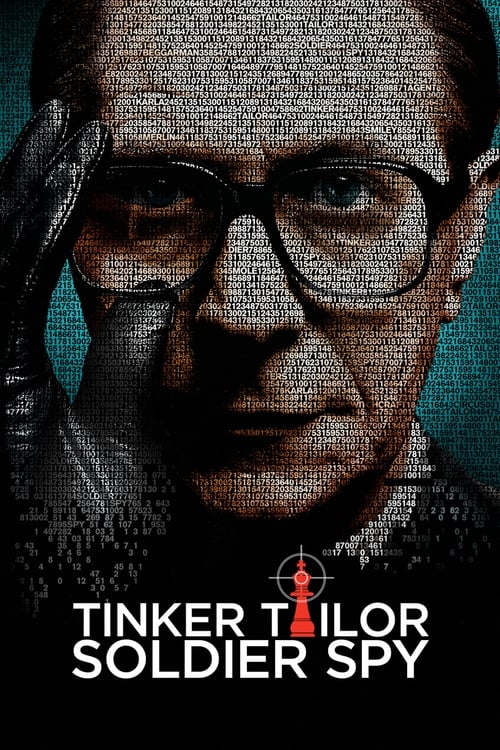
Tinker Tailor Soldier Spy
2011 · Tomas Alfredson
For when you want to lean in, not lie back — a rainy-evening film for viewers who like piecing things together themselves. Expect to think; some people happily watch it twice.
What it's about
Early-1970s London, deep in the Cold War: British intelligence has a Soviet mole at the very top, and George Smiley — an aging spymaster pushed out in a purge — is quietly brought back to find him. Working from the outside with a handful of allies, Smiley sifts old operations, old betrayals, and old friends, knowing the traitor is one of the men he's worked beside for decades.
The experience
Hushed, precise, and dense — a puzzle told in glances, file folders, and things left unsaid, where the tension comes from watching rather than being told. It rewards patience and close attention, and the melancholy lingers longer than the plot.
Performances
Gary Oldman plays Smiley at a near-whisper — a man who has trained himself into invisibility — and it's mesmerizing; around him, Colin Firth, Mark Strong, Tom Hardy, Benedict Cumberbatch, and John Hurt make every small role count.
The craft
The film is a masterclass in atmosphere: a smoky, nicotine-stained early-70s London in sickly browns and greens, a mournful score, and editing that deliberately withholds information so you work alongside Smiley. Gorgeous in a deliberately drab way — it plays beautifully with the lights off and the sound up.
Why it matters
It proved a slow, cerebral le Carré adaptation could be a prestige hit, reset the template for serious screen espionage in the 2010s, and gave Gary Oldman the defining lead role of his later career.
Snapshot
Tinker Tailor Soldier Spy is a 2011 espionage drama directed by the Swedish filmmaker Tomas Alfredson, adapted from John le Carré's 1974 novel of the same name. It compresses the book's labyrinthine mole-hunt into roughly two hours: George Smiley, a recently ousted veteran of British intelligence (the "Circus"), is quietly recalled to identify a Soviet double agent burrowed at the top of the service. The film is celebrated for its austerity — a muted, period-perfect early-1970s London rendered in sickly browns and greens, a near-whispered performance from Gary Oldman as Smiley, and an editorial design that withholds nearly as much as it reveals. It stands as one of the most acclaimed and influential British prestige pictures of its decade, and as the most prominent rival to the canonical 1979 BBC miniseries with Alec Guinness. The principal creative voices are Alfredson, screenwriters Bridget O'Connor and Peter Straughan, cinematographer Hoyte van Hoytema, composer Alberto Iglesias, and production designer Maria Djurkovic.
Industry & production
The film was produced by Working Title Films — Tim Bevan, Eric Fellner, and Robyn Slovo are credited among its producers — with financing and distribution involving StudioCanal, and was very much a British studio-prestige proposition rather than a Hollywood tentpole. Adapting le Carré carried a particular institutional weight: the 1979 television version, directed by John Irvin and scripted by Arthur Hopcraft, was (and remains) widely regarded as a landmark of British television, and any feature attempt invited unflattering comparison. The decision to hire Alfredson, a Scandinavian director with no prior English-language feature and no espionage pedigree — his calling card was the 2008 vampire film Let the Right One In — was the production's defining gamble, betting on tonal control and atmosphere over genre fluency.
The screenplay was written by the married pair Bridget O'Connor and Peter Straughan. O'Connor died of cancer in 2010, before the film was completed; the finished picture is dedicated to her. Le Carré himself was involved as an executive producer and gave the adaptation his blessing, and he appears in a brief cameo at the recurring Christmas-party scene. Casting assembled a deep bench of British talent — Colin Firth, Tom Hardy, Mark Strong, John Hurt, Toby Jones, Benedict Cumberbatch, Ciarán Hinds, David Dencik, Stephen Graham, and Kathy Burke — many of them shortly before or during their own ascendancy, which has given the film an additional retrospective luster. The production reconstructed a vanished institutional London of the early Cold War in considerable physical detail. I do not have reliable figures for the budget or final box-office gross to cite here, and will not invent them; contemporary reporting generally framed the film as a solid commercial performer for a literary adult drama rather than a blockbuster.
Technology
Tinker Tailor Soldier Spy was shot photochemically on 35mm film by Hoyte van Hoytema, a choice consistent with the period setting and with the grain, latitude, and color rendition the production sought — this was made at the cusp of the industry's broad transition to digital capture, and the film's celluloid texture is part of its argument. The decisive technological work, however, was less about capture format than about the controlled engineering of color and surface: a deliberately desaturated, jaundiced palette achieved through art direction, costume, lighting, and grading in concert. Beyond that, the film does not foreground novel imaging or post-production technology; its sophistication lies in restraint rather than innovation. Where the specific lenses, stocks, or laboratory processes are concerned, I would be speculating to give particulars, so I note only the general 35mm provenance.
Technique
Cinematography
Van Hoytema's photography is the film's most discussed formal achievement and, arguably, the launchpad for his subsequent major career (later Her, Interstellar, Dunkirk). The visual scheme is one of enclosure and observation: characters are repeatedly framed through glass, doorways, and partitions, or shot in shallow focus that isolates them within institutional spaces. The palette runs to nicotine yellows, olives, browns, and cold grays — a world that looks perpetually overcast and under-heated. Compositions are frequently static and frontal, favoring stillness over movement, so that the camera behaves like a patient watcher rather than a participant. This surveillance grammar is thematically exact for a story about a service that spies on itself.
Editing
The cutting, by Dino Jonsäter, is the structural heart of the adaptation. Le Carré's novel is intricate and interior, and the film's central problem was rendering a dense web of memory, interrogation, and inference legibly without flattening its ambiguity. The solution is an associative, layered structure built around recurring motifs — chiefly the Circus Christmas party, returned to repeatedly with shifting emphasis — and elliptical transitions that trust the viewer to assemble chronology and motive. The film is famous for what it leaves out: explanations are withheld, glances and objects carry information, and several pivotal turns are conveyed obliquely. This demanding edit is the principal reason the film is often described as one that rewards a second viewing.
Mise-en-scène / staging
Maria Djurkovic's production design reconstructs the bureaucratic interior of British intelligence as a closed, slightly shabby world of soundproofed rooms, filing systems, frosted glass, and worn institutional furniture — most memorably the windowless inner sanctum where Smiley's team works. Staging tends toward the recessive: actors are often placed in depth or at the edges of frames, performing minimally, so that physical environment and arrangement do much of the dramatic work. The overall effect is of a sealed, airless establishment, which externalizes the story's claustrophobia and mutual distrust.
Sound
The soundscape is notably hushed and precise, with long stretches of near-silence broken by small, telling sounds — a tactic that heightens tension and forces attentiveness. This quietness is integral to the film's mode of withholding: dialogue is sparse and frequently delivered low, and the absence of conventional scoring across many scenes makes the eventual musical cues land harder. The most discussed sound choice is the closing use of a romantic vocal standard over the denouement, an ironic, melancholic counterpoint to the bleakness of what has been revealed; I want to be precise rather than misattribute the specific recording, so I flag only that the ending deploys a period-appropriate song to bittersweet effect.
Performance
Performance style across the ensemble is deliberately suppressed — interiorized, watchful, withholding. Gary Oldman's Smiley is the centerpiece and a near-inversion of his earlier reputation for flamboyance: stillness, measured speech, a face that registers calculation rather than emotion. Inheriting a role indelibly associated with Alec Guinness, Oldman built a distinct, quieter interpretation that earned the film's central acclaim. The supporting cast works in the same key, with the suspects and colleagues defined through small gestures and restraint. The result is an acting register where the drama is in suppression and inference.
Narrative & dramatic mode
The film operates as a procedural mystery turned inward: the genre machinery of the whodunit (a finite set of suspects, codenamed Tinker, Tailor, Soldier, Poorman) is preserved, but the investigation is conducted through memory, document, and quiet interview rather than action. Its dramatic mode is analytical and elegiac rather than suspenseful in the conventional sense — the pleasures are deductive and atmospheric. The storytelling is markedly elliptical, distributing exposition across fragmented flashbacks and trusting the audience to reconstruct events. Tension derives less from physical danger than from institutional betrayal and the slow narrowing of suspicion. This is a film about the act of attention itself: watching, remembering, and reading other people.
Genre & cycle
Tinker Tailor Soldier Spy belongs squarely to the realist, anti-glamour strain of the spy film — the le Carré tradition that defines itself against the Bond fantasy. Where the popular espionage cycle trades in gadgets, exoticism, and heroics, this tradition emphasizes bureaucracy, moral compromise, drabness, and the ordinariness of treachery. The film is at once a period piece and a revival, arriving amid a renewed appetite for prestige spycraft and helping to reanimate le Carré on screen. It can be situated alongside the broader cycle of literary Cold War adaptations and "intelligent" spy drama that the 2010s sustained, and it set a tonal template — somber, slow, design-forward — that subsequent entries in the mode would echo.
Authorship & method
The film is best understood as a meeting of a distinctive directorial sensibility with a strong collaborative team. Alfredson carried over from Let the Right One In an aesthetic of cold restraint, negative space, and emotional reticence — a willingness to let scenes breathe, to withhold, and to privilege atmosphere over plot mechanics. That sensibility, applied to le Carré, produced the film's defining quietness. His method is frequently described as trusting ambiguity and resisting over-explanation, which suits material about unknowable loyalties.
The key collaborators each contribute decisively. Van Hoytema's cinematography supplies the surveillance grammar and jaundiced palette. Djurkovic's production design builds the sealed institutional world. Editor Dino Jonsäter realizes the associative, motif-driven structure. Composer Alberto Iglesias — long associated with Pedro Almodóvar — provides a spare, tense, often melancholic score that earned an Academy Award nomination. The screenplay by Bridget O'Connor and Peter Straughan performs the underrated feat of compression, distilling a sprawling novel (and the shadow of a multi-part television version) into a coherent feature while preserving its ambiguity; it too was Oscar-nominated. Le Carré's involvement as executive producer lent the adaptation authorial sanction.
Movement / national cinema
The film sits at an interesting national-cinematic crossing. It is emphatically a British production — British source material, cast, setting, and studio (Working Title) — and contributes to the strong 2010s line of British literary prestige cinema. Yet its director and several department heads are Scandinavian, and the picture is often read as importing a Nordic sensibility (cool tonality, restraint, atmospheric melancholy) into a quintessentially English subject. It thus exemplifies the increasingly transnational character of European prestige filmmaking, where a Swedish auteur and a Dutch-Swedish cinematographer reinterpret the most English of genres.
Era / period
The film is set in the early-to-mid 1970s, at a low, weary point of the Cold War, and is meticulous in evoking that moment — its institutions, anxieties, and worn surfaces. The story's preoccupations (détente-era betrayal, declining British prestige, the long shadow of real-world intelligence scandals such as the Cambridge spy ring that demonstrably informed le Carré's fiction) are period-specific. As a production, it belongs to the early 2010s wave of awards-oriented adult dramas, made just as the industry was transitioning from photochemical to digital capture — its 35mm origination is itself a marker of that threshold.
Themes
The film's governing themes are betrayal and the corrosion of loyalty within an institution that exists to deceive. It is preoccupied with surveillance and the act of watching — the camera, the characters, and the audience all engaged in reading others for hidden meaning. It dwells on aging, obsolescence, and the melancholy of careers and an empire in decline, with Smiley a figure of weary expertise recalled past his time. Mirroring and doubling recur — Smiley and his Soviet counterpart Karla, the mole and the man who hunts him — framing East and West intelligence as distorted reflections of each other. Underlying all of it is a bleak moral relativism: the conviction that the methods and compromises of the West differ from its adversary's in degree more than in kind. Personal betrayal (romantic and professional) is repeatedly braided with political betrayal, so that the private and the geopolitical contaminate one another.
Reception, canon & influence
Critical reception was strong, with particular praise for Oldman's performance, the cinematography and design, and Alfredson's atmospheric control; the most common reservation among critics and general audiences concerned the film's deliberate difficulty — its withholding structure and demand for close attention. It earned three Academy Award nominations — Best Actor for Gary Oldman (his first), Best Adapted Screenplay, and Best Original Score — and won BAFTA recognition including, by my recollection, Outstanding British Film and Adapted Screenplay; I flag that specific award tallies should be verified against the record rather than taken as exhaustive here. The film premiered on the international festival circuit (it screened in competition at the Venice Film Festival) before its commercial release.
The influences on the film are clear and twofold: le Carré's novel and its real Cold War substrate (the anxiety of high-level Soviet penetration, exemplified historically by the Cambridge spies), and the towering precedent of the 1979 Guinness miniseries, against which Alfredson's version had to define an independent identity — choosing compression, atmosphere, and a colder palette over the television version's expansive, talk-driven patience. Its influence forward is felt in the renewed prestige of restrained, design-forward spy drama through the 2010s and in the continued screen revival of le Carré's work (notably the later television adaptation of The Night Manager and other le Carré projects). It also functioned as a career accelerant for several participants — consolidating van Hoytema's path to major international cinematography, and arriving at a formative moment for cast members like Hardy and Cumberbatch. Within the canon it is now routinely cited as a high-water mark of intelligent, atmospheric espionage cinema and as a model for adapting dense literary material through ellipsis rather than exposition.
A Deleuzian reading
A man sits in a room with no windows.
The full Deleuzian reading of Tinker Tailor Soldier Spy →
Reception
Critics swooned at Venice in 2011 but plenty of audiences walked out baffled, complaining it was impenetrable next to the beloved 1979 Alec Guinness miniseries. Fifteen years on it's settled comfortably into 'quiet masterpiece of the 2010s' status — the confusion reframed as density that pays off on rewatch.
How Tinker Tailor Soldier Spy was received, from release to now →
Influences: the films it descends from and the films it influenced
- Let the Right One In (2008) — Alfredson's own template of negative space, recessive blocking and emotional reticence — letting scenes hang in cold silence — carries directly into the spy film's withholding atmosphere.
- The Spy Who Came in from the Cold (1965) — Established the anti-Bond le Carré grammar: drab, desaturated tradecraft photographed without glamour, where betrayal is bureaucratic rather than heroic.
- The Ipcress File (1965) — Pioneered oblique espionage framing — composing through foreground objects, glasses, and partitions to render spying as alienated clerical routine, prefiguring van Hoytema's shot-through-glass surveillance.
- The Conversation (1974) — Built the surveillance-as-procedure mode in which near-silence and sound design do the dramatic work, and the watcher's interiority becomes the subject.
- Klute (1971) — Gordon Willis's shallow focus and pooled shadow turn surveillance into a visual language of isolation, a key source for the film's selective focus and watched-figure framing.
- The Parallax View (1974) — Dwarfs lone figures inside vast institutional architecture to convey unknowable conspiracy — the recessive-blocking-against-cold-spaces strategy the film inherits.
- All the President's Men (1976) — Shot-through-glass institutional interiors and patient procedural accumulation of paperwork as suspense — the template for Control's sealed bureaucratic world.
- Three Days of the Condor (1975) — 1970s paranoid spy procedural in which the threat comes from inside one's own agency — the institutional-betrayal architecture the seed reanimates.
- The Godfather Part II (1974) — Demonstrated the elliptical interwoven-flashback structure (again with Willis's desaturated period light) that the film borrows to braid past and present mole-hunt.
- Tinker Tailor Soldier Spy (1979) — The Guinness miniseries is the direct precedent Alfredson defines himself against — compressing its talk-driven patience into atmosphere, ellipsis and a colder palette.
- North by Northwest (1959) — Hoyte van Hoytema's geometric staging within Cold War institutional architecture — the Circus's rectilinear glass offices used as spatial traps — inherits NxNW's architectural-enclosure grammar; Alfredson's sustained reaction-shot duration as the primary carrier of suspense derives from Hitchcock's editing vocabulary via the Burks collaborations.
- The Lives of Others (2006) — Hoyte van Hoytema's cinematography directly inherits The Lives of Others' bureaucratic-realism palette — institutional khakis, muted grays, amber fluorescents — and Alfredson deploys Bogdanski's shallow-focus close-up strategy on Gary Oldman's face to register micro-adjustments of a man trained in concealment; Dino Jonsäter's editing replicates the delayed-revelation structure in which audience knowledge runs persistently ahead of character knowledge.
- Her (2013) — Van Hoytema extends his soft, glass-reflective shallow-focus palette here, carrying the jaundiced-warm tonal control he developed photographing the spy film's interiors.
- Interstellar (2014) — Consolidates van Hoytema's path to major 35mm/65mm photochemical cinematography — the texture and naturalistic light grammar honed on Tinker Tailor scaled up.
- A Most Wanted Man (2014) — Re-applies the restrained, interiorized le Carré procedural — muted palette, near-silence, performance held back — riding the prestige restored by the seed's success.
- Bridge of Spies (2015) — Adopts the cold-war restraint and glass-partition institutional framing of negotiation-as-tradecraft, espionage staged through bureaucratic interiors rather than spectacle.
- The Night Manager (2016) — Part of the le Carré screen revival the seed accelerated, extending design-forward, atmospherically restrained prestige espionage to long-form television.
- The Imitation Game (2014) — Alfredson's near-static camera within British intelligence interiors, Iglesias's score bleeding between diegetic source music and underscore, and the staging of institutional loyalty as a concealment-identity paradox in Cold War Britain establish the precise aesthetic register Tyldum's film inherits.
- Conclave (2024) — Peter Straughan co-scripted both films; the le Carré method he distilled here — bureaucratic loyalty and betrayal sustained within genre structure, arriving at plot resolution without moral resolution, institutional secrecy revealed through the slow accumulation of small disclosures — transfers intact to Conclave's Cardinal Benítez revelation.
- The American (2010) — Shares the European near-silence, recessive blocking and watchful interiorized restraint, treating the operative as a still, withholding figure rather than an action hero.
- Zero Dark Thirty (2012) — Renders intelligence work as an inward, detail-driven procedural mystery centered on one analyst's obsessive interiority, paralleling the anti-glamour spy procedural mode.
- Casino Royale (2006) — Alfredson crystallizes the le Carré inflection Casino Royale imported into Bond: Oldman's inward performance mode, deliberate procedural pacing that reads as authenticity, and the revelation that the institution itself is the wound — the establishment as source of espionage's tragedy.
- Argo (2012) — Concurrent sibling in Super 35mm film with a muted tripartite institutional palette (greens, grays, tobacco), stoic lead navigating betrayal through cognitive procedure rather than action — the period spy-thriller as a purely deductive suspense machine, released one year before Argo.
- J. Edgar (2011) — Hoyte van Hoytema's desaturated amber-and-gray cinematography for a Cold War institution — treating period color as epistemological decay, sidelighting faces as if memory itself were the medium — is the closest formal parallel to Tom Stern's palette work on J. Edgar.
- Tenet (2020) — Hoyte van Hoytema—before his Nolan collaboration—establishes here the specific cold-war visual grammar Tenet inherits: cool analytical palette, de-saturated institutional interiors, and the depersonalized intelligence professional whose competence is demonstrated procedurally rather than through emotional display; the cinematographer's sensibility runs unbroken into Tenet.
- The Outfit (2022) — Mark Rylance's performance in Alfredson's film establishes the economy-of-expression register — minimal gesture carrying maximum information, concealment as the default physiognomic state — that Moore then draws on by casting Rylance as Mack; the patient observational camera that serves this performance style is shared between both films.
- 12.12: The Day (2023) — Alfredson's institutional Cold War procedural deploys the same muted color palette of bureaucratic interiors (institutional green, khaki, drained gray), tight framing that constricts characters within hierarchical space, and orchestral dread as ambient pressure — sharing 12.12's complete visual-sonic grammar of systemic betrayal.
- Black Bag (2025) — Alfredson structures the mole-hunt as archaeological reconstruction rather than pursuit, and Gary Oldman's performance of radical controlled interiority — suppressed emotion as professional competence — establishes the performance register Black Bag inhabits throughout its ensemble; the lateral investigation that accumulates certainty through inference rather than action is the shared narrative architecture.
- The Bourne Legacy (2012) — A sibling in the talky, exposition-forward intelligence-procedural mode — prioritizing bureaucratic detail, tradecraft, and institutional rot over action, the same instinct that gives Legacy its slow expository first half.
- Spectre (2015) — Re-establishes the period-textured British espionage mood of institutional decay and surveillance bureaucracy that underwrites Spectre's post-Snowden 'Nine Eyes' subplot.
- Operation Mincemeat (2022) — Shares the understated ensemble, banked-reserve performances and shallow-focus period palette wired to a slow, delayed-payoff intelligence procedural rather than action.
Similar films
- The Spy Who Came In from the Cold (1965) — influence & lineage
- A Most Wanted Man (2014) — influence & lineage
- Skyfall (2012) — shared sensibility
- The Man from U.N.C.L.E. (2015) — shared sensibility
- Black Bag (2025) — shared sensibility
- Tenet (2020) — shared sensibility
- Kingsman: The Secret Service (2015) — shared sensibility
- The Man from London (2008) — shared sensibility
All the films related to Tinker Tailor Soldier Spy →
Film essays and courses that include it
- The Watcher Watched: A History of Screen Espionage
- Draining the World: The Grammar of Gray
- Eyes That Watch: A History of Espionage Cinema
- The Paranoid Machine: A Century of Conspiracy Cinema
- The Paranoid Eye: How the Spy Film Taught Us to Watch
- In Camera: The Institutional Chamber Thriller from Joan to Conclave