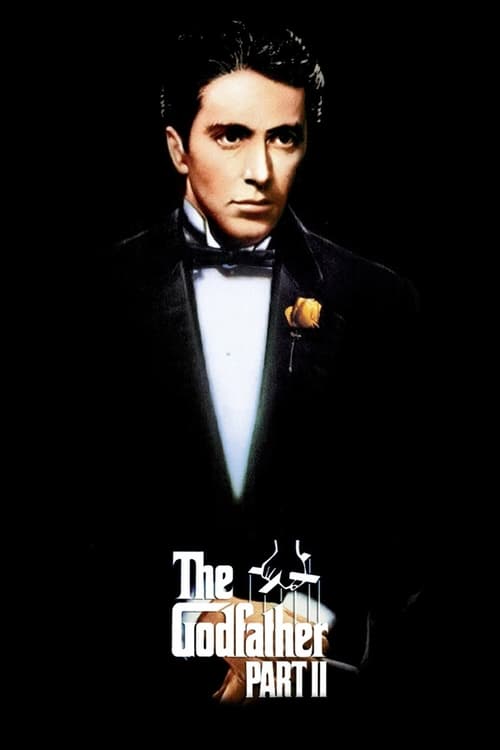
The Godfather Part II
1974 · Francis Ford Coppola
Megalopolis is the decade's great folly narrative: self-funded with $120M of wine money, chaotic Cannes premiere, a pulled trailer with AI-fabricated critic quotes, on-set conduct allegations, and a defiant "I don't care" tour. The conversation is about the mythology of the last mogul-auteur.
For when you want to give an evening over to something monumental — a long, serious, endlessly rich film to sink into and argue about after. Demanding, and worth every minute.
What it's about
Two stories of the Corleone family, told side by side across half a century. In one, young Vito arrives in New York from Sicily in the 1910s and rises from immigrant poverty toward power; in the other, his son Michael, now head of the family in the late 1950s, pushes the business into Las Vegas and Cuba while enemies circle — some outside the family, some within. One timeline shows an empire being built; the other shows what it costs to keep.
The experience
Vast, somber, and hypnotic — it moves with the patience of a great novel, and the cutting between eras gives every scene a shadow of consequence. It's less thrilling than the first film and more haunting; the chill of the final stretch stays with you.
Performances
Al Pacino gives one of the great screen performances, playing Michael's descent almost entirely through stillness — the eyes go dead by degrees. Robert De Niro won an Oscar as young Vito, somehow channeling Brando while making the role entirely his own, largely in Sicilian dialect.
The craft
Gordon Willis's shadow-soaked cinematography earned him the nickname 'the prince of darkness,' and the film's daring structure — two timelines in constant conversation — turns cross-cutting into moral commentary. Nino Rota's mournful score binds the eras together; it's a film that rewards total immersion, ideally in one sitting.
Why it matters
The first sequel ever to win Best Picture, it took six Academy Awards and is widely argued to surpass the original — the benchmark against which ambitious sequels are still measured.
Snapshot
The Godfather Part II is simultaneously a prequel and a sequel, a dual-timeline epic that traces the rise of young Vito Corleone in early-twentieth-century New York alongside the moral disintegration of his son Michael in the late 1950s. Released in December 1974, it won six Academy Awards including Best Picture — the first sequel in history to achieve that distinction — and is now widely regarded as one of the supreme achievements of American cinema, a work that in many critical assessments surpasses its celebrated predecessor. Where the original Godfather charts the seduction of power, Part II measures its total cost.
Industry & production
The commercial and critical success of The Godfather (1972) gave Coppola unusual leverage within the studio system, but the relationship with Paramount Pictures remained tense. Coppola used his newfound standing to negotiate significant creative control over the sequel, insisting on a scope — dual timelines, an international canvas, a running time approaching three and a half hours — that any studio might otherwise have resisted. The production was budgeted at considerably more than the first film, reflecting both Coppola's ambitions and the cost of period reconstruction across multiple locations, including Sicily, New York, Nevada, and sequences representing pre-revolutionary Cuba.
The script was again co-written with Mario Puzo, and drew substantially on the flashback chapters of Puzo's 1969 novel that the original film had left largely untouched. Coppola conceived the two films as a single epic work; he would later edit them together in chronological order as The Godfather Saga for television broadcast in 1977, a version that, while illuminating structurally, largely eliminates the expressive power of the parallel montage that defines the theatrical release.
Casting decisions were consequential and sometimes contentious. Robert Duvall returned as Tom Hagen, though his reduced screen time relative to the first film reflected budget negotiations that were never fully resolved. John Cazale's Fredo, a peripheral figure in the first film, was elevated to dramatic centrality. Lee Strasberg — the legendary director of the Actors Studio, teacher of a generation of Method actors — made his screen debut as Hyman Roth, a character whose surface cordiality over a bowl of birthday cake is among the film's most chilling sequences. The character is understood to draw on the life of Meyer Lansky, though the extent of the parallel was carefully left unspecified. Michael V. Gazzo, himself a playwright and actor associated with the theatrical avant-garde, was cast as Frankie Pentangeli.
For the role of the young Vito, Coppola cast the twenty-nine-year-old Robert De Niro, who had recently appeared in Mean Streets (1973). De Niro's preparation was intensive: he spent months learning the Sicilian dialect, traveled to the Corleone region of Sicily, and studied Marlon Brando's physicality and vocal mannerisms closely enough to suggest biological continuity without imitation. The casting required De Niro to carry entire sequences of a major studio production largely in a language foreign to most of its audience — a gamble that Coppola and Paramount accepted.
Technology
The film was shot on 35mm anamorphic stock, continuing the widescreen vocabulary of the first film. Gordon Willis again served as director of photography and employed the full range of his reputation for extreme low-key lighting, though Part II demanded a more differentiated palette than its predecessor. The early-twentieth-century sequences required a visual grammar distinct from the cold darkness of Michael's world: Willis developed a warmer, slightly amber-tinted aesthetic for the Vito material, filtering and printing to suggest the texture of period photographs and early cinema without lapsing into nostalgia. The contrast is never programmatic but operates subliminally — the immigrant New York of 1917 carries an earthy warmth that the burnished interiors of Michael's Lake Tahoe compound categorically refuse.
Willis's lighting philosophy — rigorously motivated, deeply reluctant to flatter — earned him the nickname "The Prince of Darkness" among colleagues. Despite the cinematography's obvious distinction, Willis was not nominated for an Academy Award for either Godfather film, an oversight that has become something of a cause célèbre in discussions of Oscar history. He received an honorary Academy Award in 2010.
The production design by Dean Tavoularis required meticulous period reconstruction for the Little Italy sequences, with locations in New York, and additional shooting in Sicily and in the Dominican Republic standing in for pre-revolutionary Havana. The Cuba sequences are particularly significant: the fall of Batista is dramatized as background action, Coppola using actual historical rupture as the occasion for a scene of devastating dramatic irony as Michael and Roth argue over a birthday cake while their empire crumbles.
Technique
Cinematography
Willis's visual scheme in Part II operates across several registers simultaneously. The opening Sicilian prologue — the murder of the young Vito's father and brother, the child's flight — is shot with a documentary restraint, the Mediterranean light harsh and unadorned. The New York tenement sequences that follow introduce shadows and enclosure gradually, as if the built environment of immigrant America were itself a kind of moral compression. By contrast, the Lake Tahoe sequences open onto a landscape whose apparent spaciousness is perpetually undermined by frame composition: Michael is habitually placed in the background, or at the edge of the frame, or separated from other characters by glass and architecture. The widescreen format is used not for spectacle but for isolation.
Particularly celebrated is the baptism sequence's visual and structural mirror in this film: no equivalent montage exists, but the pattern of juxtaposition — ceremony and violence, family ritual and its betrayal — informs the film's deepest structural logic.
Editing
The film was edited by Peter Zinner, Barry Malkin, and Richard Marks. The central editorial challenge — interweaving two timelines separated by four decades — is managed not through any persistent chronological marker but through thematic resonance. Scenes do not cut between timelines to create narrative suspense but to create ironic commentary: Vito's patient construction of community and loyalty is constantly counterpointed against Michael's destruction of both. The editing rhythm in the Vito sequences tends toward a longer, more contemplative pace; Michael's world cuts more abruptly, reflecting the paranoia of power maintained by force.
The final sequence — Michael alone, aging, the compound empty, his marriage destroyed, his brother ordered killed — achieves its effect precisely because the editing offers no resolution, no cut to anything more consoling. The film simply holds on the face of a man who has won everything and lost everything simultaneously.
Mise-en-scène / staging
Coppola's staging characteristically uses the deep focus and architectural depth that anamorphic photography makes available. Conversations frequently occur with characters at markedly different distances from the camera, creating a spatial hierarchy that encodes power relations visually. The Lake Tahoe hearings sequence, in which Michael testifies before a Senate committee investigating organized crime, is staged with the committee framed as institutional machinery and Michael as a figure of composed opacity — a man who has learned to perform innocence so completely that it has become a kind of truth.
The Cuba sequences have a different visual texture: heat, crowds, festivity, a world in which Michael's calculating coldness appears most explicitly incongruous. Coppola and Willis allow the Cuban locations genuine exoticism without condescension, and the sequences register the historical moment — New Year's Eve 1958, Batista's flight — with genuine weight.
Sound
Walter Murch, who had worked on the original Godfather as well as on The Conversation (also 1974, Coppola's companion piece of that extraordinary year), contributed to the sound design. The film's use of ambient sound in the New York tenement sequences — the noise of the street, the acoustic texture of poverty — is carefully calibrated against the relative quiet and control of Michael's world. Sound is used expressively rather than naturalistically: the world of the past is sonically more alive, more populated, more human.
Performance
Pacino's performance as Michael is one of the great studies in psychic closure in American cinema. Between the first and second films something has died behind his eyes, and Pacino renders this not through theatrical display but through what he withholds. The late scenes with Kay (Diane Keaton), particularly the scene in which she reveals she terminated a pregnancy rather than bring another Corleone son into the world, produce from Pacino a response of controlled devastation that remains one of the defining moments of the era's acting culture.
De Niro's performance works entirely differently: it is a performance of becoming, of a man discovering and constructing his authority in real time. The famous scene in which Vito, newly arrived in America, climbs across tenement rooftops to kill the neighborhood extortionist Fanucci is a study in deliberate, premeditated violence rendered almost tender by De Niro's absolute physical specificity. The contrast between the two performances — the old man's warmth as remembered in the first film, the young man's warmth as observed here, and Michael's absolute coldness in the present — is the film's central argument in human form.
Narrative & dramatic mode
The dual-timeline structure is the film's most discussed formal achievement. It functions not as a simple contrast between idealized past and degraded present but as a sustained investigation into causality: is what Michael has become determined by Vito's choices, by the logic of the institution he inherited, by his own nature, or by contingency? The film refuses to adjudicate. The parallel editing invites the viewer to seek symmetries and divergences simultaneously — Vito building a business in a moment of crisis, Michael consolidating one in a moment of crisis — and the meaning generated is irreducibly double.
The narrative is also distinguished by its use of historical backdrop: the congressional hearings on organized crime in the early 1950s, the Cuban revolution, the broader postwar expansion of American capitalism. The film is genuinely interested in history as a force, not merely as costume.
Genre & cycle
Part II participates in the early 1970s cycle of revisionist American genre filmmaking that includes Chinatown (1974), McCabe & Mrs. Miller (1971), The Long Goodbye (1973), and Coppola's own The Conversation. The gangster film — a genre whose founding texts include Little Caesar (1931), The Public Enemy (1931), and White Heat (1949) — is here stripped of the genre's traditional consolations: the gangster's rise is shown to be spiritually fatal rather than romantically doomed. The immigrant myth, the bootstrap narrative of American self-making, is subject to the same revision: Vito's success is real, but the institution it creates is a machine for the production of Michael Corleones.
Authorship & method
Coppola's method in this period combined the European art-cinema ambition of his film-school formation with the organizational demands of major studio production. He had studied at UCLA and worked under Roger Corman before establishing himself, and his aesthetic debts run toward Visconti (whose The Leopard (1963) offers the closest precedent for the operatic Italian-American epic mode) and Fellini as much as toward classical Hollywood.
Gordon Willis's contribution to both Godfather films is so structurally integrated that it constitutes co-authorship in any meaningful sense. Nino Rota, who had scored the first film, returned alongside Carmine Coppola — the director's father, a musician — for the score, which weaves the famous Godfather theme with new material for the immigrant sequences; the score earned both an Academy Award. Mario Puzo's co-authorship of the screenplay is similarly significant: the flashback chapters of the novel provided the raw material for Vito's story, and Puzo's instinct for the mythic dimensions of the Corleone narrative shaped the film's ambition from its origins.
Movement / national cinema
The film belongs to the moment — roughly 1967–1976 — designated as the New Hollywood or American New Wave, a period in which a generation of directors with art-house educations and countercultural sympathies gained unprecedented creative control within the studio system, producing formally ambitious, often pessimistic work that engaged directly with the social and political ruptures of the era. Part II is in some respects the culmination of that movement's achievement within the crime genre, demonstrating that popular narrative cinema could sustain the structural complexity and thematic weight of the European art film.
Era / period
The film is indelibly marked by its moment of production. The Watergate scandal was unfolding as it was shot and released; the congressional hearings sequence, in which a powerful man evades institutional accountability through practiced performance, carried an obvious contemporary charge. The broader disillusionment of the post-Kennedy, post-Vietnam, post-Watergate moment — the collapse of official American innocence — gives the film's critique of the American Dream its specific historical urgency.
Themes
The film's central theme is the cost of the will to power when that will is exercised through an institution requiring the systematic suppression of love, loyalty, and conscience. Michael's tragedy is constructed with Greek precision: the qualities that make him effective — intelligence, coldness, strategic patience — are precisely the qualities that destroy every human relationship he values. The film is also a meditation on the immigrant experience and its betrayal: Vito came to America in flight from violence and built something in order to protect his family; Michael inherits the protection mechanism but has nothing left to protect.
The question of whether Michael is a victim of circumstances or a man who chose his fate at every turn — refusing to leave the family business after the war, ordering the killing of rivals, ordering the killing of his own brother Fredo — is never resolved, which is the source of the film's lasting power. The final image offers no answer.
Reception, canon & influence
The film opened to strong reviews, though some critics found its length and structural complexity taxing relative to the more conventionally satisfying first film. Pauline Kael, whose enthusiasm for the original Godfather had been influential, was cooler on the sequel, a response that reflected genuine critical disagreement about whether its formal ambitions were fully realized. Vincent Canby's notice in the New York Times was substantially positive.
The six Academy Awards, including Best Picture, Best Director, Best Adapted Screenplay, and Best Supporting Actor for De Niro, represented an unusual institutional validation of the work's ambition. The film's place in the canon has only strengthened in the decades since: it appears consistently at the summit of critical lists of the greatest American films, and the debate over whether it surpasses the original has become one of the constitutive arguments of film culture.
Backward influences include the classical Hollywood gangster cycle; Visconti's operatic Italian historical epics; Italian neorealism (particularly in the visual texture of the immigrant sequences); the Greek tragic tradition in its structural logic; and the first Godfather film, from which it is inseparable.
Forward influence is immense. The Sopranos (1999–2007) is inconceivable without Part II — not merely in its subject matter but in its willingness to sustain a long-form meditation on a morally compromised protagonist whose interiority remains irreducibly opaque. Breaking Bad (2008–2013) acknowledged the parallel-timeline structure and the tragic-arc model as formative influences. The dual-timeline construction — using the past not for nostalgia but for ironic structural commentary on the present — has become one of the standard devices of prestige dramatic narrative in both film and television. And De Niro's performance established a template for the preparation-intensive, linguistically specific, physically total immersion that came to define American screen acting in the subsequent generation.
A Deleuzian reading
Hold the last shot in your mind.
The full Deleuzian reading of The Godfather Part II →
Reception
No flop-to-classic arc here — it swept the 1975 Oscars including Best Picture — but a few contemporary critics (Pauline Kael among the admirers, Vincent Canby notably not) found its fractured structure cold and enervated; today that very structure is why many rank it above the original.
How The Godfather Part II was received, from release to now →
Influences: the films it descends from and the films it influenced
- The Godfather (1972) — Willis established the anamorphic low-key palette here — extreme shadow, single-source motivated light, amber domestic interiors — that Part II then bifurcated into two differentiated registers: warm golden amber for Vito's immigrant past, cold silver-gray for Michael's present.
- Rocco and His Brothers (1960) — Visconti's operatic staging of a southern Italian family's disintegration upon migration north — betrayal within blood ties as the moral architecture of social ambition — is the direct narrative and emotional template Coppola has cited for the Corleone saga's dual tragedy.
- The Leopard (1963) — Visconti's anamorphic staging of powerful men dwarfed by palatial architecture — the Prince framed small against grand interiors as his class becomes obsolete — is directly absorbed into Willis's compositional habit of placing Michael at frame edges and behind reflective glass to register his isolation.
- Citizen Kane (1941) — Gregg Toland's deep focus cinematography — objects and faces sharp across all planes, every frame a staged argument about power and spatial hierarchy — is the explicit visual model Willis followed, extending Toland's deep-staging innovation into a color medium with motivated low-key sources.
- The Conformist (1970) — Storaro's cinematography externalizes Clerici's moral bankruptcy through shadow geometry and motivated darkness — a technique Willis absorbed and radicalized, establishing the principle that a character's ethical condition is expressed through the quality and angle of light falling on them.
- Salvatore Giuliano (1962) — Rosi's semi-documentary treatment of Sicilian organized crime as a social institution — actual locations, non-professional faces, a sociological rather than romantic gaze — provides the visual and tonal grammar for Part II's Sicilian prologue and its refusal to aestheticize poverty or violence.
- Once Upon a Time in the West (1968) — Leone's use of Morricone's score as a structural and ironic counterpoint to images — themes arriving before their subjects, music commenting on what the image has not yet shown — is the direct model for Rota's deployment in the Godfather films, where the waltz foreshadows and ironizes action.
- Mean Streets (1973) — De Niro's physicalized, dialect-rooted, improvisationally textured performance here led directly to his casting as Vito; Coppola extended Scorsese's method-inflected Italian-American performance grammar into a more rigorous linguistic program, requiring months of Sicilian dialect immersion.
- Intolerance: Love's Struggle Throughout the Ages (1916) — Intercuts two time periods in sustained parallel toward a unified moral indictment, extending Intolerance's cross-temporal montage into character tragedy.
- The Roaring Twenties (1939) — Enlarges the decades-spanning rise-and-fall epic into a formal architecture, using period texture and historical time as the medium of a criminal's moral ruin.
- Once Upon a Time in America (1984) — Leone's four-hour gangster epic directly inherits Part II's dual-timeline architecture: immigrant-era childhood sequences intercutting with adult criminal corruption, the innocent past deployed as a structural irony machine against the degraded present — the formal technique is so closely followed it reads as explicit homage.
- Raging Bull (1980) — De Niro's transformative methodology for LaMotta — obsessive weight gain, posture and dialect research as character construction — descends directly from the Vito preparation he undertook for Coppola; Chapman's high-contrast monochrome chiaroscuro also extends Willis's principle of motivation-based extreme darkness into black-and-white.
- Miller's Crossing (1990) — The film's visual language is built on Willis's shadow-heavy low-key grammar: extreme darkness as moral weight, figures isolated in pools of motivated light, shadow treated as a physical presence rather than decoration — the forest sequence is the most concentrated echo of Willis's style anywhere in subsequent American cinema.
- Road to Perdition (2002) — Conrad Hall's cinematography is the most direct visual homage to Willis's Godfather work in American studio filmmaking: rain-lit, deeply low-key, every source motivated by practicals, shadow used as moral weight around a patriarch whose violence destroys the family it was meant to protect.
- Carlito's Way (1993) — Establishes the exit-narrative impossibility as formal genre logic — Michael's failed attempt at legitimacy is the structural template Carlito revises — while its extended scene duration, holding guilt and grief past the moment conventional editing would cut, is the pacing model De Palma and Pankow follow in the courtroom and apartment sequences.
- Infernal Affairs II (2003) — Coppola's invention of the prequel-as-dynastic-tragedy — where younger versions of established figures are watched through audience foreknowledge of their fates, and crime family succession staged through formal patriarch-centered ritual compositions — is IA2's structural template transposed wholesale to the Triad milieu.
- New World (2013) — Shakespearean succession structured as dynastic tragedy in which the heir's ascent destroys the moral framework that made ascent worth having — the precise narrative architecture Park Hoon-jung reproduces in New World's refusal of any redemptive reading for its conclusion.
- Tinker Tailor Soldier Spy (2011) — Demonstrated the elliptical interwoven-flashback structure (again with Willis's desaturated period light) that the film borrows to braid past and present mole-hunt.
- The Brutalist (2024) — The immigrant-arrival epic in which the American dream curdles into a corrupt contract, narrated across decades through interleaved temporal blocks.
- A Most Violent Year (2014) — Supplies the immigrant-capitalism-as-tragedy arc and the dim, amber-lit interior compositions where consequential family-business decisions are made in near-shadow — the underexposed restraint Young and Chandor inherit wholesale.
- Ad Astra (2019) — Source of Gray's classical melodramatic restraint and his abiding subject of inherited paternal identity, staged in somber, dialogue-driven interiors that prize emotional gravity over kineticism.
- The Best of Youth (2003) — Demonstrates the cross-generational family chronicle whose emotional force comes from watching the same actors carry a bloodline across sweeping historical time.
- Apocalypse Now (1979) — Coppola's next major film continues Part II's darkness-as-moral-argument: Storaro's cinematography applies Willis's principle that light is an ethical statement, pushing it toward full expressionism as Willard's river journey descends into the same moral void Michael occupies at Lake Tahoe.
- The Deer Hunter (1978) — Cimino's parallel-time structure uses working-class community ritual — the wedding — as moral baseline against which a corrupted present is measured, applying the same formal logic as Part II's intercutting, where Vito's warm immigrant world ironizes Michael's cold disintegration.
- Barry Lyndon (1975) — Kubrick and Alcott's radical constraint of period-accurate candlelight — refusing artificial illumination as a cinematographic discipline — runs parallel to Willis's equally extreme low-key innovations; both films demonstrate simultaneously that period epic can be a laboratory for formal extremity in available and motivated light.
- Heaven's Gate (1980) — Cimino and Zsigmond directly applied Part II's dual-palette differentiation — warm golden light for an idealized origin (the Harvard commencement prologue) versus cold, diffuse gray for the corrupted present (Wyoming) — extending the technique of using color temperature as moral argument to a period Western epic.
- Goodfellas (1990) — Scorsese and Ballhaus extend Part II's revisionist Italian-American gangster world and method-performance ensemble — Liotta, De Niro, and Pesci's improvisation-rooted ensemble continues what De Niro pioneered — but inverts the visual strategy, with Ballhaus's kinetic zoom-heavy camera explicitly refusing Willis's static compositional authority.
- The Funeral (1996) — Model for interleaving present grief with period-flashback origins, using cross-cut chronology to make the crime dynasty's doom feel retroactively sealed.
- Gangs of New York (2002) — Shares the gangster-origin-story-as-American-founding-myth structure, treating immigrant criminal ascent and oedipal succession as the secret history of the nation's civic formation.
- The Hours (2002) — The model for cross-cutting between two widely separated time periods so that an action in one era rhymes with and comments on the other, the editing creating thematic continuity across a temporal gap.
- The Irishman (2019) — Pioneers the decades-spanning nonlinear crime epic carried by age makeup and elegiac cross-cutting, the multi-era structural model Zaillian's nested confession reworks.
- Star Wars: Episode III - Revenge of the Sith (2005) — Shares the craft of the tragic-descent structure — a protagonist's principled soul corroded scene by scene into tyranny — the 'democracy into dictatorship' arc mapped onto a single character's damnation.
- Little Women (2019) — The canonical parallel-timeline architecture where warm-amber past and cooler present are color-graded as distinct emotional registers, the exact temperature-as-narration logic Gerwig and Le Saux adopt.
- Vada Chennai (2018) — Its braided past/present two-timeline structure — a rise intercut with its moral consequences — is the tragic architecture Vetrimaaran adapts to interleave Anbu's origins with the vendetta present.
Similar films
- The Godfather (1972) — influence & lineage · same viewing thread
- GoodFellas (1990) — influence & lineage
- Rocco and His Brothers (1960) — influence & lineage
- The Leopard (1963) — influence & lineage
- Raging Bull (1980) — influence & lineage
- Once Upon a Time in America (1984) — influence & lineage
- Scarface (1983) — same viewing thread
- Gangs of New York (2002) — shared sensibility
All the films related to The Godfather Part II →
Watch it with: curated runs of related films
- Rise, Reign, and Ruin — Watch these together for the full arc of the self-made man — the hunger, the empire built on violence, and the rot that comes for whoever built it.
Film essays and courses that include it
- Sequel Logic: The Engineering of the Franchise Saga
- Blood, Myth, and Grammar: The Gangster Film's Century
- Out of Order: A Century of Fractured Time
- The Family Business: Ten Films That Built the Mob Movie
- The Fix Is In: Cinema's Anatomy of Corruption, 1939–2007
- The Courage of Darkness
- The Man Who Made Cinema Listen
- The Melody That Smiles and Weeps