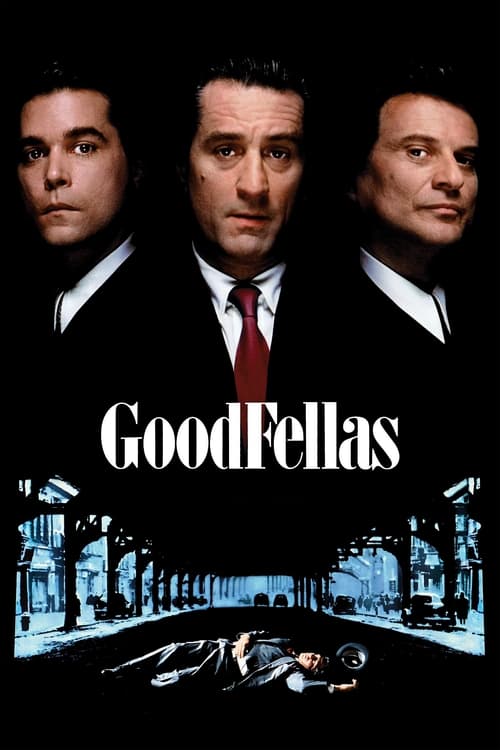
GoodFellas
1990 · Martin Scorsese
His "Marvel isn't cinema" comments spawned a years-long culture war about what cinema even is; Killers of the Flower Moon added runtime discourse and questions about centering white perspectives in Osage history. Also beloved as a TikTok dad and Letterboxd's patron saint.
For when you want to be completely swept up — a big, propulsive crime saga that entertains every single minute. It's a rewatchable crowd-pleaser with a dark aftertaste, not a heavy sit.
What it's about
Henry Hill grows up in 1950s Brooklyn idolizing the neighborhood gangsters, gets taken under their wing as a teenager, and spends the next three decades climbing through the ranks of a Mafia crew alongside his mentor Jimmy Conway. It follows the whole arc of that life — the money, the marriage, the drugs, the paranoia — told from inside by Henry and his wife Karen, who fell for the life almost as hard as he did.
The experience
It moves like nothing else — fast, funny, and intoxicating, pulling you into the glamour before the dread creeps in and the laughs start catching in your throat. By the end you feel wired and a little complicit.
Performances
Ray Liotta holds the center with charm that slowly curdles into paranoia; Joe Pesci won an Oscar for a performance that flips from hilarious to terrifying inside a single sentence; Lorraine Bracco makes Karen far more than a mob wife; Robert De Niro's quiet menace does the rest.
The craft
Scorsese narrates through restless camera moves, freeze frames, and one of the great needle-drop soundtracks, with a dual voiceover that lets Henry and Karen seduce you into their world. The editing keeps 146 minutes feeling like 90. It's exhilarating filmmaking that rewards volume and attention.
Why it matters
It reset the template for how crime stories get told on screen — its voiceover-driven, music-soaked style echoes through decades of films and prestige TV about life inside an outfit.
Snapshot
GoodFellas is a 146-minute American crime film produced by Irwin Winkler for Warner Bros. and released in September 1990. Based on Nicholas Pileggi's 1985 nonfiction book Wiseguy, it dramatizes the career of Henry Hill — a half-Irish, half-Sicilian outer-borough kid who enters the orbit of the Lucchese crime family as a teenager and rises within it over three decades before becoming a federal informant. The film is narrated in dual voiceover by Henry (Ray Liotta) and his wife Karen (Lorraine Bracco), a structural device that divides moral authority and withholds any stable vantage of judgment. It received six Academy Award nominations and won Best Supporting Actor for Joe Pesci; Scorsese's loss of the Best Director award to Kevin Costner for Dances with Wolves remains among the most contested Oscar outcomes of the era. Critically, the film has only grown in stature since release and is now a touchstone of world cinema.
Industry & production
Scorsese came to the project immediately after the bruising controversy surrounding The Last Temptation of Christ (1988). He read Pileggi's book in galleys and called the journalist the same day, an account Pileggi has repeated in interviews; they co-wrote the screenplay together, Pileggi supplying reportorial granularity and Scorsese imposing narrative velocity. The collaboration was productive enough that they repeated it for Casino five years later.
Warner Bros. financed and distributed the picture. The production shot primarily on location in Queens and the Bronx — the milieu Scorsese knew from childhood — with a schedule of roughly ten weeks. The budget has been reported in the range of $25 million, though precise figures vary across sources; the film performed solidly at the domestic box office without being a blockbuster phenomenon, its prestige and cultural afterlife accruing over subsequent years rather than at first release.
The casting required navigating Scorsese's long working relationship with Robert De Niro (as Jimmy Conway, based on the actual Jimmy Burke) alongside newer collaborators. Ray Liotta, whose screen presence combined surface charm with a volatile undercurrent, was chosen for Henry Hill; Lorraine Bracco was cast as Karen; Paul Sorvino as Paulie Cicero (based on Paul Vario); and Joe Pesci, who had collaborated with Scorsese on Raging Bull a decade earlier, was cast as Tommy DeVito, a composite drawing on the real Tommy DeSimone.
Technology
GoodFellas arrived at a transitional moment in cinematographic technology. It was shot on 35mm by Michael Ballhaus using Panavision anamorphic lenses, and the fluidity of the camera movement was enabled significantly by the Steadicam system — then roughly fifteen years old but fully institutionalized in Hollywood production. Thelma Schoonmaker edited on flatbed equipment; the non-linear editing systems that would transform postproduction were still years from industry-wide adoption. The film's extraordinary soundtrack — an extended popular-music score running from Tony Bennett to the Rolling Stones — required extensive licensing negotiations that set a template for music-driven period films in subsequent decades. No specialized photographic processes or large-format stocks were used; the film's formal ambitions were achieved through choreography and editing discipline rather than technological novelty.
Technique
Cinematography
Michael Ballhaus, who trained in German television and became a key collaborator of Rainer Werner Fassbinder before relocating to Hollywood, brought a European fluency with moving-camera work to GoodFellas. The film's signature shot — a continuous Steadicam take of roughly three minutes following Henry and Karen through the service entrance of the Copacabana, down stairs, through the kitchen, past staff, and to a ringside table that materializes on command — is among the most analyzed shots in American cinema. Steadicam operator Larry McConkey executed the movement; the logistics required coordination with dozens of extras and Copa employees. Scorsese's stated intention was to make the audience feel Henry's seductive power viscerally rather than describe it discursively: the world literally parts and reorganizes itself around him, and the camera's unbroken movement implicates the viewer in Karen's experience of being swept along.
Ballhaus also deployed slow-motion expressively, most memorably in Henry's first glance at the gathered wiseguys outside the cab stand — a tableau held for an extra beat that signals the film's romantic register at the moment of Henry's initiation. The camera throughout favors proximity and forward momentum; even static setups have an energy of presence rather than observation.
Editing
Thelma Schoonmaker has edited every Scorsese feature since Raging Bull (1980), and GoodFellas gave her a canvas of unusual temporal complexity. The film's rhythm changes markedly across its three acts: the first half is almost languorous in its episodic accumulation, while the final sequences — the cocaine-fueled paranoia of Henry's last day as a free man — use rapid cutting and frame-trimming to create a subjective effect of time dissolving under chemical pressure. Freeze-frames punctuate the narration, arresting the flow to underscore Henry's voice and pin down specific moments of self-mythologization. Jump cuts appear without apology, importing a French New Wave alertness into a mainstream American production. The editing of the "Layla" montage — Derek and the Dominos' instrumental coda laid over the discovery of several bodies — achieves a mordant counterpoint between musical beauty and corporeal horror that is widely cited as an exemplary case of audiovisual irony.
Mise-en-scène / staging
Scorsese's staging reflects an Italian-American sensibility saturated in specific social rituals: meals, gifts, card games, the geography of restaurants and back rooms. The film is extraordinarily attentive to the visual grammar of hierarchical belonging — who sits where, who faces the door, who is brought to a table and who waits. The "funny how?" scene, in which Tommy's digression about being funny circles back as a threat, was developed from an anecdote Scorsese had heard from an actual gangster; Pesci rehearsed it privately and then performed it without tipping the other actors, who were instructed to respond authentically. The resulting tension is genuine. Scorsese's management of such improvisatory precision within tightly controlled setups — the table geometry held constant while emotional unpredictability operates freely within it — is characteristic of his mature practice.
Sound
The film's most distinctive sonic choice is its refusal of an original orchestral score in favor of a continuous flow of licensed popular music, organized not thematically but affectively and ironically. Songs are selected to create counterpoint: exuberant rock and roll accompanies violence, romantic ballads undercut domestic misery. The "Sunshine of Your Love" motif, deployed as Paulie contemplates cutting Henry loose, has been analyzed as both comic and chilling — Cream's blues-inflected swagger contrasted with a scene of cold-blooded calculation. Beyond the music, the film's sound design is notably dense with ambient texture: the crowded warmth of restaurants, the echo of warehouses, the mundane domestic noise of Karen's house. These textures anchor the milieu without drawing attention to themselves.
Performance
Joe Pesci's Tommy DeVito is the film's most studied performance, winning the Academy Award and setting a template for a certain register of working-class volatile masculinity in American cinema. Robert De Niro, in a supporting role, works in a lower key — Jimmy Conway is menace rendered through stillness and careful deployment of the eyes. Liotta's Henry Hill operates as both protagonist and unreliable guide; his charm is the film's primary instrument for generating viewer complicity, and Liotta calibrates it precisely against moments when the mask slips. Lorraine Bracco's Karen was a genuine formal innovation: giving the female partner a competing voiceover and a narrative arc of her own was unusual for the genre, and Bracco's performance sustains a psychological complexity — attraction, culpability, denial — that the script demands but cannot alone produce.
Narrative & dramatic mode
GoodFellas operates in the register of the retrospective confession, though it withholds genuine contrition. Henry's voiceover does not moralize; it admires, rationalizes, and sometimes marvels at the life it is describing. The double-narrator structure — Karen's sections offer a parallel subjective account — prevents any single perspective from assuming authority. The film is non-linear in its use of flash-forward and temporal compression but broadly chronological in its underlying arc: initiation, ascent, excess, collapse. The opening sequence — the car, the trunk, the bodies, the freeze-frame title — establishes that we will be retrospecting from a position of already-fallen knowledge without revealing why or how.
There is no conventional moral resolution. Henry enters witness protection and complains, in the film's final line, about eating "egg noodles and ketchup." The gangster world is not condemned so much as mourned — the film's emotional logic is elegiac, not admonitory, which troubled some critics and continues to generate discussion about the ethics of Scorsese's identification with his subjects.
Genre & cycle
GoodFellas intervenes in the American gangster film at a specific juncture. The Godfather (1972) and The Godfather Part II (1974) had reoriented the genre toward operatic tragedy and dynastic themes; the mobster became a figure of tragic grandeur. Scorsese explicitly demythologized this inheritance. His wiseguys are not tragic princes but outer-borough men of limited education whose criminal organization is less a feudal hierarchy than a dysfunctional small business. The film's interest is in the texture of daily life within this world — the meals, the score-settling, the boredom between crises — rather than in Shakespearean arcs of fall.
This demythologization proved generative. GoodFellas effectively inaugurated a cycle of sociologically textured crime films and television that runs through Casino (1995), Donnie Brasco (1997), and most consequentially The Sopranos (1999–2007), whose creator David Chase has acknowledged the film's foundational influence on his series' approach to both milieu and moral ambiguity. The gangster biopic, now a stable genre, takes much of its formal vocabulary from Scorsese's film.
Authorship & method
Scorsese's directorial method on GoodFellas synthesizes influences absorbed across two decades of filmmaking. He has described his preparation as extremely detailed — storyboards supplemented by extensive conversations with actors about improvisatory possibilities — but the set itself allows for spontaneous deviation within tightly choreographed frames. His collaboration with Thelma Schoonmaker is perhaps Hollywood's most enduring director-editor partnership; she participates in the creative process from early stages, and the editing is inseparable from the film's identity.
Nicholas Pileggi's contribution was irreplaceable: the book's access to Henry Hill's actual testimony provided the granular specificity — the prices, the protocols, the particular restaurants and names — that gives the film its documentary texture. The screenplay is in some ways an act of editorial selection and rhythmic transformation of material Pileggi had already gathered.
Michael Ballhaus brought a sensibility formed by Fassbinder's mobile, character-embedding camera — the sense that space around a person expresses their psychological situation — to a New York milieu he was encountering relatively fresh. The combination of his European training and Scorsese's downtown New York-Italian background produced a visual language at once kinetically American and inflected by European art cinema.
Movement / national cinema
GoodFellas is firmly within American cinema while drawing on Italian neorealism (the location texture, the documentary impulse to render a specific social stratum), the French New Wave (jump cuts, direct-camera address in Karen's sections, a disdain for classical continuity editing when a cut serves better), and classical Hollywood genre cinema. Scorsese has always positioned himself as an intermediary between the tradition he absorbed in film school and the popular forms he grew up with, and GoodFellas is a precise expression of that synthesis.
The film is also a document of Italian-American culture in the outer boroughs of mid-twentieth-century New York — a milieu Scorsese depicts with the intimacy of the insider. This specificity of ethnic and geographic grounding distinguishes it from the more abstracted world of The Godfather.
Era / period
The film is set across roughly two and a half decades, from the late 1950s to 1980, encompassing the postwar prosperity of the American working class, the expansion of organized crime's reach into legitimate industries, the Vietnam era, and the disco economy's collapse into recession and crack cocaine. The period reconstruction is meticulous without being fetishistic: the clothes, the hair, the cars, and above all the music locate each scene precisely while the film's critical attention keeps nostalgia from curdling into uncritical celebration.
The Lufthansa heist of 1978 — at the time the largest cash robbery in American history — functions as the film's turning point, the moment of maximum criminal achievement and the beginning of unraveling, as Jimmy begins eliminating everyone connected to the score.
Themes
The film's central preoccupation is seduction: how a life of crime becomes appealing, how the viewer is drawn in alongside Henry, and what the costs of that seduction ultimately are. Status, loyalty, and the performance of masculinity are constantly in play; the wiseguy identity is a role as much as a condition, requiring continuous enactment in front of an audience of peers. Violence in this world is not operatic but pragmatic and banal — Tommy kills a waiter in a sustained scene that is more uncomfortable than exciting — and the film's insistence on this banality is one of its most morally serious gestures.
Karen's arc introduces a gendered perspective on complicity: she is drawn into the life by the same seductive surfaces that draw Henry, and her voiceover acknowledges her own agency in a way that prevents her from functioning as simple victim. Material excess — furs, jewelry, restaurants, cash — is rendered desirable and then hollow. The final image of Henry in witness protection is not a punishment but a diminishment: he has lost the world that defined him and cannot be compensated.
Reception, canon & influence
GoodFellas premiered at the Venice Film Festival and opened in the United States to strong reviews. Roger Ebert awarded it four stars and placed it immediately among Scorsese's major works; the critical consensus was that it represented a return to form after a period of varied projects. The Academy nominated it for six awards — Picture, Director, Supporting Actress (Bracco), Supporting Actor (Pesci), Adapted Screenplay, and Editing — and Pesci won. Scorsese's loss to Costner was widely characterized as a critical failure of the Academy's judgment and is often cited in discussions of the Oscars' troubled relationship with formally challenging American cinema.
The film draws substantially on earlier work: Scorsese's own Mean Streets (1973) and Raging Bull (1980) are immediate precursors, the former for its milieu and associative structure, the latter for its willingness to inhabit a morally compromised male consciousness. Beyond Scorsese's own filmography, the influences include classical Hollywood gangster films (The Public Enemy, White Heat), the French New Wave's liberation of editing and direct address, and the tradition of American literary journalism that Pileggi's book inhabits.
Its forward influence is substantial and well-documented. Casino (1995) recycles the narrator-driven gangster epic structure almost schematically, arriving at bleaker conclusions. Paul Thomas Anderson has spoken directly about GoodFellas as a formal influence on Boogie Nights (1997), which transplants the rise-and-fall episodic structure to the porn industry. The Sopranos could not exist without GoodFellas — the series inherits its demythologizing social texture, its dual attention to domestic and criminal life, and its ironic use of popular music. The Wolf of Wall Street (2013) is Scorsese returning to his own methodology with a different substrate, applying the same complicity-inducing narrator and episodic structure to finance capitalism.
GoodFellas now appears regularly near the top of critical rankings of American cinema. Its formal innovations — the Copacabana shot, the "Layla" montage, the double voiceover, the cocaine-paranoia editing — have passed so thoroughly into the language of mainstream filmmaking that their originality risks being obscured by familiarity. It remains the film against which American crime cinema measures itself.
A Deleuzian reading
The trunk lid pops on a dark highway, and the body that should be dead isn't — Billy Batts kicks.
The full Deleuzian reading of GoodFellas →
Reception
A critical hit on release, but it famously lost the 1991 Best Picture Oscar to Dances with Wolves — a result now routinely cited as one of the Academy's all-time blunders. Three decades on, it's the consensus pick for the greatest gangster film of its era, and for many, of any era.
How GoodFellas was received, from release to now →
Influences: the films it descends from and the films it influenced
- À bout de souffle (1960) — Godard's jump cuts — abrupt elisions within scenes that prioritize rhythmic momentum over spatial continuity — are the direct formal ancestor of the cutting patterns Scorsese and Schoonmaker deploy throughout GoodFellas, making it the first mainstream Hollywood crime production to use this New Wave device without apology.
- Les Quatre Cents Coups (1959) — Truffaut's closing freeze-frame — suspending the protagonist mid-motion to deny resolution — gave Scorsese the punctuation device he uses throughout GoodFellas to arrest Henry's self-mythologizing narration at charged moments, importing a defining New Wave signature into American crime cinema.
- White Heat (1949) — Walsh's refusal to frame Cody Jarrett's psychotic violence within a redemptive moral arc — presenting gangster charisma as seductive spectacle while withholding corrective judgment — established the demythologizing register GoodFellas inherits, where the criminal world is glamorized and indicted simultaneously without resolving the tension.
- Citizen Kane (1941) — Welles's retrospective voiceover structure — a narrator who is also the unreliable subject constructing a self-flattering biography — is the formal model for Henry Hill's narration in GoodFellas, which Scorsese doubles by adding Karen's competing voiceover to further destabilize any stable vantage of moral authority.
- Roma, Città Aperta (1945) — Rossellini's Italian Neorealist practice of shooting on actual city locations with mixed professional and non-professional performers to embed fictional drama in documentary-textured environments directly informed Scorsese's location-based, socially granular approach to the Queens and Bronx milieu of GoodFellas.
- Bonnie and Clyde (1967) — Penn's use of Flatt & Scruggs' joyful bluegrass playing over robbery sequences — music affectively at odds with the violence onscreen — established the template of licensed popular music as ironic counterpoint to criminal action that Scorsese expands into GoodFellas' entire sonic architecture.
- Mean Streets (1973) — Scorsese's own earlier film first established the practice of deploying licensed rock songs non-diegetically over Italian-American street crime — 'Be My Baby' over the opening, 'Jumping Jack Flash' over bar violence — the exact template GoodFellas magnifies into a sustained feature-length sonic strategy.
- Raging Bull (1980) — Raging Bull consolidated the Scorsese-Schoonmaker editing collaboration and established slow-motion as expressionistic punctuation — not action replay but psychological intensification of a held moment — which GoodFellas inherits directly in the freeze-held tableau of Henry's first romanticized view of the wiseguys outside the cabstand.
- Once Upon a Time in America (1984) — Leone's use of period popular songs — 'Amapola,' 'Yesterday' — as temporal and emotional counterpoint in an elegiac organized crime biography with no moral resolution for the protagonist established the affective structure GoodFellas adopts: nostalgia for a criminal world the film simultaneously mourns and indicts.
- The Untouchables (1987) — Scorsese appropriates the gangster mythologizing and operatic violence register The Untouchables normalized for prestige Hollywood, while replacing De Palma's geometric formalism with kinetic handheld fluidity; the tonal heterogeneity — comedy coexisting with sudden brutality — extends the performance mode Connery and De Niro established.
- The Godfather (1972) — Inherits Coppola's Italian-American crime-family institution and social-history texture but replaces classical mise-en-scène and tragic elegy with kinetic steadicam and ironic celebration, constituting an implicit formal rebuttal to The Godfather's romanticization of the same material.
- Le Plaisir (1952) — Scorsese's Copacabana sequence — a single sustained crane-and-dolly following entry through a nightclub without a cut — is the most-cited American descendant of Le Plaisir's opening sustained-movement grammar, the camera embodying the protagonist's desire to belong to the social world it traverses.
- Pulp Fiction (1994) — Tarantino's deployment of jump cuts within dialogue scenes, non-linear temporal fragmentation, and soul and surf music used as ironic counterpoint to criminal violence directly extends GoodFellas' formal vocabulary, with Tarantino explicitly citing GoodFellas as the model for deploying these devices in a demythologizing crime register.
- Casino (1995) — Scorsese and Pileggi's immediate follow-up deploys GoodFellas' exact formal toolkit — dual voiceover narration from interlocking unreliable perspectives, Schoonmaker's licensed-music montage editing, rise-and-fall structure without moral resolution — applied to Las Vegas organized crime as a direct formal continuation.
- Trainspotting (1996) — Boyle modeled Trainspotting's unreliable first-person voiceover narrator, freeze-frame punctuation of the narration, and licensed music as counterpoint to a criminal-adjacent lifestyle directly on GoodFellas, applying the formal grammar to Scottish heroin culture including the elegiac no-moral-resolution ending.
- Boogie Nights (1997) — Anderson opens with a three-minute Steadicam tracking shot through a nightclub that explicitly echoes GoodFellas' Copa shot — camera moving through a crowd as the protagonist's gravitational pull reorganizes it — then structures the entire film through licensed music montage sequences applying Scorsese's formal template to the 1970s porn industry milieu.
- The Sopranos (1999) — Chase structured The Sopranos around GoodFellas' two defining formal signatures: licensed rock and pop songs as ironic emotional counterpoint to mob violence, and a protagonist whose self-narration through therapy functions as the constitutively unreliable voiceover — a direct transposition of GoodFellas' grammar into long-form television.
- City of God (2002) — Meirelles and Lund use freeze-frame narration that interrupts scenes to introduce and label characters — a device inherited directly from GoodFellas — combined with rapid jump-cut editing matching GoodFellas' late-film cocaine-paranoia rhythm, deployed through a first-person unreliable narrator mythologizing his criminal community.
- The Wolf of Wall Street (2013) — Scorsese and Schoonmaker apply GoodFellas' complete formal toolkit — unreliable self-aggrandizing voiceover, rapid subjective cutting, licensed music montage, elegiac no-moral-resolution structure — to white-collar financial crime, demonstrating that GoodFellas' grammar is not genre-specific but a transferable methodology for portraying criminal seduction.
- Snatch (2000) — Turkish's deadpan insider voice-over — guiding the audience through criminal geography with sardonic authority — inherits Henry Hill's narrative mode, including the technique of freeze-framing on a character at the precise moment of their introduction before naming them.
- Almost Famous (2000) — Retrospective voiceover narration synchronized with period needle-drops that function as emotional accelerants and temporal anchors rather than mood-setting underscore—the specific technique of a licensed catalog simultaneously marking historical time and organizing feeling that Almost Famous most directly inherits.
- The Departed (2006) — The Scorsese-Ballhaus-Schoonmaker collaboration — kinetic handheld tracking through mob spaces, rapid-cut montage of criminal ascent, and licensed pop songs sourced for ironic moral weight — is carried into The Departed intact, with 'Gimme Shelter' deployed as deliberate self-quotation of its own use in the 1990 film.
- Blow (2001) — Blow directly adopts GoodFellas' formal package: first-person voiceover anchoring needle-drop montage, the freeze-frame-with-voiceover introduction of criminal associates, and the retrospective confessional structure in which the protagonist narrates his own ruin from the end point of the story.
- American Gangster (2007) — Scorsese codified period-specific popular music as cultural annotation in the crime biopic — songs placed not for atmosphere but as ironic commentary on the scene's moral content; AG inherits the technique but restrains it, using period source music more sparingly to mark historical texture without the editorial finger-pointing.
- The Godfather Part II (1974) — Scorsese and Ballhaus extend Part II's revisionist Italian-American gangster world and method-performance ensemble — Liotta, De Niro, and Pesci's improvisation-rooted ensemble continues what De Niro pioneered — but inverts the visual strategy, with Ballhaus's kinetic zoom-heavy camera explicitly refusing Willis's static compositional authority.
- Carlito's Way (1993) — Both films pair retrospective voiceover narration with Steadicam tracking as the dominant grammar for entering criminal social space, but GoodFellas uses acceleration and fragmentation to produce exhilaration while Carlito's Way uses deceleration and extended duration to produce dread — two dialectically opposed formal solutions to the same problem of narrating a life you already know ends in ruin.
- Outbreak (1995) — Showcase for cinematographer Michael Ballhaus's fluid, legible long-take camerawork — the same European-trained mobile coverage Ballhaus brings to Outbreak's lab and command-center spaces.
- The Kid Stays in the Picture (2002) — Propulsive first-person voiceover laid over wall-to-wall period needle-drops to drive a seductive rise-and-fall arc that lets the teller glamorize his own corruption.
- The Last Temptation of Christ (1988) — Schoonmaker's subjective-rhythm editing and propulsive needle-drop/score-driven montage, developed alongside Last Temptation, structuring narrative around a guilty interior voice.
- The Age of Innocence (1993) — Same Scorsese-Schoonmaker toolkit applied to a closed tribal society: voice-over narration cataloging in-group ritual, restless tracking shots, and freeze/iris punctuation — manners as the social code that, like the Mob's, conceals violence.
- Scarface (1983) — Extends the maximalist, materialist gangster register Scarface opened — narcotic excess, cocaine-fueled paranoia, and the visceral rise-and-fall arc rendered through restless, mobile camera energy rather than Coppola's restraint.
- The Irishman (2019) — Establishes the Scorsese/Schoonmaker first-person-criminal grammar — wall-to-wall retrospective voiceover narrating a mob career — whose propulsive energy The Irishman deliberately drains into stillness and silence.
- The Cranes Are Flying (1957) — The Copacabana Steadicam shot operationalizes the Soviet team's unbroken bravura traveling take as a tool of pure subjective seduction and point of view.
- Cape Fear (1991) — Thelma Schoonmaker's aggressive associative cutting — freeze-frames, whip-pans, jarring inserts — is the editing engine carried straight from the prior year into Cape Fear's negative-image shocks.
- Vada Chennai (2018) — Its immersive documentation of a criminal ecosystem's daily rituals and hierarchy — the anthropological attention to how a gang actually operates — informs Vada Chennai's granular gang-mechanics.
- Eastern Promises (2007) — The apex of the American mob-voiceover/procedural tradition against which Eastern Promises defines itself by refusal — stripping out the seductive narration, needle-drops, and velocity to leave the crime world affectless and bureaucratic.
Similar films
- Pulp Fiction (1994) — influence & lineage · same viewing thread
- Raging Bull (1980) — influence & lineage · often watched together
- Casino (1995) — influence & lineage · often watched together
- The Wolf of Wall Street (2013) — influence & lineage
- Mean Streets (1973) — influence & lineage
- Donnie Brasco (1997) — same viewing thread · often watched together
- The Irishman (2019) — same viewing thread
- The Sting (1973) — same viewing thread
All the films related to GoodFellas →
Watch it with: curated runs of related films
- The Great American Crime Film — A run through the seductions and wreckage of American crime — mob epics that span a whole life beside capers that unravel over a weekend, all told with the same eye for how ordinary greed curdles into violence.
Film essays and courses that include it
- One Continuous Breath: Masters of the Unbroken Shot
- How Cuts Think: From Soviet Montage to New Hollywood Rhythm
- Martin Scorsese
- Blood, Myth, and Grammar: The Gangster Film's Century
- The Unbroken Take: From Camera Liberation to Single-Shot Cinema
- The Body Under the Influence: A Century of Addiction Cinema
- The Family Business: Ten Films That Built the Mob Movie
- The Corrupting Vein: Cinema's Century with Greed
- The City as Pressure: New York Cinema, 1948–2008
- Drop the Needle: Pop Music as Cinema's Beating Heart
- The Camera That Loves the Sin
- The Shot That Pulls the Ground Away
- The Ghost That Walks
- The Frame That Refuses to End
- The American Dream's Dark Twin
- The Shot That Won't Cut
- The Cut That Was a Mistake
- The Hands That Cut the Rhythm