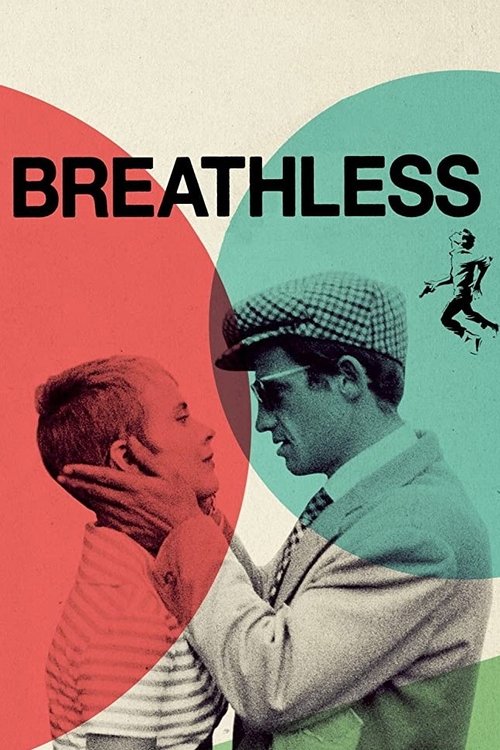
Breathless
1960 · Jean-Luc Godard
For when you want to feel effortlessly cool — a cigarettes-and-espresso movie for a night when you'd rather wander Paris with two beautiful, maddening people than follow a plot. More hangout than thriller; easy to watch, hard to shake.
What it's about
A small-time Parisian thief steals a car, shoots a motorcycle cop on impulse, and spends the rest of the film drifting through Paris with the police closing in. Instead of running, he lingers — flirting, arguing, and idling in hotel rooms with an American student he's trying to talk into escaping to Italy with him. The crime is almost beside the point; the real subject is the push-pull between these two people who can't decide what they want from each other.
The experience
Loose, jazzy, and restless — it moves like a conversation that keeps changing subjects, with jump cuts that make time skip and stutter. It's flirtatious and cool on the surface, with a fatal undertow you feel the whole way through.
Performances
Jean-Paul Belmondo is all swagger and boyish improvisation, a crook playing at being a movie gangster, while Jean Seberg's cropped-haired, unreadable Patricia became one of cinema's most imitated presences. Their chemistry is the film — half seduction, half interrogation.
The craft
Shot fast and cheap on real Paris streets with handheld cameras and available light, it threw out the rulebook: jump cuts mid-scene, direct location sound, performances that feel caught rather than staged. The result still feels startlingly alive — grainy black-and-white Paris, caught on the fly, that rewards a good print.
Why it matters
It announced the French New Wave to the world and rewired how movies could be cut, shot, and acted; generations of independent filmmakers trace their permission slip back to it.
Snapshot
Breathless (À bout de souffle) is the debut feature of Jean-Luc Godard and one of the defining works of the French New Wave. A loose crime film structured around an impulsive Parisian thief, Michel Poiccard (Jean-Paul Belmondo), and the ambivalent American student, Patricia Franchini (Jean Seberg), it rewired the grammar of narrative cinema — exploding continuity editing, embracing direct-sound location shooting, and introducing a style of performance rooted in spontaneity rather than rehearsed expression. Shot in four weeks on the streets of Paris on a shoestring budget, it arrived as both a declaration of love for American B-cinema and a thoroughgoing repudiation of the polished, literary "Tradition of Quality" that dominated French filmmaking in the 1950s. Its influence radiates so widely across subsequent decades that it functions less as a film than as a founding document.
Industry & production
The film was produced by Georges de Beauregard, one of the few French producers willing to back the Cahiers du Cinéma critics-turned-directors in the late 1950s. The story originated with François Truffaut, who drafted a short treatment based loosely on a real criminal case. Godard took the treatment and wrote the screenplay himself, expanding it into a portrait of moral drift and movie-addled masculinity. The production budget was extremely modest — in the range typically cited for New Wave first features, though exact figures vary across sources and should be treated with caution — forcing practical improvisations that would prove aesthetically generative.
Godard shot with a skeleton crew and without the union overhead that encumbered larger French productions of the era. The combination of low cost and minimal infrastructure made the film's location-first, studio-averse method not merely a stylistic preference but a structural necessity. Producer de Beauregard also backed Godard's subsequent work and was central to the early New Wave ecosystem alongside Anatole Dauman and Pierre Braunberger.
The film was dedicated, with pointed sincerity, to Monogram Pictures — the American Poverty Row studio responsible for Charlie Chan serials, Bowery Boys comedies, and scores of cheap crime films. The dedication announced exactly what kind of cultural transaction was under way: a repurposing of disreputable American genre material through a self-conscious European intelligence.
Technology
Cinematographer Raoul Coutard, a former military and press photographer with no conventional film school training, was the film's most important technical collaborator. To shoot in available light on Paris streets — without permits, reflectors, or the cumbersome lighting rigs standard to French studio practice — Coutard used Ilford HPS, a fast emulsion designed for still photography rather than cinema. Loaded into the camera magazine, it provided the high-sensitivity latitude needed to expose in low natural light, and it produced the film's characteristic grain: dense, textured, photojournalistic.
For mobility, Coutard frequently operated the Cameflex camera — a relatively lightweight French magazine camera — handheld or from improvised mounts. For longer tracking shots on crowded streets, Coutard used a wheelchair or a postal cart pushed through the scene; these low-tech solutions circumvented the time and infrastructure required to lay track while keeping the image fluid and intimate. The result was a visual texture closely aligned with street photography and newsreel footage rather than with the deep-focus clarity or controlled studio light of mainstream French cinema.
Technique
Cinematography
Coutard's images work against the polished propriety of 1950s French cinematography as practiced in the Tradition of Quality. Shadows are allowed to fall hard; skin tones go uncompensated; backgrounds bleed detail into noise. The Paris of Breathless — the Champs-Élysées, Montparnasse backstreets, the crowded sidewalks of the 8th arrondissement — is treated as reportage subject matter, not scenic backdrop. The camera is close to its subjects, sometimes uncomfortably so, and its handheld tremor anchors the image in a bodily present tense. This realist immediacy coexists, paradoxically, with a keen awareness of cinematic quotation: the film is saturated with references to American posters, darkened cinema interiors, and the iconography of Humphrey Bogart, whom Belmondo's character idolizes and mimes throughout.
Editing
The film's most radical and most imitated innovation is its systematic use of the jump cut. The mechanics are well documented: Godard had assembled considerably more footage than the film's eventual running time could accommodate, and rather than excise entire scenes, he made cuts within shots — removing sections of continuous action and splicing together incompatible screen positions, producing visible lurches in space and time. Whether the method was conceived in advance or discovered in the editing room, in close collaboration with editor Cécile Decugis, remains somewhat contested in the historical record; Godard's own accounts across interviews have varied. What is not contested is the effect: the jump cut abolished the invisible suture of classical continuity editing, making the act of cutting perceptible, foregrounding the film's own construction. It was understood immediately as an affront to convention and a liberation from it simultaneously.
Mise-en-scène / staging
Staging is largely improvised within found environments. The extended apartment sequence between Belmondo and Seberg — drawn-out, digressive, covering most of a morning and afternoon — takes place in a single small room and was reportedly shot across several days, with the actors working from a loose outline rather than fixed dialogue. The claustrophobia of that room, against the expansive street footage, creates the film's central spatial tension: freedom is always outside, domesticity and entrapment within. Godard allows takes to run long, lets performers lose their thread and recover, and cuts with no obligation to narrative continuity. The camera does not so much observe the scene as circle it restlessly.
Sound
Breathless used a mix of direct sound and post-synchronization. The street sequences were often shot silent and re-voiced in post-production, a common practice in French filmmaking given the noise of location shooting; this accounts for some of the slight dissociation between image and voice that contributes to the film's dreamy, slightly de-realized texture. The score, by jazz pianist Martial Solal, punctuates the film with a cool, improvisatory quality well suited to the material — intervallic, sparse, never underlining emotion didactically. Solal's music belongs to the same Parisian jazz milieu that the film's characters inhabit culturally.
Performance
Belmondo's Michel is a performance in constant self-performance: a petty criminal playing at being a movie gangster, touching his lips the way Bogart touched his, trying on an attitude of fatalism that doesn't quite fit. Belmondo plays this with enormous physical ease and a quality of genuine spontaneity — he was not yet a major star, and there is something undefended about his work here that later stardom would partly close off. Jean Seberg, already known to French audiences through Preminger's Bonjour Tristesse (1958), brings a complementary opacity: Patricia's emotions are never fully legible, her final betrayal neither explained nor adequately foreshadowed, and Seberg's naturalistic flatness makes her inscrutability feel like depth rather than failure.
Narrative & dramatic mode
The film dispenses with conventional dramatic architecture. There is no investigation, no chase sustained enough to build suspense, no romantic arc resolved. Michel drifts; Patricia drifts alongside him; the plot inches toward its inevitable end through long conversational detours that the film makes no effort to justify narratively. This picaresque, episodic structure — concerned more with the texture of a particular form of Parisian life than with plot mechanics — was deeply indebted to the Italian Neorealist tradition and to Roberto Rossellini specifically, whom Godard regarded as a foundational model. The ending, in which Patricia phones the police and Michel dies in the street, offers the formal closure of a crime film while refusing its moral legibility: we do not understand her, and the film does not ask us to.
Genre & cycle
Breathless belongs to the roman policier tradition filtered through American film noir and the B-picture gangster cycle. Its debts are explicit — the Monogram dedication, Belmondo's Bogart fixation, the structure of a man on the run — but it treats genre as found material rather than blueprint. The film strips away genre's narrative satisfaction while retaining its iconography and its cool. This double movement — genuine love for American popular cinema combined with a refusal to produce the pleasures that cinema conventionally delivered — would become definitional for the French New Wave as a whole. The cycle it belongs to includes Truffaut's The 400 Blows (1959), Chabrol's Le Beau Serge (1958), and Jacques Rivette's early shorts, all emerging from the same Cahiers milieu in the same narrow window.
Authorship & method
Godard's method on Breathless established habits he would maintain for decades: the director as the primary creative intelligence on set, rewriting or generating dialogue the morning of the shoot, feeding lines to actors via earpiece or chalked on boards out of frame. This was not improvisation in the theatrical sense — Godard was not inviting actors to find their own words — but a form of compositional spontaneity that kept the written element contingent and alive rather than fixed in advance.
Coutard's contribution was indispensable and should not be undervalued beneath auteurist accounts. His willingness to solve visual problems with journalistic pragmatism — using whatever film stock got the image, mounting the camera on whatever moved — made Godard's stated ambitions technically achievable. Coutard would go on to shoot the majority of Godard's 1960s work, including Vivre sa vie (1962), Contempt (1963), and Pierrot le fou (1965), developing what might fairly be called a shared visual language.
Movement / national cinema
Breathless is the French New Wave's best-known international emissary and, alongside The 400 Blows, the film most responsible for establishing the movement's global reputation. The New Wave was constituted by a generation of filmmakers — Godard, Truffaut, Chabrol, Rohmer, Rivette — who had formed their sensibilities as critics at Cahiers du Cinéma in the early and mid-1950s, writing against the Tradition of Quality (exemplified by literary adaptations with prestigious scripts and polished production values, associated with directors like René Clément and Claude Autant-Lara) and for a cinema of personal expression, genre vitality, and the American directors they celebrated as auteurs: Hitchcock, Hawks, Fuller, Minnelli.
Breathless put theory into practice. Its form embodied the argument the Cahiers critics had been making on the page: that a film could be a work of art because of its direction, not despite its disreputable genre materials, and that the personality of the filmmaker should be legible in every technical choice.
Era / period
The film emerged at the intersection of several historical forces: the end of the Fourth Republic and the early Gaullist Fifth Republic; the French intellectual culture of existentialism and its aftermath; and the post-war acceleration of American cultural influence — rock and roll, detective novels in the Série Noire translations, Hollywood — across European youth culture. Michel is a figure of this Americanized modernity: stateless, mobile, in love with an idea of freedom derived from movies rather than from any lived political tradition. The film's 1960 release places it at the beginning of a decade whose transformation of cinema it did much to enable.
Themes
The film's central preoccupation is freedom — or rather, its impossibility within a social world that will not remain as permissive as an attitude demands. Michel performs freedom as style; the film reveals that style is all there is, that underneath the Bogart lip-touch is a man with no particular depth and no viable future. Patricia's freedom is different and finally more complete: she can choose, and she chooses to be rid of him. The film thinks seriously about the American presence in France — Patricia is America in miniature, attractive and opaque, finally unreliable — and about the cinema itself as a machine for producing false but seductive images of masculine heroism. It is also, less obviously, about boredom: the long apartment sequence does not relieve tedium so much as make it the film's actual subject.
Reception, canon & influence
Breathless was a commercial success in France upon its release in March 1960, attracting substantial audiences and generating a great deal of critical controversy. At the Berlin International Film Festival that year, Godard received the Silver Bear for Best Director. Initial critical response was divided along predictable lines — the Cahiers circle celebrated it, while more conservative critics objected to its formal incoherence — but within a few years the film had been absorbed into the international critical consensus as a landmark.
Backward influences: American film noir (particularly in the Série Noire mode), the B-pictures of Monogram and Allied Artists, Howard Hawks' crime films, and the Italian Neorealist movement, particularly Rossellini. Godard has cited Roberto Rossellini as a crucial methodological model: the idea of a cinema responsive to present reality rather than to pre-scripted construction. Within French cinema, the shorts and essays of Alexandre Astruc — especially his concept of the caméra-stylo (the camera as pen, cinema as personal writing) — provided theoretical scaffolding.
Forward influence: The film's impact on subsequent cinema is so pervasive as to resist clean enumeration. In American cinema, Bonnie and Clyde (Arthur Penn, 1967) is commonly cited as a direct heir — its jump-cut violence, its glamorized criminal couple, its genre self-consciousness all bear the imprint of Godard. The New Hollywood movement more broadly — Cassavetes, Scorsese, De Palma, Altman — metabolized the formal freedoms Breathless demonstrated. The film's influence on British cinema (the early work of Richard Lester, the Free Cinema movement) and on world cinema generally is documented in the work of filmmakers as various as Nagisa Oshima, Bernardo Bertolucci, and Rainer Werner Fassbinder.
The jump cut, specifically, passed into the general vocabulary of film and television editing and is now so naturalized as a technique that its radical origin in Breathless must be actively recalled. That normalization is itself a measure of the film's success: it changed what cinema thought it could do, and then cinema forgot that it had ever thought otherwise.
A Deleuzian reading
Belmondo's thumb crosses his lip.
The full Deleuzian reading of Breathless →
Reception
It landed in 1960 as a genuine shock — the jump cuts felt like broken rules — but it was an instant sensation, winning Godard the Silver Bear for directing at Berlin. Sixty years on it's less a movie than a before-and-after line in film history.
How Breathless was received, from release to now →
Influences: the films it descends from and the films it influenced
- Rome, Open City (1945) — Rossellini's integration of documentary-style location shooting in destroyed Roman streets — non-professional actors, unavailable light, found-environment staging — is the direct formal model for Coutard's refusal of studio-built environments and Godard's found-space improvisation throughout Paris.
- Voyage to Italy (1954) — Rossellini's method of constructing scenes from behavioral observation in real locations rather than scripted action — characters improvising responses to actual landscapes and spaces — is the specific staging inheritance Godard transposes into the extended Belmondo/Seberg apartment sequence, built across days from a loose outline.
- Gun Crazy (1950) — Lewis's single-take bank robbery sequence — camera mounted in the backseat of the getaway car, recording unbroken action in real space — is the direct precursor to Coutard's wheelchair-mounted mobile shots and the principle of embedding the apparatus within an ongoing event rather than observing it from a stable exterior position.
- Hiroshima mon amour (1959) — Resnais and editor Henri Colpi's cuts between present-tense Hiroshima and memory-time Nevers — splicing incompatible temporal states without conventional transition — dismantled the classical suture the year before Godard systematized the intra-scene jump cut as a repeatable editing grammar.
- Pickup on South Street (1953) — Fuller's B-picture crime grammar — punchy close-up cutting, a protagonist with minimal psychological motivation, narrative propulsion from behavioral surface rather than dramatic interiority — is the American model the Cahiers critics valorized, and that Breathless occupies wholesale before detonating it from within.
- Shadows (1959) — Cassavetes used handheld 16mm cameras with improvised dialogue and performance in New York street locations — a near-simultaneous discovery of the lightweight-camera/found-environment performance mode that Coutard and Godard developed independently in Paris, establishing that fiction film could operate with a documentary apparatus.
- Elevator to the Gallows (1958) — Coutard adopted Decaë's fast-stock, handheld, location-not-studio method, reportedly drawing on the technical approach Decaë had demonstrated was viable on Elevator; the result is the same quality of Paris found rather than built, the same refusal of theatrical lighting arrays for a crime film shot in actual streets.
- To Have and Have Not (1945) — Godard cited Hawks explicitly, and the film's transposition of casual-American-genre cool into a French setting — including Jean Seberg's Patricia as the woman who controls the dynamic through insolent detachment — extends the Hawksian overlapping-dialogue and diegetic-music-as-social-ambiance grammar into the Nouvelle Vague as a deliberate formal inheritance.
- Journey to Italy (1954) — The Cahiers championing of Journey put into practice: improvised performance, real Paris locations, and the jump cut as a descendant of Rossellini's abrupt, causality-loosening elisions.
- Bob le Flambeur (1956) — Extends Bob's loose, location-based, available-light method into the New Wave proper — sharing Decaë's cinematographic lineage and casting Melville himself in a cameo as the Americanophile gangster ethos personified.
- Toni (1935) — The Bazin-schooled New Wave inherited Toni through its critic-canonizer, taking real Paris streets, available natural light, and synchronous outdoor sound as the basis of a new realist freedom.
- The Strange Ones (1950) — Godard adopted Melville's outsider location-based independent method as a touchstone and cast Melville himself as the novelist Parvulesco in homage.
- Bonnie and Clyde (1967) — Penn screened Breathless before production and editor Dede Allen's systematic deployment of jump cuts within scenes — visible temporal ruptures replacing the classical suture — carried Godard's anti-continuity grammar directly into American studio filmmaking and triggered the New Hollywood's formal break with classical editing.
- Easy Rider (1969) — Hopper's handheld episodic picaresque — no conventional plot arc, scenes structured around behavioral drift, score assembled from pre-existing rock tracks functioning improvisationally against image rather than composed to picture — extends Breathless's anti-narrative road form and jazz-as-counterpoint scoring method into American counterculture cinema.
- Mean Streets (1973) — Scorsese's handheld Little Italy street shooting, with a soundtrack of pre-existing rock and opera cued improvisationally against image rather than scored to it, imports Breathless's location texture and jazz-score-as-autonomous-commentary method into the American crime film — Coutard's Paris reshot in the grain of lower Manhattan.
- Badlands (1973) — Malick reworks the B-picture fugitive-couple crime form — the structural armature Godard lifted from American genre — through a lyrical observational camera that lingers in landscape rather than following action, redirecting Breathless's crime-couple picaresque toward ecological meditation while retaining the episodic drift and voice-over detachment.
- Stranger Than Paradise (1984) — Jarmusch systematizes the jump cut as a structural principle — each scene separated by a black-frame cut leaping over dead time — while shooting high-contrast 16mm B&W grain that explicitly cites Coutard's Ilford HPS photojournalistic aesthetic, converting Breathless's improvised anti-narrative into a rigorous formal architecture of absence.
- Slacker (1991) — Linklater builds an entire feature from drifting encounter-to-encounter with no protagonist — each character departed before arrival, conversations cut mid-thought as the film relays to someone new — extending Breathless's episodic picaresque logic to its structural limit: pure digression as architectural principle rather than a property of one character's movement.
- La Haine (1995) — Kassovitz shoots in handheld B&W on the streets of Paris and its banlieues across a single compressed day, deploying the city-as-location and episodic picaresque structure as a direct inheritance from Breathless's street-level urban grammar — with the provocation shifted from the polished Tradition of Quality to the French state's racial violence.
- Rumble Fish (1983) — Malkin's associative editing — cutting across temporal gaps without bridging shots — adopts Godard's jump-cut grammar of collapsing narrative time, a New Wave inheritance Coppola explicitly cited as the film's formal ambition.
- True Romance (1993) — Michel Poiccard's identity assembled from Bogart posters and American B-movie iconography is the direct model for Clarence's self-construction through comic books and kung-fu films — the premise of a young man who has built a self entirely from pop-culture objects rather than lived experience.
- Casino (1995) — Godard's jump-cut disruptions of spatial and temporal continuity gave Casino its formal license to treat time as retrospective and non-linear — images compressed, sequences out of expected order — rather than building suspense chronologically.
- Trainspotting (1996) — Godard's axiom of cutting on emotional energy rather than spatial continuity—the jump cut as rhythmic punctuation rather than continuity error—is the direct formal ancestor of Trainspotting's editorial grammar, particularly the compressed, headlong Princes Street opening sequence.
- A Hard Day's Night (1964) — Jympson's jump cuts and mid-dialogue ellipses derive directly from Coutard and Godard's editorial grammar: cuts that exit scenes before their dramatic logic resolves, violating continuity to transfer rhythmic energy rather than narrative information, a technique AHDN absorbed and synchronized to musical phrasing.
- The 400 Blows (1959) — Truffaut and Decaë's handheld Paris street shooting and episodic picaresque structure — a drifting young male observed in found environments without resolved narrative closure — establishes the shared New Wave production vocabulary that Breathless simultaneously radicalized with its jump-cut grammar.
- Shoot the Piano Player (1960) — Truffaut transplants American B-picture crime conventions into improvised Paris locations and mixes tonal registers — comedy undercutting tragedy — performing the same cultural operation as Breathless (European intelligence repurposing American genre) through a contrasting personal style on the same streets and within the same production season.
- Chronicle of a Summer (1961) — Rouch and Morin used the same Cameflex lightweight camera technology on Paris streets in the same production period, but inverted Breathless's post-sync approach — developing synchronous direct sound to pursue vérité authenticity rather than studio-controlled post-dubbing — the parallel track of the same camera-technology revolution.
- Cleo from 5 to 7 (1962) — Varda's real-time handheld Paris street tracking constructs a female flâneur's episodic city experience with the same location-first, permit-free production approach as Breathless — extending the found-urban-space method toward sustained present-tense duration rather than Godard's elliptical jump-cut compression.
- Ashes and Diamonds (1958) — Godard's handheld-anticipation camera grammar and film-noir-inflected doomed-young-man aesthetics developed in parallel with Wójcik's loose mobile work in the Maciek/Krystyna sequences; the dossier explicitly raises the question of cross-influence versus simultaneous discovery across the two movements.
- Vivre Sa Vie (1962) — Coutard's handheld location shooting and raw direct sound establish the New Wave toolkit that Vivre sa vie disciplines into long static takes.
- Le Doulos (1962) — Shares Belmondo channeling American crime-cinema cool through a French nouvelle-vague filter, the contemporary companion to Melville's own cinephile dialogue with Hollywood noir.
- Ocean's Twelve (2004) — Ancestor of the jump-cut as a rhythmic, continuity-breaking device that Twelve deploys to flaunt its New Wave editorial debt.
- Husbands (1970) — Handheld immediacy and a tossed-off, anti-composed spontaneity that legitimized rough camerawork as expressive rather than amateur — the visual permission Husbands' Kemper takes to extremes.
- Cléo from 5 to 7 (1962) — Godard (who cameos in Cléo) pioneered the New Wave method of shooting handheld in real Paris streets with natural light and non-professional bystanders that Varda deploys for Cléo's cab and café wanderings.
- Memories of Underdevelopment (1968) — Supplies the Nouvelle Vague reflexivity—handheld shooting on live streets, jump cuts, and a self-aware relation to genre—that Alea metabolizes into documentary-fiction hybridity.
- Purple Noon (1960) — Shot the same year by the same cinematographer (Decaë), it shares Purple Noon's handheld, sun-lit street immediacy while pushing the amoral-charmer protagonist toward New Wave abstraction.
Similar films
- Hiroshima Mon Amour (1959) — influence & lineage · often watched together
- Shoot the Piano Player (1960) — influence & lineage
- The 400 Blows (1959) — influence & lineage
- Bonnie and Clyde (1967) — influence & lineage · often watched together
- Pierrot le Fou (1965) — shared sensibility
- Pickpocket (1959) — shared sensibility
- Nouvelle Vague (2025) — shared sensibility
- Elevator to the Gallows (1958) — shared sensibility
All the films related to Breathless →
Watch it with: curated runs of related films
- Love as a Wrecking Ball — Watch these when you want desire pushed all the way to self-destruction — affairs and infatuations that leave nothing standing.
Film essays and courses that include it
- How Cuts Think: From Soviet Montage to New Hollywood Rhythm
- Jean-Luc Godard
- Jump Cut: The Nouvelle Vague from Birth to Dissolution
- The Camera Gets Off the Tripod: Vérité from Flaherty to Bigelow
- The Grammar of Shadow: Black & White Cinema from Caligari to Raging Bull
- A School of Looking: French Cinema's Seven Decades of Formal Invention
- The French Invention: From Grand Illusion to Caché
- The Revolution That Disappeared
- The Director Who Took Cinema Apart
- The Cut That Was a Mistake
- The Eyes of the New Wave
- The Revolution, Reenacted