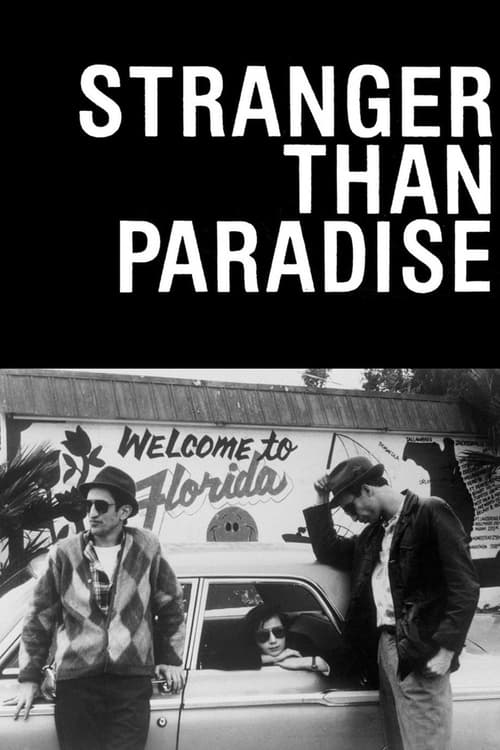
Stranger Than Paradise
1984 · Jim Jarmusch
For a low-key night when you want something cool, dry, and unhurried — cinema as hanging out. It's a comfort watch for people who like their comedy at a slouch, and a perfect first step into independent film.
What it's about
Willie, a New York layabout, gets a surprise visit from his young Hungarian cousin Eva, and an unexpected, grudging bond forms. When she moves on to their aunt's place in Cleveland, Willie and his buddy Eddie drive out to see her — a trip that drifts, on a whim and a card game, all the way to a bleak off-season Florida. Three aimless people, three drab American places, and the strange comedy of nothing much happening.
The experience
Deadpan, hypnotic, and secretly hilarious — long single takes separated by blackouts, where the joke is often the silence itself. It runs on a wavelength of cool detachment that either bores you or completely charms you, and for most people it's the latter once it clicks.
The craft
Shot in stark black and white and built almost entirely from single-take scenes punctuated by blackouts, it turns minimalism into a style: no coverage, no cutting within scenes, just duration and dead air doing the comedic work. Made on almost no money, it proves how much atmosphere you can get from framing, patience, and three faces.
Why it matters
A foundational film of American independent cinema — it won the Caméra d'Or at Cannes in 1984 and announced that art films could be made in America for pocket change, opening the door for a generation of indie filmmakers.
Snapshot
A foundational text of American independent cinema, Stranger Than Paradise follows three aimless figures—Willie, his Hungarian cousin Eva, and his friend Eddie—through the bleak emptiness of New York, Cleveland, and Florida. Structured as three labeled chapters, built from single-take scenes separated by blackouts, the film subordinates conventional drama to duration, silence, and the comedy of stasis. Its deadpan register, black-and-white cinematography, and studied indifference to narrative momentum announced a new possibility for American filmmaking: art cinema made on virtually no money, rooted in the downtown Manhattan bohemian milieu, yet immediately legible to international festival audiences as a recognizable and significant form. It won the Caméra d'Or at Cannes in 1984, was acquired and distributed theatrically in the United States by the Samuel Goldwyn Company, and has retained its place in critical canons as a hinge moment in the history of American film.
Industry & production
Stranger Than Paradise was made in two phases. In 1982, Jarmusch shot a roughly thirty-minute segment titled New York that would become the film's first chapter. The opportunity arose from a direct act of lateral solidarity between filmmakers: Wim Wenders had surplus black-and-white film stock left over from production of The State of Things (1982) and gave it to Jarmusch. This transfer of material condensed a whole network of transatlantic influence into a single practical fact. The short circulated successfully on the festival circuit and encouraged Jarmusch to expand it into a feature, which he financed through a combination of sources that included the German broadcaster ZDF and the British Film Institute—European arts-funding infrastructure rather than the American studio system or domestic investors. The US distributor came aboard only after the film had already been recognized at Cannes.
The total budget was approximately $110,000—a small sum even by the standards of early-1980s independent production. Sara Driver, Jarmusch's longtime collaborator and partner, served as producer. The production was embedded in the No Wave downtown Manhattan scene, a tight-knit community of artists, musicians, and filmmakers who moved freely between disciplines and shared a collective opposition to mainstream commercial culture.
The casting was drawn from this world. John Lurie, who plays Willie, was a co-founder of the avant-garde jazz group the Lounge Lizards and had no previous feature-film credits. Richard Edson, cast as Eddie, was at that time the drummer for the no-wave band Sonic Youth. Eszter Balint, playing Eva, was a Hungarian-born actress with a theatrical background who had emigrated to the United States as a child. None of the three were film actors in any conventional industry sense; the film is built around their particular energies and comic timing rather than against them.
Technology
The film was shot in black and white, with the original 1982 short made using the Wenders-donated film stock. The feature was shot on black-and-white negative; the distinctive grain of the image reflects both Jarmusch's aesthetic choices and the material constraints of the budget. Sound was recorded direct on location without significant post-production ADR work; the ambient texture—humming apartment radiators, the muffled deadness of Cleveland interiors in winter, the blank acoustics of Florida motel rooms—is the sound the microphone caught, not a reconstituted acoustic environment. This fidelity to location sound contributes substantially to the film's quality of unadorned observation.
Technique
Cinematography
Tom DiCillo served as director of photography, continuing a collaboration with Jarmusch that extended from the original 1982 short. DiCillo would subsequently become a filmmaker in his own right (Johnny Suede, 1991; Living in Oblivion, 1995), and his contribution to Stranger Than Paradise is constitutive rather than merely technical. His approach was rigorously static: the camera is almost invariably fixed on a tripod, pointed at a scene that plays out in full before a cut to black. There are virtually no camera movements—no panning to follow action, no dolly into close-up, no handheld urgency. This immobility is a positive stylistic decision. The frame becomes a proscenium; the actors move within it, but the film refuses the rhetorical amplification that Hollywood grammar uses to tell audiences how to feel.
Tonal choices tend toward a flattened, even exposure that keeps mid-range space legible while stripping locations of conventional pictorial beauty. The black-and-white palette neutralizes the familiar color signifiers of the American landscape—the drabness of a New York apartment, the gray flatness of Cleveland in winter, and even the Florida coast rendered under overcast skies—making all three destinations look strangely interchangeable. That perceptual interchangeability is precisely Jarmusch's argument.
Editing
Jarmusch edited the film himself. The governing principle is the blackout: each scene—each single take—ends in a fade to black, followed by a new scene. This is not classical continuity editing, which smooths over time and space in service of narrative absorption. It is something closer to a chapter structure, or the pages of a sketchbook. The blackouts serve two functions simultaneously: they mark radical temporal compression (the film covers weeks or months in under ninety minutes) and they resist the spectator's uninterrupted immersion in conventional narrative flow. There is no crosscutting, no intercutting of simultaneous action. Each scene is sealed and self-contained.
The rhythm within scenes is determined by the actors and by Jarmusch's patience with silence. Pauses are never cut around. A character speaks, and nothing follows for several beats before anyone responds. This is not editorial incompetence but a formal commitment to trusting duration—to allowing the image and the moment to register at their own speed.
Mise-en-scène / staging
Staging is minimal and anti-theatrical in the productive sense. Characters occupy cheap interiors—a cramped New York apartment, a Cleveland aunt's living room, motel rooms of indeterminate provenance—without the film either glamorizing austerity or performing poverty for the camera's benefit. The spaces are where people are, and the film declines to editorialize about them. Staging within scenes is loose and naturalistic: characters sit, stand, watch television, eat, and speak with a casualness that resists over-articulated theatrical gesture.
The production rule of shooting each scene in a single take meant that what ended up on screen was frequently the only version of a scene that existed. This introduced a documentary quality, a sense that the camera had caught something rather than constructed it—a quality that the formal rigor of fixed framing paradoxically reinforces rather than undermines.
Sound
John Lurie composed the film's jazz-inflected score, drawing on his Lounge Lizards sensibility to produce music that is cool, slightly off-kilter, and temperamentally aligned with the film's tone. The most famous sound element is Screamin' Jay Hawkins's "I Put a Spell on You," which recurs on the soundtrack as Eva plays it insistently, and which functions as a sustained comic motif: an American original, operatically excessive and melodramatic, absorbed into the film's elaborately flat affect. The disjunction between Hawkins's voodoo theatrics and the film's studied understatement is itself a small joke about cultural assimilation. Hawkins also appears briefly in the film in a cameo as a man behind a counter, collapsing the distinction between the music's diegetic and non-diegetic presence. The method of selecting pre-existing popular music for thematic and tonal resonance—rather than commissioning generic score—would become a persistent Jarmusch signature.
Performance
The three leads operate in a register of deadpan non-reaction. Lurie's Willie is perpetually aggrieved by nothing specific; Edson's Eddie is cheerfully vacant; Balint's Eva is the film's most richly observed figure—alert, wry, and visibly processing an American reality that is duller and stranger than she expected. The comedy arises not from incident but from the gap between what characters say and what the situations would conventionally be expected to produce. No one responds to anything quite the way a studio script would require. This is not alienated posturing but a particular register of realism: the humor of people too self-aware or too exhausted to perform the expected emotion.
Narrative & dramatic mode
The film is structured in three labeled chapters: New York, One Year Later (set in Cleveland), and Paradise (set in Florida). This skeletal geography—a city, a suburb, a resort—traces a mock-picaresque that goes nowhere in the most literal sense: the characters end the film approximately as lost, as broke, and as rudderless as they began. There is no character arc in any growth-and-change meaning; there is only duration and mild accumulation. The closest the film comes to dramatic escalation is a poker game and a mistaken-identity incident in Florida, and both are played for deflation rather than climax.
This is a cinema of comportment rather than event. What matters is how these three people occupy a room together—the texture of their shared boredom, their small competitions, their oblique and inadequately expressed affections. Jarmusch inherits the European art cinema's distrust of plot while grounding it in recognizably American spaces and subjects: the immigrant experience, the featurelessness of the American landscape, the comedy of a country that promises everything and delivers the same motel room.
Genre & cycle
The film is simultaneously a road movie and an anti-road movie. The genre typically encodes travel as liberation, self-discovery, or kinetic pleasure. Stranger Than Paradise systematically withholds all three: the travel is desultory, the destinations are uniformly bleak, and the Florida beaches—coded by every tourist fantasy as paradise—appear under gray skies as merely another featureless extension of the same nowhere the characters already occupied.
It belongs to a cluster of early-1980s American independent films—Repo Man (1984), Blood Simple (1984), Jarmusch's own earlier Permanent Vacation (1980)—that were finding, often through European funding, a way to make art cinema from American vernacular materials. This cluster would crystallize by the late 1980s into the Sundance-adjacent "indie" scene, with Stranger Than Paradise positioned retroactively as one of its founding documents.
Authorship & method
Jarmusch wrote, directed, and edited the film, and his authorship is unusually total. He has spoken in interviews of working without detailed shot lists or storyboards, building scenes around his actors' specific energies and the qualities of particular locations. His stated influences—Ozu, Godard, Cassavetes, Chantal Akerman, Bresson—map onto the film's formal choices with unusual precision and suggest a filmmaker who had absorbed a wide range of precedents and synthesized them into something that felt genuinely new in its American context.
DiCillo's cinematographic partnership was essential rather than subsidiary; his subsequent emergence as a director of independent features is evidence of how much creative intelligence he brought to the collaboration. Lurie's contribution as performer and composer is equally constitutive: the film is not simply illustrated by his music but structured in part around his timing, his physical presence, and the particular quality of ironic cool that he brought from the jazz world into a cinematic frame. Driver's production role provided the connective tissue between the project and its funding environment.
Movement / national cinema
Stranger Than Paradise sits at the intersection of two formations: the American No Wave cinema of the late 1970s and early 1980s—associated with downtown Manhattan, cheap 8mm and 16mm production, and a punk anti-aestheticism—and the international art cinema of European festivals and distribution circuits. Jarmusch absorbed No Wave's willingness to make films entirely outside industry structures while rejecting its more aggressively anti-narrative extremes; he simultaneously absorbed European art cinema's patience with duration and silence while grounding it in recognizably American spaces, characters, and cultural references.
The result belongs to no single national cinema. Funded by German and British television, shot in America, structured like a European art film, populated by Hungarian immigrants and downtown New York musicians, premiered at Cannes: its in-betweenness is also its subject—a film about people who belong nowhere, made in a form that belongs nowhere in particular.
Era / period
The early-1980s context bears on the film's texture. Stranger Than Paradise depicts an America of cheap apartments, idle young men, dead-end mobility, and a landscape emptied of the postwar prosperity myths encoded in its geography. The film makes no overt political commentary, but its portrait of economic stasis and cultural blankness is difficult to read as incidental to the Reagan era in which it was produced. Eva arrives from Hungary expecting something and finds Willie watching television; the joke about America has a particular valence in 1984 that it would not carry in a different historical moment.
The No Wave moment from which the film emerged was itself winding down by 1984. Stranger Than Paradise arrived at the tail end of that formation, consolidating its energies into a form durable and exportable enough to seed a subsequent generation.
Themes
The film's central preoccupation is cultural displacement and the strangeness of the familiar. Willie has assimilated into American aimlessness so completely that he is embarrassed by Eva's Hungarian-ness—her accent, her foreignness, her failure to have already absorbed the affectlessness he wears as identity. The irony the film turns on is that his assimilation has produced not belonging but a deeper placelessness. Eddie, the American-born character, is no more rooted than either of them.
Florida—nominally the paradise of the title—is simply more of the same emptiness, relocated and no warmer. The film treats America as a place one arrives into without ever quite landing. Boredom is not incidental but structural: it is the condition these characters inhabit, and Jarmusch takes it seriously as a human state rather than pathologizing or aestheticizing it from a safe ironic distance.
The Willie-Eva relationship is the film's emotional center of gravity. His resistance to acknowledging kinship, her wary and persistent warmth, generate the film's only sustained feeling beneath the comedy. Aunt Lotte in Cleveland—Hungarian displaced to Queens, then further displaced to Ohio—adds another layer of comic translation: the immigrant dream redistributed across ever-less-promising American cities.
Reception, canon & influence
Critical reception. Stranger Than Paradise premiered at the 1984 Cannes Film Festival, where it won the Caméra d'Or for best first feature. The Cannes reception established it immediately as a significant work of international art cinema rather than a marginal American curiosity. Critical response in the United States was enthusiastic among the taste-making press; Roger Ebert awarded it four stars in a widely-read review, and it became a touchstone for critics arguing that American independent filmmaking could achieve the formal ambition of European art cinema on domestic material.
Influences on the film. Jarmusch is an outspoken cinephile and has documented his debts extensively in interviews. Yasujiro Ozu's presence is evident in the fixed camera, the domestic spaces, and the acceptance of narrative slightness as a positive value. Chantal Akerman—particularly her New York–set films and Jeanne Dielman (1975)—is visible in the treatment of duration and mundane domestic space as the primary site of cinematic meaning. John Cassavetes established the American precedent for actor-driven, low-budget filmmaking outside the studio system. Godard's nouvelle vague provided the model for self-conscious genre deflation and the comedy of intellectual understatement. Wim Wenders—whose material gift was also a transfer of aesthetic sympathy—contributed a vision of American space as simultaneously mythologized and desolate, as explored in Alice in the Cities (1974) and Kings of the Road (1976). The immediate local tradition of No Wave cinema—Amos Poe, Beth B and Scott B, Eric Mitchell, and others working in downtown New York from the late 1970s—provided the most proximate context of low-budget filmmaking outside commercial structures, though Jarmusch's synthesis was more exportable and formally coherent than most of his immediate predecessors.
Legacy. The film's forward influence is substantial and well-attested. It is widely credited as a founding text of the American independent cinema that would flourish through the late 1980s and 1990s. Richard Linklater's Slacker (1990), which similarly structures a film around drifting, non-goal-directed movement through a city, acknowledges Jarmusch as formative. Todd Haynes, Hal Hartley, and a generation of American independent filmmakers absorbed the lesson that a clearly defined formal sensibility and minimal resources could produce a film with international reach and critical authority. More diffusely, Stranger Than Paradise established the "deadpan indie" as a recognizable genre—complete with its characteristic slow pace, ironic deployment of generic conventions, and preference for performers drawn from adjacent arts communities—that became so widespread by the mid-1990s as to generate its own parodies and backlash: a reliable sign of genuine cultural penetration. Jarmusch's own subsequent career—Down by Law (1986), Mystery Train (1989), Night on Earth (1991)—built directly and consistently on the methods consolidated here, and those films extended his influence further into the global art-cinema circuit.
A Deleuzian reading
Eva plays the same song again.
The full Deleuzian reading of Stranger Than Paradise →
Reception
It landed at Cannes in 1984 and took the Caméra d'Or, instantly becoming the poster child for a new American independent cinema; four decades on it's less a discovery than a founding document — the film people point to when they date the birth of US indie cool.
How Stranger Than Paradise was received, from release to now →
Influences: the films it descends from and the films it influenced
- The State of Things (1982) — Wenders donated his surplus black-and-white film stock to Jarmusch, directly enabling the 1982 New York short that became StP's first chapter; beyond the material fact, Jarmusch replicates Wenders' fixed-camera static compositions and the European arts-funding (ZDF co-production) model that financed the feature.
- Permanent Vacation (1980) — Jarmusch's own prototype, shot with DiCillo, establishes the fixed-frame single-take scene separated by hard cuts that StP inherits as its structural blueprint, premiering the downtown Manhattan no-wave milieu and aimless outsider protagonist the later film expands.
- Pickpocket (1959) — Bresson's 'models' method — casting non-actors and coaching affectless, non-expressive line delivery — is the direct template for Jarmusch's deadpan performance register; Lurie and Edson perform with precisely this Bressonian restraint, emotions withheld rather than projected.
- Masculin Féminin (1966) — Godard introduces the titled discrete chapter ('15 Precise Facts') as structural device alongside frontal fixed compositions, direct location sound without studio ADR, and pre-existing pop songs as ironic emotional counterpoint — devices Jarmusch carries wholesale into StP's form.
- Alice in the Cities (1974) — Wenders' black-and-white anti-road film posits America through a European outsider's lens as a landscape of interchangeable emptiness where the road delivers no transformation; this exact spatial and thematic logic structures StP's three-city itinerary of Cleveland, New York, and Florida.
- Playtime (1967) — Tati's camera refuses to privilege characters over environment through fixed wide-angle compositions that let action play out at a distance; deadpan comedy emerges from spatial arrangement rather than performance emphasis — the direct model for Jarmusch's proscenium-frame approach.
- L'Avventura (1960) — Antonioni establishes duration-as-form: sustained shots that wait for drama that never arrives, empty modern spaces as projections of alienation, and the anti-plot following characters going purposefully nowhere — all foundational to StP's deliberate aesthetic of productive stasis.
- Shadows (1959) — Cassavetes establishes American independent cinema's core method — available-light New York location shooting with non-professional actors — treating raw, unpolished texture not as failure but as authentic form, the direct precedent for StP's self-legitimizing roughness and its non-actor casting logic.
- Rumble Fish (1983) — Extends the black-and-white associative-ellipsis grammar — unexplained temporal gaps, minimal camera movement, refusal of continuity bridging — into a sustained feature strategy, treating Rumble Fish's formal ruptures as a baseline rather than a departure.
- Breathless (1960) — Jarmusch systematizes the jump cut as a structural principle — each scene separated by a black-frame cut leaping over dead time — while shooting high-contrast 16mm B&W grain that explicitly cites Coutard's Ilford HPS photojournalistic aesthetic, converting Breathless's improvised anti-narrative into a rigorous formal architecture of absence.
- Stroszek (1977) — Jarmusch directly inherits Stroszek's tripartite geographic structure—New York to Cleveland to Florida mirrors Berlin to Wisconsin to Cherokee—and the European-misfits-in-American-consumer-culture premise, adding Robby Müller's 16mm black-and-white flat lighting as the formal equivalent of Stroszek's available-light grain.
- The Enigma of Kaspar Hauser (1974) — Jarmusch formalizes the episodic tableau mode into a structural signature — one uninterrupted take per scene, then blackness — and places pre-existing Screamin' Jay Hawkins recordings anachronistically against deadpan outsider action, translating the episodic rhythm and disjunctive scoring of Kaspar Hauser into a minimalist American idiom.
- Mystery Train (1989) — Extends StP's chapter structure to three simultaneous converging narratives; intensifies the pre-existing music device by building each chapter around a single Elvis or Roy Orbison recording as its emotional score, advancing cultural displacement into a triangulation of Japanese, Italian, and American characters in Memphis.
- Slacker (1990) — Linklater inherits StP's episodic relay structure and deadpan observation of marginal Americans; substitutes Austin for New York but maintains the anti-dramatic logic where characters appear, philosophize, and exit without consequence, treating inaction as sufficient subject for a feature film.
- Clerks (1994) — Smith adopts black-and-white fixed-camera minimalism for a New Jersey single-location film; two immobile clerks extend StP's deadpan stasis and static compositional grammar into Gen-X slacker comedy, replacing Jarmusch's taciturn silences with verbose pop-culture monologues while preserving the proscenium-frame approach.
- Old Joy (2006) — Reichardt makes an anti-road film for two estranged male friends driving to Oregon hot springs — fixed static frame, elliptical editing, direct location sound — withholding the promised reconnection in exact structural parallel to StP's refusal to deliver on the road movie's transformative promise.
- Wendy and Lucy (2008) — Fixed static compositions observe a woman and her dog in the Pacific Northwest with near-wordless scenes and direct location sound; Reichardt's poverty cinema is StP's closest stylistic heir, extending its formal restraint and anti-narrative ellipsis to situations bereft even of the deadpan comedy Jarmusch retains.
- Coffee and Cigarettes (2003) — Carries the blackout-cut chapter structure to its logical extreme across 11 discrete vignettes; fixed overhead compositions and pre-existing music selections maintain StP's visual grammar while the accumulation of disconnected conversations — each sealed and self-contained — becomes the film's only narrative architecture.
- Father Mother Sister Brother (2025) — Establishes Jarmusch's signature fade-to-black blackouts between single-take, single-setup scenes — the chapter-fade editing grammar carried directly into this film.
- Pulp Fiction (1994) — Jarmusch demonstrated that sustained static-camera long takes of characters doing very little — eating, watching television, waiting — constituted dramatic cinema, directly licensing Tarantino's refusal to cut away from extended mundane dialogue and his leisurely intra-scene editing pace.
- Ghost Dog: The Way of the Samurai (1999) — Originates Jarmusch's deadpan-episodic grammar — static long takes, chapter intertitles, and outsider drift — the formal architecture Ghost Dog reuses for its elegiac structure.
- Buffalo '66 (1998) — Template for American-indie deadpan delivered in single-take tableaux across a bleached, desolate Americana, scenes sealed off as discrete held shots.
- Napoleon Dynamite (2004) — Establishes the indie grammar of static locked-off frontal tableaux held well past the joke and an episodic vignette structure with anti-plot drift, the deadpan-stillness template Hess inherits.
- Noi the Albino (2003) — Builds each scene as a single static long-take tableau punctuated by blackout cuts, married to an episodic picaresque of drifting deadpan outsiders — the exact grammar Nói inherits.
- Down by Law (1986) — Jarmusch replaces DiCillo with Robby Müller for Louisiana locations while maintaining blackout editing, single-take scenes, and three-chapter structure; the film tests whether StP's formal system can absorb Zanni-style slapstick while retaining deadpan stillness as its governing register.
- She's Gotta Have It (1986) — Lee shoots his debut feature in black-and-white Brooklyn the same year, adopting chapter structure, frontal static camera, direct location sound, and non-actors — applying the Jarmusch independent model to an African-American vernacular subject on a comparable micro-budget.
- Paris, Texas (1984) — Robby Müller's available-light cinematography deployed simultaneously on a contemporaneous American art film, rendering the same neon vacancy and flat geography; both films treat masculine drift as a formal principle rather than a subject to be explained.
- Kikujiro (1999) — Builds deadpan comedy from static frontal long takes separated by blackout ellipses — the same withholding cut-on-emptiness rhythm and aimless picaresque drift Kitano edits into.
- Husbands (1970) — Descendant reviving the loose, low-budget behavioral aesthetic — deadpan real-time scenes of men loafing, drama located in dead air and gesture rather than incident.
- Bleak Moments (1971) — Constructs cinema from static, frontal long takes and plotless deadpan vignettes where duration and dead air, not story, carry the meaning.
- The Man Without a Past (2002) — Contemporaneous kindred minimalism — deadpan performers held in static long takes separated by black-frame ellipses — shares Kaurismäki's refusal of coverage and naturalistic acting, a sibling strain of American deadpan.
- Shadows in Paradise (1986) — Contemporaneous parallel invention of deadpan minimalist cinema — long static takes, blank affect, drab interiors, and terse jukebox-scored scenes — arriving from American independent cinema at the same moment as Kaurismäki's Finnish variant.
- Ariel (1988) — Jarmusch's fixed-frame long takes, elliptical black-out cutting between vignettes and affectless drifting characters are the parallel American strain of deadpan minimalism critics twin with Kaurismäki.
- A Scene at the Sea (1991) — Jarmusch's static, single-setup deadpan tableaux separated by black-out ellipses share the same minimalist-comic dramaturgy of stillness punctuated by cuts to nothing.
- Fallen Leaves (2023) — Parallel deadpan minimalism built on single-take static frontal shots and affectless performers — the American branch of the same tradition, and Jarmusch is the friend whose film screens inside Fallen Leaves.
- Repo Man (1984) — Shares the contemporaneous invention of a minimalist American indie built on deadpan underplaying and elliptical, blackout-structured comic drift.
Similar films
- Down by Law (1986) — influence & lineage
- Mystery Train (1989) — influence & lineage
- Stranger Than Paradise (1983) — shared sensibility
- Paris, Texas (1984) — shared sensibility
- Satantango (1994) — shared sensibility
- Before Sunrise (1995) — shared sensibility
- Damnation (1988) — shared sensibility
- The Stranger (2025) — shared sensibility
All the films related to Stranger Than Paradise →