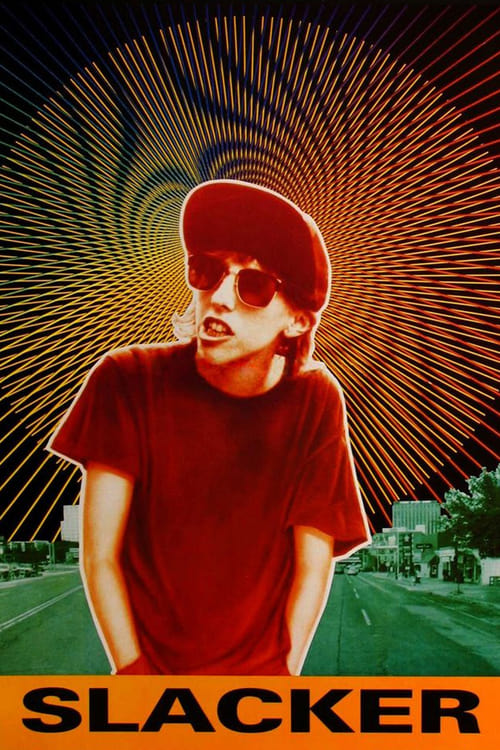
Slacker
1990 · Richard Linklater
For a lazy afternoon or late night when you don't want a plot — when hanging out is the whole point and you're happy to let a movie just talk to you. Pure hangout comfort, with a philosophical aftertaste.
What it's about
One day in Austin, Texas, among the young, broke, and gloriously unambitious. There's no plot and no protagonist: the camera drifts from a backseat philosopher to a conspiracy theorist to a woman hawking a celebrity's medical specimen, handing itself off from stranger to stranger through coffee shops, sidewalks, and living rooms.
The experience
Loose, funny, and hypnotic — like wandering a college town with nowhere to be, eavesdropping on a hundred conversations that range from brilliant to unhinged. It's low-key but weirdly addictive; the drift becomes the pleasure.
The craft
Shot on 16mm for almost nothing, its relay structure — follow one person until they cross paths with the next, then defect — is a genuine formal invention that turns a hundred non-actors and monologuists into a portrait of a whole town. The looseness is deceptive; the handoffs are choreographed like a dance.
Why it matters
A founding document of the 1990s American independent film boom, it named a generation — the word entered the dictionary — and launched Richard Linklater's lifelong project of making movies out of talk, time, and drift.
Snapshot
Slacker is Richard Linklater's first widely seen feature, a plotless, ambulatory portrait of a single day among the bohemian underemployed of Austin, Texas. Shot on 16mm for a famously tiny budget, the film abandons protagonist and story in favor of a relay structure: the camera follows one character until they cross paths with another, then defects to the newcomer, threading roughly a hundred speaking parts into an unbroken daisy chain of monologues, conspiracy theories, half-formed schemes, and overheard arguments. It arrived as a defining artifact of early American independent cinema's 1990s surge, helped popularize a word the dictionary would soon adopt, and announced a filmmaker whose career-long preoccupations — time, talk, drift, and the texture of ordinary hours — are already fully present. More than three decades on, it remains both a period document of Reagan-era aftermath youth culture and a structurally radical experiment whose formal nerve is easy to underrate beneath its laid-back surface.
Industry & production
Slacker is one of the canonical low-budget success stories of American independent film. Linklater shot it in Austin in 1989, drawing on the loose community of friends, acquaintances, and local scenesters who populate the cast; the production is widely reported to have cost in the very low five figures, financed substantially by Linklater himself with help from a small circle of collaborators. (Specific budget figures circulate in the $23,000 range in interviews and press accounts, but precise accounting should be treated cautiously rather than as fixed fact.) Crucially, Linklater had already co-founded the Austin Film Society in 1985, an institution that screened repertory and avant-garde work and seeded the local film culture out of which Slacker grew. The film was effectively a community production: nonprofessional performers, real Austin locations, and a do-it-yourself ethos that matched its subject.
The film premiered locally and then traveled the festival and regional-theater circuit, with a successful run at Austin's Dobie Theater building word of mouth. Its decisive break came when Orion Classics picked it up for national distribution, giving the film a 1991 theatrical release that carried it well beyond Texas. That distribution deal transformed a regional curiosity into a national calling card and, on a reported budget that small, made it a model of the leveraged-debt, prove-it-yourself path into the industry that defined the era's indie mythology. Linklater's next film, Dazed and Confused (1993), was a studio-backed step up that Slacker's success made possible. The Criterion Collection later released Slacker, cementing its status as a preserved object of study rather than a disposable artifact.
Technology
Slacker was shot on 16mm film — the affordable gauge of student and independent production — rather than 35mm, a choice driven by economics that also shaped the film's grainy, immediate texture. The technological story here is less about novel equipment than about the leveraging of accessible, consumer-and-prosumer-grade tools: lightweight cameras, available light supplemented sparingly, and location sound. The production's modesty is part of its argument. Where Hollywood spectacle of 1990 leaned on expensive optical and increasingly digital effects, Slacker demonstrated that a feature of real ambition could be built from 16mm stock, a small crew, and the cooperation of a city. In retrospect the film sits at the leading edge of a wave — culminating later in the digital-video and DSLR revolutions — in which falling tooling costs democratized feature production. Slacker did not use new technology so much as prove how little technology a fully realized film required, a lesson absorbed by a generation of 1990s independents.
Technique
Cinematography
Lee Daniel served as cinematographer (a long-running collaborator who would shoot Dazed and Confused and the Before films with Linklater). The visual signature of Slacker is the long, motivated traveling shot. Because the narrative passes from character to character like a baton, the camera must physically follow that handoff: it walks down sidewalks, drifts through cafés and cluttered apartments, and pivots from a departing figure to an arriving one. The result is a fluid, observational style that prizes the unbroken take and the lateral track over coverage and the cut. The 16mm image is grainy and naturalistic, favoring available light and the unglamorous interiors of rented rooms, coffee shops, and bookstores. The camera is curious but unhurried, often holding on a speaker through a complete monologue, granting the film its documentary-adjacent texture while remaining, in its choreography, highly deliberate.
Editing
The editing — Linklater is credited as editor — follows the logic of the relay. Cuts within a given encounter are sparing; the more conspicuous structural seams are the transitions between vignettes, where the film "passes" attention from one character to the next, sometimes via a literal physical proximity (two people brushing past), sometimes via a glance or a shared space. The film's most important editorial decision is therefore architectural rather than rhythmic: the refusal to return to any character means the cut is almost always a forward defection, never a reaction shot in a sustained scene. This builds a peculiar momentum out of constant abandonment — every story is dropped just as it might develop, and the accumulation of dropped threads becomes the film's form.
Mise-en-scène / staging
The staging is built around walking and talking, and around the cluttered specificity of lived-in Austin spaces: bedrooms papered with theories and pin-ups, diners, the sidewalks of the university district. Props carry enormous weight precisely because there is no plot to carry it — the alleged Madonna pap smear, a stack of postcards, a television set, a deck of cards, a revolver. Characters are frequently surrounded by the totems of their obsessions, the mise-en-scène doing the work of characterization in the absence of backstory. Linklater stages encounters as chance collisions in public and semi-public space, emphasizing the porousness of a small city's bohemia, where everyone is one sidewalk away from everyone else.
Sound
Sound is dominated by the human voice. Slacker is a film of talk — monologue, rant, pitch, and digression — and the location-recorded dialogue is its primary material. The aural texture is dense with overlapping speech, ambient café and street noise, and the analog hum of the period (televisions, cassette decks, answering machines). Music is present but not foregrounded as a pop soundtrack in the manner of Dazed and Confused; the film's rhythm comes from speech cadence rather than scoring. The effect is of eavesdropping — the sense that the microphone has simply been left running in a city where everyone is mid-explanation.
Performance
The cast is almost entirely nonprofessional: friends, local musicians, students, and Austin personalities, with Linklater himself appearing in the opening sequence as the backseat passenger delivering a monologue on parallel realities to a silent cab driver. Because most performers are essentially playing variations on milieu types they knew firsthand, the performances trade polish for authenticity — a flatness and naturalism, occasionally an amateur's stiffness, that reads as documentary truth. The acting style is conversational and unforced; the film asks each performer to inhabit a single sustained beat rather than build an arc, and the ensemble's collective credibility, rather than any individual's range, is what carries it.
Narrative & dramatic mode
Slacker is the textbook case of the plotless, anti-dramatic feature. It has no protagonist, no central conflict, no rising action, and no resolution in the conventional sense; it substitutes a structural conceit — the baton-pass relay — for story. Its dramatic mode is closer to the mosaic, the daisy-chain, or the "hyperlink" structure later associated with films like Short Cuts or Magnolia, but more radical, because it never returns to a thread once dropped. Each vignette is a self-contained miniature, often built around a single character's verbal performance, and the film's meaning emerges cumulatively from juxtaposition rather than from causation. This refusal of dramatic convention is itself thematic: a film about people who have opted out of ambition and narrative purpose adopts a form that has likewise opted out of the machinery of plot. The closest literary analogs are the episodic urban wander and the Joycean day-in-the-city; the closest cinematic ancestors are observational documentary and the European art film's drift.
Genre & cycle
Nominally a comedy-drama, Slacker resists genre as energetically as it resists plot. It belongs less to a genre than to a cycle: the early-1990s American independent film, and more specifically the wave of regional, talk-driven, low-budget features that established "Sundance-era" indie as a recognizable category. It sits alongside the contemporaneous work of filmmakers like Jim Jarmusch (whose deadpan, episodic Stranger Than Paradise and Mystery Train are clear kindred spirits), Hal Hartley, and the early Kevin Smith, whose Clerks (1994) is often cited as a direct descendant. If it has a generic lineage, it is the "hangout film" — a mode Linklater would refine across his career — in which pleasure derives from spending time with characters rather than from watching events befall them. The film also helped crystallize a loose cultural cycle of "Generation X" cinema, becoming shorthand for a sensibility as much as a style.
Authorship & method
Slacker is a near-total authorial statement: Linklater wrote, directed, produced, edited, and appears in it, and the film's method is inseparable from his biography and his Austin film-culture infrastructure. His method here is collaborative and improvisatory within a controlled frame — many vignettes were developed with or built around the people who perform them, drawing on real obsessions and real talk, then shaped into a rigorous structural scheme. The key collaborators are cinematographer Lee Daniel, whose mobile camerawork realizes the relay conceit and who became one of Linklater's defining visual partners, and the broad ensemble of Austin participants who function as co-authors of their own scenes. There is no single credited composer-as-auteur in the manner of a scored studio film; the film's "music" is its speech. The writing is the most distinctive authorial layer — a torrent of monologue that established Linklater as a filmmaker who treats conversation as event, a commitment he would extend in Before Sunrise (1995) and its sequels and in the philosophical talk of Waking Life (2001). Slacker is best read as the foundational text of his oeuvre: the place where his fascination with time, idleness, talk, and the dignity of the unproductive hour is first fully articulated.
Movement / national cinema
The film is a cornerstone of American independent cinema's early-1990s renaissance, the movement that ran through Sundance, Miramax, and the boutique distribution arms of the majors. But it is equally an artifact of a specific regional cinema — Austin, Texas — and Linklater's role in building that scene through the Austin Film Society makes Slacker a genuinely place-based work, not merely an indie shot on location. It helped establish Austin as a credible filmmaking center outside Los Angeles and New York, a status the city's later festival and production culture (and Linklater's continued presence there) would consolidate. Within the broader national cinema, Slacker represents the decentralized, regionalist strain of American independent film, in conversation with the East Coast minimalism of Jarmusch and Hartley but rooted in a distinctly Southern, university-town bohemia.
Era / period
Slacker is profoundly of its moment: the very end of the 1980s, shot in 1989 and released into 1990–91, at the hinge between the Reagan-Bush era and the cultural arrival of what would be labeled Generation X. Its characters are the educated, underemployed children of a recession-shadowed economy, marinating in conspiracy theory, pop-culture detritus, leftover countercultural politics, and a pervasive sense of belatedness — the feeling of having arrived after the parties, movements, and certainties of earlier decades had ended. The film predates the internet's mainstreaming, and its information ecology is analog: photocopied zines, late-night cable, paperbacks, and the spoken rumor. It captures, with unusual precision, the specific texture of early-1990s downward-mobile youth culture just before grunge and "slacker" became marketed identities, which makes it both a primary source and, soon after, an unwitting brand.
Themes
The film's central theme is the refusal of conventional ambition — a deliberate, almost philosophical idleness framed not simply as failure but as a stance, a way of reclaiming time from the demands of productivity. Linklater treats his unemployed dreamers, cranks, and theorists with affection rather than condescension, finding in their digressions a genuine intellectual and imaginative life. Closely related is the theme of paranoia and conspiracy: the film is saturated with characters who have constructed elaborate explanatory systems — about JFK, about the moon landing, about media control — a portrait of minds with too much time and too little institutional faith. Other recurrent concerns include the porousness of reality and dream (the opening monologue on alternate timelines sets the key), the commodification of experience and celebrity (the Madonna pap-smear vignette), and the texture of time itself as lived, unstructured duration. Above all, the film proposes that meaning resides in talk, obsession, and the ordinary encounter rather than in achievement — a quietly radical revaluation of what a life, and a movie, can be about.
Reception, canon & influence
Slacker drew strong critical attention upon its national release, widely praised as a fresh, formally daring, and culturally acute debut, and it became one of the breakout indie successes of its moment. Its title entered the broader lexicon, frequently credited with popularizing "slacker" as a generational label — though the film's own portrait is more affectionate and specific than the lazy stereotype the word came to carry, an irony Linklater himself has noted. The film's canonization is secure: its inclusion in the Criterion Collection and its standing in histories of American independent cinema mark it as a foundational text of the 1990s indie wave.
Looking backward, the influences ON the film are legible: the observational and direct-cinema documentary tradition; the episodic, deadpan minimalism of Jim Jarmusch; the European art-film tradition of urban drift and digression (the Joycean, Rohmer-ish, and Nouvelle Vague lineage of talk and walking); and the specific countercultural and conspiratorial print culture of its milieu. Looking forward, Slacker's legacy is large relative to its scale. It is routinely cited as a key enabler of the early-1990s independent boom and a direct inspiration for Kevin Smith's Clerks and the broader cycle of talky, low-budget, character-driven debuts. Within Linklater's own career it is the seed text for everything from Dazed and Confused and the Before trilogy to the rotoscoped philosophical wandering of Waking Life. More diffusely, it helped legitimize the "hangout" and mosaic structures in American film and offered a durable proof of concept — that a feature could be made on almost nothing, in your own city, with your own friends, and still alter the course of a national cinema. The precise figures and first-person details of its making should be cited with care, as accounts vary, but the film's importance as both period document and structural experiment is not in dispute.
A Deleuzian reading
A young man rides in the back of a cab and won't stop talking.
The full Deleuzian reading of Slacker →
Reception
It crept out of Austin in 1990 as a $23,000 curiosity, then became a founding text of the '90s American indie boom and a Gen X touchstone — by 2012 it was in the National Film Registry, its shagginess fully canonized.
How Slacker was received, from release to now →
Influences: the films it descends from and the films it influenced
- La Ronde (1950) — Pioneers the baton-relay structure Slacker adopts wholesale — the narrative hands off from one character to the next as they brush past each other, the camera abandoning its current subject to chase whoever exits the frame.
- The Phantom of Liberty (1974) — Perfects 'forward-defection' editing: a scene follows a character only until a more interesting passerby appears, then defects to them, dissolving plot into a chain of digressions exactly as Slacker's vignettes do.
- Breathless (1960) — Establishes the handheld walking-and-talking aesthetic on real city streets with nonprofessional energy and available light that Lee Daniel's mobile 16mm camerawork directly extends.
- My Night at Maud's (1969) — Treats sustained philosophical conversation as the film's central event rather than connective tissue — the Rohmerian conviction that talk IS action that underwrites Slacker's torrent of monologue.
- Stranger Than Paradise (1984) — Proves the deadpan, episodic minimalism of low-budget American indie — long static-to-mobile takes, nonprofessional performers, dead time as content — the immediate model for Slacker's hangout drift.
- Nashville (1975) — Demonstrates the mosaic-ensemble method where dozens of loosely linked characters share a city and overlapping speech replaces a central plot, the macro-structure Slacker miniaturizes into Austin.
- Chelsea Girls (1966) — Models the use of real subjects performing versions of themselves in real time, scenes built around the participants' own obsessions rather than scripted character — Slacker's co-authorship of vignettes by their performers.
- Down by Law (1986) — Linklater takes Down by Law's episodic, non-protagonist structure as a generative formal principle: the film passes narrative custody from character to character with no controlling thread, each encounter complete in itself, the long-take duration respecting the full texture of conversation and digression rather than editing toward compressed meaning.
- Stranger Than Paradise (1983) — Converts STP's 'nothing happening' into a structuring principle — a plotless hang-out architecture of drift and overheard talk where narrative momentum is deliberately withheld.
- Masculin Féminin (1966) — Extends the essayistic-paratactic drift through café-and-street monologuing youth, using semi-improvised naturalism and overheard ideology-versus-pop talk as structure.
- Repo Man (1984) — Literalizes Repo Man's philosophizing-drifter monologues and 'lattice of coincidence' into a whole structure of chained, aimless encounters.
- Dazed and Confused (1993) — Extends Slacker's plotless, time-bound ensemble drift across a single day, scaling the hangout-film structure and lived-in-spaces staging into a period setting.
- Clerks (1994) — The most direct heir — a dialogue-driven, single-location, no-budget debut that took Slacker as explicit proof of concept that talk among nonprofessionals could carry a feature.
- Before Sunrise (1995) — Distills Slacker's walking-camera-following-conversation into a two-hander, the relay of strangers narrowed to a single sustained dialogue traversing a city on foot.
- Waking Life (2001) — Revives Slacker's exact relay-of-talkers architecture — a wanderer drifting between philosophizing strangers — now rotoscoped, making the monologue-as-music method the entire film.
- Go (1999) — Adopts the baton-relay narrative explicitly, restarting from a second then third character whose paths cross the first, applying Slacker's forward-defection to a propulsive crime structure.
- Funny Ha Ha (2002) — Founds mumblecore on Slacker's terms — 16mm, nonprofessional actors playing near-versions of themselves, halting naturalistic talk, and aimless Gen-X drift as the whole subject.
- Nouvelle Vague (2025) — Establishes his loose ensemble sociability and drifting, plotless attention to a scene's milieu — the observational texture brought to the Cahiers circle.
- Pulp Fiction (1994) — Linklater's film of unconnected conversations — philosophy, pop culture, and conspiracy theory treated as drama without imposed action — modeled the American independent idiom in which Tarantino's characters can discuss Big Macs and foot massages at feature length before any violence occurs.
- 101 Reykjavik (2000) — Codifies the arrested-development slacker as a legitimate cinematic subject and the episodic, plot-resistant drift structure that 101's seasonal episodes inherit.
- Napoleon Dynamite (2004) — Episodic, plot-refusing structure rooted in a specific regional milieu, validating the Sundance anti-plot character-drift Napoleon runs on.
- Before Sunset (2004) — Linklater's own roving, dialogue-driven long takes that follow characters through a city establish the ambulatory talk-cinema grammar he refines into the Before method.
- Güeros (2014) — Plotless, ambulatory structure where the camera wanders from one aimless talker to the next — the drifting, quest-without-a-goal architecture underlying Güeros's episodic day.
- Mystery Train (1989) — Builds a feature from interlocking strangers passing through the same locale, sharing Slacker's portmanteau-of-eccentrics logic where geography, not protagonist, holds the film together.
- Magnolia (1999) — Carries the hyperlink-mosaic of strangers connected by coincidence and place into studio scale, sharing Slacker's faith that a web of loosely tied lives can substitute for a single plot.
- Coffee and Cigarettes (2003) — Strings together standalone conversation vignettes among real personalities with no overarching plot, the deadpan dialogue-as-event format running parallel to Slacker's.
- Short Cuts (1993) — Linklater independently developed no-protagonist network narrative by using a relay structure — the camera hands off to a new character at each scene's end — as an alternative formal solution to associative intercutting, arriving at the same no-catharsis, diffuse-ensemble territory contemporaneously with Altman.
- Night on Earth (1991) — The baton-pass long take, where the camera abandons one conversation mid-sentence to follow a passing stranger into the next, arrives at the same proposition from the opposite direction: talk as substance and the city as a field of unconnected encounters, chained spatially where Jarmusch chains temporally.
Similar films
- Dazed and Confused (1993) — influence & lineage
- Waking Life (2001) — influence & lineage
- Before Sunrise (1995) — influence & lineage
- Nouvelle Vague (2025) — influence & lineage
- Nashville (1975) — influence & lineage
- Stranger Than Paradise (1984) — influence & lineage
- The Phantom of Liberty (1974) — influence & lineage
- Boyhood (2014) — shared sensibility
All the films related to Slacker →