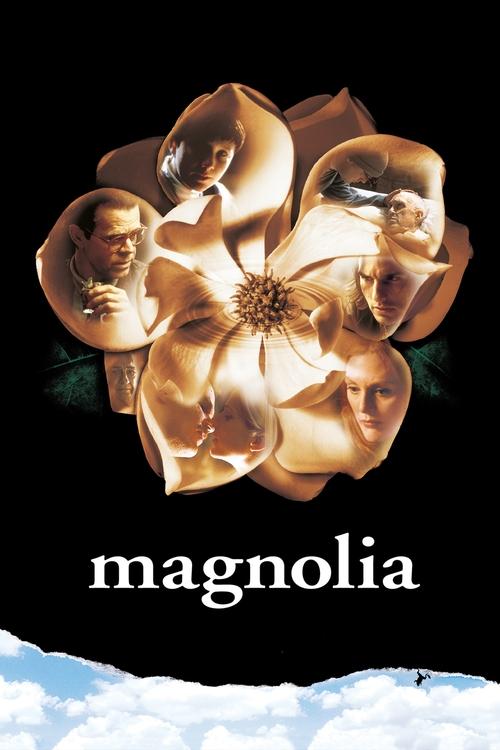
Magnolia
1999 · Paul Thomas Anderson
The critics' consensus "greatest living American director" finally made a commercial-scale film with One Battle After Another, instantly triggering debates about its politics, its reported $130M+ budget, and whether the best-reviewed film of 2025 could actually win Best Picture. PTA fandom is a Letterboxd personality type.
For a night when you want to be wrecked in the best way — a big, heart-on-sleeve epic to give a whole evening to and then talk about for days. This is challenge-and-catharsis viewing, not background comfort.
What it's about
Over one day in the San Fernando Valley, around nine lives tangle together: a dying television producer and his guilt-wracked young wife, the male nurse caring for him, an estranged son who's reinvented himself as a swaggering self-help guru, a quiz-show host with his own reckoning coming, a former child prodigy gone to seed, a current one buckling under pressure, and a lonely cop who falls for a woman in crisis. It's a mosaic about fathers and children, regret, and whether it's ever too late to be forgiven.
The experience
Three hours that feel operatic rather than long — it surges on waves of music and coincidence, swinging from raw confessional scenes to moments of almost giddy audacity. It's emotionally maximalist: it wants to overwhelm you, and by the end it usually has.
Performances
Tom Cruise, cast against type as the misogynist guru Frank T.J. Mackey, gives one of the most electric performances of his career — all bravado until the mask cracks. Around him, Philip Seymour Hoffman, Julianne Moore, John C. Reilly, and Jason Robards make the ensemble hum; there isn't a weak link in it.
The craft
Paul Thomas Anderson directs like a man betting everything: restless camera moves, bravura long takes, and an editing rhythm that keeps nine storylines aloft at once. Aimee Mann's songs aren't decoration — they're the film's connective tissue, at one point binding every character into a single moment. Great speakers matter here as much as a big screen.
Why it matters
It confirmed Anderson, not yet thirty, as one of the defining American filmmakers of his generation, and it stands as a peak of the late-'90s wave of sprawling, interlocking ensemble dramas.
Snapshot
Magnolia is Paul Thomas Anderson's third feature, a three-hour ensemble drama that braids roughly nine principal characters across a single day in the San Fernando Valley into a study of damaged fathers, abandoned children, chance, and the possibility of grace. Made immediately after the success of Boogie Nights (1997) — and largely because that success gave Anderson rare creative latitude — it is an unapologetically maximalist film: operatic in scale, confessional in tone, structured around coincidence and culminating in a now-famous biblical rain of frogs. It distilled a late-1990s American art-cinema sensibility (the sprawling, multi-strand "hyperlink" drama; the auteur's emotional sincerity against irony) into one of its defining statements, and it cemented Anderson, then not yet thirty, as a major figure of his generation.
Industry & production
Magnolia was produced through New Line Cinema, the studio that had backed Boogie Nights, and distributed by New Line. The widely repeated account of the production is that Boogie Nights's reception bought Anderson an unusual degree of freedom — final cut and a long running time among the concessions — and that he conceived Magnolia initially as a smaller, more intimate film before it expanded into the three-hour ensemble. Anderson has said in interviews that he wrote quickly and that the songs of Aimee Mann were generative to the screenplay rather than merely decorative; he has described building scenes and even dialogue around her music, an unusual inversion of the usual scoring-after-the-fact process.
The cast assembled established collaborators and new ones. Tom Cruise, then among the largest stars in the world, took the supporting role of the misogynist self-help guru Frank T.J. Mackey — a piece of against-type casting that lent the film both commercial visibility and critical surprise. Anderson's informal stock company is visible throughout: Julianne Moore, Philip Baker Hall, William H. Macy, and Philip Seymour Hoffman all carried over from Boogie Nights, with John C. Reilly likewise a recurring presence. Jason Robards, in one of his final screen roles, played the dying patriarch Earl Partridge. Production took place in and around the Valley, the working-class Los Angeles geography that Anderson treats as his native territory across his early films. Precise budget and box-office figures vary by source and I won't assert specific numbers here; the film is generally understood to have been a modest commercial performer relative to its ambition, with its cultural standing resting on critical reception and awards attention rather than ticket sales.
Technology
Magnolia was shot photochemically on 35mm and finished for conventional theatrical projection; it predates the digital-intermediate workflows that would soon become standard. Its technological signature lies less in novel equipment than in the rigorous, motivated use of established tools: extended Steadicam and dolly work, long lenses and wide compositions deployed deliberately, and a sound design and music mix that the film leans on heavily. The single most discussed "effect," the climactic fall of frogs, was achieved through a combination of practical and visual-effects techniques rather than as a digital spectacle set piece; the film treats it as a sincere narrative event, not a showcase for technology. In an industry moment increasingly oriented toward digital production, Magnolia is notable for being resolutely a film of analog craft scaled up to epic length.
Technique
Cinematography
Robert Elswit, Anderson's principal cinematographer through this period, shot Magnolia in anamorphic widescreen. The visual grammar is muscular and mobile: long tracking and Steadicam shots that thread through interiors and corridors, whip pans, and a restless camera that mirrors the film's emotional pressure. The Valley light — flat daytime sun, the sodium glow of night, fluorescent institutional interiors — is rendered without prettification, grounding the melodrama in a recognizable, unglamorous Los Angeles. Elswit and Anderson favor compositions that hold actors in sustained, unbroken takes, allowing performances to build without the relief of cutting. The camera's propulsive movement is one of the film's chief means of binding its disparate stories into a single rhythmic body.
Editing
Edited by Dion Beebe's contemporary Dylan Tichenor — Anderson's regular editor of the period — the film's central formal problem is the management of nine concurrent storylines across roughly three hours. Tichenor and Anderson use cross-cutting not merely to alternate threads but to rhyme them emotionally, cutting on gesture, on weather, on parallel crises so that separate lives seem to pulse in time. The most celebrated editorial gambit is the sequence in which the cross-cut characters, each alone, begin to sing along to Aimee Mann's "Wise Up" — a moment of frank artifice that uses cutting to assert spiritual simultaneity across the whole ensemble. The film's tempo accelerates toward its apocalyptic climax, the editing tightening as the rain of frogs falls across every storyline at once.
Mise-en-scène / staging
Anderson stages Magnolia as a series of pressurized rooms — the dying man's bedroom, the studio of a game show, a child's bedroom, a stranger's apartment, a police cruiser's interior — each a chamber of confession or breakdown. The Valley's domestic and institutional spaces are dressed with a lived-in specificity. Staging is frequently built around the long take, with actors moving through space in choreographed relation to the camera, so that blocking and camera movement become a single expressive unit. The recurring motif of "82," and the film's framing prologue of supposedly true coincidences, establish a designed universe in which patterning and chance are themselves part of the production design's logic.
Sound
Sound is foundational rather than supplementary. Aimee Mann's songs function almost as a connective tissue and at times as narration; Jon Brion's score weaves around them, building swells that carry the melodrama's emotional escalation. The mix layers overlapping dialogue, television and radio sound from the game-show world, ambient Valley noise, and music into a dense, immersive field. The film's willingness to let a pop song stop the narrative — most strikingly in "Wise Up" — treats sound as a structuring principle on equal footing with image and cutting.
Performance
Performances are pitched at a high, raw register that the film earns through sustained takes and confessional writing. Tom Cruise's Frank Mackey — strutting bravado collapsing into grief at his father's deathbed — is the film's most discussed turn and drew significant awards attention. Julianne Moore plays the trophy wife unraveling under guilt at register of near-hysteria; Philip Seymour Hoffman gives the deathbed nurse a quiet tenderness that anchors the film's gentler emotional current; William H. Macy's "Quiz Kid" Donnie Smith embodies arrested promise; Melora Walters and John C. Reilly play two of the film's loneliest, most fragile figures; Jason Robards delivers a wrenching deathbed monologue. The ensemble's coordinated intensity is the film's principal achievement of performance.
Narrative & dramatic mode
Magnolia is a mosaic or "network" narrative: multiple protagonists whose stories proceed in parallel and connect through theme, coincidence, and a few shared bloodlines rather than a single causal plot. It belongs to the lineage of the ensemble city-symphony drama — most directly Robert Altman's Short Cuts (1993) and Nashville (1975) — but Anderson departs from Altman's cooler, ironic detachment toward open emotional sincerity. The film is explicitly framed as a meditation on chance and design: a prologue narrates several "true" coincidences and poses the question of whether such events are mere chance or something meant. The dramatic mode is melodrama in the fullest sense — heightened emotion, confession, last-minute reckonings — pursued without apology and pushed, in the frog sequence, into the frankly metaphysical. Its governing structural unit is the single day, the compressed time frame intensifying the sense that many lives are converging toward one reckoning.
Genre & cycle
The film sits at the intersection of the American independent-minded ensemble drama and the melodrama of family and inheritance. It participates in a late-1990s cycle of multi-strand "hyperlink" films — works that interlace many characters' fates to suggest a hidden order — alongside such films as Short Cuts and the slightly later wave of interwoven dramas. It is also part of Anderson's own early Valley cycle, sharing geography, repertory cast, and thematic preoccupations with Boogie Nights and Hard Eight. Generically it resists tidy classification, fusing social realism, melodrama, and a strain of the visionary or biblical that surfaces in its plague imagery.
Authorship & method
Magnolia is among the strongest statements of Anderson's auteurism: he wrote and directed it, and its scale, sincerity, and formal bravura are signatures that recur across his work. His method here is collaborative within a settled team. Robert Elswit (cinematography) gave the film its mobile, anamorphic look. Dylan Tichenor (editing) solved its structural puzzle of concurrent stories. Jon Brion (score) and, crucially, Aimee Mann (songs) supplied the musical architecture; Anderson's account of writing toward Mann's songs makes her something closer to a creative source than a contributor. The repertory cast — Moore, Hoffman, Hall, Macy, Reilly, Walters — functions as part of the authorship, a company of actors Anderson knew and wrote for. The film is frequently read in relation to Anderson's biography, particularly its preoccupation with dying fathers and wounded sons, though Anderson has been measured about autobiographical readings and I won't overstate the connection beyond what he has acknowledged in interviews. Robert Altman is the most openly avowed influence on Anderson's ensemble method, an admiration Anderson has repeatedly expressed.
Movement / national cinema
The film belongs to American cinema's late-1990s auteur renaissance — the moment when a cohort of young directors (Anderson, Wes Anderson, David O. Russell, Spike Jonze, Sofia Coppola, among others) emerged with strong personal styles, often through specialty and studio-affiliated independent channels. It is a product of the New Hollywood lineage filtered through the indie sensibility of the 1990s, drawing on the 1970s ensemble cinema of Altman while addressing a contemporary, confessional emotional culture. As national cinema it is deeply Californian, rooted in the specific social texture of the San Fernando Valley.
Era / period
Released in December 1999, Magnolia is an end-of-millennium film, and its apocalyptic register — biblical plague, reckonings, the sense of accounts coming due — reads naturally against the cultural anxiety of the turn of the century. It arrived at the high-water mark of the American independent and auteur boom that preceded the industry's tilt toward franchises and digital production in the following decade. Its three-hour length and final-cut latitude reflect a brief window in which a young director's prestige could command such scale at a studio.
Themes
The film's central theme is the inheritance of pain between parents and children, particularly fathers and their abandoned sons and daughters — Earl and Frank, Jimmy Gator and Claudia, the exploitation of child prodigies past and present. Around this it organizes a cluster of preoccupations: chance versus design, and whether coincidence carries meaning; confession, forgiveness, and the longing for grace; the corrosive legacy of secrets and abuse; loneliness and the desperate reach for connection. Its recurring biblical reference — the allusion to Exodus 8:2 and the falling frogs — frames human suffering within a register of judgment and the possibility of deliverance. The film insists, against irony, that emotional sincerity and the desire to be forgiven are worthy of operatic treatment. Its oft-quoted line — that we may be through with the past, but the past is not through with us — names the theme directly.
Reception, canon & influence
Magnolia was a critical event on release, dividing some viewers by its length and emotional extremity while drawing strong admiration for its ambition and performances. Tom Cruise's supporting turn was singled out and earned significant awards recognition, including an Academy Award nomination; Aimee Mann's song "Save Me" was likewise Oscar-nominated, and the film competed for the Golden Bear at the Berlin International Film Festival, where it was well received. (I'm describing the broad shape of its awards profile; for an exhaustive ledger one should consult the formal record.)
Influences on the film (backward): Robert Altman's ensemble dramas, above all Short Cuts and Nashville, are the acknowledged structural model. The melodramatic tradition — and a strain of sincere, large-canvas American storytelling — informs its emotional pitch. Aimee Mann's songwriting, by Anderson's own account, shaped the screenplay's themes and even its dialogue. The film's biblical and apocalyptic imagery draws on a long cultural lexicon of plague and judgment.
Legacy (forward): Magnolia helped canonize the multi-strand, emotionally sincere ensemble film for a generation, and stands as a touchstone for the "everything connects" network narratives that proliferated in the 2000s. Within Anderson's own career it marks the apex of his early maximalist, Altman-inflected mode; his subsequent films (beginning with Punch-Drunk Love) moved toward greater compression, but the concern with fathers, sons, performance, and American striving persisted. The film is now widely regarded as a landmark of late-1990s American cinema and a defining work of its director, durably present on critics' and filmmakers' lists of the period's most significant films. Its set pieces — the "Wise Up" singalong and the rain of frogs — remain among the most cited sequences in modern American film, emblematic of a cinema willing to risk total sincerity.
A Deleuzian reading
Start with the windshield.
The full Deleuzian reading of Magnolia →
Reception
Divisive on release in 1999 — some found its three-hour, frog-raining sincerity overwhelming, others transcendent — but it won the Golden Bear at Berlin and has since hardened into a beloved PTA cornerstone and a cornerstone of earnest-maximalist '90s cinema.
How Magnolia was received, from release to now →
Influences: the films it descends from and the films it influenced
- Nashville (1975) — Altman's overlapping-ensemble mosaic — dozens of characters cross-cut over a single locale and timeframe, climaxing in a communal musical-public event — is the structural template PTA openly adopts for Magnolia's interwoven LA stories.
- Short Cuts (1993) — Its braiding of separate Raymond Carver stories into one cross-cut Los Angeles ensemble, resolved by a collective natural catastrophe (the earthquake), is the direct model for Magnolia's frog-rain convergence of unconnected lives.
- Network (1976) — Paddy Chayefsky's operatic, sermon-like monologues delivered at full sincere volume by performers (Finch's prophet, Beatty's boardroom aria) prefigure Magnolia's confessional set-piece speeches — the Frank Mackey interview, the dying-father's bedside oration.
- Ordinary People (1980) — Its earnest American melodrama of guilt and unhealed father/parent–child wounds, played in long therapy-room two-handers, supplies the emotional register Magnolia amplifies in the Mackey–Earl and Stanley–Jimmy strands.
- The Magnificent Ambersons (1942) — Welles's deep-focus, narrated 'rise and fall of an American family' with a portentous omniscient prologue is echoed in Magnolia's mortality-statistics narrator framing and its theme of fathers' sins visited on sons.
- Boogie Nights (1997) — PTA's own prior film establishes the toolkit Magnolia perfects — Robert Elswit's anamorphic Steadicam long takes gliding through a surrogate-family ensemble, needle-drop scene structure, and repertory casting (Hoffman, Reilly, Moore, Macy, Hall).
- Hard Eight (1996) — Anderson's debut already centers a guilt-ridden surrogate-father and a wounded young man in long anamorphic takes — the father-and-son penance dynamic Magnolia explodes across nine strands.
- Magnolia's 'Wise Up' lineage — The Umbrellas of Cherbourg (1964) — Demy's fully sung melodrama, where characters voice interior feeling through a recurring song, anticipates Magnolia's diegetic-breaking 'Wise Up' sequence in which the whole cast sings the same Aimee Mann lyric across cross-cut spaces.
- Three Colors: Red (1994) — Directly extends Red's network-narrative convergence model: parallel non-intersecting storylines that accumulate meaning through cross-cutting and resolve in a single catastrophic/miraculous event, with the trilogy-convergence-finale as explicit structural template.
- Casino (1995) — Anderson translates Casino's retrospective voiceover chronicle and ironic music-against-disaster counterpoint into an ensemble suburban tragedy, extending the form's capacity to narrate institutional collapse through multiple simultaneous perspectives.
- M*A*S*H (1970) — Builds the Nashville-style hyperlink ensemble of interlocking lives with dense layered sound, the most explicit continuation of Altman's mosaic-of-overheard-voices architecture.
- Do the Right Thing (1989) — inherits the heightened-ensemble mosaic across one city stretch built on diegetic music-as-argument, escalating polyphony toward a single cathartic eruption.
- Punch-Drunk Love (2002) — PTA's next film inverts Magnolia's maximalism but keeps the song-driven scoring and Jon Brion soundscape, and the close-anamorphic study of a sincerely overwhelmed man, against-type casting (Sandler) in place of Cruise.
- Amores Perros (2000) — It carries forward the 'everything connects' network-narrative built around a single catastrophic event (the car crash) that fractures and links three story strands, the hyperlink-cinema mode Magnolia helped canonize.
- 21 Grams (2003) — Iñárritu and Arriaga extend Magnolia's chance-versus-design metaphysics and cross-cut convergence into fractured chronology, building grief-melodrama from strangers fatefully bound by one accident.
- Crash (2004) — A direct heir to the single-city, single-span hyperlink ensemble whose strangers collide by coincidence and confess in heightened emotional arias — Magnolia's network-melodrama template, popularized for the mid-2000s.
- Babel (2006) — Globalizes the Magnolia model — parallel cross-cut strands linked by a single chain of chance, scored as sustained emotional crescendo toward a unifying catharsis.
- Synecdoche, New York (2008) — Inherits the sprawling, sincere, mortality-haunted American maximalism and Hoffman-led ensemble of wounded strivers, pushing Magnolia's 'total sincerity' ambition toward metaphysical scale.
- Take Shelter (2011) — Builds dread toward an apocalyptic weather event read as biblical judgment over a family's fate — the same fusion of domestic melodrama and Old Testament catastrophe Magnolia stakes on its rain of frogs.
- Licorice Pizza (2021) — PTA's San Fernando Valley return keeps the source-song-driven structure, anamorphic Valley geography, and roaming long-take ensemble that Magnolia codified as his authorial signature.
- Warrior (2011) — Anderson's construction of multiple simultaneous family-trauma narrative strands — each maintaining character depth while converging on a shared cathartic endpoint — and his structural use of a single licensed song ('Wise Up') to briefly suspend narrative for emotional reckoning directly anticipate Warrior's three-strand architecture and its deployment of the National's 'About Today.'
- Intacto (2001) — Elevates coincidence to a governing cosmic force through cross-cut ensemble convergence, the Borgesian 'invisible system runs everything' conceit dramatized via editing.
- Intermission (2003) — Refines the network-narrative into a clockwork of coincidence and emotional rhyme across parallel lives, the design Intermission compresses into a leaner comic register.
- Survive Style 5+ (2004) — Model for binding several unrelated ensemble strands under one shared thematic question (here, 'what is your purpose?') so the interweave pays off emotionally, not just structurally.
- Code Unknown (2000) — A near-contemporary network narrative of intersecting strangers in a single city, sharing Magnolia's hyperlink architecture of chance collisions though stripped of its melodramatic warmth.
- Traffic (2000) — Released within months, it deploys the same multi-strand cross-cut hyperlink structure and ensemble convergence, color-coding parallel stories the way Magnolia time-codes its single-day braid.
- The Green Mile (1999) — Released the same year, Anderson's film similarly employs an episodic-serial-structure derived from interlocking novelistic source material, literary-pacing with extended scene duration that refuses conventional three-act compression, and a supernatural-realism register resolved through biblical intervention—making both films a 1999 argument for the Hollywood epic as the proper container for novelistic ambition.
- Pulp Fiction (1994) — Anderson's nine-character Los Angeles ensemble uses wall-to-wall Aimee Mann compilation songs as emotional counterpoint across interlocking storylines, extending Tarantino's compilation-soundtrack-as-architecture device into an operatic register while adopting the same non-linear multi-strand construction.
- Jerry Maguire (1996) — Weaponizes Tom Cruise's meta-stardom — Frank T.J. Mackey is the dark mirror of the slick, sincerity-selling alpha persona Jerry Maguire foregrounded and softened.
- Slacker (1990) — Carries the hyperlink-mosaic of strangers connected by coincidence and place into studio scale, sharing Slacker's faith that a web of loosely tied lives can substitute for a single plot.
- American Beauty (1999) — Contemporary in its converging-plotlines architecture and its scored, operatic treatment of dread and revelation among damaged suburban lives.
- The Cooler (2003) — Shares the structured magical-realist fable logic where chance and coincidence are dramatized as cosmic forces — the conceit that luck obeys a narrative law, made literal as Bernie's contagious bad fortune.
- Happiness (1998) — Near-simultaneous network-mosaic of cross-cut San Fernando Valley despair, sharing both the braided-ensemble structure and Philip Seymour Hoffman's register of abject loneliness.
- Runaway Jury (2003) — Robert Elswit's disciplined, controlled-contrast photography organizing dense multi-strand intercutting — the same cinematographer's hand that 'elevates the look' of Runaway Jury per the dossier.
- Vanilla Sky (2001) — Cruise deliberately cast against type to interrogate his own celebrity — the same star-deconstruction strategy Vanilla Sky pursues, mounted concurrently.
- Go (1999) — Same-year mosaic of intersecting lives compressed into roughly a day, building momentum through cross-cut parallel strands scored to a continuous, mood-setting song-driven pulse.
Similar films
- Nashville (1975) — influence & lineage · often watched together
- Boogie Nights (1997) — influence & lineage
- Short Cuts (1993) — influence & lineage
- Synecdoche, New York (2008) — influence & lineage
- Punch-Drunk Love (2002) — influence & lineage
- Vanilla Sky (2001) — often watched together
- Jerry Maguire (1996) — often watched together
- The Big Lebowski (1998) — often watched together
All the films related to Magnolia →