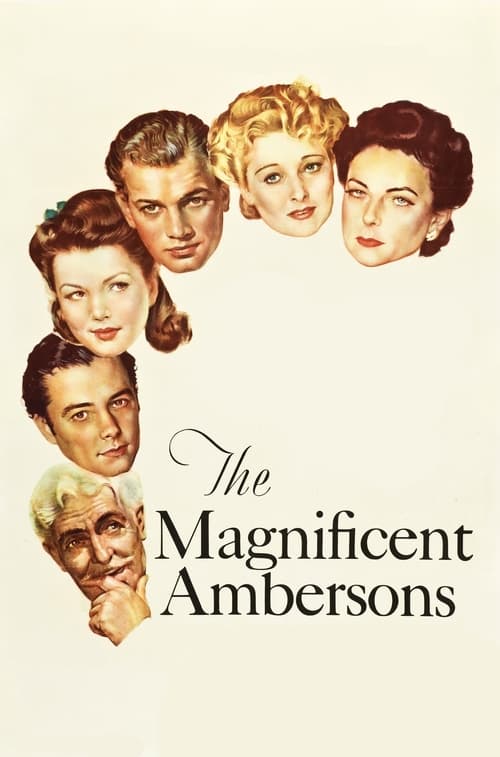
The Magnificent Ambersons
1942 · Orson Welles
For a contemplative evening when you want something autumnal — a family saga about pride, regret, and the way progress steamrolls the people who can't adapt. A film for when you're in the mood to feel time passing.
What it's about
The Ambersons are the grandest family in a midwestern town, and George, the spoiled only heir, intends to keep the world exactly as it flatters him. When his widowed mother rekindles a romance with Eugene Morgan — a kind, self-made automobile inventor she loved before her marriage — George sets himself against it with a willfulness that endangers everyone's happiness. Around them, the automobile age is arriving, and the family's gilded world is quietly running out of time.
The experience
Melancholy, wry, and gorgeous — a film about people who can't see their own era ending, told with a narrator's rueful tenderness. It's absorbing rather than slow, and its sadness sneaks up on you; the famous truncated ending leaves a genuine ache.
Performances
Agnes Moorehead is devastating as Aunt Fanny, a woman whose loneliness keeps breaking through her composure — her breakdown scenes are among the most raw acting of the era. Joseph Cotten brings warm, wounded dignity to Eugene, and Tim Holt makes George infuriating without ever tipping into caricature.
The craft
Orson Welles's follow-up to his debut is, scene for scene, even more daring: long unbroken takes that drift through a winter ball, deep-focus compositions where whole relationships play out in a single frame, overlapping dialogue that makes gossip feel alive. The studio cut nearly an hour and destroyed the footage while Welles was away, so what survives is a wounded masterpiece — which somehow suits a film about irreversible loss.
Why it matters
Cinema's most famous cautionary tale of studio interference — the mutilated second film that shadowed Welles's whole career — yet still ranked among the greatest American films ever made, even in its truncated form.
Snapshot
Orson Welles's second feature is, by his own account and by a growing critical consensus, his greatest film — and one of the great truncated masterpieces in cinema history. Adapted from Booth Tarkington's 1918 Pulitzer Prize-winning novel, it follows the Amberson family of a midwestern city through the gilded twilight of the nineteenth century and into the disorienting modern age, centering on the willful young heir George Amberson Minafer and his ruinous opposition to his widowed mother Isabel's relationship with the automobile inventor Eugene Morgan. What survives is approximately 88 minutes of what Welles cut as a film of roughly 132 minutes; the excised footage was destroyed by RKO after the studio seized editorial control during Welles's absence. The mutilation is irreversible. What remains is still, in its surviving form, formally audacious, emotionally devastating, and historically pivotal — a film that absorbed everything Welles had learned on Citizen Kane and pushed it toward greater interiority, longer breath, and darker grief.
Industry & production
The Magnificent Ambersons was produced by Welles's Mercury Productions for RKO Radio Pictures under the same contract that had yielded Citizen Kane — an unusually permissive arrangement by Hollywood studio standards that granted Welles substantial creative control. Preproduction began in late 1941; principal photography ran from late October 1941 into January 1942. Welles had selected Tarkington's novel years earlier, drawn to its portrait of provincial aristocracy undone by modernization. The Mercury Theatre ensemble — Joseph Cotten, Agnes Moorehead, Ray Collins, Erskine Sanford, and others — provided the core cast, supplemented by Hollywood actors including Dolores Costello, Anne Baxter, and Tim Holt.
Welles departed for Brazil in February 1942, before post-production was complete, to begin work on It's All True, a Good Neighbor Policy documentary commissioned at the urging of Nelson Rockefeller and coordinated through the Office of the Coordinator of Inter-American Affairs. Editorial authority over Ambersons passed to editor Robert Wise, who communicated with Welles by telegram and telephone but ultimately answered to studio executives. A preview screening in Pomona, California, drew poor audience response cards. RKO, alarmed by the film's length and somber register, ordered cuts and the addition of a more upbeat ending, discarding Welles's harsher conclusion. The trimmed film was released as a B-feature co-billed with Mexican Spitfire Sees a Ghost. After RKO was sold to Howard Hughes in 1948, the studio dissolved the excised negative footage to reclaim the silver from the film stock. The original 132-minute cut of The Magnificent Ambersons is permanently lost.
Technology
Welles and cinematographer Stanley Cortez made extensive use of the deep-focus techniques that Gregg Toland had developed for Citizen Kane, but Cortez's approach was markedly different in temperament: where Toland's deep focus tended toward analytical clarity and wide-angle spatial mapping, Cortez was drawn to a richer, more romantic chiaroscuro. The film employed wide-angle lenses to maintain front-to-back focus in interior scenes, allowing characters to occupy different planes of a frame without optical separation. Several sequences were filmed in genuinely cramped practical locations, requiring elaborate coordination of camera and actors within limited space. Welles reportedly used mirrors in certain crowd scenes — including the Amberson ball — to suggest a larger gathering than the production budget allowed, though documentation of the exact techniques is not exhaustive in the surviving record. The film's use of ceilinged sets, established at Kane, continued here, reinforcing the sense of a domestic world closing in on its inhabitants.
Technique
Cinematography
Cortez's lighting is the film's most immediately recognizable quality. Where Toland favored high contrast with a certain graphic sharpness, Cortez worked with softer gradients and a more painterly sense of shadow — the Amberson mansion is a place of beauty slowly consuming itself, and Cortez photographs it accordingly. The famous staircase sequences derive much of their power from his handling of depth: characters on different landings exist simultaneously in a single unbroken composition, their physical separation mirroring their emotional distances. The ballroom sequence is photographed with a fluid mobility that conveys the warmth and ceremony of the old world before the cold static frames that accumulate as the family's fortunes decline.
Editing
The surviving cut is 88 minutes, and the damage done by RKO's intervention is most visible in the second half, where the film lurches across narrative time with gaps that suggest missing scenes rather than ellipsis. In the first half, the editing is among the most sophisticated of the period: the prologue's montage of period fashions and customs, accompanied by Welles's narration, establishes a temporal authority that the film gradually withdraws. Welles and Wise used extended takes and deliberately slow cutting rhythms to enforce the world's unhurried weight. Robert Wise would later describe his distress at the studio's edits; his own subsequent career as a director — The Haunting, West Side Story — suggests he absorbed more from Welles than the experience of loss.
Mise-en-scène / staging
The kitchen scene, in which Fanny Minafer (Agnes Moorehead) breaks down amid the detritus of the family's collapse, is one of the supreme examples of Welles's theatrical staging translated to film. Choreographed within a confined space, with Moorehead's disintegration occurring in long take and George (Tim Holt) moving through the frame without quite comprehending what he witnesses, the scene achieves its effect through proximity, duration, and the refusal to cut away from discomfort. Throughout the film, Welles stages scenes so that characters block or expose one another spatially, making position in the frame a direct index of power and vulnerability. His theatrical background — he directed Shakespeare for the Federal Theatre Project before turning to film — is everywhere present in the precision of his blocking.
Sound
Welles narrates the film himself, a decision that establishes an authorial presence simultaneously intimate and elegiac — the voice of a man who loved these people and knows how it ends. The narration is not omniscient in the conventional Hollywood sense; it is elegiac, retrospective, sorrowful. Overlapping dialogue, a technique Welles developed under the influence of his radio work and deployed memorably in Citizen Kane, appears throughout: conversation in the Amberson household spills and crowds, replicating the texture of real social life rather than the theatrical convention of polite sequential speech. Bernard Herrmann composed the original score, continuing the collaboration begun on Kane; the extent to which RKO's re-editing altered the use of his music in the surviving print complicates any thorough analysis of the score's original design.
Performance
Agnes Moorehead's performance as Aunt Fanny Minafer is the film's emotional anchor and one of the finest pieces of screen acting in classical Hollywood cinema. Her characterization is built from small, precise gestures — a laugh held a beat too long, a stillness that communicates everything the character cannot say — and reaches its crescendo in the kitchen scene with an unbroken intensity that remains astonishing. Tim Holt brings a petulant physicality to George that the film needs: he is beautiful and catastrophically limited, and Holt refuses to soften him. Joseph Cotten's Eugene Morgan is tender and patient in a way that renders his suffering more affecting than any outburst would. Dolores Costello, returning to the screen after years away from Hollywood, gives Isabel a devotion that reads as both genuine and, in retrospect, tragic in its objects.
Narrative & dramatic mode
Ambersons operates as a tragedy of inheritance — both literal and cultural. George Minafer inherits the Amberson pride and the Amberson certainty that the world will arrange itself to accommodate aristocratic prerogative. The film is merciless in its diagnosis of this delusion while maintaining genuine tenderness for the figure who embodies it. Welles structures the narrative in two broadly symmetrical halves: the first half establishes the world as it was, in all its warmth and ceremony; the second half chronicles its collapse. The automobile — Eugene Morgan's invention and vocation — functions as the film's central symbol: modernity as something that did not kill the old world but simply moved on, leaving it behind. The film is melancholy rather than satirical, elegiac rather than polemical, even when its sympathies are clearly with the future.
Genre & cycle
The film belongs to the American family saga melodrama, a form with deep roots in nineteenth-century fiction and significant Hollywood precedent. Its period setting connects it to a cycle of literary prestige adaptations that flourished in 1930s and 1940s Hollywood — films that used American history as a vehicle for grand emotional narratives. But Welles's formal restlessness places Ambersons at an oblique angle to its generic companions: it is far slower, more willing to dwell in discomfort, less structured by the satisfactions that classical melodrama typically provides. It bears comparison to the family chronicle films of John Ford, but Welles is less interested in communal myth than in private devastation.
Authorship & method
Welles adapted the screenplay himself from Tarkington's novel, working closely with the Mercury ensemble throughout. His method was characteristically theatrical: extended rehearsal periods, ensemble blocking, an insistence that actors inhabit a scene's full duration rather than performing for the cut. Stanley Cortez, whose background included work in low-budget independent productions, brought technical ingenuity to formal ambitions that would have strained a more conventional Hollywood cinematographer. Bernard Herrmann's compositional intelligence — his gift for musical structures that imply rather than state — was well-matched to Welles's directorial emphasis on suppression and delay. The Mercury ensemble's deep familiarity with Welles's methods, cultivated through radio and theater, allowed a collaborative shorthand that is visible in the confidence of the ensemble scenes.
Movement / national cinema
The Magnificent Ambersons belongs to classical Hollywood cinema in its studio infrastructure and period sensibility, but it stands at a critical point of stress within that tradition — a film that absorbed European art cinema's formal lessons (expressionist lighting, extended takes, compositional complexity derived from theatrical staging) and applied them to American materials. Welles was always a transatlantic intelligence, steeped in European modernism as much as in American popular culture, and Ambersons reflects that dual formation. It is also, in subject, an explicitly American film: its central concern is the class formation specific to the midwestern industrial gilded age, the peculiar American experience of aristocracy without aristocratic tradition, built in a generation and lost in a generation.
Era / period
The film was released in July 1942, six months after Pearl Harbor. Its commercial failure has often been partly attributed to wartime audiences' resistance to a slow, dark, elegiac film about an old family's decline. RKO's instinct that the film needed to be lighter and shorter was commercially intelligible even if it was artistically catastrophic. Ambersons arrived at the height of the classical studio system's formal confidence, just as that system was absorbing pressures — economic, demographic, aesthetic — that would transform it over the following decade.
Themes
The film's dominant themes are decline, inheritance, and the irreversibility of change. George Minafer is not simply a villain but a figure of tragic limitation: he cannot conceive of a world beyond his own entitlement, and his eventual suffering, though earned, is rendered with something close to compassion. The automobile as modernizing force is treated with genuine complexity — Eugene Morgan's passion for his invention is sympathetic, and the film does not sentimentalize the old world it depicts. Time and memory operate as formal principles as well as thematic ones: the narration establishes a retrospective vantage from which everything is already lost, and the film proceeds under the shadow of that foreknowledge. The domestic space — the Amberson mansion — functions as an almost biological organism, alive with the family's history and gradually dying with it.
Reception, canon & influence
The film was a critical and commercial failure at its 1942 release. Its truncation and double-billing as a programmer positioned it outside the terms in which a major prestige film might have been received. Over subsequent decades, critical reassessment transformed its reputation entirely. By the time of the major retrospective surveys of the mid-twentieth century, Ambersons was established as one of the central works of American cinema. Welles himself stated on multiple occasions that he considered it superior to Citizen Kane — a claim difficult to adjudicate given the incompleteness of the surviving text, but consistent with the film's greater emotional ambition.
Backward influences: Tarkington's novel supplies not only the story but the tone of fond, rueful retrospect. The German Expressionist tradition — UFA lighting, the authority of shadow — inflects Cortez's cinematography. Erich von Stroheim's Greed (1924), another American truncated masterpiece about excess and ruin, stands as a formal antecedent in its ambition and its fate. Welles's own radio work, particularly his Mercury Theatre broadcasts, supplied the techniques of overlapping dialogue and narrator-as-character that structure the film's sound design.
Legacy: The film's influence has operated along several distinct vectors. Its cinematographic techniques — deep focus staging, ceilinged interiors, chiaroscuro with emotional rather than purely atmospheric function — were absorbed into the wider postwar Hollywood vocabulary. Its treatment of American class and decline anticipates a strand of literary-cinematic prestige filmmaking that continued through Douglas Sirk's family melodramas, through the films of Peter Bogdanovich (who explicitly acknowledged Welles as a primary influence), and into the New Hollywood period. The Mercury Theatre ensemble model — a core company of trained actors who could produce genuine ensemble work — influenced the formation of similar creative units across Hollywood and independent cinema. And the narrative of the film's destruction at studio hands became foundational to the emerging discourse of film authorship and the director's right to final cut, a political argument whose reverberations are still felt in contemporary production agreements.
A Deleuzian reading
The Amberson staircase is the image that stays with you.
The full Deleuzian reading of The Magnificent Ambersons →
Reception
In 1942 it was a box-office flop that RKO had cut by over 40 minutes and saddled with a reshot ending while Welles was in Brazil — yet it still snagged a Best Picture nomination. Today it's canon: it cracked the top ten of the Sight & Sound critics' poll in both 1972 and 1982, mutilation and all.
How The Magnificent Ambersons was received, from release to now →
Influences: the films it descends from and the films it influenced
- Citizen Kane (1941) — Welles transferred Toland's full optical system — ceilinged sets, wide-angle interior lenses, overlapping dialogue, and retrospective non-linear narration — directly from Kane into Ambersons, using the identical acoustic and photographic grammar to shift from biographical excavation to familial elegy.
- Greed (1924) — Von Stroheim's naturalist staging of a bourgeois family's material disintegration in obsessively period-accurate interiors — every room a sociological exhibit of the class being destroyed — provides Welles the template for the Amberson mansion as a declining social organism photographed from within its own ruin.
- The Rules of the Game (1939) — Renoir's long-take tracking through confined social interiors, with overlapping dialogue mapping class hierarchies without privileging a single speaker, is the direct precedent for Welles's Amberson ball sequence and his ensemble staging in which spatial movement encodes social position rather than narrative information.
- Sunrise: A Song of Two Humans (1927) — Murnau's expressionist Hollywood grammar — shadow-saturated interiors in which architecture embodies psychological states, the moving camera as emotional subjectivity — is the formal root of Cortez's painterly chiaroscuro and Welles's theatrical conception of the Amberson mansion as a character enacting its own dissolution.
- How Green Was My Valley (1941) — Ford's retrospective first-person voiceover — a narrator already positioned in the irrecoverable future of a lost family world, narration functioning as mourning rather than testimony — provides the structural template for Welles's own off-screen elegiac narration, which assumes the same posture of helpless hindsight.
- The Little Foxes (1941) — Wyler and Toland's simultaneous development of deep-focus domestic staging — antagonists held in sharp focus across multiple planes of a single unbroken composition, power dynamics encoded spatially rather than through editing — runs in direct parallel to Cortez and Welles's use of the same technique in the Amberson staircase sequences.
- The Long Voyage Home (1940) — Welles sustains the deep-focus long take as elegy, using depth staging and shadow to mourn a vanishing world in the Toland-derived idiom.
- The Leopard (1963) — Visconti's staging of an aristocratic family watching its own historical extinction — the ball sequence sustaining celebration and funeral rite simultaneously within a single extended take — directly inherits Welles's method of using duration and spatial choreography to render a dying class's elegiac self-awareness from the inside.
- The Haunting (1963) — Wise, having edited Ambersons under Welles, transposed its ceilinged-set wide-angle deep-focus system directly into horror — Hill House's architecture functions exactly as the Amberson mansion does, a domestic space that actively diminishes and distorts its inhabitants through oppressive perspective rather than supernatural event.
- All That Heaven Allows (1955) — Sirk inherited the Wellesian grammar of the domestic interior as a social power structure — deep-focus compositions in which class pressure is encoded as architecture, the confined frame trapping characters within visible mechanisms of confinement — extending Ambersons' spatial power blocking into the suburban melodrama register.
- The Go-Between (1971) — Losey's retrospective narration of a class world's destruction positions the narrator in the same relation to his past as Welles's voice-over: revisiting the exact period interiors where power was exercised over him, the long-take staging making social confinement visible as a spatial and temporal force operating on bodies in real time.
- Barry Lyndon (1975) — Kubrick's period prestige tragedy of a social climber destroyed by the aristocratic world he entered is staged in deliberately slow cutting rhythms — extended lateral takes that enforce duration as the grammar of historical weight — descending directly from Welles and Wise's insistence on long breath and unhurried accumulation over narrative efficiency.
- Days of Heaven (1978) — Malick's retrospective elegiac voiceover — narrating events already irrevocably past from a position of helpless loss, with visual time rendered as duration rather than information — extends Welles's specific use of the narrator as a mourner who cannot intervene in what he describes, transposing the posture from midwestern aristocracy to American pastoral.
- The Long Day Closes (1992) — Davies built his formal system — slow-cut rhythms, elegiac retrospective voiceover, domestic memory rendered as weighted duration — on the Wellesian model of time-as-grief, with the staircase recurring as a spatial figure for the same vertical social power that Welles encoded in the Amberson staircase compositions.
- There Will Be Blood (2007) — Anderson's American dynastic tragedy stages patriarchal power through spatial dominance — a single figure controlling frame depth while others are positioned at its periphery — in slow, deliberate cutting rhythms that impose duration as historical grammar, directly inheriting Welles's method of making a family's decline a spatial and temporal imposition on the viewer.
- Chimes at Midnight (1965) — The retrospective narrator's voice bridging ellipses to conjure a world already gone is the direct template for Ralph Richardson's Holinshed passages in Chimes, which frame the historical action as chronicle already closed.
- Touch of Evil (1958) — Welles's technique of constructing scenes through sustained wide-angle takes in which actors move toward and away from the lens to modulate dramatic emphasis — rather than cutting to coverage — is carried wholesale from Ambersons into Touch of Evil as his core directorial grammar.
- The Lady from Shanghai (1947) — RKO's removal of approximately fifty minutes against Welles's wishes is the precise institutional precedent for Columbia's intervention; both films are read as compromised texts, and both share the deep-space ensemble staging of interior confrontations at varying frame depths.
- The Royal Tenenbaums (2001) — Welles's mock-biographical structure — an off-screen narrator reconstructing a great family's decline through domestic interiors dense with accumulated objects — maps directly onto Anderson's Tenenbaum chronicle, including the technique of using material possessions as a family's externalized autobiography.
- Nashville (1975) — Altman's overlapping ensemble dialogue — no speaker privileged, social meaning emerging from acoustic texture rather than individual line — scales the Mercury Theatre sound-design principle that Ambersons applied to family breakdown into a city-wide polyphonic system where class, ambition, and grief layer without resolution.
- The Music Room (1958) — The mansion itself as the embodiment of a superseded gentry, its decline charted through deep-focus staircase and hall compositions rather than dialogue — kin to Ray's use of the crumbling house as protagonist.
- A New Leaf (1971) — The canonical case of a studio seizing an auteur's footage and recutting a darker vision into a shorter, tonally softened release makes it the precedent for A New Leaf's lost three-hour cut.
- Heaven Can Wait (1943) — Parallel experiment in the decades-chronicle: ironic offscreen narration laid over dissolve-elided years, with a great house's rooms and staircase serving as the literal diagram of a family's social decline.
Similar films
- Citizen Kane (1941) — influence & lineage
- The Little Foxes (1941) — influence & lineage
- How Green Was My Valley (1941) — influence & lineage
- Macbeth (1948) — shared sensibility
- The Royal Tenenbaums (2001) — shared sensibility
- Mr. Arkadin (1955) — shared sensibility
- Touch of Evil (1958) — shared sensibility
- Othello (1951) — shared sensibility
All the films related to The Magnificent Ambersons →