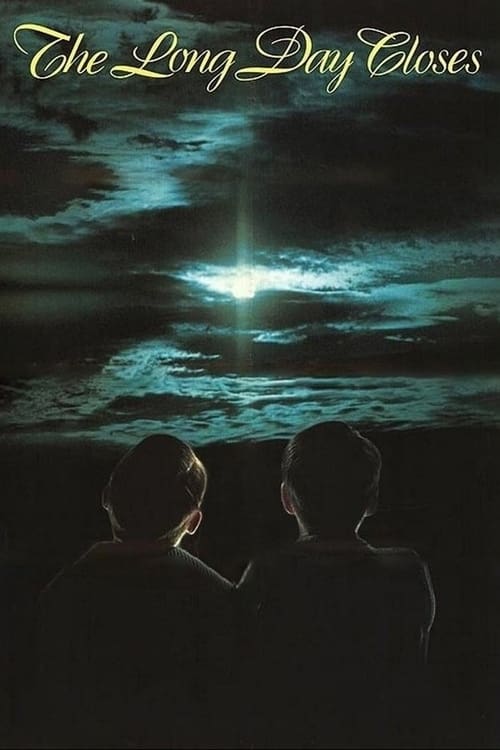
The Long Day Closes
1992 · Terence Davies
For a quiet, contemplative evening when you want to be held rather than gripped — comfort viewing of the most melancholy, beautiful kind. Not for a night when you need momentum.
What it's about
In mid-1950s Liverpool, an eleven-year-old boy named Bud lives with his mother and older siblings in a working-class terraced house, enduring school and church and loneliness, and finding his one reliable joy in the dark of the local cinema. There's barely a plot — instead the film drifts through the textures of his days: family singsongs, rain on windows, light on a doorstep, and the first unspoken stirrings of being different.
The experience
Less a story than a remembered feeling — slow, tender, and bathed in music, it moves through long dissolves like memory itself. It can leave you aching with a nostalgia that isn't even yours.
Performances
Marjorie Yates radiates warmth as the mother, and young Leigh McCormack carries the film on watchful silences alone.
The craft
Terence Davies composes each scene like a tableau and binds them with popular songs and snippets of film soundtracks, so the movie plays almost as music. The camera glides where other films would cut; with good sound, it's enveloping.
Why it matters
A high point of Terence Davies's autobiographical cycle and a touchstone of British art cinema, it's regularly cited among the great films about childhood and moviegoing itself.
Snapshot
The Long Day Closes is Terence Davies's second feature-length excavation of his own Liverpool childhood, following Distant Voices, Still Lives (1988). Where that film had reckoned with the terror of a violent father, The Long Day Closes turns to a quieter, warmer interval — a boy of about eleven named Bud, living with his mother and older siblings in a working-class terraced house in the mid-1950s, finding refuge from school, church, and loneliness in the enveloping dark of the local picture palace. There is almost no plot in the conventional sense. The film proceeds instead as a sequence of remembered moods — light falling on a doorstep, a family singsong, the drone of a schoolroom, the ecstasy of the cinema screen — bound together by long dissolves and a curated tissue of popular songs and quoted film soundtracks. It is among the most formally rigorous and emotionally exposed of British autobiographical films, an act of memory rendered as a nearly musical structure.
Industry & production
The film was made within the distinctive British art-cinema ecology of the late 1980s and early 1990s, in which the British Film Institute's production arm and Channel Four (through Film Four International) underwrote work with little commercial prospect but strong cultural ambition. The Long Day Closes was a BFI production associated with Channel Four, produced by Olivia Stewart, Davies's regular producer of the period. Budgets for such projects were modest; I have not seen a reliably documented figure, so I will not assign one, but the film's scale — a handful of interiors, a recreated street, a small largely non-star cast — is consistent with the low-cost, culturally-subsidised model that made a director as uncompromising as Davies viable at all.
That production context matters interpretively. Davies has repeatedly described his method as slow, meticulous, and storyboarded to the frame, an approach at odds with commercial television-derived economies of shooting. The BFI/Channel Four framework gave him the latitude to shoot in a deliberate, tableau-driven manner and to build a soundtrack out of licensed songs and film extracts — an expensive and unusual choice for so small a picture. The film premiered at the 1992 Cannes Film Festival, the customary launch for prestige British art cinema of the era, and circulated thereafter primarily through festivals, specialized distribution, and critical advocacy rather than wide theatrical release.
Technology
The Long Day Closes was photographed on 35mm color film by Michael Coulter. Its technological signature lies not in novelty but in an almost painterly control of exposure and color timing: burnished ambers, deep shadow, and a palette that reads as remembered rather than observed, closer to the tonalities of Old Master interiors or hand-tinted photographs than to naturalistic 1950s Liverpool. The film's celebrated camera movements — extended, gliding tracks and cranes at an unusually slow tempo — depend on motorised dolly and crane rigs handled with metronomic precision. I would not overstate the technical apparatus; the film's radicalism is one of restraint and duration rather than equipment. Its most "technological" gesture is arguably in the sound domain, where multiple licensed recordings and film-clip soundtracks are layered and cross-faded into the image with the care of a scored composition. The specific aspect ratio and lab-timing particulars I cannot state with confidence and will not invent.
Technique
Cinematography
Coulter's images are the film's foundation. Compositions are frontal, stilled, and frequently symmetrical, framing the family home and its inhabitants like a series of illuminated dioramas. Light is treated as an emotional agent: a shaft falling across a stairwell, the glow of a cinema doorway, firelight on faces during a singsong. The camera's movement is the film's most discussed formal trait — slow lateral tracks that survey a space, or upward tilts and craning moves that lift out of the domestic and into something closer to reverie. The most famous of these travels across the interlocked worlds of Bud's life to Debbie Reynolds's recording of "Tammy," gliding over cinema audience, church congregation, and schoolroom as though revealing that all three are chambers of the same remembered house. The effect is contemplative rather than kinetic; the camera seems to breathe with memory itself.
Editing
Edited by William Diver, the film organizes itself by association rather than causation. Its signature transition is the long, slow dissolve, which lets one remembered image bleed into the next so that time feels layered rather than sequential. Fades to black punctuate the film like breaths or the closing of eyes. Because there is little narrative throughline, editing carries much of the structural burden, shaping tempo, rhyme, and emotional crescendo out of material that would otherwise be inert. The cutting is musical in the precise sense that it is governed by the songs and soundtracks laid beneath it, images arriving and departing on the phrasing of the music.
Mise-en-scène / staging
The production design, by Christopher Hobbs, reconstructs a 1950s Liverpool terraced interior and street as a memory-space — detailed but slightly heightened, warm and enclosing. Staging tends toward the tableau: figures arranged within the frame and held, often facing the camera, as in a family photograph. The domestic geography — stairs, doorway, hearth, the wet street outside — recurs as a fixed emotional map. Davies's compositions frequently place Bud small within a large, softly-lit space, dramatizing both the security and the solitude of the child's world.
Sound
Sound is arguably the film's primary expressive medium. Davies constructs a dense collage of period popular music and quoted film soundtracks — Hollywood dialogue and scoring drifting in over the images so that the movies Bud loves literally colonize the film's own soundtrack. Extracts from studio-era cinema (the kind of British and American pictures a Liverpool boy would have absorbed in the 1950s) are woven in as both diegetic memory and structuring device. Popular vocal recordings — Debbie Reynolds's "Tammy" chief among them — function as leitmotifs. The film notably eschews wall-to-wall naturalistic ambience in favour of this composed, allusive soundscape, in which silence, hymn, pop song, and remembered movie dialogue all carry equal dramatic weight.
Performance
The performances are pitched toward stillness and restraint. Leigh McCormack, a non-professional child performer, plays Bud largely through watchfulness — a quiet, receptive face turned toward light, screen, and family. Marjorie Yates as the mother gives the film its center of warmth, a maternal presence whose tenderness (contrasted with the paternal terror of Distant Voices, Still Lives) defines the film's gentler emotional key. The supporting ensemble of siblings, neighbors, and schoolmates works in a naturalistic register, but the film subordinates individual "acting" beats to the larger orchestration of image and sound; performance here is closer to the placement of figures within a memory than to psychological drama.
Narrative & dramatic mode
The film's dramatic mode is lyric and elegiac rather than dramatic in the Aristotelian sense. There is no goal-driven protagonist, no rising conflict and resolution; instead there is a suspended present tense of childhood, organized by mood, season, ritual, and recurrence. Time is cyclical and associative — Christmas, churchgoing, cinema outings, the schoolroom — rather than linear. In this respect The Long Day Closes belongs to a tradition of the "memory film," where the shaping consciousness is that of the adult artist recalling, and the child on screen is both subject and emanation of that remembering mind. Emotion is generated by juxtaposition and accretion — the tenderness of a song against the loneliness of a face — rather than by event.
Genre & cycle
Nominally a drama, the film sits most naturally in the lineage of poetic autobiographical cinema and the coming-of-age film, though it resists the causal machinery of both. It forms the second panel of Davies's Liverpool cycle, extending the autobiographical project of Distant Voices, Still Lives and his earlier short Trilogy. Within British cinema it can be read against the grain of the era's social-realist tradition: it shares that tradition's working-class subject matter but replaces its documentary immediacy with stylization, ellipsis, and reverie. It also participates in a broader European art-cinema mode of the memory film — the childhood-as-recollection picture — while remaining idiosyncratically Davies's own.
Authorship & method
Terence Davies is the film's unmistakable author; it is, quite literally, drawn from his life, and its every formal choice bears his fingerprint — the slow camera, the long dissolve, the sacralising of popular song, the fusion of Catholic ritual and cinematic ecstasy. Davies has spoken of composing his films with an almost musical sense of structure, storyboarding meticulously and building sequences around specific recordings. His method is one of transfiguring autobiography into form: memory is not narrated but architecturally constructed.
His key collaborators shaped that vision materially. Cinematographer Michael Coulter realized the film's memory-palette and its stately camera moves. Editor William Diver gave the film its dissolving, associative rhythm. Production designer Christopher Hobbs built the heightened memory-space of the Liverpool interior. Producer Olivia Stewart secured and shepherded the difficult financing. On the question of a composer: the film characteristically forgoes a conventional original score in favour of a compiled and quoted soundtrack of period songs and film music, so its "musical" authorship lies in Davies's own selection and montage of found recordings rather than in newly written cues. Where I am uncertain of a specific credit — the exact division of music supervision, for instance — I flag it rather than guess.
Movement / national cinema
The film is a landmark of British art cinema and specifically of a strain that diverges from the dominant social-realist school. It belongs to British national cinema by subject — post-war working-class Liverpool, Catholicism, the picture-house as communal institution — but aligns aesthetically with a more European, modernist tradition of memory and stylization. Davies stands somewhat apart from movements or schools; he is best understood as a singular figure within British cinema whose work bridges regional autobiography and formal experiment.
Era / period
Two eras are in play. The film is set in the mid-1950s, the last era of the neighborhood picture palace as a mass communal ritual, before television's saturation — a moment central to the film's nostalgia for cinema itself. It was made in the early 1990s, within the BFI/Channel Four funding environment that briefly sustained authored, uncommercial British filmmaking. The gap between the two — the adult of the 1990s recalling the child of the 1950s — is the film's essential structure.
Themes
The film's governing themes are memory and the passage of time (the title, drawn from a Victorian part-song, signals its elegiac consciousness of days closing). Cinema appears as refuge, transcendence, and secular sacrament — the screen as a place of light and belonging against the day's oppressions. Loneliness and the solitude of the sensitive child run throughout, as does the tension between the warmth of family and the cruelties of school and the outside world. Catholicism suffuses the film — guilt, ritual, hymn, and the aestheticized beauty of religious observance sit alongside, and are rhymed with, the ecstasy of the movies. Bud's emerging homosexuality is treated obliquely and tenderly, most memorably in the boy's charged, wondering gaze at a labourer — desire registered as longing and unease rather than incident. Underlying all is a maternal tenderness that gives the film its distinctive gentleness within Davies's often anguished body of work.
Reception, canon & influence
Critically, The Long Day Closes was received as a major achievement by Davies's advocates, consolidating the reputation he had established with Distant Voices, Still Lives, and it has since been widely regarded as one of the finest British films of its decade; its standing has grown rather than diminished over time, and it is frequently cited in critical retrospectives of Davies and of British cinema. (I note honestly that precise contemporary review quotations and awards records I will not reconstruct from memory for fear of error.)
Its influences run backward to the studio-era Hollywood and British pictures Davies loved as a boy — the very films whose soundtracks he quotes — and to a Catholic, working-class Liverpool sensibility; formally, its slow camera and dissolves have affinities with a contemplative European art cinema of memory. Looking forward, the film's legacy is felt in the continuing esteem for the "memory film" as a mode and in Davies's own subsequent career (The Neon Bible, The House of Mirth, Of Time and the City, A Quiet Passion), where the same preoccupations with time, music, light, and loss recur. More broadly, it stands as a touchstone for filmmakers and critics who value cinema's capacity to render subjective memory and emotion through form rather than plot — a small, luminous work whose influence is one of example and permission rather than of imitation.
Reception
Admired but hardly seen when it premiered in competition at Cannes in 1992, it spent years as the 'other' Davies memory film behind Distant Voices, Still Lives; decades of critical devotion and a 2014 Criterion release have since re-crowned it, for many, as his masterpiece and one of the great British films of the 90s.
How The Long Day Closes was received, from release to now →
Influences: the films it descends from and the films it influenced
- Distant Voices, Still Lives (1988) — Davies's immediate predecessor fixed the method the seed refines — static family tableaux singing period songs while the frame dissolves across years rather than cutting on plot.
- Meet Me in St. Louis (1944) — Minnelli's Technicolor domestic musical models the sacralising of popular song and the seasonal tableau, and its MGM ecstasy is precisely the kind of studio-era number Davies quotes and mourns on his compiled soundtrack.
- The Magnificent Ambersons (1942) — Welles's elegy for a vanished world builds nostalgia from gliding crane moves and hushed voice-over narration — the camera-as-mourner grammar Davies inherits, and a source he samples aurally.
- Sunrise: A Song of Two Humans (1927) — Murnau's unbroken lyrical tracking shots and studio-built expressive lighting establish camera-as-emotion over camera-as-narrator, the impulse Davies's slow tracking crane extends.
- Mirror (1975) — Tarkovsky assembles plotless autobiography from associative montage, poetry and found period-radio audio — the compiled-sound memory architecture Davies practices in a working-class register.
- Amarcord (1973) — Fellini's episodic childhood memoir of provincial ritual and communal tableau supplies the vignette-not-plot structure of elegiac autobiography Davies adopts.
- Wild Strawberries (1957) — Bergman's dissolves between present and remembered/dreamed past model the seamless temporal glide Davies achieves through his signature long dissolve.
- Kind Hearts and Coronets (1949) — Quoted directly on Davies's soundtrack, its clipped Ealing wit is one of the found-film voices woven into the memory-collage as sacralised aural artifact.
- The Spirit of the Beehive (1973) — Erice's child's-eye reverie treats a cinema screening as sacrament under hushed painterly light — the cinema-as-holy-space and tableau stillness Davies shares.
- El Sur (1983) — Elliptical-associative montage of a lonely boy's inner life, drenched in preexisting popular music and pooled, source-motivated light through domestic space.
- Of Time and the City (2008) — Davies's own later Liverpool memory-essay, built entirely from compiled archival footage and quoted music, extends the seed's found-audio elegy into the documentary essay form.
- Ratcatcher (1999) — Ramsay renders a working-class childhood through lyrical image and associative sound design rather than narrative, carrying Davies's British poetic-memory mode forward.
- The Tree of Life (2011) — Malick builds a plotless childhood from associative montage, sacralised domestic imagery and classical music-as-prayer — cinema-as-sacrament pitched in Davies's exact key.
- Roma (2018) — Cuarón reconstructs an autobiographical childhood home in painterly monochrome with slow lateral tracking and dense ambient found sound standing in for the texture of memory.
- Belfast (2021) — Branagh's monochrome working-class childhood memoir scores memory with pop songs and stages moviegoing as transcendence — an explicit heir to Davies's song-and-screen nostalgia.
- Aftersun (2022) — Wells assembles an elegiac memory-film from elliptical fragments and a compiled pop soundtrack, deploying the associative-not-narrative grammar Davies pioneered.
- Blue Heron (2026) — Autobiographical memory built through elliptical editing and off-screen diegetic sound (overheard voices, ambient domestic noise) standing in for narrative, the associative-recall editing logic Blue Heron adopts.
- All of Us Strangers (2023) — Stages the childhood home as a memory-space bathed in warm nostalgic light, using popular music and slow camera drift to render a lonely boy's interiority directly.
- The Metamorphosis of Birds (2021) — Reconstructs a family's domestic past as static, lovingly lit tableaux held for their own sake, using lyrical voiceover and pooled light to turn recollection into a sequence of luminous still images.
- Boyhood (2014) — Renders childhood as elided episodes bound together by pop records and ambient household sound rather than by causation, holding the camera on a boy's attention while the events that would constitute a plot happen elsewhere or not at all.
- Cinema Paradiso (1988) — Tornatore's contemporaneous hymn to childhood moviegoing enshrines projection as sacrament through clip-montage, sharing Davies's theme of cinema as sacred working-class refuge.
- Jacquot (1991) — Reconstructs a boy's cinema-worship as the engine of memory, mirroring Jacquot's thesis that a child's love of moving images becomes his adult craft.
Similar films
- Distant Voices, Still Lives (1988) — influence & lineage
- Mirror (1975) — influence & lineage
- Ratcatcher (1999) — influence & lineage
- Close (2022) — shared sensibility
- Blue (1993) — shared sensibility
- All of Us Strangers (2023) — shared sensibility
- Perfect Days (2023) — shared sensibility
- Boyhood (2014) — shared sensibility