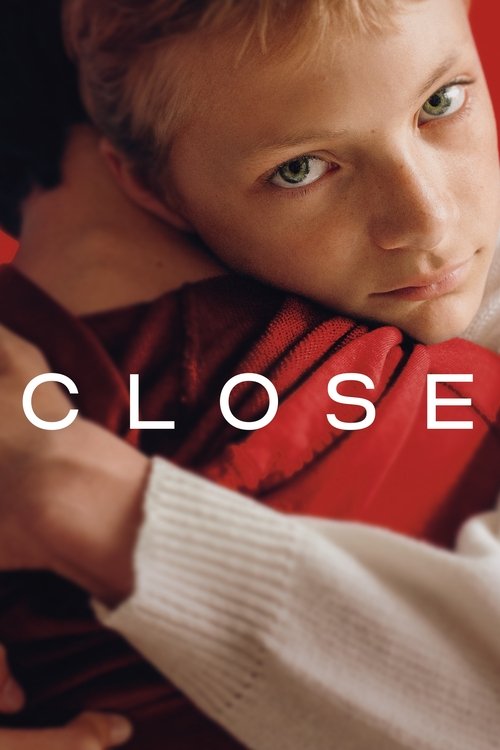
Close
2022 · Lukas Dhont
For when you need a good cry and want to earn it — a film to watch when you're ready to feel something real about friendship, boyhood, and the things left unsaid. A challenge, not a comfort, but a beautiful one.
What it's about
Two thirteen-year-old boys share the kind of friendship that hasn't yet learned self-consciousness — sleeping head to head, sprinting through flower fields, finishing each other's days. Then a classmate's idle question at their new school suggests that closeness like theirs requires a name, and something between them begins to shift. It's about how boys learn to withdraw from tenderness, and what that schooling costs.
The experience
It opens in pure sunlight and gradually tightens around your chest; the emotion lives in small withdrawals rather than big scenes, which makes it hit harder. Expect to be quietly wrecked — this one follows you out of the room.
Performances
Eden Dambrine, discovered by the director on a train, gives a performance of astonishing restraint for a first-time child actor — the film's deepest feelings live in his posture, a tightened jaw, the words he decides not to say.
The craft
Frank van den Eeden's camera stays at the boys' eye level amid an industrial flower farm's ranks of dahlias, and the harvest seasons quietly structure the film — color itself marking time and loss. Dhont directs by subtraction: what's withheld from a scene is usually the point.
Why it matters
Winner of the Grand Prix at Cannes and an Oscar nominee, it confirmed Dhont as the leading chronicler of adolescent inner life in European cinema.
Lukas Dhont's second feature won the Grand Prix at Cannes and an Oscar nomination, confirming the young Belgian as the poet laureate of adolescent interiority. Two thirteen-year-old boys share a friendship of total, unselfconscious physical ease — sleeping head to head, racing through flower fields — until a classmate's idle question introduces the idea that such closeness requires a name. What follows is a study of how boys learn to withdraw from tenderness, and what that schooling costs. Dhont found his lead, Eden Dambrine, on a train, and draws from him a performance of extraordinary restraint: the film's grief lives in posture, in a jaw held tight, in what a child decides not to say. Frank van den Eeden's camera stays at the boys' height amid the industrial flower farm's ranks of dahlias, harvested by season — a structure that lets color itself mark the passage from summer abundance to winter clarity. Belgian cinema gave us the Dardennes' moral rigor; Dhont offers something adjacent but lusher, sorrow rendered in full bloom.
A Deleuzian reading
Two boys asleep head to head, breathing into each other's hair.
The full Deleuzian reading of Close →
Reception
Premiered at Cannes 2022 to a rapturous reception and a share of the Grand Prix, then rode the awards wave to an Oscar nomination for Best International Feature — and since then it's settled into a second life as one of Letterboxd's designated devastation machines, the film people dare each other to watch without crying.
How Close was received, from release to now →
Influences: the films it descends from and the films it influenced
- Rosetta (1999) — Establishes the handheld camera locked to a young protagonist's shoulders and back so we read emotion through gait and haste rather than dialogue — the exact bodily grammar Dhont uses to chase Léo through the farm.
- The Son (Le Fils) (2002) — Films grief and guilt from the nape of the neck, withholding the face and refusing musical cues, teaching Dhont's method of letting a boy's averted body carry unspeakable loss.
- The Kid with a Bike (2011) — Centers a restive pre-adolescent boy in a redemptive-grief arc and uses the bicycle as kinetic motif, a direct template for Léo's cycling through seasons.
- Girl (2018) — Dhont's own debut sets his signature: a non-professional young lead, near-clinical restraint, and the camera pressed against an adolescent body negotiating identity through physical discipline.
- Tomboy (2011) — Pioneers the child-height, patient observational camera that treats a kid's gender and friendships with adult gravity and no explanatory voiceover — Dhont inherits the eye level.
- Water Lilies (2007) — Builds adolescent intimacy through glances, proximity, and withheld gesture rather than plot, modeling the charged wordless closeness of Léo and Rémi's early scenes.
- The 400 Blows (1959) — Founds the coming-of-age realism of following one boy's face and flight through institutions, the tracking-with-the-child logic Dhont's Dardenne-descended camera extends.
- Days of Heaven (1978) — Turns agrarian labor and magic-hour fields into an emotional register keyed to seasonal cycle, the lyrical-harvest palette Dhont borrows for the flower farm's chromatic structure.
- Brokeback Mountain (2005) — Renders repressed male tenderness and its aftermath of grief through landscape and physical reticence, the masculinity-and-withdrawal grammar Close transposes to boyhood.
- Ratcatcher (1999) — Fuses working-class child realism with poetic, guilt-haunted imagery after a death, showing how a boy's culpability can be staged through mood and object rather than confession.
- System Crasher (2019) — Draws a study of a child's emotional dysregulation from a non-professional young lead via a workshop-heavy, research-based rehearsal method, shot in intimate immersive handheld.
- The World of Us (2016) — Builds its rupture entirely from ostracism-without-violence — a chair moved, a look withheld — and cuts on the excluded child's reaction rather than on the act, the editing logic the seed established for wangtta.
- Young Hearts (2024) — The named model: Dhont's method of casting two untrained boys for emotional transparency and directing them into unguarded physical closeness against a flat rural Flemish landscape is exactly the register Schatteman adopts.
- Moonlight (2016) — Uses color as chapter-structure and extreme performance restraint to trace tender, imperiled male intimacy across a boy's growth — the closest peer to Close's craft on masculinity and palette.
- Summer 1993 (Estiu 1993) (2017) — Shoots grief entirely from a small child's eye level with a non-professional lead across a single season, sharing Close's child-height camera and seasonal-mourning form.
- Petite Maman (2021) — Distills loss into a hushed, autumnal child's-world miniature with restrained kid performances, extending the same eye-level tenderness-toward-grief Dhont works in.
- God's Own Country (2017) — Locates inarticulate male intimacy in the physical labor of a working farm, sharing Close's staging of emotion through rural work and withheld speech.
- Aftersun (2022) — Reconstructs unbearable loss through elliptical restraint and the ache of what a young person couldn't yet see, a contemporary twin to Close's under-stated grief mechanics.
- The Quiet Girl (An Cailín Ciúin) (2022) — Builds an entire emotional arc from a withholding child's silences on a rural farm across a season, the same non-professional-lead restraint and pastoral setting as Close.
- The Eight Mountains (2022) — Traces a lifelong male friendship and its severance across landscape and time with Belgian-directed restraint, echoing Close's study of intimacy between boys and its rupture.
- Falcon Lake (2022) — Renders tender pre-adult intimacy between two friends and its rupture in soft natural light and restrained observation, where desire and loss are conveyed by withholding rather than statement.
- Joyland (2022) — Frames tender same-sex intimacy crushed by peer and social pressure in a melodramatic register, sharing Joyland's grammar of soft closeness policed by others.
- My Sunshine (2024) — Two boys' tender first feelings shot in warm natural light with soft, close framing and minimal dialogue — a direct sibling in filming children's earliest emotions.
- The Broken Circle Breakdown (2012) — Advances the contemporary Flemish-cinema idiom of face-close handheld intimacy and grief among ordinary people that Broken Circle helped make internationally visible.
- Fireworks (2023) — Mirrors the casting of unknown young leads whose boyhood intimacy is policed by peers into catastrophe, sustaining tension through dramatic irony toward an off-screen loss.
Similar films
- The Eight Mountains (2022) — influence & lineage · same viewing thread
- The Kid with a Bike (2011) — influence & lineage
- Moonlight (2016) — influence & lineage
- Monster (2023) — same viewing thread · often watched together
- Tomboy (2011) — influence & lineage · same viewing thread
- Young Hearts (2024) — same viewing thread
- Brokeback Mountain (2005) — influence & lineage · often watched together
- I Saw the TV Glow (2024) — often watched together
All the films related to Close →
Watch it with: curated runs of related films
- The Unspoken Between Boys — Watch these together for the way each lets a boyhood friendship curdle into longing, grief, or something neither kid can quite name.