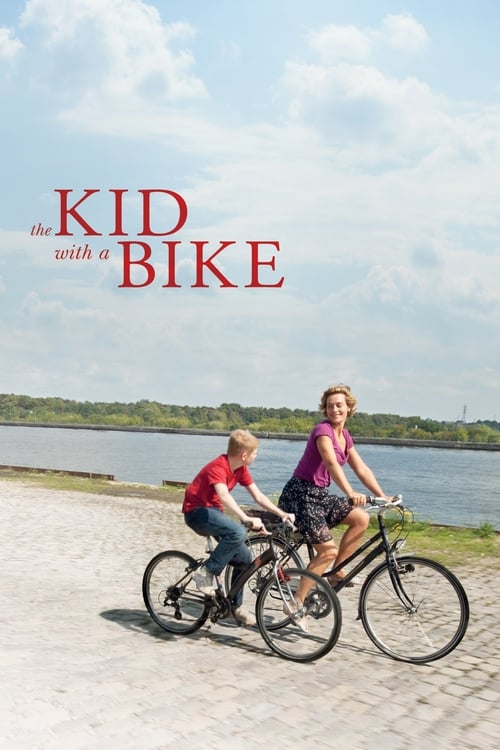
The Kid with a Bike
2011 · Luc Dardenne
When you want a short, gripping film with a big heart — something that makes you feel for a difficult kid without ever manipulating you. Emotionally direct rather than comfortable, and over before you know it.
What it's about
Cyril, an eleven-year-old boy in a Belgian town, refuses to accept that his father has dumped him in a children's home and disappeared — he keeps escaping to look for him, and for his missing bike. A local hairdresser named Samantha, for reasons she never explains, agrees to take him in on weekends, and the film follows the fierce, prickly kid as he tests her patience, chases his father's love, and drifts toward the attentions of a neighborhood criminal.
The experience
It moves fast and hits hard — barely 87 minutes, shot close to the boy as he runs, pedals, and fights, so his desperation becomes physical. It's tense and unsentimental, yet it builds toward something genuinely tender; the kindness in it lands harder because nothing about it is soft.
Performances
Thomas Doret, as Cyril, gives one of the great child performances — all coiled fury and stubborn hope, never cute for a second. Cécile de France plays Samantha with a plainspoken warmth that makes her unexplained generosity completely believable.
The craft
The Dardenne brothers shoot in their signature style: handheld camera at the boy's shoulder, natural light, real locations, no fat on any scene. Unusually for them, they punctuate the film with brief swells of Beethoven — a few seconds at a time — and those flashes of music land like grace notes in an otherwise stripped-bare world.
Why it matters
It won the Grand Prix at Cannes in 2011 and became one of the Dardennes' most beloved films — the warmest, most accessible entry point into a body of work that shaped two decades of European realist cinema.
Snapshot
Le Gamin au vélo is an 87-minute Belgian-French-Italian drama about an eleven-year-old boy, Cyril Catoul, who refuses to believe his father has abandoned him, and about the hairdresser who, for reasons the film never explains, agrees to take him in on weekends. It is credited here to Luc Dardenne alone, but the film — like every Dardenne feature since Falsch (1987) — is co-written and co-directed with his brother Jean-Pierre, and the record throughout treats them as a single authorial unit. It premiered in competition at Cannes in May 2011 and took the Grand Prix, shared with Nuri Bilge Ceylan's Once Upon a Time in Anatolia, under Robert De Niro's jury; the Palme went to Terrence Malick's The Tree of Life.
The film sits at a hinge in the Dardennes' career. It retains the method they built for La Promesse (1996) — real locations in the Liège industrial suburb of Seraing, weeks of on-site rehearsal, a camera that follows bodies rather than composing around them — but softens almost every parameter: summer light instead of gray, a protagonist who is a child rather than a young adult, an act of unearned kindness placed at the center rather than at the very end, and, for the first time in their work, non-diegetic music. It is their most legible film as a fable and, partly for that reason, the one their admirers argue about most.
Industry & production
The production is a textbook late-2000s European co-production. The lead producer is Les Films du Fleuve, the company Jean-Pierre and Luc Dardenne founded in Liège in 1994 to gain control over their own financing after the compromised experience of Je pense à vous (1992), a more conventionally mounted film they have consistently described as a mistake. French co-production came through Archipel 35 (Denis Freyd), an established Dardenne partner, and Italian participation through Andrea Occhipinti's Lucky Red — the Italian leg reflecting the brothers' reliable theatrical audience in Italy.
The Belgian side of the financing rests on infrastructure that transformed the country's cinema in the 2000s: the federal tax shelter for audiovisual investment introduced in 2003, regional support via Wallimage and the Center du Cinéma et de l'Audiovisuel of the Fédération Wallonie-Bruxelles, and public broadcast participation. That system is the reason a small Francophone territory of a few million people was, by 2011, producing several internationally competitive features a year. The competition was domestic as well as global: Belgium's submission to that season's Academy Award for best foreign-language film was not the Dardennes' Cannes prize-winner but Michaël Roskam's Bullhead, which secured the nomination.
Distribution followed the festival-auteur pipeline the brothers have used since Rosetta (1999) — Diaphana in France, Sundance Selects/IFC in the United States — and the film performed in line with their previous work: a durable specialty release rather than a crossover, sustained through 2011–12 by the Cannes prize and a Golden Globe nomination in the foreign-language category. Reliable budget and gross figures for the film are not something I can state with confidence, and I won't estimate them.
Technology
The film was shot on 35mm at 1.85:1, at a moment when that was becoming a choice rather than a default; the Dardennes stayed on photochemical capture for several more years before moving to digital acquisition later in the decade. The technical package is deliberately modest: available and lightly supplemented light, no elaborate grip infrastructure inside the small real interiors (Samantha's salon, the children's home, the flat above the restaurant), and a heavy reliance on the mobility of handheld and shoulder-rigged camera work.
The one area of genuine technical investment is movement. Cyril's bicycle is the film's engine, and the riding sequences required tracking vehicles and camera mounts capable of holding a moving child in frame at speed through real streets and along the Meuse-valley roads around Seraing. The resulting shots are the film's most kinetically sophisticated: the camera neither races ahead of the boy nor lags behind him, but keeps station beside him, so that his velocity registers as a state of being rather than as an event.
Technique
Cinematography
Alain Marcoen, the brothers' director of photography since La Promesse, shoots the film in a register noticeably calmer than Rosetta or L'Enfant. The nape-of-the-neck pursuit shot that made the Dardenne style famous is still present, but it is used sparingly; more of the film is framed at a slight remove, with steadier operating, cleaner sightlines and fuller figures in the frame. The palette is the film's most-discussed formal departure. The brothers set the story in summer and let the images carry green foliage, sunlight on tarmac and saturated primaries — above all the red of Cyril's shirt and jacket, a costume decision that functions as a tracking device, letting the eye find the boy instantly in wide exteriors and forest cover. Against fifteen years of Walloon winter grays, this reads almost as a manifesto.
Editing
Marie-Hélène Dozo, who has cut nearly all their features, works here with fewer of the abrasive mid-action cuts of the earlier films and more elision at the level of story. Scenes begin late and end early; consequential events (Cyril's transfer between institutions, the passage of weeks) are simply skipped. The film's most severe cut is its last: Cyril rises, retrieves his bicycle and rides out of frame, and the film ends without a reconciliation scene, without a reaction shot from anyone, without a coda. The refusal of the closing beat is the point.
Mise-en-scène / staging
The Dardennes' working method is essentially theatrical in preparation and documentary in appearance. They rehearse for weeks in the actual locations, fixing the choreography of bodies, doors, thresholds and objects before a frame is exposed, then shoot many takes to wear the performances down to behavior. The staging logic is one of grip and release: Cyril's first meeting with Samantha is a physical seizure — he clamps onto a stranger in a doctor's waiting room to avoid being dragged back — and the negotiation of how tightly he may hold her becomes the film's recurring physical motif. Objects carry the plot with the concreteness of a Bressonian model: a disconnected telephone, a bicycle sold for cash and bought back, a baseball bat, a wad of banknotes that nobody will accept.
Sound
Jean-Pierre Duret's location sound gives the film the Dardennes' characteristic density — traffic, salon dryers, kitchen clatter, breath, the specific rattle of a bicycle chain — and no score. That absence had been an absolute rule across five features. Here it breaks: four brief passages from the Adagio of Beethoven's Piano Concerto No. 5 in E-flat, Op. 73 ("Emperor") enter at moments of rupture or reprieve. The brothers have described the cue in interviews as a consoling gesture toward the boy, something like an arm placed around him that no character in the film is able to provide. Formally, the effect is precisely calibrated: the music never accompanies a scene, it interrupts one, lasting seconds and cutting off. Notably, it does not return at the end.
Performance
Thomas Doret, cast from open auditions and acting for the first time, plays Cyril without any of the softening register child performances usually carry — he is hard, fast, physically combative, and largely opaque. Cécile de France, as Samantha, is the film's real casting anomaly: a genuine star (Around the World in 80 Days, Haute Tension, Eastwood's Hereafter) in a body of work built on non-professionals and a small stock company. She plays down to nothing, cropped hair, minimal inflection, refusing every available cue for explaining her own charity. Jérémie Renier — who was the boy in La Promesse and the young father in L'Enfant — plays Guy, the father, in a piece of casting that folds fifteen years of Dardenne history into one face; Fabrizio Rongione and Olivier Gourmet, the other pillars of the company, appear in supporting roles. Egon Di Mateo plays Wes, the neighborhood dealer who recruits Cyril, styling himself with a borrowed name from Batman.
Narrative & dramatic mode
The dramatic mode is behaviourist: motive is withheld, and psychology is inferred from action alone. The film opens on Cyril refusing to accept that a phone line is dead, and that refusal — to be told a true thing — organizes everything after. The central sequence is the one in which Samantha forces Guy to say aloud, to his son's face, that he does not want to see him again; the film's cruelty and its ethics are both located there.
Structurally it is a rescue narrative with two competing adoptive fathers — Samantha as the benign claimant, Wes as the predatory one — and a boy who chooses badly before he chooses well. The last act converts the film's moral logic into physical consequence: the newsagent's son recognizes Cyril at a petrol station, chases him, and a thrown stone knocks him from a tree. He lies motionless. The adults above him begin, appallingly, to discuss how to avoid liability. Then he stands up, and rides away. Whether this is resurrection, grace or simple physical resilience is left entirely to the viewer, in a manner directly descended from Bresson.
Genre & cycle
Formally the film belongs to the post-neorealist European social drama; functionally it is a fairy tale, and the Dardennes have said so. Samantha is the fairy godmother who appears without motivation and asks nothing; Wes is the ogre in the woods; the forest, the bicycle and the stone are folkloric properties. This hybrid — the moral schema of the märchen executed with the surface grammar of observational realism — is what makes the film distinct within their filmography and what its skeptics object to.
It also belongs to a long cycle of European films about abandoned or delinquent children: Rossellini's Germany Year Zero, De Sica's Bicycle Thieves and Shoeshine, Truffaut's The 400 Blows, Bresson's Mouchette, Loach's Kes. The bicycle explicitly reactivates De Sica's object-logic, in which a machine that makes movement possible is also the thing that can be taken away.
Authorship & method
The Dardennes' formation is unusual and explains a great deal. Both worked in the 1970s around the dramatist Armand Gatti, then founded the video workshop Dérives in 1975 and spent roughly a decade making documentaries about working-class memory and resistance in the Liège steel basin — the same Seraing streets they have filmed ever since. Their fiction only cohered when they abandoned conventional coverage for the pursuit-camera method of La Promesse. Luc's published production notebooks, Au dos de nos images, are the primary document of their thinking, and they show the influence of Emmanuel Levinas — the ethical claim made by the face of another person — running through the work as a structural principle rather than a decorative theme.
The genesis of this film has been recounted consistently by the brothers: a story heard years earlier from a juvenile-court judge in Japan, about a boy placed in care who waited on a roof for a father who never came, and who afterwards turned to delinquency. The film is the hypothetical the anecdote left open — what if someone had intervened.
The collaborators are close to permanent: Marcoen on camera, Dozo cutting, Igor Gabriel designing, Duret on sound, Les Films du Fleuve producing, and a repertory company of actors (Gourmet, Renier, Rongione) who have grown up on screen inside the work. There is no composer credit, because there is no score — only Beethoven, used as found material.
Movement / national cinema
The film is a central text of contemporary Belgian Francophone cinema and, more narrowly, of the Walloon cinema the Dardennes essentially invented as an international category. Its geography is specific: Seraing, a post-industrial commune whose steelworks decline structures the entire Dardenne project. The brothers' Belgium is not a national image but a regional one — housing estates, ring roads, motorway service stations, riverside scrub — filmed by people who have known it since childhood.
Internationally, the Dardennes are the most prominent inheritors of a European realist line running from neorealism through Bresson and Loach, and by 2011 "Dardennean" had become a functioning adjective in film criticism, denoting handheld proximity, working-poor milieux, moral crisis without moralizing, and endings that withhold consolation.
Era / period
2011 is post-crisis Europe: austerity, precarious work, strained social services. The Dardennes' subjects had already migrated from the deindustrialisation of the 1990s films to the trafficking and paperwork economies of Lorna's Silence (2008), and would move next to the workplace referendum of Two Days, One Night (2014). The Kid with a Bike addresses the period obliquely, through institutions: a children's home that is competent but cannot love, a father whose new life has no room in it, a small-business owner whose weekends are the only slack in the system. The film's implicit argument — that the welfare apparatus can house a child but cannot claim him — is a distinctly 2010s European proposition.
Themes
Abandonment and the search for the father; substitute kinship formed by choice rather than blood; the transmissibility of violence and the possibility of interrupting it; and money, the Dardennes' most persistent material motif. Cash moves through the film as it does through Rosetta, L'Enfant and Lorna's Silence: the father sells the boy's bicycle for it, Samantha spends it to buy the bicycle back, Wes uses the boy to steal it, and at the climax it is offered and refused. The distinction between a transaction and a gift is the film's moral axis. Samantha never explains herself, and the refusal to supply her a reason is the film's most radical gesture: grace, in the Dardennes' framework as in Bresson's, is exactly that which is not accounted for.
Reception, canon & influence
Critical reception was strongly positive — the Cannes Grand Prix, wide year-end list placement across 2011 and 2012 releases, and a broad consensus that this was the brothers' warmest and most immediately accessible film. The dissent was consistent and worth recording: that the fairy-tale scaffolding, the Beethoven and the summer palette amounted to a softening of an art built on refusing comfort, and that Samantha's motiveless goodness is a device where earlier Dardenne films would have demanded a cost. Its defenders answer that the ending grants no absolution at all — that a boy standing up and cycling away, unwitnessed and unforgiven, is as austere a resolution as they have written.
Backward, the lineage is unusually explicit: Bresson above all (the object-logic, the withheld interiority, the ambiguous rising at the end), Bicycle Thieves for its central machine, Germany Year Zero and The 400 Blows for the child adrift in an indifferent adult economy, Grimm for the structure, Levinas and Dostoevsky for the ethics.
Forward, the influence operates less through this single film than through the style it consolidated. The over-the-shoulder pursuit camera the Dardennes normalized became a default grammar for two decades of festival cinema, visible in work as different as Andrea Arnold's, the Safdie brothers', and — in its most extreme application — László Nemes's Son of Saul. Within Belgium the brothers function as institutional forebears as much as aesthetic ones: Les Films du Fleuve's producing arm and the tax-shelter ecosystem underpin a generation including Roskam, Fien Troch and Lukas Dhont, whose films about children under pressure are unthinkable without this precedent. Abroad, the affinity most often drawn is with Hirokazu Kore-eda, whose films of improvised and chosen families run on a comparable ethics of the unearned gift. The Dardennes themselves went on to Two Days, One Night, The Unknown Girl, Young Ahmed and Tori and Lokita, extending the same method — but The Kid with a Bike remains the point at which they proved the method could accommodate light, music, and something very close to hope, without ceasing to be theirs.
A Deleuzian reading
A boy holds a phone to his ear and dials a number that does not ring.
The full Deleuzian reading of The Kid with a Bike →
Reception
A warm reception from the start — it shared the Grand Prix at Cannes 2011 and was greeted as the Dardennes' most tender, accessible film. A decade on it's settled in as the gateway Dardenne: the one people recommend before Rosetta or The Son, and a fixture on best-of-the-2010s lists.
How The Kid with a Bike was received, from release to now →
How to watch The Kid with a Bike: what to notice on a first viewing
- Watch Cyril dial the same dead number again and again. The film opens with him refusing to believe a disconnected line is really dead, redialing a number that will not ring for him. His father is not simply elsewhere in the story. He is nowhere the film can locate at all.
- Notice how tightly Cyril holds on when he grabs someone. He clamps onto a stranger's waist in a waiting room so hard that adults cannot pry him loose, and how tightly he is allowed to hold becomes a recurring negotiation. His arms are doing the talking here, a boy who has learned that holding on is the only way to keep an adult.
- Watch Cyril's hands more than his face. Doret plays him fast, hard, and largely unreadable in expression, so his state comes through in what his hands are doing instead of what his face shows. The interiority you would expect from close-ups on a face lives in his hands and movement instead.
- Notice how Cyril's red shirt stands out in every shot. The Dardennes shoot in green summer light and saturated color, and keep Cyril in a red jacket that makes him easy to find in wide exteriors and the forest. The color is doing tracking work, so your eye never loses him even in a crowded frame.
- Listen for a few seconds of piano music breaking into a scene. After five films with no score at all, the Dardennes let brief passages of Beethoven interrupt a scene for seconds, then cut it off rather than let it swell. The music arrives like a hand placed on Cyril's shoulder that no person in the story is able to offer.
The whole guide to watching The Kid with a Bike, with the keys for a rewatch →
Influences: the films it descends from and the films it influenced
- Pickpocket (1959) — Supplies the hands-and-objects grammar the Dardennes run on — action rendered as a close-shot chain of grips, transfers and pockets rather than as psychology, so that Cyril's clutching of the bike, the knife and the cash bag carries the interiority the faces refuse.
- Mouchette (1967) — The template for the withheld ending: a child's body falling and the camera declining to gloss it, inverted here into Cyril rising from the ground and pedaling off unwitnessed, an ambiguous resolution that grants neither absolution nor closure.
- L'Argent (1983) — Object-logic as plot engine — a thing passed hand to hand generates every consequence — plus the elliptical omission of violence itself, cut away from and inferred from aftermath, exactly how the newsagent assault and its retribution are staged.
- Bicycle Thieves (1948) — Establishes the bicycle as the load-bearing machine of a working-class narrative — a means of livelihood and dignity whose theft and recovery structures the entire film — which the Dardennes reprise as a boy's last material link to an absent father.
- Germany Year Zero (1948) — The non-professional child cast for physiognomy and gait rather than technique, walked through real post-industrial streets in long takes, with the adult economy filmed as indifferent infrastructure surrounding him.
- The 400 Blows (1959) — The runaway-boy-in-care structure and the tracked flight — Léaud's lateral run rhymed in Marcoen's vehicle-mounted rigs following Cyril's bike — resolving on a withheld freeze rather than an explanation.
- The Red Balloon (1956) — The precedent for tracking a single saturated red through drab urban gray as a purely visual continuity device; Cyril's red T-shirt performs the same function, keeping the boy legible inside the handheld chaos and the summer foliage.
- Kes (1969) — Behaviourist observation of a boy in a regional working-class location, cast locally and directed toward action rather than line readings, with his one attachment — an animal there, a bicycle here — carrying all the affect the screenplay withholds.
- La Promesse (1996) — Where the brothers abandoned conventional coverage for the over-the-shoulder pursuit camera at close focal distance, and set the Seraing streets, the adolescent under a father's failed economy, and the moral turn made through gesture instead of dialogue.
- Rosetta (1999) — Perfects the nape-of-the-neck handheld pursuit and the grip-and-release rhythm — a body seized, resisting, breaking free, seized again — which the film restages literally in Samantha's repeated physical holding of Cyril.
- The Son (2002) — Establishes the narrative of the withheld motive: an adult acts inexplicably toward a damaged boy and the film denies the explanatory scene entirely, the structural device that makes Samantha's motiveless 'yes' possible without backstory.
- The Child (2005) — Direct continuation reusing the moral-parable structure and choreographed-realist staging, again centered on a child and questions of who claims responsibility for him.
- Two Days, One Night (2014) — Extends the star-against-type experiment proven by Cécile de France here — a recognizable actor stripped of glamour, costumed in a single repeated outfit, and absorbed into the repertory company and the walking-and-knocking method.
- Son of Saul (2015) — The most extreme application of the nape-following camera: the pursuit shot pushed to a fixed shallow-focus lock on one head, with the surrounding world deliberately thrown out of focus and displaced into the diegetic location sound mix.
- Good Time (2017) — Builds an entire feature from grip-and-release construction — bodies dragging other bodies through real locations in unbroken handheld pursuit, propulsion generated by physical struggle rather than by cutting pattern.
- Girl (2018) — Direct institutional and formal succession within Belgium's Les Films du Fleuve/tax-shelter ecosystem — a body-close handheld study of an adolescent under pressure, motive withheld and read off physical practice rather than stated.
- Shoplifters (2018) — Shares the ethics of the unearned gift made concrete: a child taken in without justification, performances built from non-professional children directed through activity and repetition, and the family bond registered only through shared domestic gesture.
- The Florida Project (2017) — Channels a volatile child's restless energy by keeping the camera at the child's level and pace — the Dardenne technique Baker applies to Moonee's roaming.
- My Life as a Zucchini (2016) — An abandoned boy placed in care whose grief is carried by small gestures rather than exposition — the withholding, backstory-starved economy Zucchini's script mirrors.
- System Crasher (2019) — An abandoned boy cycling through foster placements and sudden rages, rendered in kinetic realism warmed by rare bursts of Beethoven — anti-miserabilist emotional cueing inside social realism.
- Close (2022) — Centers a restive pre-adolescent boy in a redemptive-grief arc and uses the bicycle as kinetic motif, a direct template for Léo's cycling through seasons.
- Fjord (2026) — The Dardennes' first use of non-diegetic music — four brief Beethoven stabs over a boy in state care, in a filmography that had refused score outright — is the precedent for Fjord's first composed score and its rationing.
- Ratcatcher (1999) — Parallel method rather than debt — non-professional child leads shot in a real deindustrialised housing landscape, with the film's decisive events elided and left to be reconstructed from what surrounds them.
- Fish Tank (2009) — Takes the Dardenne pursuit grammar wholesale — street-cast lead, boxy frame held tight to a teenager's back and shoulders, available light, no score — and applies it to an English estate, arriving at the style independently and concurrently.
- Like Father, Like Son (2013) — Extends the Loachian social-realist lineage: a child's belonging staged through handheld attentiveness to behavior, with class and fostering as the moral engine — a parallel branch of the same naturalist craft.
- Summer 1993 (2017) — Shares the near-scoreless, handheld observational realism trailing a child through abandonment and a fragile new caregiver bond, letting behavior rather than dialogue disclose the wound.
- C'mon C'mon (2021) — Naturalist, unsentimental child performance opposite an adult reluctantly pulled into caretaking, emotion carried by behavior rather than scored catharsis.
- My Sunshine (2024) — Unsentimental portrait of a child attaching himself to a fallible adult who may not hold — the same fragile-guardian dynamic viewed without pity.
- Children of Heaven (1997) — Shares the handheld-pursuit grammar built around a determined child in motion and a charged object (the bicycle), staging moral drama through physical chase rather than dialogue.
- Lingui, the Sacred Bonds (2021) — Shares editor Marie-Hélène Dozo's rhythmic discipline — long, unhurried takes cut on gesture and movement rather than dialogue — and the Dardennes' unusual embrace of warm color, a bridge to Lingui's departure from gray social-realist palettes.
Similar films
- La Promesse (1996) — influence & lineage
- Rosetta (1999) — influence & lineage
- Bicycle Thieves (1948) — influence & lineage
- The 400 Blows (1959) — influence & lineage
- Mouchette (1967) — influence & lineage
- Two Days, One Night (2014) — influence & lineage
- The Broken Circle Breakdown (2012) — same viewing thread
- Urchin (2025) — same viewing thread
All the films related to The Kid with a Bike →
Watch it with: curated runs of related films
- Grief with Nowhere to Land — Watch these together when you can sit with loss — widows, addicts, and lost children drifting through worlds that refuse to hold still.