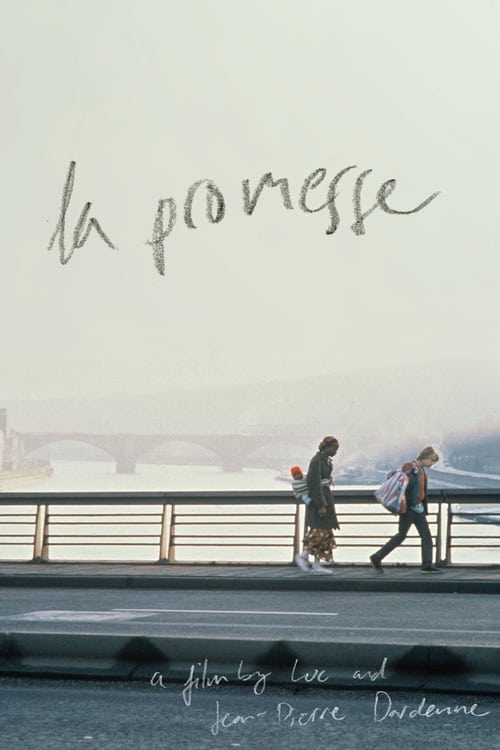
La Promesse
1996 · Jean-Pierre Dardenne
For when you want a film that treats you like an adult — no comfort, no cushioning, just a story that earns every emotion honestly. Reach for it when you want to be moved by something real rather than swept away by something big.
What it's about
In the post-industrial outskirts of Liège, fifteen-year-old Igor helps his father run a small business exploiting undocumented immigrants — housing them, working them, skimming from them. When one of the workers is gravely injured on a construction site, he asks Igor to promise to look after his wife and baby, and the boy is caught between the only father he has and the first moral demand anyone has ever placed on him. It's a coming-of-age story where growing up means choosing whom to betray.
The experience
Raw, urgent, and completely gripping — the handheld camera stays glued to Igor so you live the dilemma at his shoulder, with no music to tell you what to feel. It's tense like a thriller but the stakes are entirely moral, and it leaves you shaken and strangely hopeful.
Performances
A teenage Jérémie Renier is astonishing as Igor — you watch a conscience being born in real time on his face — and Olivier Gourmet makes the father terrifying precisely because he's affectionate, ordinary, and utterly without shame.
The craft
The Dardenne brothers shoot with documentary-honed directness: handheld camera, real locations, no score, work filmed as work — hands, tools, money changing hands. The restraint is the power; because nothing is dramatized, everything feels like it's actually happening. Small-screen friendly, but demands your undivided attention.
Why it matters
The breakthrough that made the Dardenne brothers the most influential moral realists in European cinema — the handheld, at-the-character's-shoulder style they forged here shaped two decades of social-realist filmmaking worldwide.
> A note on attribution: although this dossier is filed under Jean-Pierre Dardenne, La Promesse was directed jointly by Jean-Pierre and Luc Dardenne, who have co-authored every fiction feature of their mature career. The shared signature is not a formality but the working unit of the film, and the account below treats "the Dardennes" as a single directorial intelligence throughout.
Snapshot
La Promesse is the film in which the Dardenne brothers found their voice — the breakthrough that converted two veteran documentarians and political-essay filmmakers into the most influential exponents of European moral realism of the following quarter-century. Igor (Jérémie Renier), a fifteen-year-old apprentice mechanic, helps his father Roger (Olivier Gourmet) run a small empire of exploitation in the post-industrial sprawl around Liège: substandard rooms let to undocumented immigrants, forged papers, confiscated wages, off-the-books labor. When one of Roger's workers, the Burkinabè laborer Hamidou, falls from scaffolding and bleeds to death while Roger hides the accident to avoid an inspection, the dying man extracts a promise from Igor: look after my wife, Assita, and my child. The remainder of the film is the slow, granular drama of a boy honoring that promise against the gravitational pull of his father. Stripped of music, shot on a restless handheld camera at the height of a fifteen-year-old's shoulders, and built around two unknown faces, La Promesse established the template — ethical rather than psychological, observational rather than expository — that would carry the Dardennes to two Palmes d'Or.
Industry & production
La Promesse was a modest Franco-Belgian-Luxembourgian co-production, produced through the Dardennes' own Liège company Les Films du Fleuve (the fiction successor to their long-running production house Dérives) in partnership with French and Luxembourg outfits. It was made on a small budget characteristic of regional European art cinema of the mid-1990s, sustained by the patchwork of subsidies — Belgian and Luxembourg national funds, French co-production money, European support schemes — on which Walloon filmmaking depended.
The crucial industrial fact is that La Promesse was a deliberate reset. The Dardennes' previous fiction feature, Je pense à vous (1992), had been a comparatively conventional production with a professional crew, a recognized cinematographer, and a more orthodox shooting method; the brothers have repeatedly described it as a failure — a film that did not sound like them. La Promesse was their answer: a self-consciously reduced, self-owned production in which they reclaimed total authorship of method as well as material. By producing it themselves in their home region, they bought the freedom to rehearse exhaustively, to shoot in sequence where possible, and to refuse the industrial conveniences (coverage, score, star casting) that they felt had betrayed the earlier film.
The film premiered in 1996 at the Quinzaine des Réalisateurs (Directors' Fortnight) in Cannes — a parallel, non-competitive section rather than the main competition — and its reception there launched the brothers internationally. It traveled the festival circuit widely and accumulated critics' citations and smaller festival prizes over the following year; precise award tallies vary by source and I will not invent a list. What is uncontested is that it functioned as a discovery: it put the Dardennes, Renier, and Gourmet on the international map essentially at once.
Technology
La Promesse belongs to the era and aesthetic of lightweight celluloid realism just before the digital turn. It was shot on film in the 1.66:1 / 1.85:1 register of European art cinema, using portable cameras suited to long, mobile handheld takes; sources commonly describe the brothers working in 16mm-derived workflows in this period, and the texture of the image — grainy, available-light, unglamorous — is consistent with that lineage. (Where the exact gauge is contested across reference sources, I flag it rather than assert a single figure.)
The decisive "technology" here is less the camera body than the rig and the discipline around it: a handheld apparatus light enough to follow a teenager through stairwells, garages, and muddy lots, and a sound and lighting practice that refused studio control in favor of real locations. The Dardennes' technical choices are subtractive. There is no Steadicam smoothing, no dolly elegance, no artificial fill that would prettify the Seraing interiors. The image is built to feel found rather than composed — a tool deployed in service of an ethic of proximity.
Technique
Cinematography
Shot by Alain Marcoen, the brothers' regular director of photography, the film's camera is its argument. Marcoen and the Dardennes keep the lens close to Igor — frequently behind him, on his neck and shoulders, so that the viewer is bound to the boy's body and denied the comfort of an establishing overview. The handheld frame is reactive: it lurches, recomposes, loses and recovers its subject, refusing the omniscience of classical coverage. Available and practical light dominates, yielding a flat, overcast palette of grays, browns, and the sodium tones of working interiors. There are no master-shot reassurances; space is revealed only as the characters move through it, which keeps the spectator in a permanent state of moral and physical uncertainty. This proximity is not stylistic decoration but the film's epistemology — we know only what Igor is near enough to know.
Editing
Cut by Marie-Hélène Dozo, the Dardennes' long-term editor, La Promesse favors duration over compression. Scenes run on past the point a conventional drama would cut, holding bodies in real time so that decisions accrue weight. The editing resists the manipulative grammar of suspense — there are few reaction-shot punctuations, little cross-cutting for tension — and instead lets moral pressure build through continuity. Crucially, the cutting withholds: it does not flag the "important" beat or italicize the turning point, leaving the viewer to register ethical shifts as they happen, almost unmarked. The rhythm is the rhythm of labor and consequence.
Mise-en-scène / staging
The film is staged in the real geography of the de-industrialized Walloon basin around Liège and Seraing — garages, building sites, cramped rented rooms, roadside cafés, a karaoke bar. Bodies are blocked for work: hammering, mixing concrete, fitting doors, handling cash and documents. The staging is choreographic in its precision while appearing wholly unforced; the Dardennes rehearse movement until the camera can find it organically. Props carry the moral plot — a passport, a ring, a chain, a wad of banknotes, the wet concrete in which Hamidou's body is hidden. The mise-en-scène insists on the material substrate of ethics: promises are kept or broken through physical acts in actual rooms, not through speeches.
Sound
La Promesse uses no non-diegetic score. This is one of the defining choices of the Dardenne style and it begins, fully formed, here. The soundtrack is the world's own: engines, drills, footsteps on stairs, traffic, the karaoke machine that scores the one moment of father-son intimacy. The absence of music removes the conventional cue for how to feel, throwing emotional interpretation back onto the spectator and refusing to sentimentalize either the cruelty or the tenderness. Diegetic music — the karaoke duet between Igor and Roger — lands all the harder precisely because it is the only "music" the film permits, and it humanizes the exploiter at the very moment we are learning to condemn him.
Performance
The film is a landmark of non-professional and first-time casting. Jérémie Renier, an unknown adolescent, plays Igor in his screen debut and carries the picture with a watchful, near-affectless presence; his withholding is the performance, the moral drama legible in small adjustments of attention rather than emoting. Olivier Gourmet, then little known, makes Roger genuinely frightening because genuinely ordinary — a father whose love and predation are inseparable. Assita Ouédraogo plays Assita, the widow, with a guarded dignity that refuses victim pathos. The Dardennes' direction of actors is behavioral: long rehearsal, suppression of theatrical signaling, an emphasis on doing rather than expressing. The result is a register of performance that reads as caught rather than acted.
Narrative & dramatic mode
The film operates in a mode of ethical realism rather than psychological drama. It is built not on backstory or motivation but on a single moral predicament dramatized through action: a promise made, and the cost of keeping it. The narration is rigorously restricted to Igor; we learn what he learns, we are present at what he witnesses, and the film never cuts away to explain or contextualize. There is no voiceover, no flashback, no expository scaffolding. The structure is a gradual, almost imperceptible defection — Igor does not "decide" to break with his father in a single dramatic beat but is drawn, act by concrete act, toward responsibility for Assita. The climactic revelation, when Igor finally tells Assita the truth about her husband's death, is staged with extraordinary restraint and then simply stops, refusing catharsis or resolution. The dramatic mode is parable-like in its moral clarity and documentary-like in its texture — a combination that is the Dardennes' signal achievement.
Genre & cycle
Nominally a drama, La Promesse is more precisely a work of social realism with the architecture of a moral fable and the coming-of-age skeleton of a Bildungsfilm. It sits at the intersection of the European art film and the cinema of social conscience, and it inaugurated what is effectively a Dardenne genre of their own: the contemporary ethical thriller of the working poor, in which suspense derives not from plot mechanics but from the question of whether a person will do right at unbearable cost. Within the brothers' own body of work it is the first entry in the cycle that continues through Rosetta (1999), Le Fils (2002), L'Enfant (2005), and beyond — films sharing a region, a method, a recurring company of actors, and a single ethical preoccupation.
Authorship & method
The film is the product of an unusually integrated authorship. Jean-Pierre and Luc Dardenne write and direct as a unit, having come up through documentary and video work in the Liège region from the 1970s — politically engaged non-fiction rooted in the Walloon working class and its industrial decline. That documentary apprenticeship is the foundation of the fiction style: the instinct for real places, real labor, and the observational camera. Their method, codified in La Promesse, involves extensive location scouting in their home territory, long rehearsal periods that block action down to the gesture, shooting in continuity where feasible, and a refusal of the consolations of score and conventional coverage.
The key collaborators recur across the filmography and are essential to the authorship: cinematographer Alain Marcoen, editor Marie-Hélène Dozo, and the actor Olivier Gourmet, who became something close to the brothers' on-screen avatar (he would win Best Actor at Cannes for Le Fils). Jérémie Renier, launched here, also became a member of their repertory company. There is, characteristically, no composer — the absence of a musical author is itself an authorial signature. The screenplay is the brothers' own.
Movement / national cinema
La Promesse is a foundational text of contemporary Belgian (specifically Walloon) cinema and one of the touchstones of the broader revival of European social realism in the 1990s. It is rooted in a precise national and regional reality — French-speaking Belgium's de-industrialized Meuse valley, with its shuttered steelworks, its precarious labor, and its newly arrived undocumented migrants. The brothers' work gave this overlooked corner of European life a cinematic identity it had not previously possessed, and made Liège a recognizable map on the festival circuit. Internationally, the film is routinely grouped with the wave of austere, ethically driven realism associated with figures such as Ken Loach in Britain and, later, the Romanian New Wave and kindred filmmakers across Europe — a transnational tendency rather than a formal movement, but one for which La Promesse served as a defining early model.
Era / period
The film is precisely of its mid-1990s moment. Its subject — the exploitation of undocumented African and Eastern European laborers in a post-industrial Western Europe — registers the period's anxieties about migration, the collapse of the old manufacturing economy, and the rise of an informal, lawless service-and-slum economy in its place. Made just before the digital revolution transformed low-budget production, it is a late flowering of lightweight celluloid realism. It also arrived at a moment when the international art-film market was receptive to rigorous, miserabilist-adjacent realism, and it helped define the tone of "serious" European cinema for the years that followed.
Themes
The film's governing theme is responsibility to the Other — the moment at which a person is claimed by another's need and must answer. Critics have frequently read the Dardennes through the ethics of Emmanuel Levinas, for whom the face of the other person issues an inescapable moral summons; La Promesse dramatizes exactly this, as the dying Hamidou's plea and Assita's continuing presence impose an obligation Igor cannot rationalize away. Around this core cluster further themes: the father-son bond as both love and corruption, and the wrenching cost of breaking it; complicity and guilt, and whether a debt to the dead can be paid; the commodification of human beings under informal capitalism, where people are reduced to labor, papers, and rent; and moral awakening as action rather than feeling — conscience expressed through what one does with one's hands. Underlying it all is a redemptive, secular-religious current: the possibility of grace in a degraded world, achieved not through epiphany but through small, costly acts of fidelity.
Reception, canon & influence
Critical reception. La Promesse was widely and enthusiastically received as a discovery upon its 1996 festival premiere, and its critical standing has only grown. It is now routinely regarded as the film that announced the Dardennes as major artists and as one of the essential European films of the 1990s, recurring on critics' lists of the decade and on overviews of the best of modern realist cinema. (Specific poll placements vary by source and are not invented here.)
Influences on the film (backward). The brothers' aesthetic descends visibly from several lineages: the spiritual austerity and behavioral, anti-psychological direction of Robert Bresson; the location realism and social compassion of Italian neorealism; the working-class engagement of Ken Loach; and the raw emotional directness of Maurice Pialat. Beneath these cinematic models lies their own decade-plus of documentary practice in the Liège region, which supplied the instinct for real labor and real place that distinguishes the film from studio-bound social drama.
Legacy and what it shaped (forward). La Promesse is the seed of one of modern cinema's most coherent and decorated bodies of work: the Dardennes went on to win the Palme d'Or twice (for Rosetta in 1999 and L'Enfant in 2005), with Le Fils and later films extending the project. Its impact reaches well beyond their filmography. The handheld, music-less, ethically driven realism it crystallized became one of the defining house styles of twenty-first-century world art cinema, visible in the close-following camera and moral-pressure dramaturgy adopted by filmmakers across Europe and beyond — a grammar so absorbed that it now reads as the default mode for serious contemporary realism. The film also launched the careers of Jérémie Renier and Olivier Gourmet and put Walloon cinema permanently on the international map. Few single films of the 1990s can claim to have founded both an authorship and a widely imitated style; La Promesse did both.
A Deleuzian reading
For most of La Promesse the camera rides a few inches behind a fifteen-year-old's neck.
The full Deleuzian reading of La Promesse →
Reception
It broke out of the 1996 Cannes Directors' Fortnight as the surprise discovery of the festival, and three decades on it's seen as the true beginning of the Dardennes — the film where the style that would win them two Palmes d'Or arrived fully formed.
How La Promesse was received, from release to now →
Influences: the films it descends from and the films it influenced
- Pickpocket (1959) — Bresson's anti-psychological 'model' direction — actors stripped of performed emotion and shot in fragments of hands and objects — is the template for the Dardennes' behavioral blocking and their refusal to let faces editorialize.
- Mouchette (1967) — The withholding of musical consolation and the flat, un-cathartic framing of a child's suffering give the Dardennes their grammar of moral pressure without score.
- Bicycle Thieves (1948) — Neorealist location shooting with non-professional casting and a father-son moral crisis driven by a single contested object furnishes the model La Promesse rebuilds around the work permit.
- Rome, Open City (1945) — Rossellini's available-light street shooting and documentary-derived observation of real places established the location realism the Dardennes inherited through their own Liège documentary practice.
- Kes (1969) — Loach's regional working-class engagement, dialect performance, and casting of locals model the social compassion and class-specific texture the Dardennes apply to post-industrial Wallonia.
- L'Enfance nue (1968) — Pialat's raw, unsentimental direction of a working-class child and his elliptical refusal of melodramatic uplift feed directly into the Dardennes' handling of Igor.
- Au Hasard Balthazar (1966) — The Dardennes, who name Bresson foundational, build their fragmented, ethically charged realism on his model of non-professional performers, withheld affect, and moral consequence shown through gesture rather than explanation.
- L'Argent (1983) — Carries forward the moral realism of fragmented bodies, hands and gestures, non-actor performance, and a scoreless soundtrack tracing guilt through concrete labor and exchange.
- Il Posto (1961) — The Dardennes' unadorned observational realism of precarious labor, following a working youth's moral choices without score or explanation, extends Olmi's tender, unflinching attention to the ordinary worker.
- Rosetta (1999) — The method codified in La Promesse intensifies — Alain Marcoen's camera glued to the back of the protagonist's neck, no score, continuity shooting — into the close-following style that won the Palme d'Or.
- Le Fils (2002) — Pushes the shoulder-level handheld to near-abstraction, framing Olivier Gourmet's nape and shoulders so tightly that withheld information becomes the dramaturgy — a direct extension of La Promesse's restricted POV.
- L'Enfant (2005) — Reprises Jérémie Renier and the props-as-moral-plot device (a sold baby in place of a withheld confession), proving the repertory-company and object-driven ethics first set up here.
- The Kid with a Bike (2011) — Continues the father-son corruption and responsibility-to-the-other themes through behavioral direction of a non-professional child, with score admitted only in spare bursts that prove the rule of its general absence.
- 4 Months, 3 Weeks and 2 Days (2007) — Romanian New Wave realism extends the Dardenne grammar — long unbroken takes, no non-diegetic music, restricted POV trailing one protagonist through a single moral ordeal.
- Capernaum (2018) — Handheld camera following a teenage male protagonist entangled in the exploitation of undocumented African migrant workers; the Dardennes establish the ethical grammar of handheld filming as moral accountability for precarious immigration status that cinematographer Christopher Aoun applies throughout Capernaum.
- Maria Full of Grace (2004) — The Dardennes' handheld observation of migration and human trafficking as exploited labor, filmed without sensation, is the template for treating the mule trade as work rather than spectacle.
- Crossing (2024) — Handheld social-realist ethics built around an immigrant underclass, where a moral obligation to a stranger drives the protagonist's arc through unadorned urban locations.
- Souleymane's Story (2024) — Direct parent: undocumented-migrant labor and moral debt shot in restless handheld vérité, the camera bound to a protagonist forced into complicity by economic precarity.
- Ee.Ma.Yau. (2018) — Handheld, shoulder-height observational following of working-class figures under economic strain — the dignity-versus-poverty realism and camera-attached-to-body method behind Shyju Khalid's cinematography.
- Prince of Broadway (2010) — The closest structural template — a young man complicit in an undocumented-labor racket, shot with a shoulder-borne camera held at working height that trails the body through corridors and thresholds, no composed score, and a final beat that stops on unresolved moral admission.
- The Death of Mr. Lazarescu (2005) — Handheld, available-light observation in real institutional spaces and a refusal of catharsis carry the Dardennes' close-following ethics into Bucharest.
- Fish Tank (2009) — Arnold adopts the camera tethered to a non-professional teenager and the regional social-realist texture, plus the props-and-place specificity, as a British inheritance of the Dardenne house style.
- Wendy and Lucy (2008) — Strips score and plot to behavioral observation of a marginal figure in a single bind, sharing the Dardennes' restricted POV and refusal of consolatory resolution.
- The Class (2008) — Documentary-derived handheld coverage of real classroom labor with non-professional casting applies the Dardennes' observational fiction method to institutional space.
- Winter's Bone (2010) — Location shooting in a real depressed region with non-professional support cast and a young protagonist navigating an adult moral economy transposes La Promesse's post-industrial realism to the Ozarks.
- Pusher (1996) — The Dardennes simultaneously developed the camera-follows-body handheld method — framing at neck and shoulder, reacting rather than anticipating action — for tracking protagonists through economic entrapment, an essentially contemporaneous discovery of the same formal solution as Pusher's.
- Biutiful (2010) — The immigrant-underworld exploitation economy plus a father-and-son moral-complicity structure shot in tight verité handheld — the closest social-realist ancestor to Uxbal's people-smuggling guilt.
- Little Odessa (1994) — Independently arrives at the same toolkit — camera pinned behind the head of a boy implicated in his father's criminal economy, no score, immigrant milieu rendered through untranslated languages, moral catastrophe delivered without catharsis.
Similar films
- The Child (2005) — influence & lineage
- The Kid with a Bike (2011) — influence & lineage
- Rosetta (1999) — influence & lineage
- Bicycle Thieves (1948) — influence & lineage
- Young Mothers (2025) — shared sensibility
- Jean de Florette (1986) — shared sensibility
- Humanité (1999) — shared sensibility
- L'Argent (1983) — shared sensibility
All the films related to La Promesse →