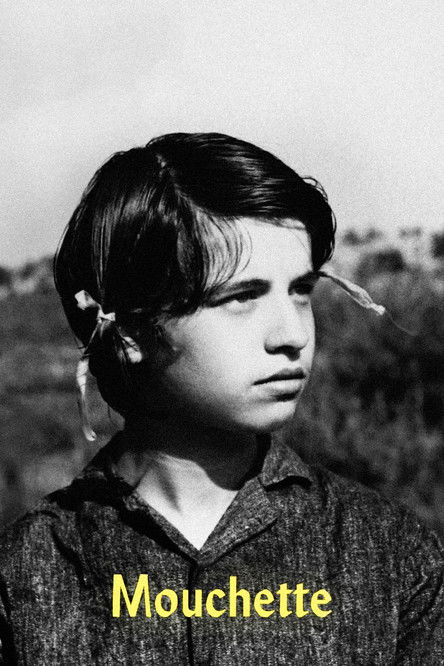
Mouchette
1967 · Robert Bresson
For when you want cinema at its most stripped-down and honest, and you're ready to be genuinely moved — this is challenge, not comfort, at a short and merciful 80-ish minutes. Not the pick for a fragile night.
What it's about
In a poor French village, a girl of about fourteen shoulders more than anyone should: a dying mother, a baby sibling, a drunken father, and schoolmates and adults who treat her with casual cruelty. Over a few days — including one stormy night in the woods with a local poacher — the film follows how she endures, resists, and snatches small moments of defiance and joy where she can.
The experience
Spare, quiet, and devastating. There's no music telling you how to feel and no actorly pleading for sympathy — just precise images and sounds that accumulate until the weight is enormous. A brief scene at a fairground bumper-car ride delivers one of the most piercing flashes of happiness in all of cinema.
Performances
Nadine Nortier, a nonprofessional in her only major screen role, is unforgettable — Bresson strips away all conventional acting, and what's left is a stubborn, wordless presence that stays with you for years.
The craft
Robert Bresson's method is total control through subtraction: nonprofessional performers, elliptical cuts that skip what other films would milk, and a soundtrack of clogs, rain, gunshots, and cart wheels that carries as much meaning as the images. It's a masterclass in how little a film needs to achieve maximum force.
Why it matters
Paired with the film Bresson made just before it, it stands at the summit of his influence — generations of filmmakers pursuing austerity, restraint, and nonprofessional casts trace their lineage straight back to this.
Snapshot
Mouchette is Robert Bresson's adaptation of Georges Bernanos's 1937 novella Nouvelle histoire de Mouchette, his second film drawn from that Catholic novelist after Diary of a Country Priest (1951). It follows a roughly fourteen-year-old girl in a poor French rural village — saddled with a dying mother, an infant sibling, a drunken smuggler father, mocked at school, and finally raped by a poacher during a night in the woods — across a span of a few days that ends in her suicide. Made immediately after Au hasard Balthazar (1966), with which it forms a tightly linked diptych on innocence crushed by a pitiless world, Mouchette is among the purest expressions of Bresson's mature method: nonprofessional "models," elliptical construction, a refusal of psychological performance, and a sound design as expressive as the image. It is frequently named among his greatest works and a touchstone of austere, transcendental cinema. The film premiered in 1967 and was associated that year with the Prix Louis Delluc and recognition at Venice; precise award citations should be checked against primary sources before being asserted as fact.
Industry & production
Mouchette was produced in France in the mid-1960s, financed and distributed within the French art-cinema ecosystem (Argos Films, the company of Anatole and Florence Dauman associated with much of the era's serious cinema, is generally credited as producer; readers should verify the exact production-company attribution against the credits). It belongs to a period when Bresson, never a commercially prolific director, worked on modest budgets supported by the prestige economy of French film culture — state aid mechanisms, festival exposure, and the critical capital he had accrued since the 1940s. The film was shot largely on location in rural France, in and around the Provençal countryside Bresson favored, using the textures of real villages, schoolrooms, cafés, and farms rather than constructed sets.
Bresson's productions were slow and exacting by industry standards. He cast non-actors found through searches in the relevant milieu and rehearsed them toward a flattened, repeatable neutrality rather than expressive interpretation. The lead, Nadine Nortier, was an unknown teenager cast for presence rather than experience, as was his consistent practice. The film's economic scale was small, its ambitions entirely artistic; it was made for a cinephile and festival audience rather than a mass market, and it functioned within the industry as a work of authorial prestige.
Technology
Mouchette was shot on 35mm black-and-white film, the format Bresson retained for this work even as color was becoming the commercial norm; he would not move to color until Une femme douce (1969). The monochrome is integral, not nostalgic: it abstracts the rural poverty into a grave, tonal register and concentrates attention on faces, hands, and objects. The technology is otherwise unremarkable by design — Bresson sought no spectacle from the apparatus. What is notable is the role of synchronized and post-synchronized sound: location and studio sound were marshaled with great precision, and the film's expressive force depends heavily on the recording and mixing of discrete, isolated noises (a moped engine, a rifle, dodgem cars, water, footsteps) given unusual prominence in the mix. The optical and acoustic means are conventional for the period; the artistry lies wholly in their disciplined selection.
Technique
Cinematography
The cinematography is credited to Ghislain Cloquet, who also shot Au hasard Balthazar and was among the finest French cinematographers of the era. The black-and-white photography is sober and unadorned: even, often overcast natural light; medium and close framings that isolate gestures and fragments of bodies; a camera that holds steady and observes rather than dramatizes. Bresson's framing characteristically privileges hands, feet, and partial views over establishing geography or expressive faces, and the camera moves only when motivated — following an action, never editorializing. The famous sequence at the bumper-car ride, where Mouchette experiences a brief flicker of joy and connection, is built from glances and movement rendered with rare warmth against the prevailing austerity. The visual grammar resists beauty-for-its-own-sake; its restraint is the point.
Editing
Editing — long central to Bresson's aesthetic — is where the film's meaning is largely made. Bresson constructs through ellipsis and fragmentation: actions are broken into discrete shots, often of parts rather than wholes, and assembled so that the cut, not the performance, carries emotion. Crucial events may be withheld, glimpsed obliquely, or registered through their aftermath and through sound. The rhythm is measured and exact; Bresson spoke of cinema as an art of relations between images and sounds, and the cutting here enacts that principle. The film's most devastating moment — the suicide, accomplished by rolling down a slope into a pond — is staged and cut with extreme economy, refusing climax or catharsis. The editing's deliberate withholding is precisely what makes the ending land.
Mise-en-scène / staging
Bresson's staging is anti-theatrical. Bodies are positioned and moved with a choreographic precision aimed at neutrality; gestures are repeated until drained of "acting." The mise-en-scène foregrounds objects and the material world — clogs, a bowl of coffee laced with gin, a rifle, a snared bird, mud and water — as the carriers of moral and spiritual weight. Spaces are real and humble: the schoolroom, the café, the family's cramped home, the woods at night. The staging refuses to underline; it presents the world's hardness plainly and lets the spectator feel its accumulation.
Sound
Sound is arguably the film's most radical achievement. Bresson treated sound not as accompaniment to image but as an equal, sometimes superior, expressive channel — "when a sound can replace an image, cut the image or neutralize it," he wrote in Notes on the Cinematograph. Isolated, amplified noises punctuate the film: the whine of the poacher's moped, the report of a gun, the mechanical clatter of the fairground, the rush of water. These sounds often carry events the image declines to show, and their precise, almost abstract deployment creates a heightened sensory reality. Music is used sparingly; the spareness makes its rare appearances weighty.
Performance
Bresson did not direct actors; he directed "models." Nadine Nortier as Mouchette delivers no conventional performance in the sense of psychological interpretation — she is asked to move, speak, and look with a stripped neutrality from which feeling emerges by implication rather than display. The supporting figures (the poacher Arsène, the father, the gamekeeper, the village women) are similarly flattened. The effect is paradoxical and central to Bresson's theory: by denying performed emotion, the films allow a deeper, unfeigned interiority to register on the spectator. Mouchette's blankness becomes a screen onto which her suffering and her brief moments of grace are projected with overwhelming force.
Narrative & dramatic mode
The narrative is linear in its few-day span but profoundly elliptical in execution. It is a chronicle of accumulating indignities rather than a plotted drama with reversals and resolutions; cause and effect are present but never explained psychologically. The dramatic mode is one of observation and withholding — Bresson refuses the consolations of melodrama even as the events are, in summary, melodramatic. The film's power comes from the gap between the brutality of what happens and the restraint with which it is shown. The ending, in which Mouchette deliberately rolls into the pond after a third, failed attempt, is presented without explanatory grief or moralizing; it is at once a defeat and, in the Bressonian-Bernanosian framework, a possible release — a question the film leaves open rather than answers.
Genre & cycle
Nominally a drama, Mouchette sits within the tradition of social-realist rural portraiture but transforms it through Bresson's spiritual-formalist lens. It belongs most clearly to the cycle of Bresson's "Bernanos films" alongside Diary of a Country Priest, and to the broader sequence of his films about persecuted innocents — most directly Au hasard Balthazar, with which it shares the structure of a guileless creature destroyed by human cruelty. It also anticipates the later "studies of the trapped" (Une femme douce, The Devil, Probably, L'Argent) in which suicide or moral collapse follows from an unlivable world. It is an art film par excellence, defined by authorship rather than genre convention.
Authorship & method
Robert Bresson (1901–1999) is the film's total author in the sense his own theory demands. By 1967 he had fully articulated the "cinematography" he opposed to mere filmed theater: nonprofessional models, the suppression of acting, fragmentation and montage, the autonomy of sound, and the pursuit of an austere spiritual realism. Mouchette is one of the clearest demonstrations of these principles, later codified in his Notes sur le cinématographe (published 1975). His key collaborators here were among his most important: cinematographer Ghislain Cloquet (shared with Balthazar) and editor Raymond Lamy, a frequent Bresson cutter whose work realized the director's exacting montage. The adaptation was Bresson's own, faithful to Bernanos's novella in event while wholly Bressonian in form. The film uses music by Claudio Monteverdi (the Magnificat) at key points; specific cue placements and any additional original music should be confirmed against the credits rather than asserted from memory.
Movement / national cinema
Bresson is a singular figure who stands apart from movements while being claimed by several. He was revered by the Cahiers du cinéma critics and the Nouvelle Vague as a model of pure authorship — an auteur in the strongest sense — yet his slow, ascetic practice belongs to no school. Mouchette appeared at the tail of the French New Wave's first wave and amid the politicized ferment that would erupt in May 1968, but it is untouched by the New Wave's stylistic playfulness. Within French national cinema, Bresson represents a high modernist, spiritual tradition distinct from both mainstream "cinema of quality" (which he detested) and New Wave iconoclasm. Internationally, he is the central figure of what Paul Schrader theorized as "transcendental style," alongside Ozu and Dreyer.
Era / period
The film is a product of the mid-1960s European art cinema at its height — a moment of intense formal experimentation and seriousness, when directors like Antonioni, Bergman, Dreyer, and Bresson commanded critical authority and festival prestige. It precedes by a year the political rupture of 1968, and though Bresson's concerns are metaphysical rather than topical, the film's unsparing view of rural poverty, social cruelty, and institutional indifference resonates with the period's interrogation of French society. Made between Balthazar (1966) and Une femme douce (1969, his first color film), it marks the close of Bresson's black-and-white period and a high point of his middle-to-late career.
Themes
The governing theme is innocence destroyed by a fallen world — grace glimpsed amid relentless cruelty. Mouchette endures poverty, illness, abuse, humiliation, and rape; the film catalogs the ways community, family, and institution fail the vulnerable. Yet Bresson, working from Catholic Bernanos, frames her suffering within a spiritual economy: her death is ambiguous, readable as despair and as deliverance, even as a dark kind of grace. Recurrent motifs — the snared bird and the hunted game, water, the contrast between mechanical cruelty and momentary joy (the bumper cars) — articulate the film's vision. Other themes include the brutality and solidarity of the poor, the indifference of the respectable, the muteness of suffering, and the impossibility of consolation in human terms. Bresson resists didactic resolution: the film poses the problem of innocent suffering without resolving it, leaving its theological dimension as a haunting question.
Reception, canon & influence
Mouchette was received as a major work by serious critics on release and has only grown in stature, routinely cited among Bresson's finest films and among the canonical works of European art cinema. It was honored at the time within French and international film culture (it is commonly associated with the 1967 Prix Louis Delluc and with recognition at the Venice Film Festival; exact citations should be verified against authoritative records). Its critical legacy was secured by its restoration and home-video circulation, including a Criterion Collection edition that consolidated its standing among English-language cinephiles.
Looking backward, the film's deepest influence is Georges Bernanos, whose Catholic vision of grace, sin, and suffering shaped both this film and Diary of a Country Priest. Formally, Bresson's mature method was self-generated across his prior films (A Man Escaped, Pickpocket, Balthazar), drawing distantly on the spiritual gravity of Dreyer. Looking forward, Mouchette has been enormously influential on filmmakers committed to austerity, ellipsis, and the dignity of the marginalized: the Dardenne brothers' handheld moral realism, the rigorous compositions and worldview of Michael Haneke, Aki Kaurismäki's deadpan restraint, and the broader strain of "slow cinema" all bear Bresson's mark, with Mouchette and Balthazar the most cited touchstones. Paul Schrader's Transcendental Style in Film enshrined Bresson — and this period of his work — as foundational theory. The film's image of a child's suffering, refused all sentimentality, remains a benchmark for how cinema can confront cruelty without exploiting it.
A Deleuzian reading
Start with her hands.
The full Deleuzian reading of Mouchette →
Reception
Mouchette was acclaimed pretty much from its 1967 Cannes premiere — no rescue-from-obscurity story here — but its stature has only hardened since, boosted by Paul Schrader's 'transcendental style' framing and a Criterion canonization that made it the entry-level 'serious Bresson' pick.
How Mouchette was received, from release to now →
Influences: the films it descends from and the films it influenced
- Diary of a Country Priest (1951) — Bresson's first Bernanos adaptation establishes the diaristic ellipsis and austere Catholic grace-through-suffering structure that Mouchette reworks without the voiceover.
- A Man Escaped (1956) — Pioneers sound-as-equal-channel — amplified off-screen noises and isolated mechanical sounds carrying narrative weight — that Mouchette extends to the bumper cars and forest.
- Pickpocket (1959) — Codifies the non-professional 'model' drained of expression and the montage of isolated gestures (hands, objects) that Mouchette applies to a child's body.
- The Passion of Joan of Arc (1928) — Dreyer's fragmentary, decontextualized close framing of a suffering face refusing theatrical performance is the visual grammar Bresson inherits for filming humiliation.
- Ordet (1955) — Its slow spiritual gravity and withholding of the miraculous climax model the 'transcendental style' Schrader later traces straight into Bresson.
- Bicycle Thieves (1948) — Establishes non-professional casting and location social realism around the dispossessed — the naturalist tradition Bresson radicalizes by stripping the 'acting' De Sica still sought.
- La Strada (1954) — Bresson's female holy fool in rural France — victimized by a brutish social order, carrying invisible grace through expressionless endurance — refines La Strada's secular parable structure; the elliptical editing that withholds cathartic release until a final elemental act and the technique of ambient natural sound as emotional register rather than scored punctuation push the formal devices of La Strada toward austerity.
- Stromboli (1950) — Female entrapment in a suffocating provincial milieu rendered through non-editorial observation: Bresson carries Rossellini's refusal to explain or motivate the female protagonist's suffering forward into a systematic withholding of psychological access, the camera patient where classical Hollywood would cut.
- The Loneliness of the Long Distance Runner (1962) — Bresson takes Richardson's withholding-performance method to its formal extreme, showing a working-class girl's body conscripted and damaged by institutional forces — school, church, family — with the same refusal of cathartic resolution, ending in self-annihilation rather than defiance.
- Europa '51 (1952) — Bresson carries the hagiographic-as-social-verdict structure — passive female protagonist whose spiritual extremity is rendered through behavioral close attention and ambient sound, the institution of rural community performing the same judgment as Rossellini's asylum — into his most austere register of observational continuity.
- The Trial of Joan of Arc (1963) — Continues the subtraction method—concrete-sound design and blank-faced non-professional lead—to render a passion and death without hagiographic spectacle.
- L'Enfance nue (1968) — Pialat takes Bresson's unsentimental child-in-distress and non-professional casting into raw foster-care realism the year after Mouchette.
- Vagabond (1985) — An elliptical chronicle of a marginalized young woman's death-foretold, assembled from fragmentary encounters that refuse psychological explanation, directly descended from Mouchette's structure.
- The Seventh Continent (1989) — Haneke adopts Bresson's fragmentary framing of hands and objects plus amplified isolated sound to render bourgeois despair without dramatized emotion.
- The White Ribbon (2009) — Confronts cruelty toward and among children in austere black-and-white, withholding the explanatory climax exactly as Bresson refuses to sentimentalize Mouchette's torment.
- The Match Factory Girl (1990) — Kaurismäki's affectless, neutral performances and deadpan restraint chronicling a humiliated working-class woman are a direct stylization of Bresson's model acting.
- La Promesse (1996) — The Dardennes graft Bresson's moral seriousness about the dignity of the marginalized onto handheld immediacy and non-professional immediacy.
- Rosetta (1999) — A relentless chronicle of a poor young woman's struggle, withholding interiority and ending abruptly, transposing Mouchette's compassion-without-pity into kinetic realism.
- The Turin Horse (2011) — Slow-cinema austerity built on repetition, amplified ambient sound, and the suffering of the humble, extending the Bresson/Balthazar line of patient attention to the abused.
- First Reformed (2017) — Schrader directly applies his own 'transcendental style' theory — static framing, withheld emotion, spiritual crisis ending in a suspended gesture — that he built on Bresson's 1960s films.
- Young Mothers (2025) — The cornered adolescent girl whose dignity is observed without score or sentiment is the direct precursor to the Dardennes' young women filmed under unrelenting moral pressure.
- Breaking the Waves (1996) — Bresson's accumulative documentation of a rural girl's sexual abjection and final drowning, refusing emotional editorializing through non-diegetic score or expressive close-up, establishes the martyrology template von Trier inherits and deliberately inverts—replacing Bressonian distance with relentless facial close-up while retaining the structure of suffering-without-redemption-until-grace.
- The Piano Teacher (2001) — Bresson's 'model' performance method — stripping the actor of expressive gesture until behavior becomes revelation rather than communication — is the precise subtractive mode Haneke demands of Huppert throughout, most visibly in the peep-show and self-harm sequences.
- Au Hasard Balthazar (1966) — Shot by the same DP Ghislain Cloquet a year earlier, it shares the episodic chronicle of an innocent (a donkey) abused across a rural community, the direct formal twin to Mouchette.
- The 400 Blows (1959) — A contemporaneous French portrait of a child crushed by institutional and parental neglect, ending on an unresolved flight that rhymes with Mouchette's refusal of catharsis.
- Nights of Cabiria (1957) — Bresson's sustained close-up tracking of a female adolescent's resistant consciousness through episodic social humiliation—without redemptive arc, the portrait building through accretion alone—is the most formally rigorous parallel development of the neorealist female-protagonist method.
- Small Things Like These (2024) — Childhood/working-class suffering observed at close proximity with sparse sound and refusal of sentiment; its diegetic-ambient austerity and unblinking watching of an institution's cruelty inform the film's observational grammar.
- The Headless Woman (2008) — Foundational for the off-screen soundscape as narrative engine — events and violence heard but not shown, source sound privileged over score, forcing meaning into the acousmatic space Martel radicalizes.
- First Cow (2020) — Source of the flattened, non-declamatory performance register and the weight given to hands, objects and material culture over psychological explanation.
Similar films
- Au Hasard Balthazar (1966) — influence & lineage
- Pickpocket (1959) — influence & lineage
- Diary of a Country Priest (1951) — influence & lineage
- Vagabond (1985) — influence & lineage
- The 400 Blows (1959) — influence & lineage
- Rosetta (1999) — influence & lineage
- A Man Escaped (1956) — influence & lineage
- Au Revoir les Enfants (1987) — shared sensibility
All the films related to Mouchette →