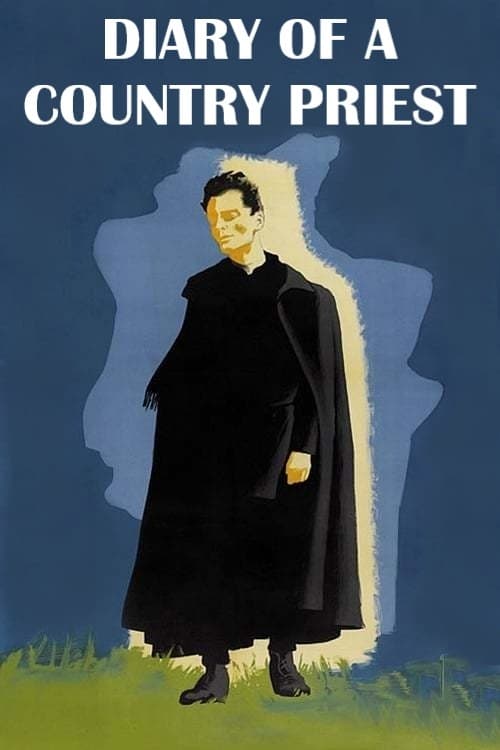
Diary of a Country Priest
1951 · Robert Bresson
For when you want silence and seriousness — a film to sit with alone, late, when you're ready to be moved by something that refuses to entertain you. Challenge, not comfort, but the kind that stays with you for weeks.
What it's about
A young priest, frail in body and new to the job, arrives at his first parish in a bleak village in northern France. The locals meet him with indifference and quiet cruelty — the schoolgirls mock him, the local gentry keep their secrets, and his attempt to help with one family's private misery blows up into scandal. He pours it all into his diary, which we hear him read as he struggles to keep faith alive in a place that seems determined to starve it.
The experience
Stark, hushed, and slow-burning — it strips away everything a drama usually leans on and leaves you alone with one man's inner voice. It's heavy going in the best sense: the austerity gets under your skin, and the ending lands with a force the quiet never prepares you for.
Performances
Claude Laydu, as the priest, gives one of cinema's great haunted faces — Bresson stripped his acting down to almost nothing, and what's left reads as pure interior life.
The craft
Bresson tells the story through the diary itself — a hand writing, a voice reading, images that echo the words rather than illustrate them — and cuts away from every big scene a conventional film would milk. The black-and-white images are plain and wintry, and the restraint is the point: by withholding everything, the film makes the smallest gesture enormous. It rewards total attention in a quiet room.
Why it matters
This is the film where Bresson's famous method crystallized, and it became the founding text of what critics call transcendental or spiritual style — a touchstone for generations of filmmakers drawn to austerity and faith on screen.
Snapshot
Journal d'un curé de campagne is the film in which Robert Bresson became fully himself. Adapted from Georges Bernanos's 1936 Catholic novel, it follows a young, ailing priest assigned to his first parish in the bleak Artois village of Ambricourt, where he meets indifference, mockery, and quiet cruelty while privately enduring spiritual desolation and the stomach cancer that is killing him. Bresson tells the story largely through the priest's diary — a hand writing, a voice reading, images that double rather than illustrate the words — and arrives at a cinema of radical reduction: flat affect, suppressed performance, withheld climaxes, and an austerity that converts narrative defeat into spiritual transparency. It is the keystone of what Paul Schrader would later name "transcendental style," and one of the most influential religious films ever made. Its closing line — the report that the priest died murmuring "Tout est grâce" (All is grace), over the image of a bare cross's shadow — is among the canonical endings of postwar cinema.
Industry & production
The film was produced within the French studio system of the early Fifties, financed and distributed through Union Générale Cinématographique (UGC), with production credited to Léon Carré. It was a prestige literary adaptation of a revered author — Bernanos had died in 1948, and his fiction carried significant cultural weight in Catholic and literary France — which gave Bresson both leverage and scrutiny.
The project had a tangled pre-history. An earlier adaptation had reportedly been developed by other hands in the "tradition of quality" mode (the screenwriting school associated with Jean Aurenche and Pierre Bost), and Bernanos himself was said to be hostile to liberties taken with his text. Bresson, taking the project over, insisted on extreme fidelity to the novel's language, discarding the prior treatment and writing his own adaptation drawn closely — often verbatim — from Bernanos's prose. The exact contractual chronology is recounted variously in the literature and some details are uncertain; what is firmly established is that Bresson fought for and obtained the right to preserve Bernanos's words rather than to "cinematize" them.
Bresson came to the film as a still-emerging director with only two prior features — Les Anges du péché (1943) and Les Dames du Bois de Boulogne (1945) — both made with professional actors and conventional dramaturgy. Diary was where he broke from that apparatus. He worked with his lead for an extended preparation period and rehearsed obsessively, a slow, exacting method that would define the rest of his career. The film was a critical success on release, taking the Louis Delluc Prize and earning honors at the Venice Film Festival, and it established Bresson as a major artist rather than a promising adapter.
Technology
Standard for its moment: 35mm black-and-white photography in the Academy ratio (roughly 1.37:1), monophonic optical sound, studio-and-location shooting in the French countryside and on built interiors. There is nothing technologically novel in the apparatus. What matters is how conventionally Bresson deployed it and how unconventionally he subtracted from it — refusing the expressive lighting, the lush scoring, and the camera flourishes that the same equipment routinely produced in prestige cinema of the period. The "technology" of the film is essentially a poverty of means imposed deliberately on an ordinary toolkit.
Technique
Cinematography
The photography is by Léonce-Henri Burel, a veteran whose career reached back to silent cinema (he had worked with Abel Gance) and who would shoot several subsequent Bresson films, including A Man Escaped and Pickpocket. The images are gray, even, and undramatic — overcast light, plain interiors, faces isolated in close or medium shot. Burel and Bresson largely avoid chiaroscuro theatrics; the visual world is muted and damp, matching the priest's physical and spiritual exhaustion. The camera tends to hold, to frame frontally, and to attend to fragments — hands, a face, an object — rather than to compose grand pictorial tableaux. This restraint is itself the style: the refusal of beauty as persuasion.
Editing
Cut by Paulette Robert, the film advances through a montage of small, often elliptical units rather than dramatic build. Bresson's editing is governed by the diary structure: scenes are introduced, interrupted, or summarized by the writing and the voice, so that cause and consequence are frequently separated, and emotional peaks are clipped or elided. The rhythm is patient and accretive. Crucially, the cutting often privileges aftermath over event — we see the trace of an action rather than its climax — a principle Bresson would refine throughout his work and which gives the film its characteristic sense of withholding.
Mise-en-scène / staging
Bresson strips the frame. Gestures are pared to essentials; actors are positioned and moved with a near-musical precision; ornament is removed. The recurring physical motifs — the priest's meager diet of stale bread soaked in cheap wine and sugar (a near-blasphemous, self-destroying inversion of the Eucharist that is also literally poisoning him), the diary and pen, doorways and thresholds, the bicycle, the bottle — accrue meaning through repetition rather than emphasis. Staging is frontal and undemonstrative; the village is a place of closed faces and shut doors. The settings feel observed rather than decorated.
Sound
Sound is central to Bresson and already highly developed here. The score by Jean-Jacques Grünenwald, an organist-composer, is used sparingly; Bresson distrusted music as emotional underlining and would soon nearly eliminate it from his films. Far more important is the soundtrack of plain noises and, above all, the human voice. The diary's voiceover is not conventional narration but a structural counterpoint: the priest reads what he writes, and the spoken text frequently coincides with, anticipates, or shadows the image, producing a doubling that André Bazin singled out as the film's formal discovery. Ambient sound — bells, wind, footsteps, the scratch of the pen — carries the world's texture in the absence of swelling music.
Performance
This is the film in which Bresson began developing his theory of the actor as "model" — the non-theatrical, affect-suppressed presence that he would later codify in Notes on the Cinematograph. Claude Laydu, in his screen debut, plays the priest with a drained, inward stillness, his suffering registered through fatigue and small physical signs rather than emoted feeling. Bresson worked with him at length to flatten conventional expressiveness into something more transparent and involuntary. The supporting cast — Nicole Ladmiral as the embittered Chantal, Jean Riveyre as the Count, Marie-Monique Arkell as the grieving Countess, Adrien Borel as the robust curé of Torcy, Antoine Balpêtré as Dr. Delbende — observe the same discipline of restraint, though Laydu's transparency is the film's emotional center.
Narrative & dramatic mode
The film is structured as a journal: a first-person spiritual record that we both read (the written page) and hear (the voice). This double inscription is the dramatic engine. Rather than dramatize events directly, Bresson filters them through the priest's act of writing, so that the film is at once a record of failure and the consciousness reflecting on it. The mode is confessional, interior, and processional — a via dolorosa rather than a plotted arc. Its one sustained dramatic set-piece, the long scene in which the priest confronts the Countess, hardened by grief over her dead son, and wrenches her toward grace shortly before her sudden death, stands out precisely because the surrounding film so consistently refuses such intensity. The narrative is one of accumulating defeat — illness, scandal, misunderstanding, abandonment — that the film reframes, in its final movement, as hidden victory.
Genre & cycle
Nominally a literary drama, the film belongs more truly to a small and rarefied category: the religious or spiritual film conceived not as inspirational uplift but as an account of interior agony. It sits alongside the work of Carl Theodor Dreyer (Ordet, Day of Wrath) and, later, Bresson's own A Man Escaped and Pickpocket, as part of a cycle of films that treat grace and transcendence as formal problems. Within Bresson's filmography it inaugurates the mature cycle — the run of austere, first-person, prison-like spiritual dramas that defines his reputation.
Authorship & method
Diary is the decisive document of Bresson's authorship. Here he consolidated the principles he would pursue for three decades: extreme textual or narrative fidelity married to extreme stylistic subtraction; the actor as "model" rather than performer; the primacy of sound and the fragment; the rejection of theatrical and psychological acting; the conviction that meaning emerges from relation and rhythm, not expression. His key collaborators on the film point forward as well as back: cinematographer Léonce-Henri Burel would become his regular cameraman; composer Jean-Jacques Grünenwald supplied a score Bresson used minimally, foreshadowing his near-total later abandonment of music; editor Paulette Robert realized the elliptical, aftermath-weighted cutting that the diary structure demanded. The writer of record is Bresson himself, but in a real sense the co-author is Georges Bernanos, whose novel supplies not only the story but much of the literal language — a collaboration with a dead author that Bresson treated as a discipline rather than a constraint.
Movement / national cinema
The film is French but stands deliberately apart from the dominant currents of its national cinema. It is the antithesis of the "tradition of quality," the polished literary-adaptation mode that the young critics of Cahiers du Cinéma would soon attack — even though Diary is itself a literary adaptation, it adapts by an opposite method, refusing to "open up" or psychologize the source. This made Bresson a hero to the future New Wave critics: André Bazin championed the film at length, and figures like François Truffaut and Jean-Luc Godard would treat Bresson as a model of personal authorship. He belongs to no school; he is, with Dreyer, one of the founding figures of a transnational tradition of ascetic spiritual cinema.
Era / period
Made in the early 1950s, in a France still close to the Occupation and within a Catholic intellectual culture in which Bernanos's anguished, anti-complacent faith carried real charge, the film reflects a postwar preoccupation with suffering, complicity, and grace. It predates the Nouvelle Vague's eruption (1959) while helping to make it imaginable, and it arrives at the moment when European art cinema was beginning to claim interiority and spiritual seriousness as its distinctive province against Hollywood spectacle.
Themes
The governing theme is grace — its hiddenness, its arrival through failure, its independence from worldly success. The priest is a figure of the hidden saint whose ministry appears to accomplish nothing and whose sanctity is invisible to those around him. Bresson dwells on spiritual desolation, the dark night in which God seems absent precisely to the most faithful; on the priest's Gethsemane, his agony in the garden, made literal in his physical collapse. The body is inseparable from the soul here: the bread-and-wine diet that mimics communion while destroying his stomach binds Eucharist, sustenance, and self-immolation into one image. Other recurring concerns are the imitation of Christ through suffering, the solitude of vocation, the cruelty of a closed rural community, and the paradox that defeat in the world may be the very form of redemption. The final "All is grace" gathers these into a single, hard-won affirmation that the film has earned rather than asserted.
Reception, canon & influence
The film was acclaimed on release, winning the Louis Delluc Prize and earning recognition at Venice, and it transformed Bresson's standing. Its most consequential early champion was André Bazin, whose essay (collected in What Is Cinema?) argued that the film achieves fidelity to Bernanos not by translating the novel into images but by respecting the text as text — letting the written and spoken word stand in dialectical tension with the image, so that the film redoubles the book rather than replacing it. Bazin treated this as a breakthrough in the theory of adaptation itself.
Influences on the film (backward): the literary source is paramount — Bernanos's novel supplies structure, theme, and language. Behind Bresson's developing method lie the example of Carl Theodor Dreyer's spare, face-centered spiritual cinema and a broader Jansenist-inflected Catholic sensibility often noted in Bresson's outlook; the writing-and-voice structure also draws on the first-person diaristic tradition of the novel itself.
Legacy (forward): the film's reach is enormous relative to its quiet surface. It is the central exhibit in Paul Schrader's Transcendental Style in Film: Ozu, Bresson, Dreyer (1972), the book that named and theorized the ascetic, withholding mode of religious cinema; Schrader's own First Reformed (2017) is an explicit homage, transposing the diary, the illness, the doubting clergyman, and the spiritual agony to a contemporary American setting. Bresson himself extended the film's discoveries through A Man Escaped and Pickpocket, and the method radiated outward to filmmakers who prize restraint and moral seriousness — among them Andrei Tarkovsky and Martin Scorsese, who have acknowledged Bresson's importance, and a later lineage of austere European directors including the Dardenne brothers and Michael Haneke. More broadly, Diary of a Country Priest helped establish that the most intense drama could be staged through withdrawal — that a camera holding on an unmoving face, a flattened voice, and a withheld climax could carry more spiritual weight than any conventional display. Few films have so durably shaped the grammar of seriousness in art cinema.
A Deleuzian reading
A hand moves across a page.
The full Deleuzian reading of Diary of a Country Priest →
Reception
A critical triumph in France on release — André Bazin hailed it in one of the most famous essays in film criticism — and it's only climbed since, canonized by Paul Schrader's 'Transcendental Style in Film' as exhibit A of spiritual cinema.
How Diary of a Country Priest was received, from release to now →
Influences: the films it descends from and the films it influenced
- The Passion of Joan of Arc (1928) — Dreyer's fragmented frontal close-ups of a suffering face, stripped of theatrical gesture, are the direct precedent for Bresson's frontal-fragment framing and the face as the site of withheld spiritual drama.
- Vampyr (1932) — Its drained, greyscale atmospherics and disquiet built from ambient sound and absence rather than incident model the austere sensory subtraction Bresson pursues.
- Les Dames du Bois de Boulogne (1945) — Bresson's own prior film, where he began flattening dialogue delivery and excising psychological 'acting,' is the laboratory step toward the actor-as-model method consolidated here.
- Day of Wrath (1943) — Codifies the transcendental restraint Dreyer modeled — flattened affect, withheld performance and spiritual weight built through duration rather than incident.
- La Roue (1923) — Léonce-Henri Burel carries his La Roue discipline into Bresson's cinema: the same insistence that objects and hands bear expressive weight equal to faces, now stripped of superimposition into flat gray austerity — photogénie by subtraction.
- Winter Light (1963) — Bergman's doubting pastor, near-total abandonment of score, and drama of spiritual desolation run parallel to Bresson's withheld-climax treatment of a clergyman's crisis of faith.
- A Man Escaped (1956) — Bresson extends the diaristic first-person voiceover and the primacy of off-screen ambient sound, letting flat narration counterpoint the image rather than describe it.
- Pickpocket (1959) — Carries forward the model-as-actor and the diary-voiceover-against-image structure toward the same grace-through-failure arc, with affect entirely suppressed.
- Au Hasard Balthazar (1966) — Perfects the elliptical, aftermath-weighted cutting and the refusal of emotional emphasis, building meaning from rhythm and relation as the diary structure first demanded.
- Mouchette (1967) — A second Bernanos adaptation that reprises the discipline of fidelity to a literary source married to extreme stylistic subtraction and a withheld redemptive turn.
- Andrei Rublev (1966) — Tarkovsky, who acknowledged Bresson, sustains spiritual desolation through contemplative duration and ambient naturalism, treating faith as endured rather than dramatized.
- Taxi Driver (1976) — Schrader's screenplay transposes the diaristic confessional voiceover of an isolated, self-mortifying man, the written word held in tension against the image.
- Rosetta (1999) — The Dardennes' non-professional model performers, ambient-only sound, and observational austerity carry Bresson's anti-theatrical method into contemporary social realism.
- Le Fils (2002) — Suppressed affect, refusal of score, and moral gravity built from gesture and rhythm rather than expression directly extend the actor-as-model discipline.
- The White Ribbon (2009) — Haneke's austere greyscale, stripped frames, and withheld explanations pursue Bresson's conviction that severity and absence carry more moral weight than display.
- Silence (2016) — Scorsese, an avowed Bresson admirer, stages clerical spiritual agony and grace-through-failure in extremity, faith tested through silence and desolation rather than miracle.
- First Reformed (2017) — An explicit homage that imports the diary voiceover, the ailing doubting priest, and the transcendental-style withholding wholesale into a contemporary American setting.
- Ordet (1955) — A near-contemporary work of Jansenist-inflected spiritual cinema that stages grace as event rather than spectacle through stripped interiors, minimal music, and slow frontal compositions.
- Tokyo Story (1953) — Schrader's co-pillar of transcendental style: static frames, emotional withholding, and decisive events left off-screen achieve the same ascetic withdrawal independently.
- The Seventh Seal (1957) — Bresson's country priest undergoes an ordeal of God's silence through minimal performance and systematic stripping of expressivity — a parallel development to Bergman's stillness-as-spiritual-register technique, both filmmakers arriving independently at performance-emptiness as a method of encoding theological states.
- Small Things Like These (2024) — Establishes the model of conviction conveyed through a withheld, near-blank face and diary-voice ellipsis rather than dramatic outburst — Murphy's internalized restraint and the film's elliptical withholding descend directly from this Bressonian suppression of affect.
- Gertrud (1964) — Shares the flattened, anti-naturalistic 'model' performance and reduction of drama to face, voice, and duration drained of conventional emphasis.
- Nazarín (1959) — Treats a priest's grace as an unresolved formal problem through austere framing and refusal of catharsis, the same treatment of holiness-as-difficulty that Nazarín pursues by other means.
- The Wind Will Carry Us (1999) — Bressonian restraint of affect and refusal to dramatize the central deathwatch supplies the ethical model for Kiarostami's off-screen dying elder and the moral gravity placed on withholding the spectacle.
- The Flowers of St. Francis (1950) — Renders inner spiritual experience through anti-dramatic ellipsis and de-theatricalized performance, the contemplative, event-refusing treatment of faith Francis pioneered a year earlier.
Similar films
- Au Hasard Balthazar (1966) — influence & lineage · often watched together
- Mouchette (1967) — influence & lineage
- A Man Escaped (1956) — influence & lineage
- Misericordia (2024) — influence & lineage
- Ordet (1955) — influence & lineage
- Pickpocket (1959) — influence & lineage
- The White Ribbon (2009) — influence & lineage
- Silence (2016) — influence & lineage
All the films related to Diary of a Country Priest →
Film essays and courses that include it
- The Unreliable Eye: Cinema's First Person
- Radical Attention: A Century of Art Cinema
- A School of Looking: French Cinema's Seven Decades of Formal Invention
- The Habit and the Void: Faith, Institution, and Doubt in World Cinema
- The Art of Duration: Slow Cinema from Dreyer to Tarr
- The Wound of Time: Cinema's Elegiac Masters
- The Silence of God: Cinema's Argument with the Divine
- The Land Speaks: Rural Landscape as Moral Force
- Grace in the Empty Gesture
- You Can Only Film the Doubt