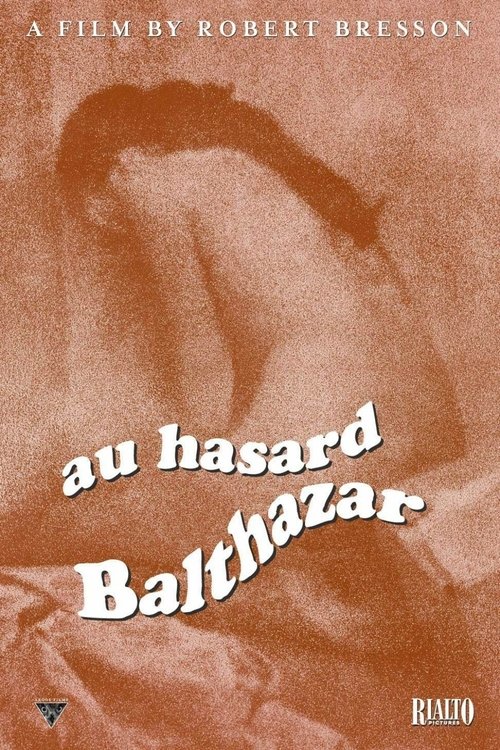
Au Hasard Balthazar
1966 · Robert Bresson
For when you're ready to be genuinely wrecked by something beautiful — a film to watch alone or in silence, not background viewing. Challenge, not comfort, but the kind that leaves you feeling cleaner afterward.
What it's about
A donkey named Balthazar is passed from owner to owner in a French farming community — some kind, some careless, some outright cruel — while his fate stays entwined with Marie, the shy farm girl who loved him first. Through his eyes, without a single word he can say, the film watches a whole village's pride, greed, tenderness, and violence play out. It's the life of a beast of burden told as if it mattered as much as any human life — because here it does.
The experience
Quiet and unsparing, then suddenly, overwhelmingly moving. The style is so plain — short scenes, flat delivery, no emotional cueing — that you may wonder for a stretch what you're watching, and then it lands with a force almost nothing else in movies matches. Many people who don't cry at films cry at this one.
The craft
Bresson cast mostly non-professionals and directed them toward stillness, so the donkey — patient, uncomplaining, watching — becomes the most expressive presence on screen. Fragments of a Schubert piano sonata drift in and out against brays, cart wheels, and rural silence, and the elliptical editing trusts you to assemble the story from pieces. Every frame is composed with monastic economy.
Why it matters
Widely held to be one of the summits of postwar cinema, championed by generations of major directors, and the standard reference point for film as a spiritual, rather than merely dramatic, art. Its animal's-eye moral witness has echoed through art cinema ever since.
Snapshot
Au Hasard Balthazar follows a donkey from birth to death as he passes through the hands of a series of owners in a French rural community, his fate braided to that of Marie, the farm girl who names and first loves him. Bresson conceived the film as a kind of secular passion: the animal absorbs human cruelty, vanity, and indifference without protest, becoming at once a witness to and a vessel for sin. It is among the purest distillations of Bresson's mature method — the systematic refusal of conventional acting, dramatic emphasis, and psychological explanation in favor of an austere, fragmentary surface from which meaning is meant to rise unbidden. Widely regarded as one of the supreme achievements of the postwar art cinema, it has been championed by figures as varied as Andrei Tarkovsky, Jean-Luc Godard, and the Dardenne brothers, and it remains the film most often cited to define what critics mean by Bresson's "transcendental style." Its reputation rests less on plot than on a sustained tonal achievement: the conviction that an ordinary beast of burden, filmed plainly, can carry the moral weight of a fallen world.
Industry & production
The film was made within the ecosystem of the postwar French art-cinema, a sector sustained by small specialized production houses, state subvention through the avance sur recettes, and international co-financing. It was produced by Mag Bodard — one of the most important producers of the French New Wave era, whose credits include work with Agnès Varda, Jacques Demy, and Bresson — through a configuration of companies associated with Argos Films and Parc Film, with Swedish participation via Svensk Filmindustri. (Exact corporate billing varies across sources, and the precise division of financing is not something I can reconstruct with certainty here.) The Swedish involvement reflects the period's reliance on cross-border co-production to fund non-commercial auteur work.
Bresson came to the project after a long fascination with the figure of the donkey, and the film was produced on the modest scale typical of his work: limited locations in rural France, a small crew, and a cast composed almost entirely of non-professionals, the "models" Bresson had used since Diary of a Country Priest (1951) and A Man Escaped (1956). The donkey itself required patient handling and multiple animals or extensive on-set conditioning, though the granular production record is thin and I will not invent specifics. The film premiered in 1966, screening at Venice that year, and entered distribution as a prestige art-house title rather than a commercial release. Reliable box-office figures are not something I can cite; like most of Bresson's films it was a critical event rather than a popular success.
Technology
Technologically the film is conservative by design. It was shot on 35mm black-and-white stock with standard Academy framing, eschewing the widescreen formats and color that had become commercially dominant by the mid-1960s. Bresson's aesthetic was one of subtraction, and the monochrome image — with its restrained tonal range and absence of expressive lighting flourishes — was integral to that program. There is no technological novelty being showcased; the camera, lenses, and recording apparatus are deployed to disappear. What is notable is the rigor with which sound was recorded and constructed (see Sound): Bresson treated the soundtrack as an equal partner to the image, and his films of this period demonstrate a meticulous attention to the discrete, isolated recording of effects. The film stands as evidence that Bresson's revolution was methodological rather than technological — he extracted radical results from entirely ordinary means.
Technique
Cinematography
The cinematography is by Ghislain Cloquet, a major figure who also shot for Alain Resnais, Jacques Demy, and later Roman Polanski. Under Bresson's direction the camerawork is deliberately plain: frontal, eye-level or lower, with minimal camera movement and a fondness for the static or modestly reframing shot. Bresson's signature fragmentation governs the visual scheme — the image is built from parts, especially hands, feet, doorways, and objects, rather than from establishing wide shots and reaction close-ups in the classical manner. The donkey is frequently filmed in tight framings of his eyes, head, and flanks, granting him a grave presence without anthropomorphizing him through editorial point-of-view. The lighting is even and undramatic, refusing the chiaroscuro that would editorialize a scene's emotion. This studied neutrality is the point: by withholding pictorial emphasis, Bresson forces the spectator to supply attention and feeling rather than receive them pre-digested.
Editing
Editing — credited to Raymond Lamy, Bresson's regular collaborator of the period — is the engine of the film's meaning. Bresson cut according to a logic of ellipsis and juxtaposition, omitting transitional and explanatory material so that the narrative advances in discrete blocks separated by sometimes considerable gaps in time. Causality is frequently elided; an action and its consequence may be severed, leaving the spectator to bridge them. The cutting is rhythmically precise rather than dramatically motivated, and it often privileges the detail shot — a hand exchanging money, a foot, a turning latch — over the human face. The famous circus sequence, in which Balthazar exchanges looks with caged animals, is constructed through a series of matched cuts that produce a sense of recognition and kinship purely through montage. Editing in Bresson is not invisible continuity but a visible, almost musical structuring of attention.
Mise-en-scène / staging
Bresson's staging is anti-theatrical to the point of austerity. Gesture is pared down, blocking is functional, and the décor is unembellished rural and domestic space — barns, kitchens, roads, a mill. Objects are charged with significance through repetition and isolation rather than symbolic dressing. The donkey's body becomes the organizing presence around which human cruelty and tenderness arrange themselves: he is beaten, raced, laden, set on fire as a circus trick, and finally driven into smuggling. Bresson refuses the picturesque; the countryside is neither pastoral idyll nor expressionist landscape but a plain ground for moral action. The staging consistently subordinates spectacle to a grave, ritualized plainness, so that small physical events acquire the weight of sacrament.
Sound
Sound is central to Bresson's art and to this film in particular. He recorded effects discretely and deployed them with great selectivity, allowing isolated sounds — braying, footsteps, an engine, a chain — to stand out against silence rather than dissolve into ambient naturalism. Bresson held that when the ear is given precedence the image is freed, and that a sound can replace an image more powerfully than another image can. The donkey's bray functions almost as a voice, recurring at charged moments. The film also makes celebrated use of music: Franz Schubert's Piano Sonata No. 20 in A major (D. 959), specifically its andantino second movement, recurs as a grave musical refrain, set against the diegetic intrusion of pop and circus sounds. The juxtaposition of Schubert's elevated lament with the coarse textures of the worldly soundtrack encapsulates the film's tension between the spiritual and the brutal.
Performance
Bresson did not direct actors; he directed "models." His non-professionals were drained of conventional performance — instructed to deliver lines flatly, to repeat actions mechanically until self-consciousness and "expression" fell away, and to withhold the emotional signaling on which ordinary screen acting depends. Anne Wiazemsky, making her debut as Marie (she would soon become a significant figure of the period and marry Jean-Luc Godard), embodies this method: her Marie is opaque, passive, and affectingly inexpressive. The human players — including the cruel Gérard and the avaricious miller — register as types caught in behavior rather than psychologies performed. The "performance" that anchors the film belongs, paradoxically, to the donkey, whose impassive presence the method renders unreadable in exactly the way Bresson wants: a blank screen onto which the spectator projects suffering, dignity, and grace.
Narrative & dramatic mode
The narrative is episodic and parabolic. Rather than a single protagonist's arc, it offers a sequence of ownerships and encounters, the donkey threading them together as he is bought, sold, lost, and reclaimed. Bresson explicitly modeled the structure on the idea of a life passing through the seven deadly sins, each owner or episode embodying a human vice — pride, avarice, lust, cruelty — that the animal endures. The dramatic mode is one of withheld affect and elliptical causation: motives go unexplained, climaxes are muffled or occur offscreen, and the spectator is denied the catharsis of conventional drama. Marie's parallel degradation — her submission to the brutal Gérard, her humiliation, her disappearance — runs alongside Balthazar's, the two fates rhyming without the film ever underlining the analogy. The famous ending, in which the wounded donkey dies in a field surrounded by a flock of sheep, is presented without rhetorical climax, an image of death that critics have read as both desolate and transcendent.
Genre & cycle
Nominally a drama, the film resists genre almost entirely. It can be situated within the tradition of the art film as a mode — the loose, ambiguous, authored narrative cinema that crystallized internationally in the late 1950s and 1960s — and within Bresson's own cycle of spiritually inflected works concerned with grace, suffering, and confinement (Diary of a Country Priest, A Man Escaped, Pickpocket, Mouchette). It is sometimes grouped with the "animal film" and with parable cinema, but these are descriptive rather than industrial categories. Au Hasard Balthazar and Mouchette (1967), made back to back and both centered on an innocent crushed by a cruel world, are often treated as a paired late-middle peak in Bresson's filmography.
Authorship & method
The film is the work of a singular auteur in the strongest sense. Robert Bresson (1901–1999) wrote, designed, and directed it according to an aesthetic philosophy he would later codify in Notes on the Cinematographer (Notes sur le cinématographe, 1975), where he distinguished "cinematography" — his own automatic, model-based, fragmenting art — from "filmed theater." His method's pillars are all present: the model in place of the actor; fragmentation of the body and the action; the autonomy and precision of sound; ellipsis in editing; and the refusal of psychological explanation. His key collaborators here extend rather than dilute that authorship: cinematographer Ghislain Cloquet, whose restrained images serve Bresson's plainness; editor Raymond Lamy, executing the elliptical cutting; and the borrowed "score" of Franz Schubert, Bresson using pre-existing music rather than a commissioned composer, in keeping with his preference for the autonomous, found musical object over illustrative scoring. Producer Mag Bodard enabled the project's existence within an industry that offered few homes for such uncompromising work. The screenplay is Bresson's own.
Movement / national cinema
Au Hasard Balthazar belongs to French national cinema but stands somewhat apart from the New Wave with which it was contemporary. Bresson was an elder figure revered by the Cahiers du cinéma critics-turned-directors — Godard called him essential to French cinema — yet his rigorous, classical austerity differs sharply from the New Wave's improvisatory energy and stylistic play. He is better understood as a sovereign tradition of one, more often bracketed with Carl Theodor Dreyer and Yasujirō Ozu (the trio anatomized in Paul Schrader's Transcendental Style in Film) than with his French juniors. The film thus sits at the intersection of 1960s French art cinema and a transnational lineage of austere spiritual filmmaking that transcends national-movement labels.
Era / period
The film appeared in 1966, at the high-water mark of the international art cinema and amid the ferment of the French New Wave's second phase. It was a moment when the auteur theory had triumphed critically, when European festivals (Venice, Cannes) functioned as the primary marketplace for ambitious authored work, and when filmmakers enjoyed unusual latitude to pursue difficult, non-commercial projects. Yet Bresson's film is in some sense anti-period: its rejection of fashion, color, widescreen, pop modernity (which it admits only as an intrusive, debasing noise), and youthful stylistic exuberance sets it deliberately against the textures of its own decade. It is a 1966 film that seems to come from outside time, which is part of its enduring authority.
Themes
The film's governing themes are suffering, innocence, and grace. Balthazar is an innocent who absorbs the sins of those around him — Bresson's Catholic-inflected sensibility makes him a Christ-like figure, though the film withholds explicit allegory, leaving the religious reading available but unforced. Closely bound to this is the theme of human cruelty and moral indifference: the donkey passes through pride, greed, and gratuitous violence, and the parallel ruin of Marie extends the indictment to the corruption of innocence in the human world. Determinism and chance shadow the whole — the title's hasard ("chance") gestures at a universe of arbitrary fortune, while Bresson's predestinarian sensibility suggests grace operating beneath apparent randomness. The famous final image, the donkey dying among sheep, gathers these strands into an ambiguous benediction: death as both meaningless and sanctified. Materialism, the tyranny of money, and the silent dignity of the animal before human folly round out the film's moral universe.
Reception, canon & influence
Critically, Au Hasard Balthazar has ascended to near-unanimous canonical status. It was admired on release by the most serious critics and has only grown in stature; it appears regularly on lists of the greatest films ever made and is frequently named the summit of Bresson's career. Tarkovsky and others held it in the highest esteem, and Godard's admiration for Bresson is well documented. It is a fixture of academic film study, the touchstone example in discussions of Bresson's method and of Schrader's "transcendental style."
Influences on the film (backward): Bresson drew on his own evolving practice across the 1950s, on a Catholic literary-spiritual tradition (his earlier adaptation of Bernanos, and his recurring concern with grace and damnation), and on a philosophy of cinematic specificity opposed to theater and to literary illustration. The use of Schubert places the film within a European high-cultural musical inheritance deliberately set against modern coarseness. Dreyer's spiritual cinema is the most frequently cited kindred precedent.
Legacy (forward): The film's influence on subsequent art cinema is profound and traceable. The Dardenne brothers have repeatedly acknowledged Bresson as foundational, and their fragmented, ethically charged realism descends directly from this work. Michael Haneke's austere moral cinema, and the broader "slow cinema" tendency that privileges duration, ellipsis, and withheld affect, are unimaginable without Bresson's example, of which Balthazar is the keystone. The film's afterlife in cinephile culture was renewed by Bresson revivals and home-video restoration, and its donkey-protagonist has echoed forward in later films that adopt an animal's vantage as a moral lens. Among working filmmakers and critics it functions less as a historical artifact than as a living standard for what a cinema of moral seriousness and formal rigor can be.
A Deleuzian reading
Start with the eyes.
The full Deleuzian reading of Au Hasard Balthazar →
Reception
Godard hailed it on release as 'the world in an hour and a half,' but general audiences found Bresson's austerity forbidding and it took years to travel (it didn't open in the US until 1970). Now it's consensus-masterpiece territory — a fixture near the top of Sight & Sound's greatest-films polls.
How Au Hasard Balthazar was received, from release to now →
Influences: the films it descends from and the films it influenced
- The Passion of Joan of Arc (1928) — Dreyer's fragmenting of faces and bodies into isolated close-ups divorced from theatrical space, paired with non-illustrative spiritual gravity, is the precedent Bresson cites for his own anti-psychological fragmentation of the body and action.
- Diary of a Country Priest (1951) — Bresson's own Bernanos adaptation establishes the model-not-actor method, voice flattened of inflection, and the Catholic grace-and-damnation parable structure that Balthazar carries forward without dialogue's crutch.
- A Man Escaped (1956) — Pioneers Bresson's autonomy of isolated sound effects (clinking, footsteps, scraping metal doing narrative work) and elliptical cutting around off-screen action, the exact sound-and-editing grammar Balthazar applies to the donkey's world.
- Pickpocket (1959) — Perfects the fragmentation of gesture into hands-and-objects inserts and the withholding of psychological motive, the cinematographic syntax of detached body-parts Balthazar extends to an animal protagonist.
- Ordet (1955) — Dreyer's austere, slow-paced staging of miracle and faith with flattened performance and refusal of melodramatic affect models the transcendental restraint Schrader later groups with Bresson.
- La Strada (1954) — Bresson's secular parable of an innocent passed between brutish or indifferent owners across an episodic picaresque directly inherits La Strada's structural template; the technique of reading spiritual grace through an expressionless, receptive face under physical suffering — the donkey's blankness as the formal equivalent of Masina's mime stillness — is Bresson's rigorous extrapolation and de-sentimentalization of the Gelsomina method.
- Stromboli (1950) — Bresson's phenomenological accumulation method — mundane events observed in full duration without psychological explanation, spiritual meaning emergent from patient accumulation of ordinary suffering — develops Rossellini's editing ethics of non-subordination into a systematic formal and theological practice.
- Germany, Year Zero (1948) — Bresson radicalizes Germany Year Zero's direction of non-professional performers toward blankness — eliminating all expression that could be read as acting — and applies the same editorial discipline of refusing to psychologize through reaction shots.
- Umberto D. (1952) — Carries forward Umberto D.'s fusion of an animal's fate with human suffering and its reliance on material objects and restrained, near-affectless performance to generate emotion the script withholds.
- Nazarín (1959) — Advances the holy-innocent-passed-through-a-cruel-world structure across discrete abusive encounters ending in unresolved suffering, the ironic picaresque of failed grace Nazarín pioneered.
- The Trial of Joan of Arc (1963) — Extends the ellipsis-driven martyrdom structure and affectless model performance, staging grace-under-suffering through elided scenes and averted faces rather than psychology.
- The Flowers of St. Francis (1950) — Frames innocent, uncomprehending suffering as saintliness across discrete episodes, extending Francis's linkage of holy-foolishness to a passive, Christ-like figure.
- L'Argent (1983) — Bresson's final film distills the Balthazar method to its purest form: a chain of cause and effect traced through isolated sounds, fragmented hands, and models, money replacing the donkey as the object passed through corrupting human hands.
- La Promesse (1996) — The Dardennes, who name Bresson foundational, build their fragmented, ethically charged realism on his model of non-professional performers, withheld affect, and moral consequence shown through gesture rather than explanation.
- Rosetta (1999) — Extends Bresson's ellipsis and refusal of psychological interiority into handheld immediacy, the suffering protagonist observed without commentary as a moral test exactly as Balthazar is observed.
- The Seventh Continent (1989) — Haneke's austere moral cinema inherits Bresson's fragmentation of bodies into hands-and-objects inserts and the clinical withholding of affect, refusing emotional cueing to implicate the viewer.
- EO (2022) — An explicit homage that adopts Balthazar's donkey-as-moral-lens vantage, passing the animal through a chain of human cruelties to use its uncomprehending gaze as ethical instrument.
- Of Gods and Men (2010) — Carries forward the transcendental-style parable of grace and suffering through monastic restraint, plain frontal staging, and pre-existing sacred/classical music used as autonomous object rather than illustrative score.
- First Reformed (2017) — Schrader directly applies the 'transcendental style' he theorized from Bresson: static framing, withheld affect, austere flat compositions, and a grace-and-damnation arc consciously modeled on Diary and Balthazar.
- Jeanne Dielman (1975) — Foundational to slow cinema, it extends Bresson's privileging of duration, ellipsis, and undramatized gesture, observing repetitive bodily action in real time with affect rigorously withheld.
- Silent Light (2007) — Reygadas revives transcendental restraint with non-professional cast, flat natural light, isolated ambient sound, and a miracle-of-grace structure that quotes Dreyer-via-Bresson directly.
- Young Mothers (2025) — Builds an ethical drama of the vulnerable out of restraint, objects, and withheld reaction shots — the austerity Luc Dardenne explicitly threads through Levinas in his diaries.
- Dry Leaf (2026) — Bresson's 'model' method — drilling non-actors into flat, affectless delivery so meaning lands in gesture and framing rather than expression — underwrites Koberidze's understated non-professional performance register.
- Three Colors: Blue (1993) — Bresson's discipline of filming around moments of maximum dramatic charge rather than into them — deaths occurring off-frame, grief registered through averted bodies and ambient sound — is the direct model for Kieślowski's refusal to show the crash impact, the funeral, or the child's body.
- Mouchette (1967) — Bresson's immediate companion piece reuses the non-professional model, the suffering-innocent parable, and isolated-sound design, the donkey's martyrdom transposed to a peasant girl.
- The Gospel According to St. Matthew (1964) — Shares the period's recourse to non-professional faces and a stripped, anti-spectacular sacred realism that treats the holy through plain, frontal, undramatized images.
- Andrei Rublev (1966) — Tarkovsky, a declared admirer, pursues the same cinema of spiritual duration and material texture, withholding affect and explanation while staging grace amid cruelty in long, contemplative passages.
- Winter Light (1963) — Bergman's chamber austerity, silence-as-substance, and crisis of faith rendered through flat lighting and stripped staging parallel Bresson's transcendental-style restraint of the same decade.
- Persona (1966) — In the same year, Bresson's most complete realization of negation-based performance — Wiazemsky and the donkey both enacting presence through withholding — establishes with Persona the twin poles of European art cinema's formal repertoire of performed absence, the two films together defining what non-expressive screen acting can accomplish.
- Sansho the Bailiff (1954) — Shares Sansho's refusal of catharsis and performance-by-restraint, treating cruelty and mercy with austere ellipsis and a withholding of emotional underlining that the audience must complete.
- The Eel (1997) — The silent animal as moral witness to human sin, paired with affectless suppressed performance, is the 'animal-confessor' grammar The Eel adopts through its impassive captive eel.
- The Man Without a Past (2002) — Austere elliptical cutting that omits dramatic climaxes and lingers on impassive faces provides Kaurismäki's model for compressing an amnesiac's re-entry into life through gaps rather than exposition.
- The Wind Will Carry Us (1999) — Its use of blank, non-professional 'models' whose interiority is denied to the camera underwrites Kiarostami's flattened non-actor performances and the ethics of looking at people who are not performing.
Similar films
- Andrei Rublev (1966) — influence & lineage · same viewing thread
- Diary of a Country Priest (1951) — influence & lineage · often watched together
- EO (2022) — influence & lineage
- Mouchette (1967) — influence & lineage
- L'Argent (1983) — influence & lineage
- A Man Escaped (1956) — influence & lineage
- Pickpocket (1959) — influence & lineage
- The Turin Horse (2011) — same viewing thread
All the films related to Au Hasard Balthazar →
Watch it with: curated runs of related films
- Transcendental Style — A run for when you want cinema as prayer — faith, ritual, and the turning of seasons rendered in long takes and painterly stillness, where time itself becomes the subject rather than the story.