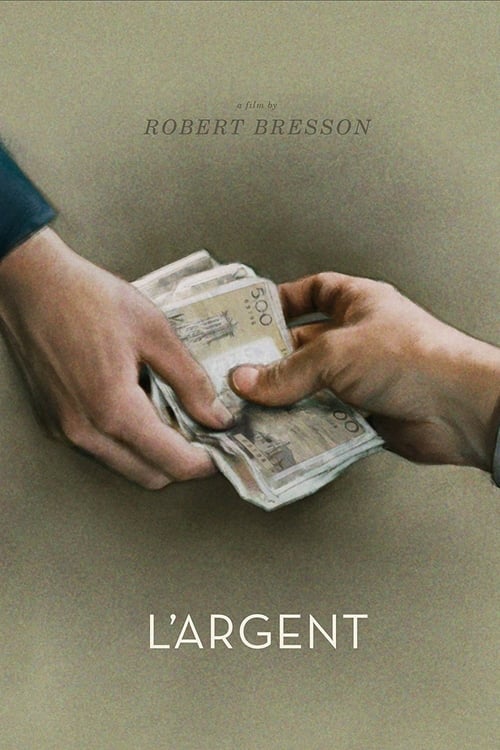
L'Argent
1983 · Robert Bresson
For when you want cinema at its most stripped-down and serious — a short, severe film to think hard about, not comfort food. Reach for it when you're ready to be challenged.
What it's about
Two schoolboys pass a forged 500-franc note in a Paris photography shop, and the shop quietly palms it off on Yvon, a delivery man who has no idea what he's holding. That one small lie sets off a chain of consequences — accusations, courtrooms, prison — that steadily dismantles an ordinary, decent life. It's a crime story told as a chain reaction, following the money rather than a hero.
The experience
Cold, precise, and riveting in a way that sneaks up on you: no music to guide your feelings, no melodrama, just consequence after consequence landing like dominoes. It leaves you shaken and arguing with it for days.
The craft
Robert Bresson's final film is his method at its purest: non-professional performers kept deliberately flat, scenes pared to hands, doors, and money changing hands, every shot doing exactly one thing. The rigor is the point — the style makes a moral argument, and at barely 85 minutes it wastes nothing.
Why it matters
Made in his eighties, it won Bresson a directing prize at Cannes and stands as the summation of one of cinema's most influential styles — filmmakers from every tradition still cite its austerity as a north star.
Snapshot
L'Argent is Robert Bresson's fourteenth and final feature, completed when the director was in his early eighties, and it stands as one of the most austere distillations of a style he had spent four decades refining. Adapted from the first part of Leo Tolstoy's late novella The Forged Coupon, the film follows a counterfeit 500-franc note as it moves through a chain of hands—two schoolboys, a photography-shop owner, a delivery man named Yvan, the courts—accumulating lies and small betrayals until it has destroyed a fundamentally decent man and turned him into a murderer. Bresson strips Tolstoy's redemptive arc away entirely, retaining the mechanism of moral contagion while withholding the novella's Christian consolation. The result is a cold, geometric parable about money as the abstract medium through which evil circulates, executed in Bresson's most rigorous late manner: flat performances from non-professionals, fragmentary editing, hands and objects favored over faces, and an ending of shocking, matter-of-fact violence. It shared the Best Director prize at the 1983 Cannes Film Festival and is widely regarded as a summative statement—the last word of a filmmaker who had quietly become one of cinema's most influential.
Industry & production
By 1983 Bresson was a revered but commercially marginal figure, and L'Argent was, like much of his late work, difficult to finance. It was produced as a French-Swiss co-production—Marion's Films in Paris with Swiss participation (the project drew on Eos Films / Swiss television involvement)—reflecting the patchwork funding on which European art cinema of the period depended. Bresson worked, as always, slowly and on his own exacting terms, having developed the screenplay himself from Tolstoy. The film was shot largely in Paris and its environs. Precise budget and box-office figures for L'Argent are not well documented in the readily available record, and I will not invent them; what is clear is that the film operated entirely outside commercial logic, made by a director whose method—endless retakes to drain performances of "acting," a refusal of stars—was incompatible with conventional production economics. That it was made at all owed much to Bresson's prestige and to the European subsidy and co-production structures that sustained auteur cinema in the late twentieth century.
Technology
L'Argent was shot on 35mm color film, the standard professional format of its moment, with synchronized sound recorded and assembled in Bresson's characteristically selective fashion. There is nothing technologically novel about the film's apparatus; Bresson was indifferent to spectacle and to the gadgetry of cinema. What matters is the discipline with which he used ordinary tools. The film is in color—Bresson had worked in color since Une femme douce (1969)—but his palette is deliberately muted and unglamorous: the grays of Parisian streets, the institutional surfaces of shops, prisons, and bourgeois apartments. His use of the standard tools is essentially subtractive: he employs the camera, the cut, and the soundtrack to remove rather than to add, eliminating the redundancies—establishing shots, reaction shots, swelling music—that conventional technology is normally marshaled to provide. The "technology" of L'Argent, in any meaningful sense, is Bresson's own codified system of fragmentation, refined across a career.
Technique
Cinematography
The photography, by Emmanuel Machuel and Pasqualino De Santis (the celebrated Italian cinematographer best known for his work with Visconti and the Taviani brothers), is precise, frontal, and undemonstrative. Bresson's framing favors the medium and the close shot over the wide; he repeatedly isolates hands—hands exchanging notes, hands opening cash drawers, hands grasping an axe—so that the human body is registered through gesture and transaction rather than expression. The camera rarely moves to underline emotion; when it moves, it follows action with a flat functionality. There are no expressive lighting effects, no chiaroscuro psychology. Compositions are clean, often centered, and frequently cut off the head or torso to concentrate attention on the gesture or the object at the moral center of the shot. This fragmentation of the body is one of Bresson's signature devices, and L'Argent deploys it with extraordinary consistency: the human being is presented as a node in a circuit, glimpsed in parts.
Editing
Editing is the heart of Bressonian cinema, and L'Argent is among the most radically cut films of its era. Bresson assembles the narrative from short, often elliptical fragments, eliding the connective tissue that conventional film grammar supplies. Crucial events—including acts of violence—are frequently shown obliquely, displaced onto an object, a sound, or an aftermath rather than depicted directly. The notorious climax, in which Yvan murders a family with an axe, is rendered through fragmentary glimpses and suggestion: a lamp knocked sideways, blood, a dog, rather than a staged spectacle of killing. This elliptical method generates a peculiar moral force, refusing the viewer the catharsis of full depiction and instead implicating the imagination. The rhythm is clipped and unsentimental; cuts arrive a beat sooner than expected, and the chain-of-hands structure—each transaction a discrete cell—is itself an editing principle made narrative.
Mise-en-scène / staging
Bresson's staging is anti-theatrical by design. Actors—he called them "models"—are positioned and moved with the impassivity of figures in a frieze. Faces are kept neutral; the drama is located not in performance but in arrangement, in the placement of bodies and objects within the frame and in their juxtaposition through the cut. Interiors are spare and functional: the photo shop, the prison cell, the bourgeois household that becomes a slaughterhouse. Doors, thresholds, counters, and money itself are recurring elements, organizing space around exchange and confinement. The mise-en-scène registers a world reduced to its mechanisms—commerce, law, punishment—and drained of warmth.
Sound
Sound in L'Argent is exact, isolated, and frequently more eloquent than the image. Bresson built his soundtracks as carefully as his cuts, foregrounding discrete, concrete noises—the clink of coins, the scrape of a chair, a door, the mechanical hum of a cash dispenser—at near-musical thresholds of attention. He used sound to suggest what the image withholds: violence, off-screen action, the texture of an institutional world. Non-diegetic music is essentially absent; Bresson trusted the rhythm of real sound, deployed with great selectivity, to carry feeling. This is "the ear is more creative than the eye" doctrine of his Notes on the Cinematograph put fully into practice—the soundtrack does the imaginative work the picture refuses.
Performance
The performances are deliberately affectless. Bresson cast non-professionals—Christian Patey as Yvan chief among them—and directed them to deliver lines and gestures without inflection, repeating takes until any trace of conventional "acting" had been worn away. The aim was not realism but a kind of behavioral neutrality through which, Bresson believed, an inner truth might involuntarily surface. The "models" do not interpret their roles; they execute them. The effect can be disconcerting—characters seem to act and react with somnambulant inevitability—but it is essential to the film's vision of human beings caught in a determinism of circumstance and money, their fates moving through them rather than chosen by them.
Narrative & dramatic mode
The film's narrative mode is parabolic and deterministic. Its governing structure is a relay: a single false object passes from hand to hand, and at each transfer a small lie or evasion compounds, the consequences cascading outward until they fall, catastrophically, on the one genuinely innocent party. This causal chain is presented with the inexorability of a proof. Bresson suppresses psychology and motive—we are rarely told why characters do what they do—so that the drama reads less as the story of individuals than as a demonstration of how evil propagates through a social and economic system. The mode is anti-melodramatic: climaxes are elided, emotion is withheld, and the ending arrives without resolution or consolation. The departure from Tolstoy is decisive here. Where the novella moves toward repentance and grace, Bresson cuts the parable off at its bleakest point, leaving only the spectacle of moral cause and effect running to its conclusion.
Genre & cycle
Nominally a crime drama, L'Argent belongs less to genre than to Bresson's own lifelong cycle of films about guilt, grace, confinement, and the soul under pressure—Pickpocket (1959), Au hasard Balthazar (1966), Mouchette (1967), Le Diable probablement (1977). It shares with Pickpocket an interest in petty crime and the circulation of money and hands; with Au hasard Balthazar the device of a protagonist (there a donkey, here a banknote) passed between owners as a means of surveying a fallen world; and with the late films Lancelot du Lac and Le Diable probablement a darkening, near-despairing pessimism about modern existence. To the degree it engages crime-film conventions—theft, fraud, murder, the courts—it does so only to evacuate them of suspense and genre pleasure, redirecting the form toward metaphysical inquiry.
Authorship & method
L'Argent is a near-pure expression of Bresson's authorship and of the theory set out in his Notes sur le cinématographe (1975), where he distinguished "cinematography"—his term for true film art—from mere photographed theater. Bresson wrote the adaptation, directed, and controlled every element toward the elimination of the conventional and the redundant. His method—non-professional "models," exhaustive retakes, fragmentation of body and action, primacy of sound, refusal of psychological explanation—is fully realized here in its most stringent late form. Among collaborators, the cinematography was shared by Emmanuel Machuel and the eminent Pasqualino De Santis; the editing was overseen in Bresson's own exacting manner. Consistent with his late practice, Bresson dispensed with a conventional musical score, trusting structured sound rather than a composer. The film is, in the fullest sense, the work of a single sensibility, and as a final feature it functions as a summation of a method that had no real precedent and few true imitators.
Movement / national cinema
Bresson is a foundational figure of French cinema but a solitary one, impossible to assimilate to any movement. He preceded and outlasted the French New Wave; the Cahiers du cinéma critics, including Godard and Truffaut, revered him as a model of personal authorship, yet his austere, anti-spectacular style bears little resemblance to the New Wave's playful spontaneity. He is better understood within a tradition of "transcendental" or spiritual cinema—a lineage the critic Paul Schrader influentially grouped with Ozu and Dreyer—in which form is marshaled toward the representation of the ineffable. Within French national cinema, L'Argent represents the survival, into the 1980s, of an uncompromising auteurism increasingly at odds with the commercial film culture around it, sustained by the festival and subsidy system that valued Bresson's prestige.
Era / period
Made and released in 1983, L'Argent belongs to a late-modernist moment in European art cinema, and it carries a distinctly contemporary disquiet beneath its parable structure. Its world is one of cash machines, consumer commerce, banks, prisons, and bourgeois comfort—the apparatus of late-twentieth-century capitalism. The film's vision of money as an autonomous, abstract force corrupting human relations resonates with anxieties of its era about consumer society and moral exhaustion, anxieties Bresson had already voiced in Le Diable probablement. Yet its rigor and pessimism also mark it as the terminus of an older modernist project. Coming at the very end of Bresson's life, it reads simultaneously as a film of its decade and as a valediction—a last, undiminished statement from a sensibility formed decades earlier.
Themes
The film's central theme is announced in its title: money as the medium of modern evil—abstract, transferable, indifferent to the persons it passes through, and uniquely capable of severing acts from accountability. Around this Bresson organizes his enduring preoccupations. Determinism and the propagation of guilt: a small lie, told to evade responsibility for a forged note, sets in motion an unstoppable chain ending in murder, suggesting that evil is systemic and contagious rather than individual. Innocence destroyed: Yvan, fundamentally decent, is ground down by institutions—commerce, the law, the prison—until he becomes the instrument of catastrophe. The absence of grace: where Tolstoy offered redemption, Bresson, despite his lifelong Catholic-inflected concern with the soul, withholds it almost entirely, leaving the parable to end in a void. Social and institutional complicity: the courts, the shopkeepers, the respectable bourgeoisie are all implicated, their small self-protective deceptions the true engine of the tragedy. These themes are not stated but enacted through structure, so that form itself becomes the argument.
Reception, canon & influence
L'Argent was received as a major work and shared the Best Director award at the 1983 Cannes Film Festival—an award Bresson received alongside Andrei Tarkovsky (for Nostalghia), in a recognition that the festival itself treated as honoring a lifetime's achievement. Reports of the time noted that the prize was met with some hostile reaction in the hall, a reminder that Bresson's severity divided audiences even at the end; but among serious critics the film was widely esteemed, and it has since settled firmly into the canon as a fitting capstone to one of cinema's essential bodies of work.
The influences on the film are clear and acknowledged: Tolstoy's The Forged Coupon supplies its structure and moral mechanism, and Bresson's own preceding films—Pickpocket, Au hasard Balthazar, Le Diable probablement—supply its method and worldview. The deeper "influence" is Bresson's own theoretical system, fully codified in his Notes and here brought to its purest realization.
The influence of Bresson, and of this film, on later cinema is immense and well documented in critical discourse, even where direct lines are hard to prove. Bresson's example—elliptical editing, the primacy of sound, non-professional performance, the fragmentation of the body, the refusal of psychology—shaped filmmakers across generations and nations. The transcendental style Paul Schrader theorized (drawing Bresson together with Ozu and Dreyer) became a touchstone for a strain of contemplative world cinema. The Dardenne brothers' moral realism, the rigorous minimalism of directors such as Michael Haneke, and the broader tradition of "slow" and austere art cinema all stand in evident dialogue with Bresson's practice, of which L'Argent is the final and in many ways most concentrated example. As a last film, it has acquired the additional authority of a testament: the closing statement of a director whose influence on the language of serious cinema is difficult to overstate.
A Deleuzian reading
A boy asks his father for money.
The full Deleuzian reading of L'Argent →
Reception
Jeered by parts of the Cannes crowd in 1983 — even as Orson Welles handed the 82-year-old Bresson a directing prize shared with Tarkovsky's Nostalghia — it's now routinely canonized as one of the greatest final films any director ever made.
How L'Argent was received, from release to now →
Influences: the films it descends from and the films it influenced
- Pickpocket (1959) — Establishes the fragmented-hands choreography and tactile cutting on the exchange of objects that L'Argent reuses to track the forged note from hand to hand.
- A Man Escaped (1956) — Codifies Bresson's primacy of concrete, isolated diegetic sound over image and his refusal of a continuous score, the sonic system L'Argent brings to its strictest form.
- Diary of a Country Priest (1951) — Introduces the frontal, undemonstrative framing of an affectless protagonist and the theme of grace withheld that L'Argent secularizes into a study of money's spreading evil.
- Au hasard Balthazar (1966) — Models the parabolic chain-of-transmission structure in which a passive figure passes through successive owners/sins, the narrative engine L'Argent inherits from Tolstoy via Bresson's own template.
- Mouchette (1967) — Perfects the non-professional 'model' drained of psychological expression and the elision of violence to its aftermath, both pushed further in L'Argent's offscreen axe murders.
- Le Diable probablement (1977) — Supplies the flat, affectless young protagonist adrift in a deterministic moral economy, the immediate stylistic predecessor to Yvon's blank descent.
- The Passion of Joan of Arc (1928) — Pioneers the anti-theatrical frontal close-up stripped of stage performance, one of the two poles (with Ozu) of the transcendental style Bresson distills.
- Ordet (1955) — Demonstrates the austere, decelerated staging toward a moment of grace that Schrader grouped with Bresson as 'transcendental cinema.'
- Late Spring (1949) — Provides the frontal, undemonstrative compositions and stillness-as-disparity that Schrader's transcendental-style theory binds to Bresson's method.
- The Seventh Continent (1989) — Extends Bresson's fragmentation of bodies into close-ups of objects and money and the refusal of psychological motive, building dread from elided rather than shown destruction.
- Caché (2005) — Inherits the anti-suspense crime structure and the off-screen/elided act of violence that withholds catharsis, the Bressonian rejection of genre mechanics.
- La Promesse (1996) — Carries forward the moral realism of fragmented bodies, hands and gestures, non-actor performance, and a scoreless soundtrack tracing guilt through concrete labor and exchange.
- Rosetta (1999) — Applies Bresson's parabolic determinism and elided emotion to a protagonist driven by money and work, refusing music and psychological exposition.
- L'Humanité (1999) — Adopts the non-professional 'model' cast for affectless neutrality and the frontal, undemonstrative framing of inexpressive faces directly out of Bresson's playbook.
- First Reformed (2017) — Consciously enacts the transcendental style Schrader theorized from Bresson—withheld camera, elliptical austerity, a protagonist's affect held in check until rupture.
- Japón (2002) — Builds its contemplative slow-cinema austerity on non-professional performers and a sound-driven, anti-psychological approach descended from Bresson's transcendental method.
- Fireworks (1997) — Bresson's final film deploys ambient silence as emotional register and cuts between scenes without psychological bridging, delivering moral accounting for a criminal life without authorial judgment—the narrative stance and tonal grammar Kitano transfers to Nishi's reckoning.
- Tokyo Sonata (2008) — Bresson's model of economic shame rendered through behavioral compression — a man undone by money who cannot speak his crisis, shown through compulsive routine, averted gaze, and physical automatism rather than confession — is the direct formal precedent for Ryuhei's daily performance of employment: the suit put on, the briefcase carried, shame architectured as behavior.
- Destiny (2006) — The fatalistic accumulation structure in which a protagonist's destruction follows the inner necessity of their own character rather than external plot mechanics is Bresson's late formal method; Demirkubuz replicates it as the narrative engine of Destiny, where obsession functions as an inescapable internal logic rather than dramatic circumstance.
- You Were Never Really Here (2017) — Bresson places violence offscreen and renders it through material aftermath — a door, a body, an object — while elliptical causation makes action feel overdetermined yet morally inexplicable; Ramsay applies this logic to the hotel-room sequences and the structural withholding of Joe's childhood trauma.
- The Child (2005) — Bresson's chain of cause-and-effect launched by passed money, with flat affectless performance and no psychological underscoring, is the direct model for The Child's traceable economy of a sold infant.
- Jeanne Dielman, 23 Quai du Commerce, 1080 Bruxelles (1975) — Shares the anti-theatrical real-time staging, the money-for-body economy, and the sudden elided act of violence delivered without psychological underlining.
Similar films
- Pickpocket (1959) — influence & lineage
- A Man Escaped (1956) — influence & lineage
- Au Hasard Balthazar (1966) — influence & lineage
- Mouchette (1967) — influence & lineage
- Caché (2005) — influence & lineage
- Diary of a Country Priest (1951) — influence & lineage
- La Promesse (1996) — influence & lineage
- The 400 Blows (1959) — shared sensibility
All the films related to L'Argent →