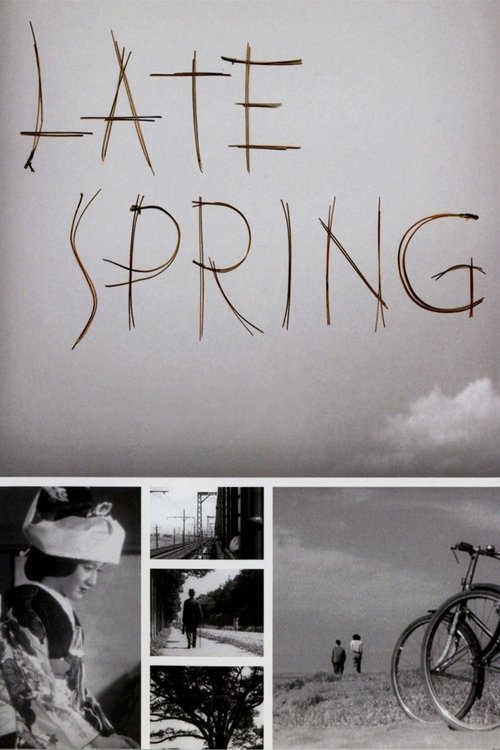
Late Spring
1949 · Yasujirō Ozu
For a quiet evening when you want something gentle that sneaks up on you — when you're thinking about your parents, or leaving home, or how families change. Comfort viewing that will still make you cry.
What it's about
A widowed professor and his grown daughter, Noriko, share a quiet, contented life in postwar Kamakura — she keeps house, he works, and neither wants anything to change. Then an aunt starts insisting that Noriko, at 27, must marry before it's too late, and the gentle pressure of family and custom begins to pull at the one relationship both of them treasure. It follows what each of them is willing to give up so the other can be happy.
The experience
Calm on the surface and quietly devastating underneath. It moves at the unhurried pace of daily life — tea, bicycle rides, small talk — and then a single look or a pause lands with more force than most films' biggest scenes. You come out feeling tender and a little bruised.
Performances
Setsuko Hara's Noriko is one of the great screen performances: a radiant smile that gradually reveals everything it's been covering for. Chishū Ryū matches her as the father, saying almost nothing and conveying everything.
The craft
Ozu shoots from low, fixed positions with a stillness that makes every small gesture legible, and cuts away to empty rooms and rooftops that let the emotion settle. The black-and-white compositions are so precise that the placement of two people in a doorway tells you the state of their hearts. It rewards patience and full attention more than a big screen.
Why it matters
The film that defined Ozu's late style and began his great run of postwar family dramas; it's now a fixture near the top of all-time critics' polls and a foundation stone for slow, observational family cinema worldwide.
Snapshot
Late Spring (Banshun) is the film in which Yasujirō Ozu, returning to full command after the Second World War and the American Occupation, crystallized the style and subject that would define his late period. Its premise is almost weightless: a widowed professor, Shukichi Somiya, and his unmarried adult daughter, Noriko, live in quiet contentment in Kamakura until family pressure dictates that she must marry and leave him. Noriko resists; her father, believing her happiness depends on a life of her own, pretends he intends to remarry so that she will feel free to go. From this slender thread Ozu builds a study of duty, time, and the dissolution of a household that has become one of the most admired works in world cinema. It inaugurated his collaboration with screenwriter Kōgo Noda on the postwar Shochiku domestic dramas, introduced Setsuko Hara as his great muse, and established the "Noriko" figure who recurs (in different incarnations) across Late Spring, Early Summer (1951), and Tokyo Story (1953). The film is the foundation of Ozu's mature reputation in the West.
Industry & production
Late Spring was produced and distributed by Shochiku, the studio with which Ozu had been associated since the silent era and whose Ōfuna studio specialized in the shomin-geki — dramas of ordinary lower-middle-class life. By 1949 the Japanese film industry operated under the supervisory apparatus of the American Occupation (SCAP), whose Civil Information and Education Section reviewed scripts. Period-appropriate samurai and overtly nationalist subjects were discouraged, while contemporary domestic stories were encouraged; Ozu's intimate family drama fit comfortably within that climate, though it carries quiet traces of the era — references to wartime labor, postwar fatigue, and the modernizing pressures on the traditional family. Ozu, who had served in the army and spent time as a prisoner of war, made only a couple of films in the immediate postwar years (Record of a Tenement Gentleman, 1947; A Hen in the Wind, 1948) before Late Spring, which is generally regarded as the picture that returned him to top form. The production reunited him with cinematographer Yūharu Atsuta and, crucially, with writer Kōgo Noda, with whom Ozu had not co-written since the 1930s and with whom he would write every subsequent film. Specific budget and box-office figures are not part of the reliably documented record and should not be invented here; the film's importance is critical and historical rather than commercial.
Technology
The film was shot on black-and-white 35mm with the Academy ratio standard to the period. Ozu worked entirely without the technologies that defined "prestige" filmmaking elsewhere — he did not adopt color until Equinox Flower (1958), never used widescreen, and was famously indifferent to the moving camera, the optical zoom, or elaborate crane work. His technological conservatism was a positive aesthetic choice rather than a limitation of means: by the late 1940s the equipment for tracking, craning, and dissolving was readily available to a senior Shochiku director, and Ozu deliberately declined it. The one piece of apparatus closely associated with him is the low tripod that placed the camera roughly at the eye level of a person seated on a tatami mat. Accounts also describe custom mounts and a preference for a single lens (around 50mm) to maintain a consistent perspectival "grammar." Sound was monophonic optical, recorded to the studio standard of the day.
Technique
Cinematography
Working with Yūharu Atsuta, Ozu composes almost the entire film from a low, static camera. Shots are frontal and symmetrical, frequently aligned so that figures, doorframes, corridors, and furniture organize the frame into nested rectangles. The famously low camera height does more than mimic the tatami sightline; it flattens depth into stacked planes and lends domestic objects a calm monumentality. Ozu generally favors a longer-than-natural take held in stillness, and he violates the conventional 180-degree rule of shot/reverse-shot: in his dialogue scenes, characters tend to look almost directly into the lens, and the camera crosses the axis so that two speakers appear to gaze in the same direction rather than at one another. The effect is at once intimate and slightly abstract, drawing the spectator into the position of the listener.
Editing
Ozu's cutting is metronomic and additive rather than dramatically punctuated. He largely abandoned the dissolve and fade by this point, relying on straight cuts. Between scenes he inserts what Western critics, following Donald Richie and Noël Burch, have called "pillow shots" or transitional still lifes — an empty corridor, a vase, treetops, a temple roof, laundry, a train — images that are not strictly part of the narrative action but establish locale, mark the passage of time, and provide contemplative rest. The most celebrated instance in Late Spring is the shot of a vase in the darkened inn room at Kyoto, held across a cut as Noriko lies awake; the image has generated extensive interpretation (Richie reads it as a vessel of accumulated emotion, Paul Schrader as an instance of transcendental "stasis," Abé Mark Nornes and others as a more open formal device). The editing rhythm is consistent, the cuts matched on graphic and directional logic of Ozu's own devising rather than on Hollywood continuity.
Mise-en-scène / staging
The film is staged within the spare geometry of the Japanese house — sliding shōji, layered thresholds, low tables — and Ozu choreographs bodies into and out of these planes with great precision. Characters kneel, rise, pour tea, and fold cloth in actions given as much weight as dialogue. Recurrent objects and motifs (the peeling of an apple near the end, the Noh performance, the bicycle ride to the beach, the train) carry the emotional argument. Compositions are built on balance and repetition, and the staging tends to keep the camera outside the action looking in, so that the household itself — its rooms, its quiet — becomes a presence.
Sound
Sound in Late Spring is restrained and naturalistic, punctuated by Senji Itō's score. Ozu and his composer use music sparingly, often as a gentle, recurring motif over the transitional still-life passages rather than to underline emotion within scenes. Ambient sound — a kettle, a train, the sea — is allowed to register. The famous final sequence, in which Shukichi sits alone peeling fruit after his daughter's wedding, lets the absence of dialogue and the quiet of the empty house do the dramatic work.
Performance
Acting is calibrated to Ozu's stillness. Chishū Ryū, a lifelong Ozu player, gives Shukichi a gentle, self-effacing dignity, conveying the father's sacrifice through minute shifts of expression and his characteristic mildness. Setsuko Hara, in the first of her Ozu roles, plays Noriko with a luminous, slightly insistent brightness — the radiant smile that masks resistance and grief. Hara's performance, hovering between cheerfulness and sorrow, became central to her screen persona and to the film's emotional ambiguity: the famous moment when her smile falters at the Noh theater, as she registers her father's apparent interest in the widow seated nearby, is achieved almost entirely through the face. Haruko Sugimura brings worldly briskness as Aunt Masa, and Yumeji Tsukioka provides a modern counterpoint as Noriko's divorced friend Aya.
Narrative & dramatic mode
The dramatic mode is one of understatement and ellipsis. Ozu and Noda construct the story as a series of domestic encounters — conversations over tea, a day trip, a theater outing, a father-daughter journey to Kyoto — from which the central conflict emerges obliquely. The film withholds its most conventionally "dramatic" events: the marriage interview (miai) and the wedding ceremony itself are never shown. We see Noriko dressed in bridal costume and then we see the house after she has gone; the husband is never glimpsed at all. This systematic elision throws the emphasis onto interior states and onto the texture of ordinary life. The narrative is structured around partings and the inexorable movement of time, and its emotional climax is an absence — a man alone in a room. The mode is closer to lyric than to plot; tension arises from the gap between what characters say (cheerful surfaces, polite deflection) and what they feel (loss, reluctance, resignation).
Genre & cycle
Late Spring belongs to the shomin-geki (drama of common people) and, more specifically, to the haha-mono/family-drama tradition centered on the household and its generational tensions. Within Ozu's own output it opens the great cycle of postwar marriage-and-separation films — Early Summer, Tokyo Story, Late Autumn (1960), An Autumn Afternoon (1962) — many of which return to the same fundamental situation: an aging parent, an adult child who must marry, and the quiet grief of a family breaking up. The recurrence of the name "Noriko" and of Setsuko Hara across several of these films has led critics to speak of an unofficial "Noriko trilogy" (Late Spring, Early Summer, Tokyo Story), though the three are independent stories rather than a continuous narrative.
Authorship & method
Late Spring is a paradigmatic auteur film, and it consolidated the working method Ozu would follow for the rest of his career. He co-wrote the screenplay with Kōgo Noda, reportedly drawing in part on a story by Kazuo Hirotsu; the Ozu-Noda collaboration, conducted famously over long sake-soaked writing retreats, produced scripts of meticulous structural symmetry. His cinematographer Yūharu Atsuta executed the low, locked-down framing that became Ozu's signature, working as the director's close technical partner. The score is by Senji Itō. The editing reflects Ozu's own rigid system of matched cuts and tonal transitions. And the casting of Chishū Ryū and Setsuko Hara established the central players of his late period. Ozu's authorship is unusually total: a consistent camera height, lens, cutting rhythm, color palette of behavior, and thematic preoccupation recur with such discipline across his films that the style has been described as a closed, self-sufficient system. He is often quoted (the attribution is widely repeated though one should treat the exact wording with care) as saying he was "a tofu-maker" who made only one thing — a remark that captures the deliberate narrowness of his range.
Movement / national cinema
The film stands as a central monument of classical Japanese cinema's golden age, alongside the contemporaneous work of Kurosawa and Mizoguchi, though Ozu's sensibility is the most inward and least "exportable" in conventional dramatic terms. He is frequently called "the most Japanese" of the great directors, a label rooted in his concentration on domestic ritual, seasonal feeling, and the aesthetics of restraint and impermanence sometimes linked to mono no aware — the gentle sorrow at the transience of things. Late Spring is also a document of a specific national moment: the early postwar, when traditional family structures, arranged marriage, and women's roles were under visible strain from modernization and the reforms of the Occupation. The film registers these pressures without polemic, in details such as Aya's divorce and Noriko's resistance to a prescribed path.
Era / period
The film is set in its own present — Kamakura and Tokyo around 1949 — and is steeped in the atmosphere of recovery. Allusions to wartime forced labor (Noriko's wartime privations are mentioned as having affected her health), to American consumer culture (Coca-Cola signage, English-language placards visible in the urban exteriors), and to a society rebuilding itself give the domestic story a quiet historical undertow. Ozu does not foreground the Occupation, but its presence is legible in the margins, and the tension between an older Japan of Noh, temples, and tatami and a newer, Westernizing one is part of the film's texture.
Themes
The governing themes are the passage of time and the inevitability of separation. Late Spring dramatizes the dissolution of a household as a natural, recurring event — the necessary cost of a child's maturity — and treats marriage less as romantic fulfillment than as a melancholy rite of passage. Sacrifice runs through it: Shukichi gives up his companion and his comfort, and lies, for what he believes is his daughter's good; Noriko gives up the life she prefers out of love and social duty. The film meditates on the conflict between individual desire and familial/social obligation (giri), on loneliness, and on the acceptance of impermanence. Father-daughter intimacy — its tenderness and its quiet impossibility — is its emotional center. The Kyoto journey, the Noh performance, the rock garden of Ryōan-ji, and the seasonal imagery all serve a contemplation of endings that are also continuations.
Reception, canon & influence
Late Spring drew on a deep native tradition — the shomin-geki, the family novel, the seasonal aesthetics of classical Japanese art — and on Ozu's own prewar comedies and dramas, which had already explored generational friction in a lighter key. Its formal radicalism grew out of decades of Ozu's self-refinement rather than from foreign models, though in his youth Ozu had admired American cinema.
For many years Ozu was thought "too Japanese" to travel, and his films reached Western audiences later than Kurosawa's or Mizoguchi's. From the 1960s onward, however, the advocacy of critics and scholars — Donald Richie above all, later Paul Schrader (who placed Ozu at the center of his Transcendental Style in Film), David Bordwell (whose major study analyzes Ozu's form in exhaustive detail), and Noël Burch — secured his international standing. Late Spring came to be regarded as one of his supreme achievements and a cornerstone of the world-cinema canon, regularly appearing in critics' polls of the greatest films (it and Tokyo Story are the Ozu titles most often cited).
Its forward influence is wide. Ozu's contemplative stillness, elliptical storytelling, and attention to domestic rhythm shaped filmmakers including Hou Hsiao-hsien, Abbas Kiarostami, and Claire Denis, and the German director Wim Wenders made his documentary Tokyo-Ga (1985) as an explicit homage, interviewing Ryū and Atsuta. Most directly, the Iranian-born director Abbas Kiarostami and others have acknowledged Ozu's example, and Late Spring itself was remade and reworked: Hou's Café Lumière (2003) was made as a centenary tribute to Ozu, and the film's father-daughter marriage plot has been reimagined by later filmmakers (for instance in works that transpose its situation to other cultures). Within Ozu's career it set the template for everything that followed, making Late Spring not only a masterpiece in itself but the keystone of the late style on which his global reputation rests.
A Deleuzian reading
A woman lies awake in an inn at Kyoto.
The full Deleuzian reading of Late Spring →
Reception
A hit at home — it topped Japan's prestigious Kinema Junpo poll as the best film of 1949 — but the West barely saw it for decades, with no US release until 1972. Now it's climbed the global canon hard: a Sight & Sound top-25 fixture and, for many, the equal of Tokyo Story.
How Late Spring was received, from release to now →
Influences: the films it descends from and the films it influenced
- The Marriage Circle (1924) — Ozu repeatedly cited Lubitsch's silent comedies as a formative model, absorbing the elliptical 'comedy of construction' in which narrative information is conveyed by withheld gesture and offscreen implication rather than dramatized event — the mechanism behind Late Spring's unshown wedding.
- I Was Born, But... (1932) — Ozu's own silent comedy where the low, locked-down camera height and the rigorous geometric blocking of bodies within the domestic frame were first systematized into the tatami-eye grammar Late Spring perfects.
- A Story of Floating Weeds (1934) — Develops the 'pillow shot' — cutaways to empty exteriors, hanging laundry, still objects — as tonal punctuation between scenes, the contemplative inserts that culminate in Late Spring's vase shot.
- The Only Son (1936) — Ozu's first talkie establishes the parent-child sacrifice plot and the use of sparing, near-silent sound design with Chishū Ryū's emotional restraint, the template for Late Spring's father.
- Tokyo Story (1953) — Built from the same closed system — 90cm camera, frontal symmetrical compositions, 360-degree axis-violating eyeline matches, and Hara/Ryū casting — applied to generational rupture; the companion masterpiece of Ozu's late style.
- Early Summer (1951) — The middle film of the 'Noriko trilogy,' reusing Setsuko Hara's radiant-smile performance and the daughter's-marriage plot, scripted with Kōgo Noda in the same structurally symmetrical mode.
- An Autumn Afternoon (1962) — Ozu's final film returns once more to a widower (Ryū) marrying off a daughter, closing the cycle with the identical low-camera, straight-cut, color-coded-behavior method.
- Tokyo-Ga (1985) — An explicit homage-documentary that interviews Ryū and cameraman Yūharu Atsuta about the tatami-mat camera mount and the lens discipline, making the technical apparatus of Late Spring its literal subject.
- Café Lumière (2003) — Commissioned as Ozu's centenary tribute, it transposes Late Spring's family-and-marriage situation into modern Tokyo using static long takes and frontal domestic framing in homage to Ozu's stillness.
- The Time to Live and the Time to Die (1985) — Hou's autobiographical family film adopts Ozu's contemplative fixed-camera tableaux and elliptical handling of deaths offscreen, the domestic stillness and withheld-event narration descending directly from Late Spring.
- 35 Shots of Rum (2008) — Denis openly modeled this on Late Spring — a widowed father and a devoted daughter whose looming marriage threatens their household — reworking Ozu's central father-daughter bond and its ritual of domestic objects.
- Still Walking (2008) — Kore-eda's family drama inherits Ozu's attention to meal-table geometry, generational friction conveyed through small gesture, and elliptical time-jumps, situating it as the most direct heir to the shomin-geki domestic mode.
- Yi Yi (2000) — Yang's multigenerational family epic uses static, symmetrically composed interiors and a calm observational ellipsis over weddings and funerals that extend Ozu's contemplative domestic framing into contemporary Taipei.
- Where Is the Friend's House? (1987) — Kiarostami acknowledged Ozu's example; his patient, frontally-framed long takes and refusal to dramatize, letting meaning accrue through stillness and repetition, carry forward Late Spring's contemplative restraint.
- Father Mother Sister Brother (2025) — Ozu's 'pillow shots' of empty rooms and objects holding the frame as pure duration models the way Jarmusch lets location and domestic object function as character while emotion stays suppressed.
- Ikiru (1952) — Ozu's deep-focus geometric compositions of domestic and institutional space as visual entrapment — rooms and corridors framed as arguments about social obligation — and his extreme restraint of non-diegetic score establish the Japanese humanist visual grammar that Nakai and Kurosawa inherit and intensify for the bureaucratic world of Ikiru.
- Late Autumn (1960) — A direct gender-inverted reworking of Late Spring's premise — a widowed mother marrying off a reluctant daughter — confirming the plot as a reusable structural object within Ozu's catalog.
- Equinox Flower (1958) — Ozu's first color film extends the marriage-negotiation drama by adding a disciplined palette — recurring reds (the famous kettle) — to the existing fixed grammar of frontal framing and tatami height.
- Repast (1951) — A contemporary shomin-geki of domestic disappointment that shares Late Spring's genre terrain and Setsuko Hara, treating marriage and quotidian household rhythm with comparable understatement, though through Naruse's more fluid, less geometric camera.
- Ordet (1955) — Ozu's stillness, sparse cutting, and 'coda' abstraction of ordinary domestic space form the third leg of Schrader's transcendental triad alongside Dreyer's patient, decentered durations.
- Perfect Days (2023) — Ozu builds mono-no-aware from repeated domestic rituals and transferred-emotion gestures; Hirayama's identical wake–fold-futon–water-plants morning is the same accumulation of everyday habit into feeling.
- Our Little Sister (2015) — The tatami-level static camera and cutaway 'pillow shots' of empty rooms, corridors and landscape that Kore-eda borrows to let daily space breathe between scenes derive directly from Ozu's grammar here.
Similar films
- Early Summer (1951) — influence & lineage
- An Autumn Afternoon (1962) — influence & lineage
- Tokyo Story (1953) — influence & lineage
- Still Walking (2008) — influence & lineage
- The Time to Live and the Time to Die (1985) — influence & lineage
- Tokyo Twilight (1957) — shared sensibility
- Yearning (1964) — shared sensibility
- Maborosi (1995) — shared sensibility
All the films related to Late Spring →