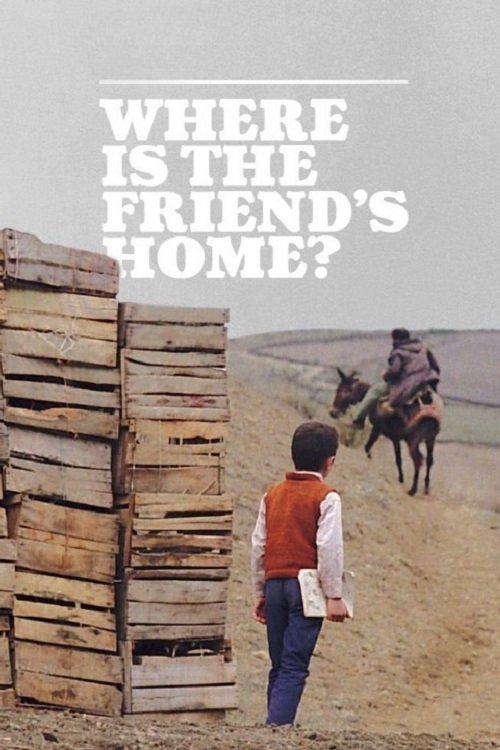
Where Is The Friend's House?
1987 · Abbas Kiarostami
For when you want something humane and unadorned that restores your faith in small acts of decency — comfort viewing of the most honest kind, gentle enough for anyone but never sentimental.
What it's about
An eight-year-old boy in a rural Iranian village realizes he has accidentally taken his classmate's notebook home — and that his friend will be expelled if his homework isn't done in it. Against his mother's chores and every adult's indifference, he sets off alone across the hills to a neighboring village he doesn't know, trying to find one boy's house before nightfall.
The experience
Simple on its surface and quietly gripping underneath — you feel the stakes of a child's promise as if they were life and death, because to him they are. It's tender and suspenseful at once, and the ending lands with a warmth that stays with you.
Performances
The non-professional child lead, Babek Ahmadpour, gives one of cinema's great kid performances precisely because it never feels like performing — his worry, stubbornness, and darting eyes carry the entire film.
The craft
Kiarostami builds enormous feeling from almost nothing: real villages, real light, long takes of a small figure zigzagging up a hillside path. The image of the boy running against the landscape becomes a kind of visual refrain, and the plainness of the style is exactly what makes the emotion hit.
Why it matters
The film that opened the door for Iranian cinema's international breakthrough and launched Kiarostami's world reputation — a founding text for a whole school of humanist filmmaking built on children, villages, and moral errands.
Snapshot
Where Is the Friend's House? (Persian: Khane-ye doust kodjast?) is a deceptively simple fable that became one of the founding texts of the Iranian New Wave's international breakthrough. An eight-year-old schoolboy, Ahmad, discovers he has accidentally carried home the notebook of his desk-mate Mohammad Reza Nematzadeh, who has already been warned by his teacher that another failure to do his homework in his own book will mean expulsion. Rather than let his friend be punished, Ahmad slips away from his own chores and sets out across the hills to the neighboring village of Poshteh to return it, running the labyrinth of adult indifference, misdirection, and obligation that stands between a child and a moral act. From this thread of almost nothing — a mislaid exercise book, a boy's stubborn conscience — Kiarostami builds a work of extraordinary formal control and emotional gravity. It is the first panel of what would later be called, retrospectively, the Koker Trilogy, and it introduced Western audiences to the terrain, the methods, and the ethical seriousness that would define Kiarostami's mature cinema.
Industry & production
The film was produced by Kanun — the Institute for the Intellectual Development of Children and Young Adults — the state-sponsored organization where Kiarostami had worked since helping found its filmmaking division in 1969. This institutional home is essential to understanding the film: Kanun's remit was educational and children-oriented cinema, which gave Kiarostami both a protective cover and a genuine subject. Making films nominally "for children" and "about children" allowed him to work in the constrained, heavily censored environment of post-revolutionary Iran (the film was made under the Islamic Republic, several years after the 1979 revolution and during the ongoing Iran–Iraq War) while pursuing serious formal and philosophical ambitions.
The production was modest by any standard: shot on location in the rural villages of the Gilan region of northern Iran, with a small crew and a cast composed almost entirely of local non-professionals. Kiarostami cast children and villagers from the area, working with them in situ. The economics of Kanun productions were not commercial in the Western sense; the film was not conceived as a box-office venture, and I will not assign it revenue or budget figures, as reliable public accounting for a Kanun production of this period is not something I can responsibly cite. What matters is that the institutional and material modesty is inseparable from the aesthetic: the film's realism is partly a realism of means.
Technology
The film was shot on 35mm color film stock using conventional camera equipment of the period; there is nothing technologically avant-garde in its apparatus, and that plainness is the point. Kiarostami's innovations were not tools but methods. The most consequential "technology" of the film is arguably the long lens and the fixed or minimally mobile camera, which allowed him to observe children at a discreet distance and to compose the landscape as a graphic field. Location sound was recorded and supplemented in post; like most Iranian films of the era, dialogue and effects were substantially handled in post-production, a standard practice rather than a stylistic flourish. The absence of elaborate technology — no crane spectacle, no optical trickery — throws all the weight onto framing, duration, and the direction of performance.
Technique
Cinematography
The cinematography is credited to Farhad Saba. Its signature is a patient, frontal, almost diagrammatic clarity. Kiarostami and Saba favor the medium and long shot over the close-up, holding the boy small within the frame so that he is continually dwarfed by architecture, doorways, walls, and above all by landscape. The film's most famous image is the zigzag path cut into a bare hillside — a lone tree at its crest — which Ahmad climbs and descends. This motif, at once a real footpath and a near-abstract calligraphic line, became one of the defining images of Kiarostami's cinema and recurs across the later Koker films. The camera tends to watch rather than pursue; when it moves, it moves deliberately. Natural light and the earthen palette of the villages give the film a documentary surface, but the compositions are exact, and the recurring geometry of paths, stairways, and windows lends the whole an underlying formal rigor.
Editing
The editing is unhurried and rhythmically attuned to a child's experience of time — the film lets Ahmad's fruitless errands accumulate, allowing repetition and dead time to build the anxiety of a task that keeps being deferred. Kiarostami was famously a hands-on editor of his own work throughout his career, and the film's shaping of duration bears his sensibility; I would not, however, want to over-specify the precise editing credit without being certain of it. What is unmistakable is the editorial patience: scenes are held past the point a conventional narrative film would cut, converting simple actions into moral suspense.
Mise-en-scène / staging
Kiarostami stages the film as a series of thresholds. Ahmad is perpetually at doors, gates, and the edges of adult conversations, seeking permission or attention he cannot get. The village architecture — narrow lanes, stepped alleys, walls that obscure and reveal — is used both realistically and as an externalization of obstruction. Adults tower and turn away; the boy's smallness is a constant compositional fact. The staging quietly indicts a world in which grown-ups are absorbed in their own business, deaf to a child's urgent errand, enforcing rules (do your homework in your own book; obey your elders) without listening.
Sound
The soundtrack is largely naturalistic — wind, footsteps, doors, the ambient noise of village and countryside. Music is used sparingly rather than as a continuous emotional guide; the film trusts silence and environmental sound to carry mood. I will not attribute a specific composed score or name a composer, as I am not confident of a definitive music credit for this film and would rather flag the gap than invent one. The restraint of the sound design is consistent with the film's broader refusal of sentimental underlining.
Performance
The performances are drawn from non-professionals, chiefly children, and are among the film's great achievements. Babak Ahmadpour plays Ahmad with a grave, watchful stubbornness that never tips into cuteness. Kiarostami's celebrated method with child and amateur actors — coaxing, cueing, sometimes withholding the full script, shaping behavior rather than directing "acting" — produces a quality of presence rather than performance. The result is that Ahmad's moral determination feels observed rather than dramatized, which is precisely what gives the film its ethical weight.
Narrative & dramatic mode
The dramatic mode is the miniature quest, or perhaps the parable. The narrative engine is almost absurdly slight — a boy must return a notebook — yet Kiarostami extracts genuine suspense and moral tension from it by treating the child's dilemma with complete seriousness. The film operates through repetition and obstruction: Ahmad asks, is rebuffed, tries again, is diverted. This structure of thwarted effort recalls the moral realism of the fable while resisting the fable's tidy resolution. The stakes are entirely proportioned to a child's world, but the film insists that this scale is not trivial — that a child's promise and a child's conscience are as morally consequential as anything in the adult sphere. The famous final image (which I will not spoil in detail) resolves the plot with a small, tender gesture rather than a triumphant climax.
Genre & cycle
Nominally a children's drama and a gentle adventure, the film belongs more precisely to the tradition of humanist realism and to the specific cycle of Iranian children's cinema fostered by Kanun. It is the first of the loosely connected Koker Trilogy — followed by And Life Goes On (also translated Life, and Nothing More…, 1992) and Through the Olive Trees (1994) — a grouping Kiarostami himself regarded with some skepticism as a critics' construct rather than a designed sequence. The films are linked by geography (the Koker region) and by the 1990 Manjil–Rudbar earthquake, which devastated the area and which the two later films address, with And Life Goes On following a director's search for the child actors of the first film.
Authorship & method
The film is thoroughly Kiarostami's: he wrote the screenplay and directed, and the sensibility in every frame is his. His method here crystallized the practice he would refine for the rest of his life — casting non-professionals from the actual locations, blurring the line between documentary observation and fiction, privileging landscape and long duration, and building meaning through what is withheld as much as what is shown. Among collaborators, cinematographer Farhad Saba realized the film's clean, contemplative image. The title itself is a borrowed authorship: it comes from a poem by the modernist Iranian poet Sohrab Sepehri, whose line "Where is the friend's house?" lends the film a lyrical, almost metaphysical undertone beneath its plain surface. On editing and music credits I have flagged my uncertainty above rather than fabricate specifics; Kiarostami's habit of controlling the edit himself is well documented, and the film's shape is consistent with that authorship.
Movement / national cinema
The film is a cornerstone of the Iranian New Wave in its post-revolutionary phase and, more broadly, of the flowering of Iranian art cinema that would reach global prominence through the 1990s. It sits within the Kanun tradition of children's films that, by working in an ostensibly innocent register, opened a space for serious cinema under censorship. Kiarostami became the emblematic figure of this national cinema abroad, and Where Is the Friend's House? is frequently cited as the film that first carried that reputation across borders — a bridge between Iran's pre-revolutionary New Wave (Mehrjui, Naderi, and others) and the internationally celebrated Iranian cinema of Makhmalbaf, Panahi (a Kiarostami collaborator), and Kiarostami himself.
Era / period
Made in the mid-1980s, the film is a product of a specific and difficult moment: post-1979 revolutionary Iran, mid-way through the Iran–Iraq War, under a censorship regime that made children's subjects a pragmatic refuge for ambitious filmmakers. None of this politics is explicit in the film — there is no war, no ideology on screen — yet the era conditions everything: the modest means, the rural setting, the choice of a child's moral world as a subject safe from official interference yet rich with ethical meaning. The film's quietism is legible both as temperament and as a strategy of survival within its period.
Themes
At its center is moral responsibility — a child's refusal to let a friend suffer for his own honest mistake, pursued against a wall of adult obstruction. Related themes radiate outward: the incommunication between generations, the way adults enforce rules they will not pause to explain or to hear appeals against; the dignity and seriousness of childhood, treated by Kiarostami as a full moral universe rather than a lesser one; friendship and promise-keeping as forms of quiet heroism; and the relation between the individual and the landscape, with the zigzag path standing as an image of moral effort itself — arduous, winding, undertaken alone. There is, finally, a persistent theme of searching, embedded in the Sepehri title, that gives the literal quest a spiritual resonance: the friend's house is both an address in Poshteh and a figure for something harder to locate.
Reception, canon & influence
Backward, the film's clearest lineage is Italian neorealism — De Sica above all, whose Bicycle Thieves and Shoeshine share the structure of a small, socially inflected quest observed through a child's or a humble figure's eyes, using non-professional actors and real locations. Kiarostami absorbed neorealism's ethics and economy while pushing further toward abstraction and self-reflexivity. The specifically Iranian antecedent runs through Kanun and the pre-revolutionary New Wave, and the film's lyricism is anchored in Persian poetry via Sepehri.
Critically, the film earned Kiarostami significant festival recognition and is generally credited as his international breakthrough; it was honored at the Locarno Film Festival, where it took a Bronze Leopard, and it steadily built his reputation among Western critics through the late 1980s and 1990s. (I am confident of the Locarno recognition; I would treat any more granular award tallies with caution absent verification.) Over time the film has entered the canon of world cinema, routinely cited in surveys of the greatest films and as a gateway to Iranian cinema.
Forward, its influence is immense and traceable. Most directly, it generated the Koker Trilogy and Kiarostami's own subsequent method, feeding into masterworks like Close-Up and Taste of Cherry. More broadly, it helped establish the template — non-professional children, rural realism, moral simplicity concealing formal sophistication — that shaped a generation of Iranian filmmakers, including Jafar Panahi (whose The White Balloon Kiarostami co-wrote) and Majid Majidi (Children of Heaven is often discussed in its lineage). Internationally, Kiarostami's admirers among major filmmakers and critics — the film scholars and directors who championed him from the 1990s onward — repeatedly returned to Where Is the Friend's House? as the origin point of one of the essential bodies of work in modern cinema. Its enduring lesson, absorbed far beyond Iran, is that the smallest story, told with absolute seriousness and formal precision, can hold the whole weight of an ethics.
A Deleuzian reading
Start with the path.
The full Deleuzian reading of Where Is The Friend's House? →
Reception
Barely seen outside Iran on release, it broke through when it won the Bronze Leopard at Locarno in 1989 — the film that effectively introduced Kiarostami, and Iranian cinema's new wave, to the world. Now it's routinely called one of the great films about childhood, full stop.
How Where Is The Friend's House? was received, from release to now →
How to watch Where Is The Friend's House?: what to notice on a first viewing
- Watch how small Ahmad looks against the hillside path. Kiarostami and Saba favor medium and long shots over close-ups, keeping the boy dwarfed by architecture, doorways, and landscape throughout the film. The reading calls the path a vector, a line meant to carry the story toward a goal.
- Watch Ahmad wait at doorways for adults to notice him. Kiarostami stages the film as a series of thresholds, gates, and edges of adult conversation where Ahmad seeks permission or attention he cannot get. The staging turns simple architecture into an obstacle course between a child and the people who could help him.
- Listen for the total absence of a musical score. The soundtrack relies on wind, footsteps, doors, and village noise, with music used sparingly rather than as a continuous emotional guide. Without music to guide you, you experience the village exactly as flat and unmediated as Ahmad does.
- Watch Ahmad's face for grave, silent stubbornness, not cuteness. Babak Ahmadpour plays Ahmad with a watchful determination that Kiarostami drew out by coaxing behavior rather than directing conventional child acting. His determination reads as observed rather than performed, which is exactly what gives the film its seriousness.
- Notice how often Ahmad is turned away or ignored. The film repeats a pattern of Ahmad asking, being rebuffed, and trying again, each attempt interrupted or diverted by an adult's own business. The reading calls Ahmad a seer here: someone who can only keep watching and trying, since acting rarely changes what happens.
The whole guide to watching Where Is The Friend's House?, with the keys for a rewatch →
Influences: the films it descends from and the films it influenced
- Bicycle Thieves (1948) — Supplies the template of a humble, socially-inflected quest through real streets shot with a non-professional cast, the ethical structure Kiarostami inherits and compresses into a child's errand.
- Shoeshine (1946) — Establishes the neorealist device of routing an adult moral catastrophe entirely through children's faces and non-professional child performers, which Kiarostami adopts as his sole point of view.
- Umberto D. (1952) — Pioneers durational observation of a trivial errand in near-real time, dwelling on small gestures without dramatic payoff — the patient, withholding rhythm Kiarostami builds Ahmad's search from.
- Germany Year Zero (1948) — Places the full weight of an ethical burden on a lone child moving through real ruined locations, the model of childhood-moral-responsibility staged in actual space that Kiarostami transposes to Koker.
- Pather Panchali (1955) — Fuses a child's-eye rural realism with landscape-as-duration and non-professional villagers, demonstrating how a miniature domestic story can be enlarged by long observation of terrain and weather.
- The House Is Black (1963) — Founds the Kanun/Iranian lineage of welding recited Persian poetry to austere documentary image, the poetry-image undertone Kiarostami draws from Sepehri beneath a plain surface.
- The Cow (1969) — Launches the Iranian New Wave method of village-set allegory using real rural locations and a hushed, observational realism concealing parable — the immediate national antecedent to Kiarostami's Koker world.
- The 400 Blows (1959) — Models sustained empathetic tracking of a single child colliding with punitive, uncomprehending adult authority, the asymmetry between child conscience and grown-up rule that drives Ahmad's plight.
- Late Spring (1949) — Kiarostami acknowledged Ozu's example; his patient, frontally-framed long takes and refusal to dramatize, letting meaning accrue through stillness and repetition, carry forward Late Spring's contemplative restraint.
- Aparajito (1956) — Centers a non-professional child in natural light and elliptical, near-plotless observation, extending Ray's humanist realism into Iranian cinema.
- Good Morning (1959) — Sustains a child's-eye moral drama through patient static observation and adult incomprehension of childhood logic, extending Ozu's children-versus-the-compromised-adult-world perspective.
- Still Life (1974) — Carries forward Still Life's fixed observational gaze on rural non-professionals and its elevation of a single ordinary task (returning a notebook) to the whole of the film's dramatic stakes.
- Close-Up (1990) — Extends the film's blurring of documentary and fiction by casting real people to re-enact their own lives, radicalizing the non-professional-from-the-location method first crystallized in Koker.
- And Life Goes On (1992) — Directly continues the story by sending a director back to earthquake-struck Koker, formalizing the recurring zigzag hillside path into a self-reflexive structuring motif.
- Through the Olive Trees (1994) — Completes the trilogy by filming the making of the previous film, layering the same landscapes and non-professionals into a meta-fiction about staging the earlier images.
- Taste of Cherry (1997) — Carries forward the long-lens landscape, winding roads and durational patience, staging a moral question through minimal action and withheld resolution as the friend's-house search did.
- The White Balloon (1995) — Written by Kiarostami, it transplants the miniature real-time child's quest over a tiny object and the encounters-with-obstructing-adults structure into a Tehran street.
- Children of Heaven (1997) — Reworks the small-object moral errand — a lost pair of shoes standing in for the returned notebook — with non-professional children carrying an ethical stake through real neighborhoods.
- The Mirror (1997) — Inherits the child-navigating-a-hostile-adult-city premise and then ruptures it with a documentary break, pushing Kiarostami's fiction/observation blur to its self-aware limit.
- The Apple (1998) — Applies the docufiction method of non-professionals playing versions of themselves in their actual home and street, sustaining the humanist-realist register Kiarostami established.
- Turtles Can Fly (2004) — Extends the non-professional-children-in-rural-hardship realism to Kurdish borderlands, keeping the child's-eye moral gravity and landscape-bound long shots of the Koker template.
- A Separation (2011) — Pioneers the child-observer placed at the eye-level of adult moral failure, the device Farhadi uses with Termeh watching her parents lie and choose.
- Dry Leaf (2026) — Kiarostami's fable-quest — a small errand stretched into a journey through rural terrain, performed by non-professional villagers and a child — is the road-movie-as-digression armature Dry Leaf builds its quest on.
- Nobody Knows (2004) — Documentary-fiction hybrid built entirely on non-professional child performers, eliciting naturalism through real tasks and locations rather than scripted line-readings.
- Central Station (1998) — A child protagonist's small quest across real terrain, performed by non-professionals with patient observational staging — a parallel tradition of the neorealist child-journey Salles works within.
- Salaam Bombay! (1988) — A near-contemporary parallel in its non-actor child lead, documentary-observational camera, and refusal of plot mechanics in favor of a kid's-eye journey through an indifferent adult geography.
- Kannathil Muthamittal (2002) — Drives its narrative through a small moral errand shot at child eyeline with non-sentimental realism, the same child-quest structure that lets interiority, not plot mechanics, carry the film.
- The Wind Will Carry Us (1999) — Introduces the signature zigzag winding-road motif carved into a hillside and the non-professional child guide — both of which The Wind Will Carry Us directly reprises and complicates.
- Bashu, the Little Stranger (1989) — Contemporary Kanoon film that makes a regionally-cast child's small ethical quest the entire drama, paralleling Bashu's reliance on a non-verbal child lead to carry moral weight.
- A Hero (2021) — Source of the Kiarostami-era ethical realism A Hero descends from — an ordinary protagonist's small moral quest filmed in patient, mid-ground observational long takes without melodramatic scoring.
Similar films
- Close-Up (1990) — influence & lineage · same viewing thread · often watched together
- The Mirror (1997) — influence & lineage · same viewing thread
- Taste of Cherry (1997) — influence & lineage · same viewing thread
- Children of Heaven (1997) — influence & lineage
- The Cow (1969) — influence & lineage
- The House Is Black (1963) — influence & lineage
- Life, and Nothing More… (1992) — same viewing thread
- The Wind Will Carry Us (1999) — same viewing thread
All the films related to Where Is The Friend's House? →
Watch it with: curated runs of related films
- Where Fiction Meets the Real — Watch these in sequence for the way each lets a staged fiction quietly dissolve into something documentary-real — and the real get restaged as fiction — usually while someone is on a road or a walk.