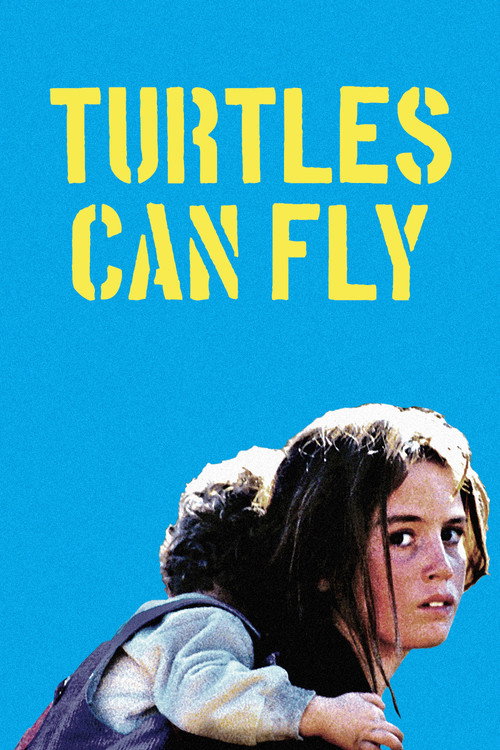
Turtles Can Fly
2004 · Bahman Ghobadi
For when you want a film that matters and are braced to be moved hard — this is a challenge, not comfort, best for a night when you have room to sit with it afterward.
What it's about
In a Kurdish refugee camp on the Turkish-Iraqi border, in the weeks before the 2003 American invasion, a hustling boy nicknamed Satellite installs TV antennas so the elders can watch the war approach — and commands a small workforce of children who harvest unexploded landmines for resale. Into his orbit comes Agrin, a haunted, nearly wordless girl carrying a weight the camp can't see. It's a story about children running an economy, and a childhood, in a place history has abandoned.
The experience
Startlingly alive where you'd expect only bleakness — full of gallows humor, playground politics, and stubborn tenderness — but its gravity is real and it doesn't flinch. It will make you laugh and then hollow you out; the ending stays with you for a long time.
Performances
The cast is non-professional children from the actual camps, some bearing real injuries from the mines the film depicts, and their unfeigned presence — especially the boy playing the fast-talking Satellite — gives the film a documentary-level authenticity no acting could fake.
The craft
Bahman Ghobadi shot the first feature made in Iraq after Saddam's fall, on real locations with the people who lived there, and the film's power comes from that proximity — mud, antennas, tank hulks, and hillsides rendered with rough, urgent beauty. The tonal control is the marvel: comedy and catastrophe share single scenes without either ringing false.
Why it matters
A landmark of Kurdish cinema and one of the defining films about the Iraq War's edges, it carried the experience of a stateless people to audiences worldwide and cemented Ghobadi as their foremost cinematic voice.
In a Kurdish refugee camp on the Turkish-Iraqi border, in the weeks before the American invasion of 2003, an industrious boy nicknamed Satellite installs antennas so the elders can watch the war approach, and commands a small army of children who harvest unexploded landmines for resale. Bahman Ghobadi, the Kurdish-Iranian director who won Cannes's Caméra d'Or with A Time for Drunken Horses, made the first feature shot in Iraq after Saddam's fall, casting non-professional children from the camps — some bearing the actual injuries of the mines the film depicts. What could be miserablist is instead startlingly alive: Ghobadi finds gallows comedy, playground politics, and stubborn tenderness in a place history has abandoned, while a wordless, haunted girl named Agrin carries the film's gravest weight. It stands at the center of a stateless Kurdish cinema Ghobadi did much to will into existence, and it won the Golden Shell at San Sebastián. The children mug, barter, and bicker; the hills around them are seeded with metal.
A Deleuzian reading
A boy climbs onto a roof in a camp on the Turkish-Iraqi border and turns a dish by hand until the static on a television becomes a war.
The full Deleuzian reading of Turtles Can Fly →
Reception
It arrived as an urgent dispatch — winning the Golden Shell at San Sebastián in 2004 and championed by critics as the first look inside post-Saddam Iraq — and has since settled into a different kind of fame: a fixture of 'most devastating films ever made' lists that each new wave of Letterboxd users discovers, braces for, and is wrecked by anyway.
How Turtles Can Fly was received, from release to now →
Influences: the films it descends from and the films it influenced
- A Time for Drunken Horses (2000) — Ghobadi's own debut established his method of casting real Kurdish border children — including a genuinely disabled child — as smugglers, letting non-actors carry an unsentimental survival narrative he then scaled up here.
- Blackboards (2000) — The Kurdish-borderland docufiction of itinerant non-professionals hauling burdens across minefields (Ghobadi himself acts in it) directly modeled the mobile, terrain-as-threat staging he reused with landmine-clearing kids.
- Kandahar (2001) — Its imagery of amputees racing on crutches toward prosthetic legs parachuted by the Red Cross set the template for casting actual landmine victims and framing prosthetics as narrative objects rather than pity props.
- Where Is the Friend's House? (1987) — Kiarostami's founding New Wave gambit — a child protagonist played by a rural non-actor, filmed in long observational takes on real terrain — is the grammar Ghobadi inherits and hardens into wartime.
- The Runner (1985) — Naderi's non-professional child scavenger, shot as elemental hustle for survival amid detritus, prefigures the enterprising 'Satellite' as an orphan entrepreneur of the war economy.
- Germany Year Zero (1948) — The neorealist device of a child navigating a bombed-out, defeated landscape with a non-professional lead is the postwar-rubble child's-eye view Ghobadi transposes to post-Saddam Kurdistan.
- Bicycle Thieves (1948) — De Sica's neorealist casting of ordinary people and a child witness, drawing performance from lived circumstance rather than technique, is the foundational method behind the whole non-professional lineage.
- Forbidden Games (1952) — Its children processing war through games and burials — innocence pressed against death and buried ordnance — is the gallows-comedy-of-childhood register Ghobadi revives around live mines.
- Come and See (1985) — Klimov's relentless child's-eye war, in which a boy's face registers atrocity the frame won't look away from, licenses Ghobadi's refusal to soften trauma seen through children.
- Children of Heaven (1997) — Applies the Iranian child-realism model — casts of non-professional children, poverty seen at child height — to a Kurdish border setting, inheriting the cycle Children of Heaven helped internationalize.
- Bashu, the Little Stranger (1989) — Directly inherits the war-displaced-child subject and a multilingual Kurdish/Arabic soundscape, mapping Iran–Iraq border trauma through children exactly as Bashu routed the war through a boy.
- Half Moon (2006) — Ghobadi's own follow-up keeps the Kurdish-borderland road structure and non-professional ensemble, extending his mix of folkloric humor and statelessness across the same Iraq-Iran frontier.
- Buddha Collapsed out of Shame (2007) — A child non-actor re-enacts the logic of war as play in post-Taliban Afghanistan, inheriting Ghobadi's tactic of letting children stage adult violence to expose it.
- War Witch (2012) — Casts a first-time actor as a conscripted child of war and leavens atrocity with magic-realist, survival-driven wit — the same anti-miserablist stance toward children in conflict.
- Beasts of No Nation (2015) — Builds an entire war around an untrained child lead whose performance carries the film, extending the lived-experience child-of-war casting into English-language cinema.
- The President's Cake (2026) — The direct precedent for shooting inside Iraq with local non-professional children under a Saddam-era power structure — production method as argument, the landscape and its inhabitants furnishing themselves rather than being doubled abroad.
- No Man's Land (2001) — Contemporary war film built on the same gallows-comedy engine, literally staging a man pinned atop a live landmine, treating ordnance as absurdist plot mechanism rather than mere horror.
- Baran (2001) — Shares the Iranian New Wave treatment of Afghan refugees and child laborers, drawing muted, dignified performances from displaced non-professionals in real camps and worksites.
- Offside (2006) — Extends the New Wave's anti-miserablist docufiction — real non-actors, improvised comedy wrung from a grim political predicament — finding humor inside oppression without dissolving its stakes.
- Farha (2021) — Casts nonprofessional child leads and scales the entire war down to their eye level, letting a newcomer's unschooled presence carry political catastrophe through restraint.
- Innocent Voices (2005) — Contemporary sibling built on nonprofessional child leads living on a war frontier, with clandestine technology (mines, radios, satellite dishes) as the children's improvised infrastructure — a cousin to the guerrilla-radio motif.
Similar films
- No Man's Land (2001) — influence & lineage · same viewing thread
- Where Is The Friend's House? (1987) — influence & lineage
- The President's Cake (2026) — same viewing thread
- No Other Land (2024) — same viewing thread
- Pretty Village, Pretty Flame (1996) — same viewing thread
- Tangerines (2013) — shared sensibility
- The Hurt Locker (2008) — shared sensibility
- Bashu, the Little Stranger (1989) — shared sensibility
All the films related to Turtles Can Fly →
Watch it with: curated runs of related films
- Bearing Witness — Watch these when you want cinema as testimony — ordinary people caught between armies, borders, prisons, and markets, filmed close to the ground and close to documentary.